Try our free AI tools – no sign-up needed!

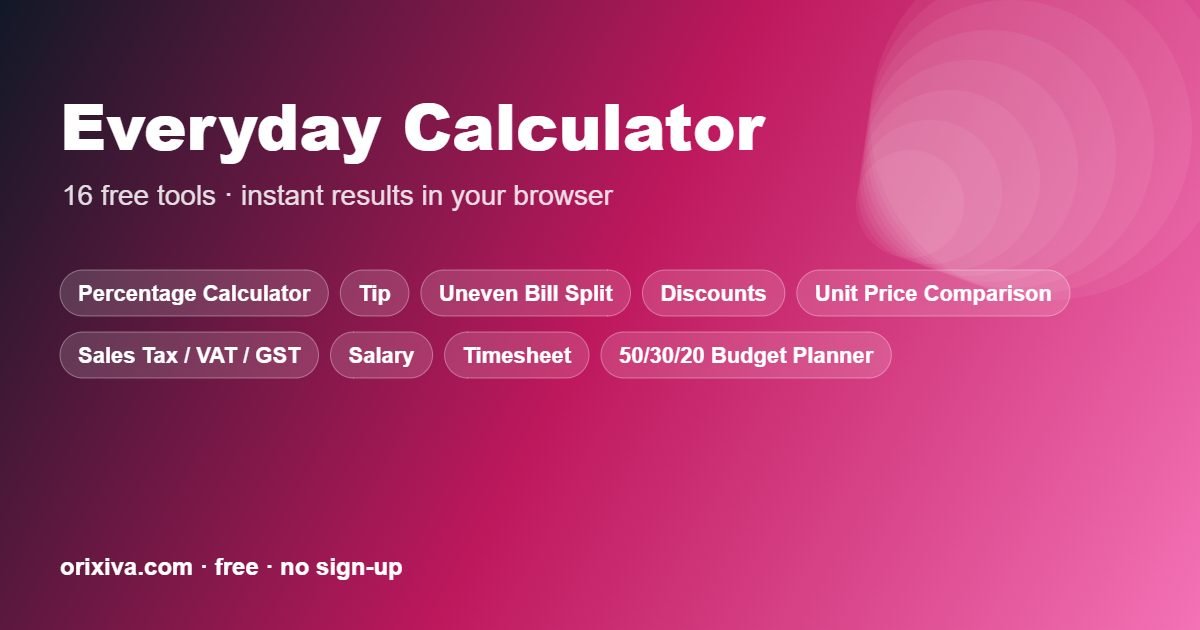
Quick answer: To use the everyday calculator, pick one of the 16 tools in the menu above, enter your values with the right units and press Calculate. The result appears with notes, and you can copy or print it.
- 16calculators
- 0sign-ups needed
- 100%in your browser
- Freeforever
What the everyday calculator includes
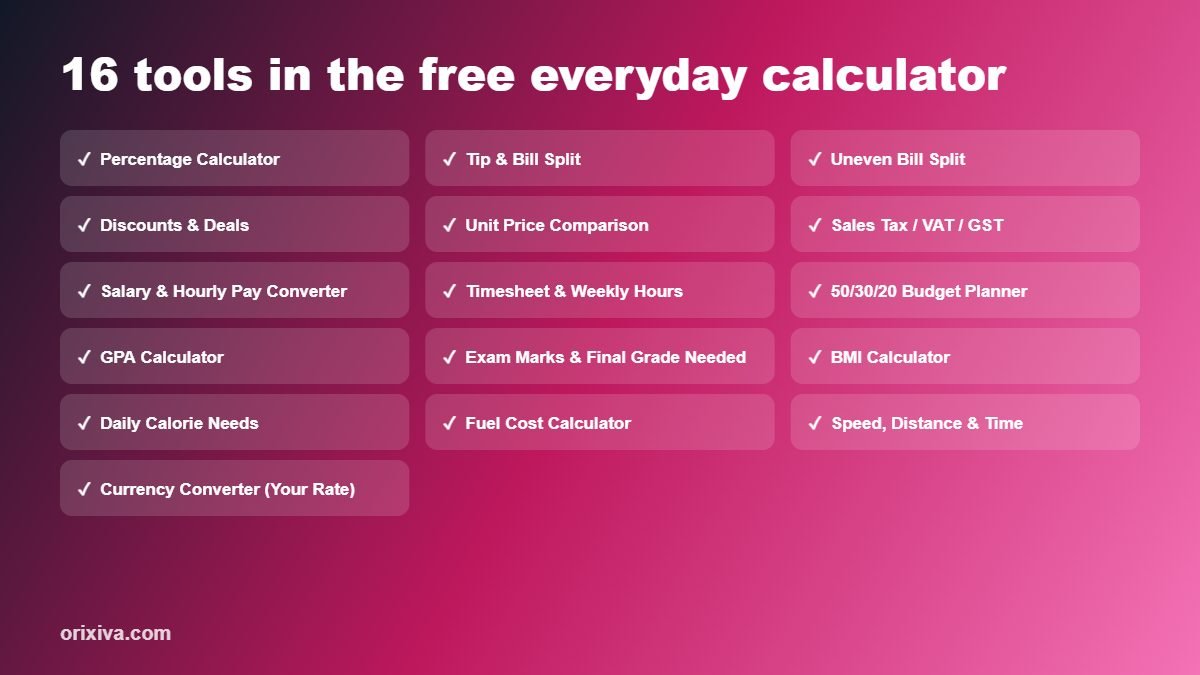
The everyday calculator contains 16 separate tools. Choose one from the menu at the top of the page; each tool keeps its own inputs and explains the formula it uses.
| Calculator | What it does |
|---|---|
| Percentage Calculator | Six modes: % of, is what %, change, increase/decrease, reverse % and % difference. |
| Tip & Bill Split | Tip on pre- or post-tax amount, split between people with rounding. |
| Uneven Bill Split | Each person pays for what they ordered plus a fair share of tax, service and delivery. |
| Discounts & Deals | Stacked discounts, coupons, buy-X-get-Y offers and the real saving. |
| Unit Price Comparison | Find the best value among up to 6 pack sizes with price per unit. |
| Sales Tax / VAT / GST | Add tax to a price or extract tax from a tax-inclusive price; multiple items. |
| Salary & Hourly Pay Converter | Convert hourly, daily, weekly, monthly and annual pay including overtime. |
| Timesheet & Weekly Hours | Total hours from daily start/end times and breaks, with overtime and pay. |
| 50/30/20 Budget Planner | Split income into needs, wants and savings and compare with your spending. |
| GPA Calculator | GPA from letter grades or percentages with credit hours, plus cumulative GPA. |
| Exam Marks & Final Grade Needed | Percentage and grade from marks, and the score needed on the final exam. |
| BMI Calculator | Body mass index in metric or imperial with healthy weight range. |
| Daily Calorie Needs | Maintenance calories (Mifflin–St Jeor) and targets for losing or gaining weight. |
| Fuel Cost Calculator | Fuel needed and cost for a trip, one way or return, split between people. |
| Speed, Distance & Time | Solve for speed, distance or time with hours-minutes input and pace. |
| Currency Converter (Your Rate) | Convert with a rate you enter, including bank margin or fees – no internet needed. |
How to use the everyday calculator
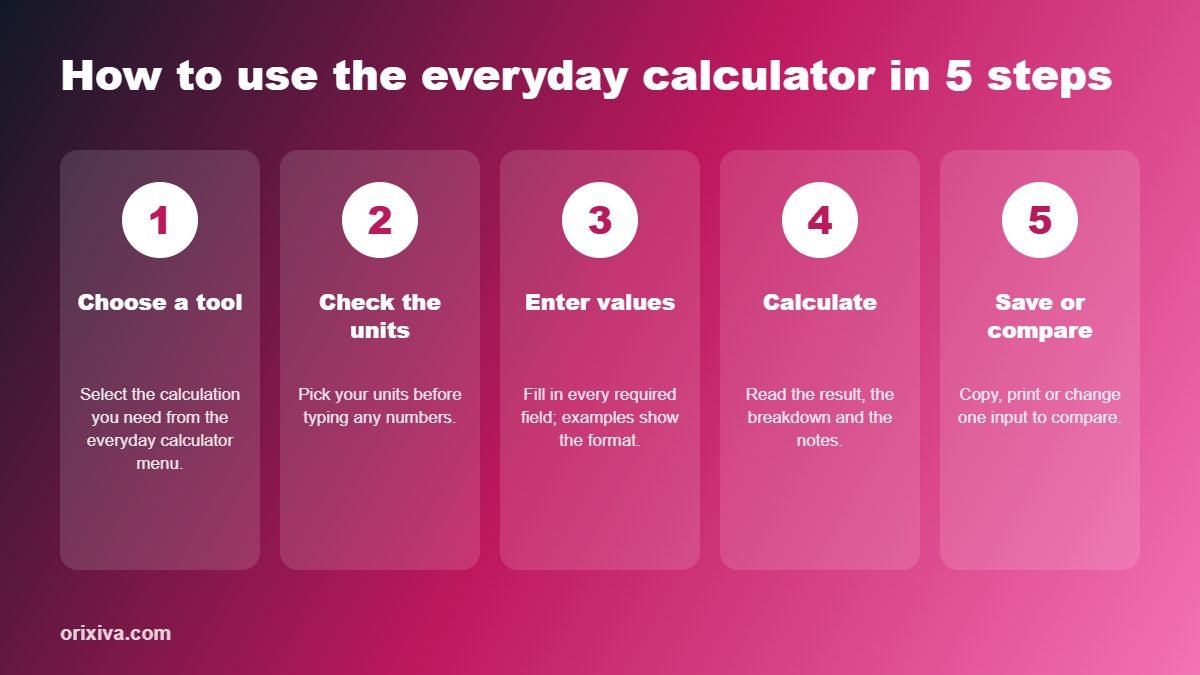
- Choose a tool. Select the calculation you need from the everyday calculator menu.
- Check the units. Pick the units you are working in before typing numbers, so the formula uses the right values.
- Enter your values. Fill in every required field. Example values show the expected format.
- Calculate and review. Read the main result, the breakdown and any notes or charts under it.
- Save or compare. Copy, print or download the result, or change one input to compare scenarios.
Who uses this everyday calculator?
- Shoppers checking discounts and unit prices.
- Friends splitting restaurant bills fairly.
- Workers converting salary and tracking hours.
- Students calculating GPA and final exam scores.
- Families planning a monthly budget.
Tips for accurate results with the everyday calculator
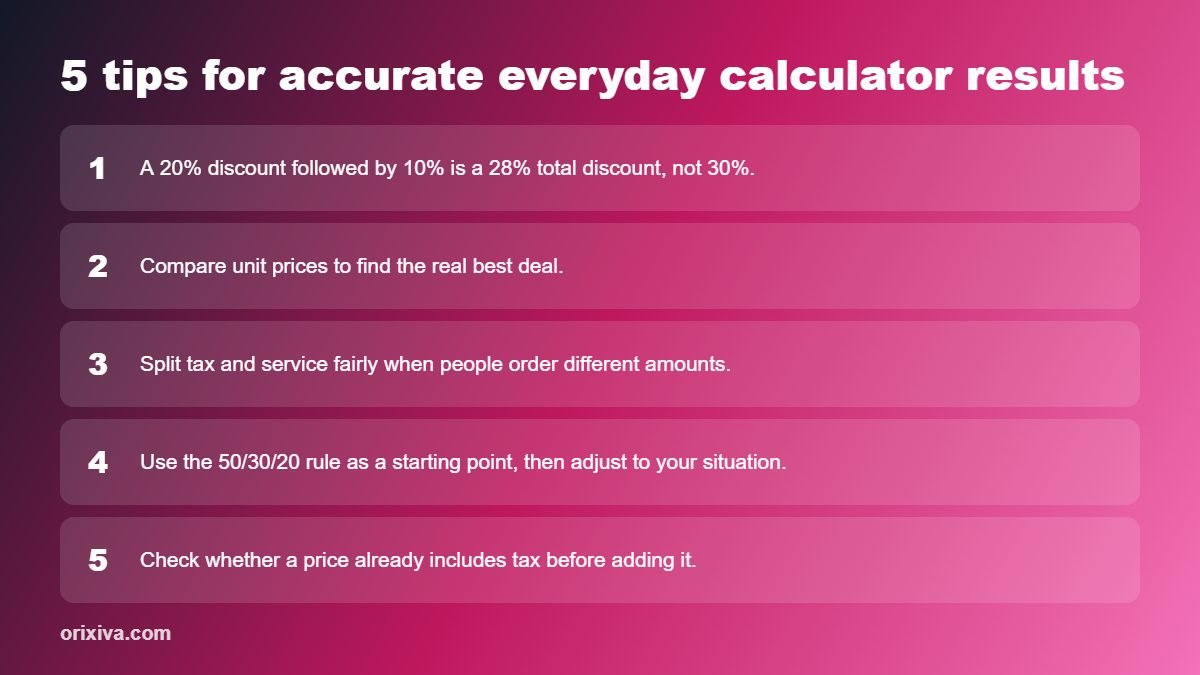
- A 20% discount followed by 10% is a 28% total discount, not 30%.
- Compare unit prices to find the real best deal.
- Split tax and service fairly when people order different amounts.
- Use the 50/30/20 rule as a starting point, then adjust to your situation.
- Check whether a price already includes tax before adding it.
Everyday calculator guide: quick methods and worked examples
Percentages, tips, discounts, tax, pay and grades come up every day, and small mistakes in them cost real money. This guide shows the formula behind each everyday calculator tool, a mental shortcut for when you have no phone to hand, and a worked example you can check.
Percentages: the six questions
| Question | Formula | Example |
|---|---|---|
| What is 15% of 80? | 80 × 0.15 | 12 |
| 18 is what % of 72? | 18 ÷ 72 × 100 | 25% |
| Change from 50 to 65 | (65 − 50) ÷ 50 × 100 | +30% |
| Increase 200 by 12% | 200 × 1.12 | 224 |
| Price after 20% off is 64; original? | 64 ÷ 0.80 | 80 |
| Difference between 40 and 60 | 20 ÷ 50 × 100 | 40% |
A useful shortcut: x% of y is the same as y% of x. So 8% of 50 is the same as 50% of 8, which is 4.
Why a 20% rise after a 20% fall does not get you back
If a 100 price falls 20% to 80 and then rises 20%, it reaches only 96. The second percentage is taken from a smaller base. To undo a 20% fall you need a 25% rise. The percentage change and reverse percentage modes in the everyday calculator help you avoid this trap when you compare prices or investment returns.
Worked example 1: tip and bill split
A dinner bill is 120 before tax and 130.80 after 9% tax. An 18% tip on the pre-tax amount is 21.60, making the total 152.40. Split between four people, each pays 38.10. Tipping on the after-tax total would add nearly 2 more. A quick way to find 18% in your head is to take 20% and subtract 2%: 24 − 2.40 = 21.60.
Worked example 2: uneven bill split
Three friends order meals costing 30, 22 and 18, a total of 70. Tax and service of 14 are shared in proportion to what each person ordered, so the first pays 30 + 14 × 30 ÷ 70 = 36, the second 22 + 4.40 = 26.40 and the third 18 + 3.60 = 21.60. A fixed delivery fee can instead be split equally, which the uneven bill split tool lets you choose.
Worked example 3: stacked discounts
A jacket costs 150 with 30% off and an extra 10% off at checkout. The discounts multiply rather than add: 150 × 0.70 × 0.90 = 94.50, a total saving of 37%, not 40%. A buy-two-get-one-free offer on 12 items gives a 33.3% saving per item, but only if you wanted three in the first place.
Worked example 4: unit price
A 500 g pack costs 3.20 and a 1.2 kg pack costs 6.90. The small pack works out at 6.40 per kg and the large one at 5.75 per kg, so the large pack is about 10% cheaper per kilogram. The unit price tool compares up to six sizes at once and highlights the best value.
Worked example 5: sales tax and VAT
To add 20% VAT to 50, multiply by 1.20 to get 60. To take VAT out of a price that already includes it, divide instead: 60 ÷ 1.20 = 50, so the VAT is 10. A common mistake is to take 20% off 60, which gives 48 and understates the net price. The same method works for any sales tax or GST rate.
Worked example 6: hourly pay to salary
At 22 an hour for 40 hours a week, weekly pay is 880. Over 52 weeks that is 45,760 a year, or about 3,813 a month. Five hours of overtime at time and a half adds 5 × 33 = 165 to that week. When you compare a salaried job with an hourly one, include paid holidays: 2,080 paid hours a year is the usual full-time figure in the US.
Worked example 7: timesheet hours
A shift from 8:45 to 17:15 with a 30-minute unpaid break is 8 hours 30 minutes minus 30 minutes, or 8 hours. In decimal hours, 7 hours 45 minutes is 7.75 hours, not 7.45. Payroll needs decimal hours, which the timesheet tool converts for you.
Worked example 8: the 50/30/20 budget
With a monthly take-home income of 3,000, the 50/30/20 rule puts 1,500 towards needs such as rent, food and bills, 900 towards wants and 600 towards savings and paying off debt. If your rent alone is 1,400, needs will run over 50%, and the planner shows how much you would have to trim from wants to keep saving 20%.
Worked example 9: GPA and the final exam
Grades of A (4.0) in a 3-credit course, B+ (3.3) in a 4-credit course and B (3.0) in a 3-credit course give a GPA of (12 + 13.2 + 9) ÷ 10 = 3.42. To finish a course at 80% when your coursework average is 76% and the final exam counts for 40%, you need 76 × 0.6 + x × 0.4 = 80, so x = 86% on the final.
Worked example 10: comparing two phone plans
Plan A costs 25 a month with 10 GB of data. Plan B costs 32 a month with 25 GB. Per gigabyte, Plan A is 2.50 and Plan B is 1.28, so Plan B is almost 49% cheaper per gigabyte. But if you only use 6 GB a month, Plan A costs 7 less every month, or 84 a year. The unit price tool tells you which option is better value per unit; the right choice still depends on how much you actually use.
Worked example 11: price change over time
A monthly grocery shop that cost 400 last year and costs 436 now has gone up by 36 ÷ 400 × 100 = 9%. If your pay rose 5% over the same period, your real buying power for groceries fell by about 1 − 1.05 ÷ 1.09 ≈ 3.7%. The percentage change mode shows the first figure instantly; comparing it with your pay rise shows whether you are keeping up.
Quick mental maths for everyday numbers
When you have no phone to hand, a few tricks get you close. To find 10%, move the decimal point one place left. For 5%, halve that. For 15%, add the two. For 25%, divide by four. To add 20% tax, multiply by 1.2, which is the same as adding a fifth. These shortcuts are good for a quick check; the percentage calculator gives the exact figure when it matters.
Rounding tips
- Round money only at the end; rounding each line can shift a total by several cents.
- When splitting a bill, round each share up to avoid coming up short on the tip.
- Keep percentages to one decimal place in reports; more digits rarely add meaning.
For help with household budgeting, the Consumer Financial Protection Bureau's free consumer tools are a good next step.
Privacy and accuracy
The everyday calculator runs entirely in your browser. Numbers you type are not sent to Orixiva or stored on a server.
Results use standard published formulas and are rounded for display. They are estimates for planning, study and everyday decisions; for legal, medical, engineering or financial decisions, confirm them with a qualified professional. For background reading, see the Consumer Financial Protection Bureau budgeting tools.
Related free calculators
Need a different kind of calculation? These pages work the same way as this everyday calculator.
- Car Calculator for fuel, car loans, EV charging and tyres.
- Chemistry Calculator for molarity, pH and gas laws.
- Cooking Calculator for recipes, cups to grams and baking.
- Electrical Calculator for Ohm’s law, wire size and physics.
- Scientific Calculator for equations, triangles and matrices.
- All free calculators in one place.
Share your feedback
Which everyday calculator tool did you use, and was the result what you expected? Tell other readers in the comments, or suggest a calculator we should add next. Comments are reviewed before they appear.
Frequently asked questions
Is this everyday calculator free?
Yes. All 16 everyday tools are free with no sign-up.
How do I calculate a percentage?
The Percentage Calculator has six modes, including X% of Y, percentage change and reverse percentage.
How do I split a bill with tip?
Use Tip & Bill Split for equal shares, or Uneven Bill Split when people ordered different items.
How is GPA calculated?
GPA multiplies each grade point by its credit hours and divides by total credits. The GPA tool also finds cumulative GPA.
Can it convert hourly pay to annual salary?
Yes. The Salary & Hourly Pay Converter converts between hourly, daily, weekly, monthly and annual pay.
Does the currency converter use live rates?
No. You enter the rate yourself, so it works offline and with any bank margin.
How do I calculate a percentage increase?
Percentage change = (new - old) / old x 100. From 80 to 100 is a 25% increase. The Percentage Calculator has six modes, including reverse percentage and percentage difference.
Should I tip on the price before or after tax?
Both are common. The Tip & Bill Split tool lets you choose, then splits the total between people and rounds each share.
How do I split a bill when people ordered different things?
Uneven Bill Split adds each person's own items and shares tax, service and delivery in proportion to what they ordered.
How do stacked discounts work?
Discounts multiply rather than add: 20% off and then 10% off is 28% off in total, not 30%. Discounts & Deals also handles coupons and buy-X-get-Y offers.
How do I find the best value pack size?
Compare the price per unit (per gram, per litre or per item). Unit Price Comparison compares up to six options and highlights the cheapest.
How do I remove VAT or GST from a price?
Net price = gross price / (1 + tax rate). At 20% VAT, a 120 price is 100 before tax. The Sales Tax tool can add or extract tax for several items.
How do I convert an hourly wage to a yearly salary?
Multiply by hours per week and weeks worked per year: $20 x 40 x 52 = $41,600. The Salary & Hourly Pay Converter also includes overtime.
How do I add up weekly hours on a timesheet?
Enter start and end times and breaks for each day in Timesheet & Weekly Hours. It totals the week, separates overtime and calculates pay.
What is the 50/30/20 budget rule?
Put 50% of take-home pay on needs, 30% on wants and 20% on savings and debt repayment. The 50/30/20 Budget Planner compares your real spending with those targets.
What score do I need on my final exam?
Exam Marks & Final Grade Needed uses your current grade, the weight of the final exam and your target grade to show the score you need.
How many calories do I need a day?
Daily Calorie Needs uses the Mifflin-St Jeor formula with your activity level for maintenance calories and gives targets for losing or gaining weight.
How do I convert currency with my own rate?
Enter the exchange rate you were given, plus any bank margin or fee, in the Currency Converter. It works offline because you supply the rate.
How do I solve speed, distance or time?
Speed = distance / time. Enter any two values in Speed, Distance & Time, with hours and minutes, and it finds the third and your pace.
Do I need to install anything?
No. All 16 everyday tools work in any browser on phone or computer, with no sign-up.
Ready to calculate? Scroll up to the everyday calculator, choose a tool and get your answer in seconds.