Try our free AI tools – no sign-up needed!

Quick answer: To use the cooking calculator, pick one of the 14 tools in the menu above, enter your values with the right units and press Calculate. The result appears with notes, and you can copy or print it.
- 14calculators
- 0sign-ups needed
- 100%in your browser
- Freeforever
What the cooking calculator includes
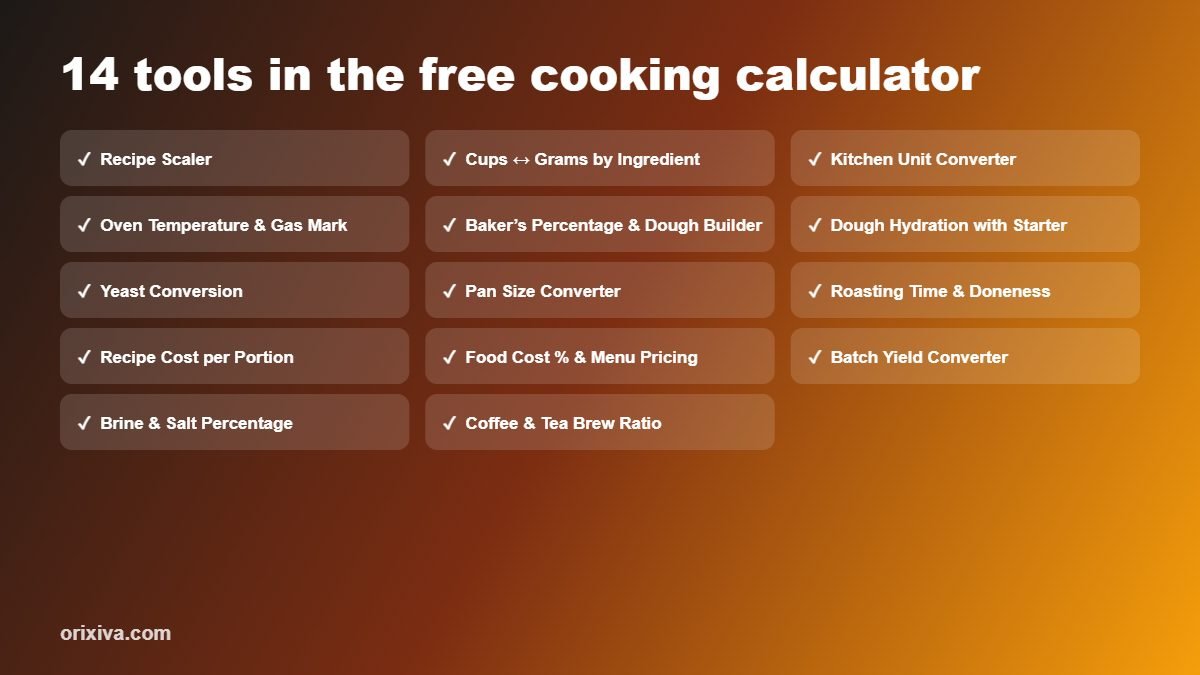
The cooking calculator contains 14 separate tools. Choose one from the menu at the top of the page; each tool keeps its own inputs and explains the formula it uses.
| Calculator | What it does |
|---|---|
| Recipe Scaler | Scale every ingredient line of a recipe to new servings, with kitchen-friendly fractions. |
| Cups ↔ Grams by Ingredient | Convert cups, spoons and mL to grams (and back) using real ingredient densities. |
| Kitchen Unit Converter | Convert any kitchen volume or weight unit and see all equivalents. |
| Oven Temperature & Gas Mark | Convert °C, °F and gas mark with fan/convection adjustment. |
| Baker’s Percentage & Dough Builder | Ingredient weights from baker’s percentages for a target dough weight or flour weight. |
| Dough Hydration with Starter | True hydration including sourdough starter (levain) water and flour. |
| Yeast Conversion | Swap fresh, active dry, instant yeast and sourdough starter. |
| Pan Size Converter | Scale a recipe or baking time when changing between round, square and rectangular pans. |
| Roasting Time & Doneness | Roasting time by meat, weight and doneness with safe internal temperatures. |
| Recipe Cost per Portion | Cost every ingredient from pack price and amount used; get cost per portion. |
| Food Cost % & Menu Pricing | Food cost percentage, gross profit and price for a target food cost. |
| Batch Yield Converter | Convert a batch by yield weight or count, including cooking loss. |
| Brine & Salt Percentage | Salt for a brine percentage or equilibrium brine (food + water). |
| Coffee & Tea Brew Ratio | Coffee grounds and water for any brew ratio and method. |
How to use the cooking calculator
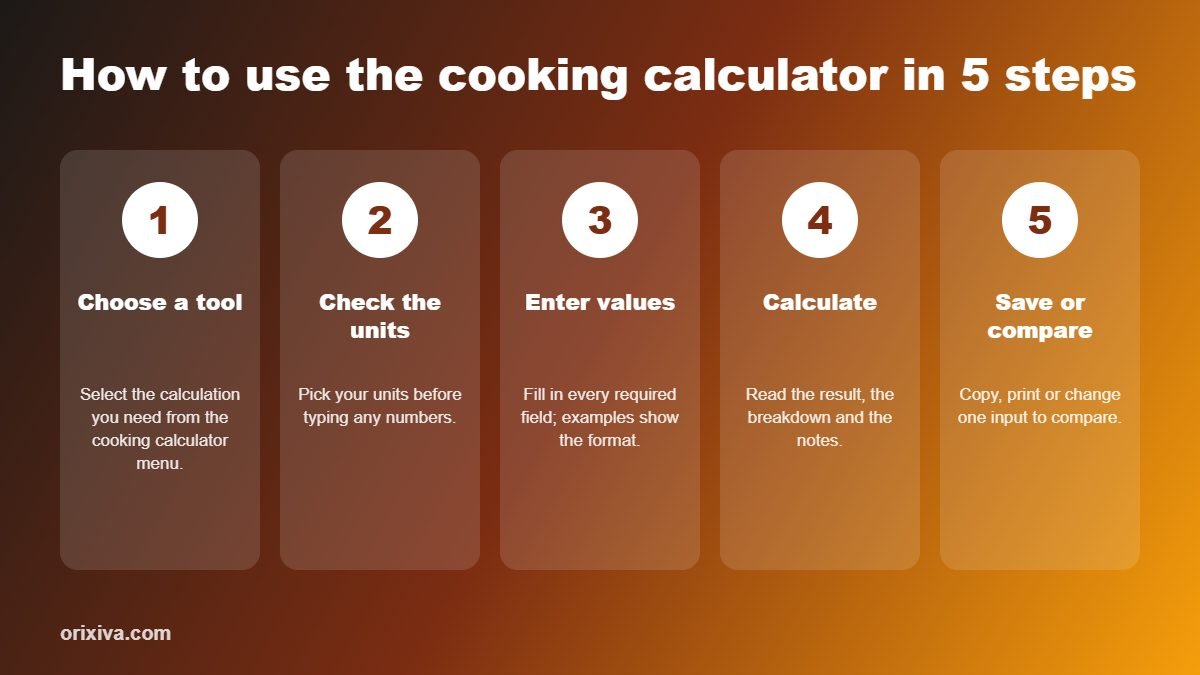
- Choose a tool. Select the calculation you need from the cooking calculator menu.
- Check the units. Pick the units you are working in before typing numbers, so the formula uses the right values.
- Enter your values. Fill in every required field. Example values show the expected format.
- Calculate and review. Read the main result, the breakdown and any notes or charts under it.
- Save or compare. Copy, print or download the result, or change one input to compare scenarios.
Who uses this cooking calculator?
- Home cooks scaling recipes up or down.
- Bakers working with baker’s percentages and sourdough.
- Restaurant owners and chefs costing recipes and menus.
- Caterers converting batch yields.
- Coffee and tea lovers dialling in brew ratios.
Tips for accurate results with the cooking calculator
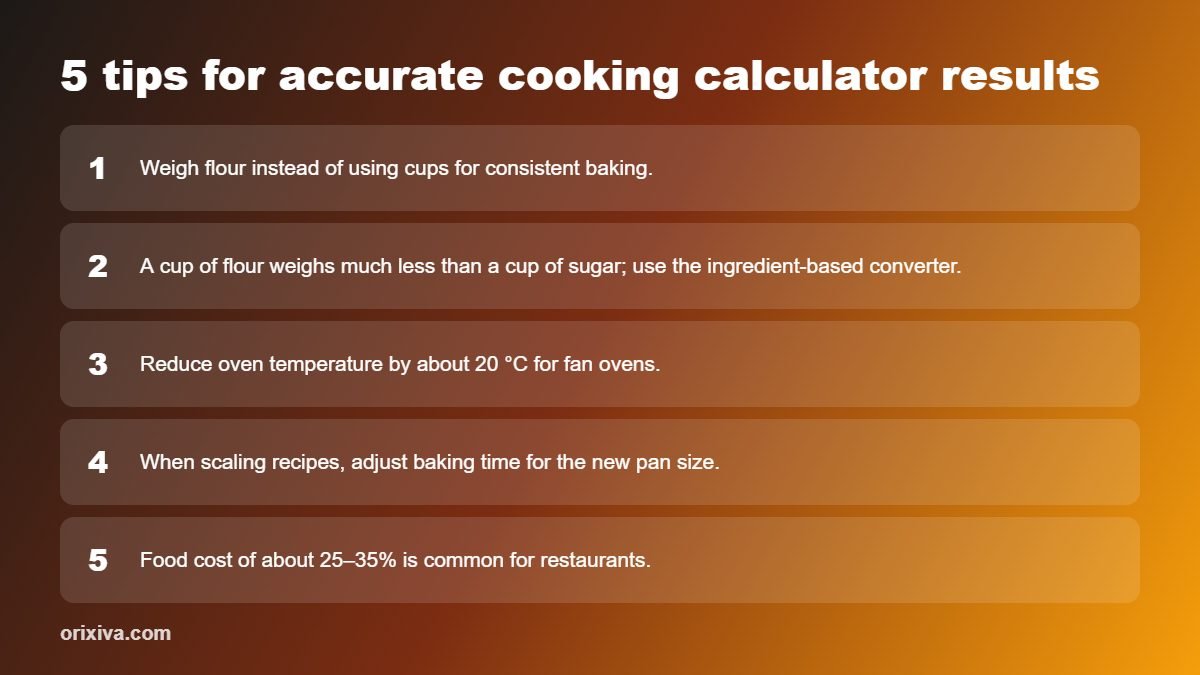
- Weigh flour instead of using cups for consistent baking.
- A cup of flour weighs much less than a cup of sugar; use the ingredient-based converter.
- Reduce oven temperature by about 20 °C for fan ovens.
- When scaling recipes, adjust baking time for the new pan size.
- Food cost of about 25–35% is common for restaurants.
Cooking calculator guide: conversions and worked examples
The tools above do the maths for you, but it helps to know the numbers behind them. This guide collects the kitchen conversions people look up most often, explains why weighing is more accurate than using cups, and walks through five worked examples you can check against the cooking calculator.
Why grams beat cups
A cup measures volume, not weight. A cup of flour can weigh anywhere from about 115 g when it is spooned in lightly to more than 150 g when it is scooped straight from the bag and packed down. That difference is enough to turn a soft cake into a dry one. Weighing removes the guesswork, which is why professional bakers and most modern recipes use grams. If you only have cups, spoon the ingredient into the cup and level it with a knife, and use the cups to grams converter to get the weight the recipe writer most likely meant.
Cups to grams for common ingredients
| Ingredient (1 US cup) | Grams | Notes |
|---|---|---|
| All-purpose flour | 120–125 g | Spooned and levelled |
| Bread flour | 127 g | Slightly heavier than plain flour |
| Granulated sugar | 200 g | Fine white sugar |
| Brown sugar | 213–220 g | Firmly packed |
| Powdered (icing) sugar | 120 g | Unsifted |
| Butter | 227 g | Two US sticks |
| Water or milk | 237–240 g | 1 mL weighs about 1 g |
| Honey or syrup | 340 g | Dense, so it weighs much more than water |
| Rolled oats | 85–90 g | Light and airy |
| Uncooked white rice | 185–200 g | Depends on grain length |
| Cocoa powder | 85 g | Unsweetened |
A US cup is 236.6 mL, while a metric cup used in Australia, Canada and New Zealand is 250 mL. The difference is about 6%, which matters for baking but rarely for soups and stews.
Spoons, cups and millilitres
- 1 teaspoon = 4.93 mL (often rounded to 5 mL)
- 1 tablespoon = 3 teaspoons = 14.8 mL (15 mL)
- 1/4 cup = 4 tablespoons = 59 mL
- 1 US cup = 16 tablespoons = 236.6 mL
- 1 US fluid ounce = 29.6 mL; 1 UK fluid ounce = 28.4 mL
- 1 US pint = 473 mL; 1 UK pint = 568 mL
Oven temperatures
| Fahrenheit | Celsius | Fan oven | Gas mark | Typical use |
|---|---|---|---|---|
| 275 °F | 140 °C | 120 °C | 1 | Meringues, slow cooking |
| 325 °F | 160 °C | 140 °C | 3 | Rich fruit cakes, cheesecake |
| 350 °F | 180 °C | 160 °C | 4 | Most cakes and cookies |
| 375 °F | 190 °C | 170 °C | 5 | Muffins, pastry |
| 400 °F | 200 °C | 180 °C | 6 | Roast vegetables, bread rolls |
| 425 °F | 220 °C | 200 °C | 7 | Pizza, crusty bread |
| 450 °F | 230 °C | 210 °C | 8 | Searing roasts, flatbreads |
Fan (convection) ovens move hot air around the food, so they cook faster. As a rule, lower the temperature by about 20 °C (25 °F) or shorten the time by about a quarter, and check a little early the first time.
Worked example 1: scaling a recipe
A stew recipe serves 4 and uses 600 g beef, 2 onions and 500 mL stock. You need to feed 10. The scale factor is 10 ÷ 4 = 2.5, so you need 1,500 g beef, 5 onions and 1,250 mL stock. Seasoning, chilli and baking powder do not always scale in a straight line, so add about 80% of the scaled amount first, taste and adjust. Cooking time also changes less than the quantity: a bigger pot takes longer to come to the boil, but the simmering time stays about the same.
Worked example 2: baker's percentage
In baker's percentages every ingredient is written as a share of the total flour weight, which is always 100%. A basic bread at 65% hydration, 2% salt and 1% instant yeast with 1,000 g flour needs 650 g water, 20 g salt and 10 g yeast. To make a smaller batch with 400 g flour, keep the percentages and you get 260 g water, 8 g salt and 4 g yeast. This is why bakers can scale any dough without rewriting the recipe.
Worked example 3: swapping yeast types
Instant yeast is the most concentrated. Use about 1.25 times as much active dry yeast, or about 3 times as much fresh (compressed) yeast. So 7 g instant yeast becomes about 9 g active dry or 21 g fresh yeast. Active dry yeast works best when it is dissolved in warm water first, while instant yeast can go straight into the flour.
Worked example 4: changing the pan size
Pans are scaled by area, not by diameter. A 9-inch round pan has an area of about 63.6 square inches, almost the same as an 8-inch square pan at 64 square inches, so you can swap them without changing the recipe. Moving from a 9-inch round to a 9 x 13-inch pan (117 square inches) means multiplying the batter by about 1.8. Deeper batter needs a slightly lower oven and a longer bake, so test with a skewer.
Worked example 5: pricing a dish with food cost
If the ingredients for one plate cost 3.20 and you aim for a 30% food cost, the menu price is 3.20 ÷ 0.30 = 10.67, which most restaurants would round to 10.95 or 11.00. Many cafés aim for 28 to 35%. The food cost tool also shows the profit left per plate before labour, rent and other costs.
Safe cooking temperatures
Use a probe thermometer in the thickest part of the food. Common safe internal temperatures are 74 °C (165 °F) for poultry and leftovers, 71 °C (160 °F) for minced beef and pork, and 63 °C (145 °F) for whole cuts of beef, pork and lamb followed by a short rest, and for fish. Food safety agencies publish full charts, such as the FoodSafety.gov safe minimum internal temperature chart.
Common mistakes the cooking calculator helps you avoid
- Mixing US and metric cups in the same recipe.
- Scaling salt, spices and leavening exactly in a big batch instead of tasting first.
- Forgetting to lower the temperature in a fan oven.
- Swapping pans by diameter instead of area.
- Using the same weight of fresh yeast as instant yeast.
- Measuring honey or syrup in a dry spoon. Grease the spoon first so all of it slides out.
- Opening the oven door often, which lets heat escape and makes cakes sink.
Privacy and accuracy
The cooking calculator runs entirely in your browser. Numbers you type are not sent to Orixiva or stored on a server.
Results use standard published formulas and are rounded for display. They are estimates for planning, study and everyday decisions; for legal, medical, engineering or financial decisions, confirm them with a qualified professional. For background reading, see the USDA Food Safety and Inspection Service.
Related free calculators
Need a different kind of calculation? These pages work the same way as this cooking calculator.
- Car Calculator for fuel, car loans, EV charging and tyres.
- Chemistry Calculator for molarity, pH and gas laws.
- Data Analysis Calculator for z-scores, weighted averages and CSV.
- Everyday Calculator for percentages, tips and GPA.
- Scientific Calculator for equations, triangles and matrices.
- All free calculators in one place.
Share your feedback
Which cooking calculator tool did you use, and was the result what you expected? Tell other readers in the comments, or suggest a calculator we should add next. Comments are reviewed before they appear.
Frequently asked questions
Is this cooking calculator free?
Yes. All 14 kitchen tools are free with no sign-up.
How many grams is one cup?
It depends on the ingredient. Cups ↔ Grams by Ingredient uses real densities, for example about 120 g for a cup of flour and 200 g for a cup of sugar.
How do I scale a recipe?
Paste the ingredient list into Recipe Scaler, enter the original and new servings, and every line is converted.
How do I convert gas mark to Celsius?
Oven Temperature & Gas Mark converts °C, °F and gas mark and adjusts for fan ovens.
What is baker’s percentage?
Each ingredient is expressed as a percentage of the flour weight. The dough builder turns percentages into grams.
Can I calculate food cost per plate?
Yes. Recipe Cost per Portion and Food Cost % & Menu Pricing work out cost and selling price.
Why convert cups to grams by ingredient?
A cup of flour weighs about 120 to 125 g but a cup of sugar about 200 g, because density differs. Cups to Grams by Ingredient uses real densities for each ingredient.
What is gas mark 4 in Celsius?
Gas mark 4 is about 180 degrees C or 350 degrees F. For fan or convection ovens, reduce by about 20 degrees C. The Oven Temperature tool converts all three with the fan adjustment.
What is baker's percentage?
Each ingredient is expressed as a percentage of the flour weight, which is always 100%. A dough with 65% water uses 650 g of water for 1,000 g of flour. The Dough Builder turns percentages into weights.
How do I calculate sourdough hydration?
Include the flour and water inside your starter. Dough Hydration with Starter adds them to the main flour and water to give the true hydration percentage.
How do I swap fresh yeast for dry yeast?
As a rule of thumb, use about 40% as much active dry yeast or about one third as much instant yeast as fresh yeast. The Yeast Conversion tool also converts to sourdough starter.
How do I change a recipe for a different pan size?
Scale by pan area. A 9-inch round pan has about 64 square inches, so a 9 x 13 inch pan (117 square inches) needs about 1.8 times the batter. Pan Size Converter also suggests baking time changes.
How long should I roast meat?
Roasting Time & Doneness estimates time from meat type, weight and doneness and shows safe internal temperatures. Always check with a thermometer; for example, poultry should reach 74 degrees C (165 degrees F).
How do I calculate cost per portion?
Recipe Cost per Portion divides each pack price by the pack size, multiplies by the amount used and adds them up, then divides by the number of portions.
What food cost percentage should a menu item have?
Many restaurants aim for about 25 to 35%. Food cost % = ingredient cost / selling price; the Menu Pricing tool also finds the price for a target food cost.
How do I account for cooking loss?
The Batch Yield Converter scales a batch by final yield weight or count and includes the weight lost during cooking.
How much salt do I need for a brine?
For a 5% brine, use 50 g of salt per litre of water. For an equilibrium brine, the percentage is calculated on the total weight of food plus water, which the Brine tool does for you.
What is a good coffee to water ratio?
About 1:15 to 1:17 for filter coffee, so 20 g of coffee to 300 to 340 g of water. The Coffee & Tea Brew Ratio tool works for any ratio and brew method.
Can I switch between metric and US units?
Yes. The Kitchen Unit Converter converts all common volume and weight units and shows every equivalent at once.
Do I need to sign up or install an app?
No. All 14 cooking tools are free and run in your browser, so you can use them on your phone in the kitchen.
Ready to calculate? Scroll up to the cooking calculator, choose a tool and get your answer in seconds.