Try our free AI tools – no sign-up needed!

Unit Converter: Free Online Tools
ORIXIVA · UNIT CONVERSION GUIDE
unit converter: Convert 14 Types of Measurements
Need to convert kilometres to miles, Celsius to Fahrenheit, kilograms to pounds, litres to gallons, GB to GiB, or Mbps to MB/s? Orixiva’s Unit & Conversion tool brings 14 measurement converters together in one browser-based interface. Choose a category, enter a value, select your units, and review the result with the working shown.
The unit converter also supports adjustable precision, standard/scientific/engineering notation, a table of related units, and options to copy, download, print, or export recent conversions. The unit converter runs in your browser and does not need a conversion API.
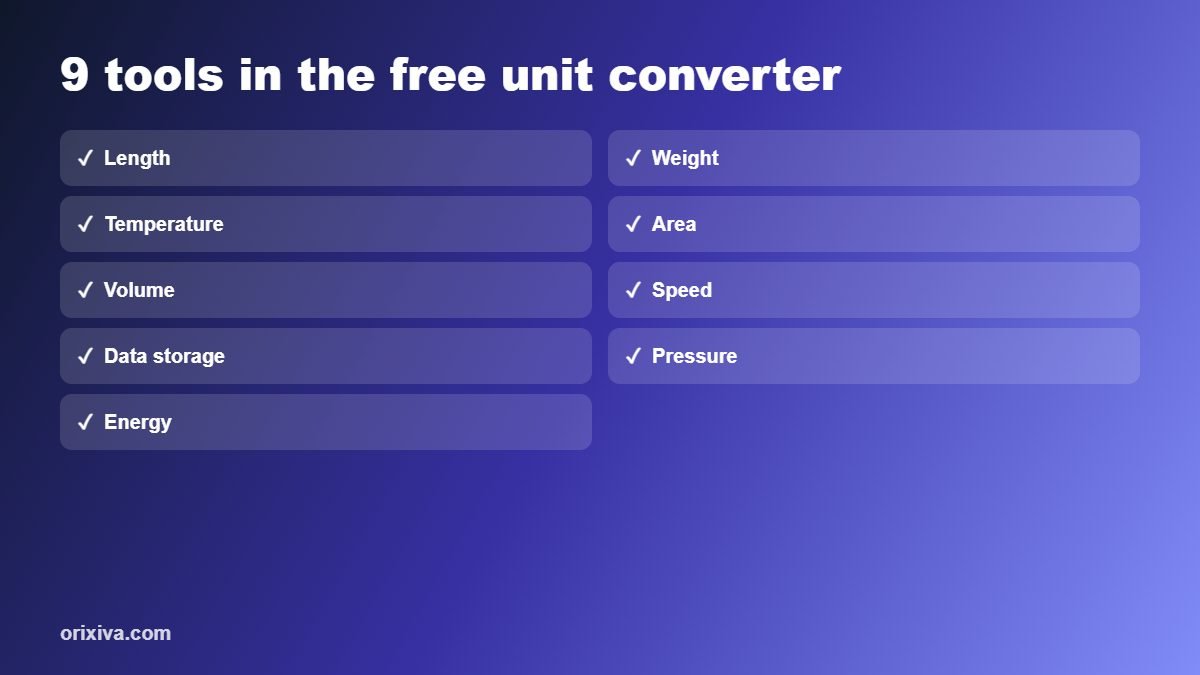
LengthMassTemperatureAreaVolumeSpeedDigital storagePressureEnergyTimePowerAngleFuel economyData rate
How to use the online unit converter
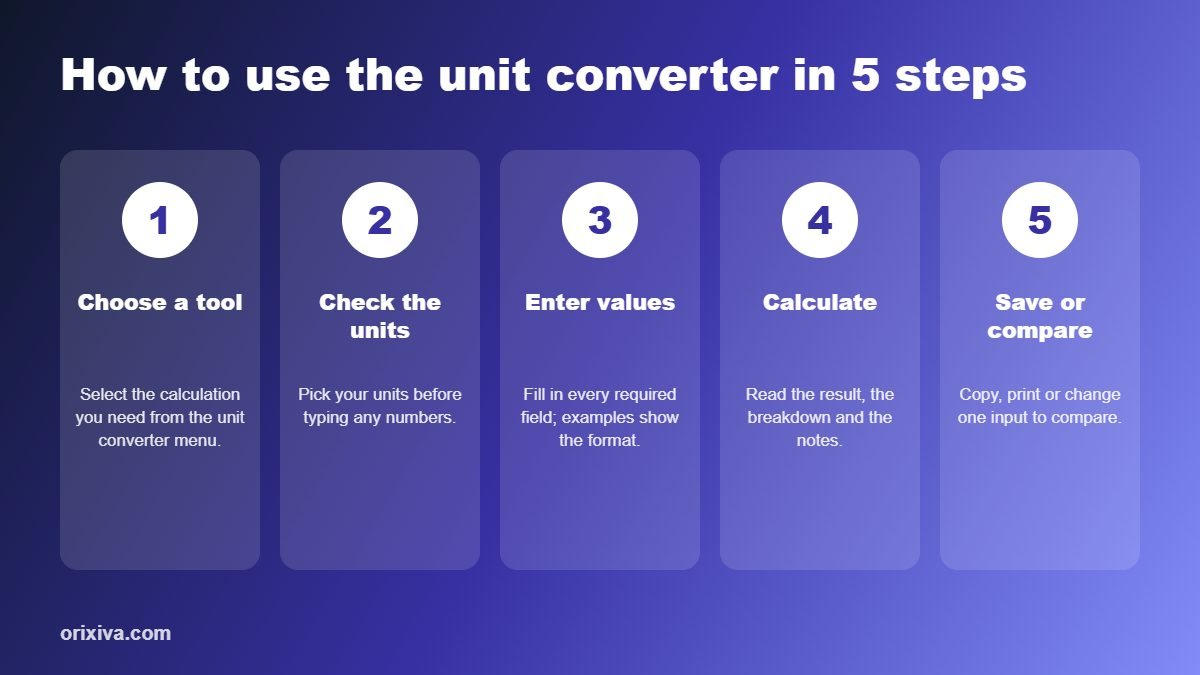
Follow these steps to convert a measurement. The result panel updates as you change the value or options; submitting the conversion adds it to the recent-conversion list.
- Choose a converterSelect the measurement type, such as length, temperature, or data transfer rate.
- Enter your valueUse a number, fraction such as 5/2, scientific notation such as 1.2e3, or a simple arithmetic expression.
- Select both unitsChoose the starting unit and the unit you want to convert to.
- Set precisionChoose significant figures or decimal places and select the display notation.
- Check and use the resultReview the calculation steps and all related units. Copy, download, or print the result if needed.
Input tip: Use a full stop as the decimal mark, for example
2.75. Commas, spaces, and underscores are removed from the input, so 1,000 is treated as 1000, not as a decimal-comma value. Use only numbers and the supported arithmetic symbols; do not type a unit name inside the value box.Which converter should you choose?
Use this guide to find the right measurement type before entering a value.
| Your task | Choose this unit converter | Example |
|---|---|---|
| Measure distance or length | Length Converter | km to miles |
| Convert mass or common weight units | Weight / Mass Converter | kg to lb |
| Change a temperature reading or temperature interval | Temperature Converter | °C to °F |
| Compare land, room, or surface sizes | Area Converter | acre to marla |
| Convert liquid or container capacity | Volume Converter | US gal to L |
| Convert travel, marine, or speed units | Speed Converter | km/h to mph |
| Compare bytes and bits | Digital Storage | GB to GiB |
| Convert pressure units | Pressure Converter | bar to psi |
| Convert work, heat, or stored energy units | Energy Converter | kWh to joules |
| Change units of elapsed time | Time Converter | minutes to hours |
| Compare rates of energy use or output | Power Converter | kW to hp |
| Convert angular measurements | Angle Converter | degrees to radians |
| Compare fuel-efficiency formats | Fuel Economy Converter | L/100 km to mpg |
| Convert network or file-transfer rates | Data Transfer Rate | Mbps to MB/s |
- What is being measured?Distance, mass, temperature, area, or volume usually uses a physical measurement converter.
- Is it a rate?Use speed for movement, fuel economy for vehicle consumption, power for energy per time, or data rate for network transfer.
- Is it digital or scientific?Use digital storage for bits/bytes, pressure for bar/psi, energy for joules/kWh, time for durations, and angle for degrees/radians.
Explore each unit converter
1. Length Converter: metres, kilometres, feet, miles, and more
The length converter changes measurements from very small distances to large distances used in travel, navigation, and astronomy. Supported units include nanometres, micrometres, millimetres, centimetres, metres, kilometres, inches, feet, yards, miles, nautical miles, astronomical units, and light-years.
Formula
Target value = source value × source-to-metre factor ÷ target-to-metre factorExample: 1 kilometre = 1,000 metres. Since one international mile is 1,609.344 metres, 1 kilometre is about 0.621371 miles.
The unit converter can also show a feet-and-inches breakdown rounded to the nearest 1/16 inch. This is useful when you need a familiar building or household measurement rather than a decimal-only result.
Watch out: The unit converter uses the international foot. Historical US survey measurements may use a slightly different foot definition. For surveying, legal boundaries, or engineering specifications, follow the standard stated in your project documents.
2. Weight and Mass Converter: kilograms, pounds, ounces, tola, and maund
Use the weight/mass converter to compare metric and customary mass units. It includes micrograms, milligrams, grams, kilograms, metric tonnes, ounces, pounds, stones, US short tons, UK long tons, carats, grains, troy ounces, tola, and maund.
Formula
Target value = source mass × source-to-kilogram factor ÷ target-to-kilogram factorExample: 1 kilogram is approximately 2.20462 pounds. The unit converter also provides a pounds-and-ounces or stones-and-pounds breakdown where applicable.
The tola and maund options use the specific factors configured in this unit converter: 1 tola = 11.6638038 grams and 1 maund = 37.3242 kilograms. Traditional units may vary by region or trade, so confirm the required local standard for buying, selling, or official work.
Terminology: The calculator converts mass. In everyday speech people often say “weight,” but physical weight as a force is a different quantity.
3. Temperature Converter: Celsius, Fahrenheit, Kelvin, Rankine, and Réaumur
Convert temperature readings for weather, cooking, science, study, and technical work. The unit converter includes Celsius, Fahrenheit, Kelvin, Rankine, and Réaumur. It also has a separate mode for converting a temperature difference.
Temperature reading
°F = (°C × 9/5) + 32Example: 25°C = 77°F. Absolute temperature readings use an offset as well as a scale factor.
Temperature difference
A change of 10°C = a change of 18°FA temperature interval does not use the same offset as an absolute reading. Choose “Temperature difference” for a rise or fall, rather than a thermometer reading.
Common mistake: Do not convert an actual temperature reading as if it were only a change. For example, 25°C is 77°F, while a change of 25°C equals a change of 45°F.
4. Area Converter: square metres, square feet, acres, marla, and kanal
The area converter helps compare land, rooms, plots, buildings, and other surfaces. It includes square millimetres, square centimetres, square metres, hectares, square kilometres, square inches, square feet, square yards, acres, square miles, marla, and kanal.
Formula
Target area = source area × source-to-square-metre factor ÷ target-to-square-metre factorExample: Using the Punjab standard configured in this unit converter, 1 kanal = 20 marla and 8 kanal = 1 acre. Local land records and regional definitions should always take priority for an official transaction.
Because area is two-dimensional, square units must not be confused with ordinary length units. A square metre is an area; a metre is a length.
5. Volume Converter: litres, millilitres, US gallons, and imperial gallons
Convert the capacity of containers, cooking measures, tanks, and other volumes. Units include millilitres, litres, cubic metres, cubic centimetres, cubic inches, cubic feet, US teaspoons/tablespoons/cups/pints/quarts/gallons, imperial fluid ounces/pints/quarts/gallons, and oil barrels.
US gallon
1 US gallon = 3.785411784 litresImperial gallon
1 imperial gallon = 4.54609 litresExample: 2 US gallons are about 7.57082 litres. Always check which gallon a recipe, vehicle specification, or manual uses. US customary and imperial units are not interchangeable.
6. Speed Converter: km/h, mph, knots, Mach, and m/s
The speed converter supports road travel, marine and aviation speed, and selected scientific units. Units include metres per second, kilometres per hour, miles per hour, knots, feet per second, Mach, and the speed of light.
Formula
Target speed = source speed × source-to-m/s factor ÷ target-to-m/s factorExample: 100 km/h is about 27.7778 m/s or 62.1371 mph.
The Mach value in this unit converter uses a fixed speed of sound of 340.294 m/s, representing the configured sea-level reference at 15°C. The speed of sound changes with atmospheric conditions, so this Mach conversion is a reference estimate rather than a live flight calculation.
7. Digital Storage Converter: bits, bytes, GB, and GiB
Use the digital storage converter to compare network and device capacity labels. It includes bits, bytes, decimal kilobits/megabits/gigabits, kilobytes/megabytes/gigabytes/terabytes/petabytes, and binary kibibytes/mebibytes/gibibytes/tebibytes/pebibytes.
Key difference
1 byte = 8 bits · SI prefixes use powers of 1,000 · IEC prefixes use powers of 1,024Example: 500 GB is about 465.66 GiB. The two labels describe different counting systems, so the displayed number may look smaller in GiB without the drive losing capacity.
Remember: GB and GiB are not the same unit. Keep the capitalisation clear too: a bit and a byte represent different amounts of data.
8. Pressure Converter: pascal, bar, psi, atmosphere, and mmHg
The pressure converter includes pascals, hectopascals, kilopascals, megapascals, bar, millibar, standard atmosphere, pounds per square inch (psi), millimetres of mercury (mmHg), inches of mercury, torr, and kilogram-force per square centimetre.
Example conversion
1 bar = 100,000 pascals = about 14.5038 psiUse it to understand pressure values in equipment notes, weather information, or technical specifications.
Safety note: Unit conversion does not tell you which pressure setting is safe. For tyres, gas systems, medical devices, or industrial equipment, follow the manufacturer’s stated unit and approved operating limits.
9. Energy Converter: joules, calories, kWh, BTU, and electronvolts
Convert energy and work values used in electricity, heating, food energy, mechanics, and science. Supported units include joules, kilojoules, megajoules, calories, kilocalories, watt-hours, kilowatt-hours, BTU, therm, foot-pound force, and electronvolts.
Formula and example
1 kWh = 3,600,000 joules = 3.6 megajoulesFood labels often use “Calories” to mean kilocalories (kcal). Check the unit label before comparing values because cal and kcal differ by a factor of 1,000.
10. Time Converter: seconds, minutes, hours, days, and average months
The time converter covers nanoseconds, microseconds, milliseconds, seconds, minutes, hours, days, weeks, an average month, and a Gregorian average year. It can also show a breakdown in days, hours, minutes, and seconds.
Example
90 minutes = 1.5 hours = 5,400 secondsThe unit converter defines an average month as 30.436875 days and a Gregorian average year as 365.2425 days. These are averages, not the length of a named calendar month such as February or March.
Choose the right tool: This is a unit converter for durations. It does not calculate a date on a calendar or handle appointments across time zones.
11. Power Converter: watts, kilowatts, horsepower, and BTU per hour
Use the power converter to compare the rate at which energy is transferred or work is done. Units include milliwatts, watts, kilowatts, megawatts, mechanical horsepower, metric horsepower, BTU per hour, kilocalories per hour, foot-pounds per second, and refrigeration tons.
Example
1 kW is about 1.341 mechanical horsepowerThe unit converter distinguishes mechanical horsepower from metric horsepower. For air-conditioning comparisons, it also includes refrigeration tons using the factor configured in the unit converter.
Power and energy are different: kilowatts measure power, while kilowatt-hours measure energy. Use the Energy Converter for kWh.
12. Angle Converter: degrees, radians, gradians, and turns
The angle converter helps with geometry, trigonometry, design, navigation, and technical calculations. It supports degrees, radians, gradians, arc-minutes, arc-seconds, and full turns.
Example
90° = π/2 radians ≈ 1.570796 radiansThe unit converter can also display a degrees-minutes-seconds breakdown, which is useful when an angle is written in a navigation or surveying format.
A full turn is 360 degrees. One degree contains 60 arc-minutes, and one arc-minute contains 60 arc-seconds.
13. Fuel Economy Converter: L/100 km, km/L, US mpg, and UK mpg
Fuel economy units can be confusing because some describe fuel used over a distance, while others describe distance travelled per unit of fuel. This unit converter includes litres per 100 kilometres, kilometres per litre, miles per US gallon, and miles per imperial gallon.
Inverse relationship
km/L = 100 ÷ (L/100 km)Example: 8 L/100 km = 12.5 km/L, which is about 29.4 US mpg. US mpg and UK mpg differ because the gallons differ.
Common mistake: Do not treat L/100 km as a direct multiplier. It converts to km/L by taking the reciprocal, using 100 divided by the L/100 km value.
14. Data Transfer Rate Converter: Mbps, MB/s, and network speeds
Convert network and storage transfer rates between bits per second and bytes per second. Units include bit/s, kbps, Mbps, Gbps, B/s, kB/s, MB/s, GB/s, KiB/s, and MiB/s.
Key formula
MB/s = Mbps ÷ 8 (when using matching decimal units)Example: 100 Mbps equals 12.5 MB/s before real-world overhead. Actual download speeds can be lower because of network conditions, protocol overhead, server performance, and device limits.
Remember: Mbps means megabits per second. MB/s means megabytes per second. The capital B changes the meaning.
How does the unit conversion formula work?
For most converters, Orixiva first changes the input into a shared base unit and then converts that base value into the target unit. This gives one consistent method for many source and destination units.
- Read the inputFor example, 5 kilometres.
- Convert to base5 × 1,000 = 5,000 metres.
- Convert to target5,000 ÷ 1,609.344 ≈ 3.10686 miles.
- Apply display settingsRound or format the result to your chosen precision.
- Show the workReview the result, conversion table, and steps.
Some quantities need a special formula rather than one simple multiplier. Temperature readings use offsets as well as scale factors, temperature differences use scale factors without offsets, and fuel economy is inverse between L/100 km and km/L. The unit converter handles these categories separately.
Precision, notation, and result tools

Significant figures
Choose from 1 to 15 significant figures. This controls how many meaningful digits are displayed, which is useful for very large or very small measurements.
Decimal places
Choose from 0 to 12 decimal places. This is useful when you need a consistent number of digits after the decimal point.
Notation choices
Use automatic, standard decimal, scientific, or engineering notation. Scientific notation is often easier to read for very large or tiny numbers.
Keep or share a result
Copy a result, download a text record, print it, or export the recent-conversion list as CSV. The page shows up to 30 recent conversions in the current session.
Precision is not the same as accuracy. Showing more digits does not make an uncertain input more accurate. Match the result precision to the precision of your original measurement and the purpose of the calculation.
Frequently asked questions about unit conversion
These are editorial answers about the unit converter and common measurement questions, not claims about questions submitted by actual users.
1. What is an online unit converter?
An online unit converter changes a value from one measurement unit to another, such as kilometres to miles or Celsius to Fahrenheit. Orixiva groups 14 converter types in one interface and shows the result and calculation steps.
2. Is the Orixiva unit converter free to use?
The unit converter runs entirely in your browser without an API service. Check your current website terms for any future access or service changes.
3. Does the unit converter need an API?
No external conversion API is called by the provided code. The calculation logic runs in the browser.
4. Can I type a fraction such as 5/2?
Yes. The value field accepts fractions, scientific notation such as 1.2e3, and simple arithmetic using plus, minus, multiplication, division, and parentheses. It does not accept a unit name as part of the expression.
5. Why is my number with a comma changed?
The input parser removes commas, spaces, and underscores. That means 1,000 is read as 1000. Enter a decimal with a full stop, such as 1.5, rather than using a decimal comma.
6. What is the difference between rounding and accuracy?
Rounding changes how many digits are displayed. Accuracy depends on the input, the conversion factor, and the measurement standard. A result with many decimal places is not automatically more accurate.
7. How do I convert kilometres to miles?
Select Length Converter, enter the kilometre value, choose kilometres as the source and miles as the target, then review the result. One kilometre is approximately 0.621371 miles.
8. What is the difference between mass and weight?
Mass describes the amount of matter, while weight is a force caused by gravity. This unit converter uses mass conversion factors, although “weight converter” is a common everyday name.
9. How do I convert kilograms to pounds?
Choose Weight / Mass Converter, enter the kilogram value, and select pounds as the target unit. One kilogram is approximately 2.20462 pounds.
10. Are tola and maund values the same everywhere?
No. Traditional units may have different local or commercial definitions. This unit converter uses 1 tola = 11.6638038 grams and 1 maund = 37.3242 kilograms, so confirm the required standard for official or commercial work.
11. How do I convert Celsius to Fahrenheit?
Use the Temperature Converter in temperature-reading mode. The formula is °F = (°C × 9/5) + 32. For example, 25°C equals 77°F.
12. What is a temperature difference conversion?
A temperature difference describes how far a temperature rises or falls, not the absolute reading. The difference between 10°C and 20°C is 10°C, which is an 18°F difference. Use the separate temperature-difference option for this type of conversion.
13. Why are US and imperial gallons different?
A US gallon and an imperial gallon are different volumes. The unit converter lists them separately, so choose the unit that matches the recipe, vehicle, tank, or specification you are using.
14. How do I convert acres to marla or kanal?
Choose Area Converter and select the relevant source and target units. The configured regional standard is 8 kanal per acre and 20 marla per kanal. Confirm local land-record definitions before using the result in a property transaction.
15. Why does 500 GB convert to about 465.66 GiB?
GB uses a decimal base of 1,000, while GiB uses a binary base of 1,024. The labels use different unit systems, so the numeric result changes even though the underlying number of bytes remains the same.
16. What is the difference between Mbps and MB/s?
Mbps means megabits per second. MB/s means megabytes per second, and one byte contains eight bits. With matching decimal units, divide Mbps by 8 to get MB/s before accounting for real-world transfer overhead.
17. How do I convert bar to psi?
Choose Pressure Converter, enter the bar value, and select psi. One bar is approximately 14.5038 psi. The conversion does not determine whether a pressure setting is safe for any equipment.
18. What is the difference between kW and kWh?
Kilowatt (kW) measures power, or the rate of energy transfer. Kilowatt-hour (kWh) measures energy. Use Power Converter for kW and Energy Converter for kWh.
19. How do I convert minutes to hours?
Choose Time Converter and convert minutes to hours. Divide the number of minutes by 60; for example, 90 minutes is 1.5 hours.
20. Does the Time Converter calculate calendar months?
No. It uses an average month of 30.436875 days and an average Gregorian year of 365.2425 days. It is designed for unit conversion, not for finding a calendar date months later.
21. What does Mach mean in the Speed Converter?
Mach compares speed with the speed of sound. This calculator uses a fixed reference speed of 340.294 metres per second, so it does not adjust for altitude or weather conditions.
22. How do I convert L/100 km to km/L?
Use the Fuel Economy Converter. These units are inversely related, so km/L = 100 ÷ (L/100 km). For example, 8 L/100 km equals 12.5 km/L.
23. Are US mpg and UK mpg the same?
No. US and imperial gallons have different volumes, so US mpg and UK mpg are different. Always select the unit standard shown in your vehicle information or reference.
24. How do I convert degrees to radians?
Choose Angle Converter, select degrees as the source and radians as the target. To convert manually, multiply degrees by π/180. For example, 90° equals π/2 radians.
25. Can I change the number of decimal places?
Yes. Open Display options and choose significant figures or decimal places. The unit converter supports 1–15 significant figures or 0–12 decimal places, plus automatic, standard, scientific, or engineering notation.
26. Can I see other equivalent units in one result?
Yes. The result includes a table of values for the units supported by the selected converter, along with calculation details. This can help compare several unit standards at once.
27. Can I export my conversion history?
The page offers a CSV export for the current recent-conversion list, as well as text download, copy, and print actions. Recent history is held in the page’s current runtime; do not rely on it as permanent saved storage.
28. Does this unit converter convert currencies?
No. It converts the 14 measurement categories listed on this page and does not provide live currency exchange rates.
29. Can I use these results for legal or safety-critical decisions?
Use the result as a calculation aid, and check the official specification when precision or compliance matters. Land records, engineering tolerances, medical settings, pressure limits, and calibrated measurements may require a particular standard or a qualified professional.
30. Are the questions above real user submissions?
No. These are editorial FAQs written to explain the unit converter. If you later add a genuine comment or feedback feature, clearly explain how it works and publish only authentic user submissions.
Related tools and unit conversion references
The unit converter handles everyday and technical units, from a simple length converter to energy and data rates. For calculations that go beyond a single conversion, try these free tools:
- Construction calculators for concrete, tiles, paint and area after you convert your measurements with the unit converter.
- Cooking calculator for cups to grams and oven temperature conversion in the kitchen.
- Computer calculator for storage, bandwidth and download time beyond the digital storage converter.
- Scientific calculator for scientific notation and powers of ten.
Three quick unit conversion examples: a 5 km run is 3.11 miles in the length converter, 180 °C is 356 °F in the temperature converter, and a 2.5 kg parcel is 5.51 lb. Every unit converter result can be copied or shared, and each unit conversion passes through the SI base unit first, so you get the same answer whichever direction you convert. If a figure looks wrong, check the unit labels in the unit converter before anything else; most mistakes come from picking US gallons instead of imperial gallons or mph instead of knots.
The official definitions behind the length converter, temperature converter and every other tool come from the International System of Units. See the NIST guide to SI units and the BIPM SI brochure for exact conversion factors.
Ready to convert a measurement?
Open the Orixiva Unit & Conversion Calculator, select the right category, and compare your units. For construction-related calculations, you can also explore construction calculators. For statistical work after you prepare your measurements, see the statistics tools.
Help improve this page: Was this guide useful? Tell us what could be clearer or which conversion example you would like added. This is a proposed feedback prompt; it does not submit or store feedback by itself. A working form, moderation, spam protection, and privacy details must be configured separately.