Try our free AI tools – no sign-up needed!


Quick answer: To use the fitness calculator, pick one of the 16 tools in the menu above, enter your values with the right units and press Calculate. The result appears with notes, and you can copy or print it.
- 16calculators
- 0sign-ups needed
- 100%in your browser
- Freeforever
What the fitness calculator includes
The fitness calculator contains 16 separate tools. Choose one from the menu at the top of the page; each tool keeps its own inputs and explains the formula it uses.
| Calculator | What it does |
|---|---|
| BMI & Healthy Weight | BMI with WHO or Asian cut-offs, BMI Prime, ponderal index and healthy range. |
| Body Fat Percentage | US Navy tape method plus BMI-based estimate, with fat and lean mass and category. |
| Waist-to-Height & Waist-to-Hip Ratio | Central-fat health risk from waist, hip and height. |
| Ideal Body Weight | Devine, Robinson, Miller, Hamwi and BMI-range ideal weights compared. |
| BMR & TDEE (3 formulas) | Basal and total daily energy with Mifflin–St Jeor, Harris–Benedict and Katch–McArdle. |
| Macro Calculator | Protein, carbs and fat in grams for your calories and diet style, per day and per meal. |
| Protein Requirement | Daily protein for your goal and activity, per kg and per meal. |
| One-Rep Max & Training Loads | 1RM from 5 formulas with a percentage table for programming. |
| Heart Rate Training Zones | Max HR by 3 formulas and Karvonen (heart-rate reserve) zones. |
| Running Pace & Race Predictor | Pace, speed and splits for a run, and predicted times for other distances (Riegel). |
| VO₂ Max Estimate | Aerobic fitness from a 12-minute Cooper test, 1.5-mile run or resting heart rate. |
| Daily Water Intake | Water needs from body weight, exercise and climate, in litres, cups and per hour. |
| Calories Burned by Activity | Energy used for 25+ activities from MET values, weight and duration. |
| Weight Loss / Gain Timeline | How long to reach a goal weight from a daily calorie deficit, with target date and chart. |
| Pregnancy Due Date | Due date, current week, trimester and key dates from last period or conception. |
| Lean Body Mass & Body Surface Area | Lean mass by Boer, James and Hume formulas plus body surface area. |

How to use the fitness calculator
- Choose a tool. Select the calculation you need from the fitness calculator menu.
- Check the units. Pick the units you are working in before typing numbers, so the formula uses the right values.
- Enter your values. Fill in every required field. Example values show the expected format.
- Calculate and review. Read the main result, the breakdown and any notes or charts under it.
- Save or compare. Copy, print or download the result, or change one input to compare scenarios.

Who uses this fitness calculator?
- People starting a weight loss or muscle gain plan.
- Runners planning pace and race times.
- Gym-goers programming lifts from a one-rep max.
- Coaches and personal trainers.
- Expecting parents checking due dates.
Tips for accurate results with the fitness calculator
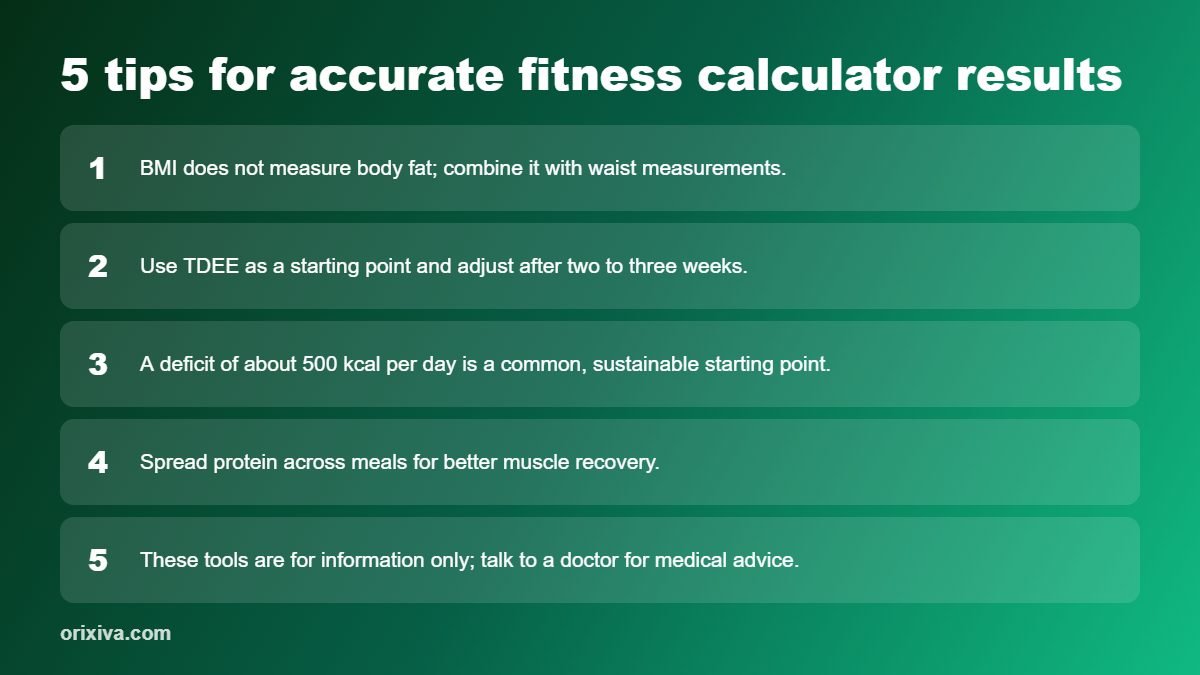
- BMI does not measure body fat; combine it with waist measurements.
- Use TDEE as a starting point and adjust after two to three weeks.
- A deficit of about 500 kcal per day is a common, sustainable starting point.
- Spread protein across meals for better muscle recovery.
- These tools are for information only; talk to a doctor for medical advice.
Fitness calculator guide: formulas, ranges and worked examples
Each tool in this fitness calculator uses a published formula. This guide explains what those formulas measure, where they fall short and how to read the results, with worked examples for one person so you can see how the numbers fit together. The results are estimates for healthy adults and are not a medical diagnosis.
Body measurements at a glance
| Measure | Formula | Common healthy range |
|---|---|---|
| BMI | Weight (kg) ÷ Height (m)² | 18.5–24.9 (WHO); 18.5–22.9 often used for Asian adults |
| Waist-to-height ratio | Waist ÷ Height | Below 0.5 |
| Waist-to-hip ratio | Waist ÷ Hip | Below about 0.90 (men), 0.85 (women) |
| Body fat (adults) | US Navy tape method | About 10–20% (men), 18–28% (women) for general fitness |
BMI is quick but cannot tell muscle from fat, so a muscular athlete can show as overweight. Waist-to-height ratio adds information about fat around the middle, which is more closely linked to heart and metabolic risk.
Worked example: one person, all the numbers
Take a 30-year-old man who is 178 cm tall, weighs 82 kg, has a 90 cm waist and trains three to four times a week.
- BMI: 82 ÷ 1.78² = 25.9, just above the WHO healthy range. His waist-to-height ratio is 90 ÷ 178 = 0.51, also slightly above 0.5.
- BMR (Mifflin–St Jeor): 10 × 82 + 6.25 × 178 − 5 × 30 + 5 = 1,788 kcal a day at complete rest.
- TDEE: with a moderate activity factor of 1.55, he burns about 1,788 × 1.55 = 2,771 kcal a day.
- Calorie target: to lose about 0.5 kg a week, a deficit of roughly 500 kcal gives a target near 2,270 kcal.
- Protein: at 1.6 g per kg, he needs about 131 g a day, or four meals of about 33 g.
- Macros: 131 g protein (524 kcal), 70 g fat (630 kcal) and the rest from carbohydrate: (2,270 − 1,154) ÷ 4 ≈ 279 g.
Which BMR formula to use
Mifflin–St Jeor is the most accurate of the three for most adults and is the default. Harris–Benedict, first published in 1919 and revised in 1984, tends to give slightly higher numbers. Katch–McArdle uses lean body mass, so it is the best choice when you know your body fat percentage, for example from the body fat tool.
Heart rate training zones
The simple estimate of maximum heart rate is 220 minus age, so 190 beats per minute at age 30. The Tanaka formula, 208 − 0.7 × age, gives 187. The Karvonen method uses heart-rate reserve: with a resting heart rate of 60, the reserve is 190 − 60 = 130, and a 70% effort is 60 + 0.70 × 130 = 151 bpm.
| Zone | % of heart-rate reserve | Feels like |
|---|---|---|
| 1 Recovery | 50–60% | Very easy, full conversation |
| 2 Endurance | 60–70% | Comfortable, can still talk |
| 3 Tempo | 70–80% | Steady, short sentences |
| 4 Threshold | 80–90% | Hard, a few words |
| 5 Maximum | 90–100% | All-out, seconds to minutes |
One-rep max and training loads
If you can bench press 80 kg for 6 clean reps, the Epley formula estimates your one-rep max at 80 × (1 + 6 ÷ 30) = 96 kg. Programs often prescribe sets at a percentage of that: 75% (72 kg) for sets of 8 to 10, or 85% (about 82 kg) for sets of 4 to 6. Estimates are most reliable from sets of 10 reps or fewer.
Running pace and race prediction
A 10 km run in 50 minutes is a pace of 5:00 per kilometre, or about 8:03 per mile. The Riegel formula, T₂ = T₁ × (D₂ ÷ D₁)^1.06, predicts a half marathon in about 1 hour 50 minutes and a marathon in about 3 hours 50 minutes from that 10 km time. Predictions assume you train for the longer distance, so treat the marathon figure as a best case.
VO₂ max from a 12-minute run
In the Cooper test you run as far as you can in 12 minutes. VO₂ max is estimated as (distance in metres − 504.9) ÷ 44.73. Covering 2,600 m gives about 46.8 ml/kg/min, a good level for a man in his thirties.
Macros for different goals
There is no single best split of protein, carbohydrate and fat. A common balanced split is about 30% of calories from protein, 40% from carbohydrate and 30% from fat. Endurance athletes often eat more carbohydrate, around 50 to 60%, to fuel long sessions. People on lower-carbohydrate diets shift the balance towards fat while keeping protein steady. The macro calculator lets you pick a diet style and then splits your daily grams into meals, which makes planning easier.
Whatever split you choose, total calories decide whether you gain or lose weight, and protein helps you keep muscle while you diet. Fibre, fruit and vegetables matter for health even though they do not change the macro totals much.
How body fat is estimated
The US Navy method uses neck and waist measurements for men, and neck, waist and hip measurements for women, together with height. It is usually within 3 to 4 percentage points of more expensive methods such as DEXA scans when measurements are taken carefully. Measure in the morning, keep the tape level and snug but not tight, and take the average of two or three readings. The body fat calculator also shows a BMI-based estimate for comparison, which is less accurate for very muscular people.
Tracking progress
Weigh yourself at the same time of day, ideally in the morning, and look at the weekly average rather than single readings. Water and food can move your weight by 1 to 2 kg from day to day. Recalculate your TDEE after every 4 to 5 kg of change, because a lighter body burns fewer calories.
Using the results safely
- Change calorie intake gradually and track your weight over several weeks, not days.
- Ranges differ for children, older adults, pregnancy and some ethnic groups.
- Talk to a doctor before starting hard training if you have a heart condition or other health concerns.
The World Health Organization fact sheet on obesity and overweight explains the BMI categories used in this fitness calculator.
Privacy and accuracy
The fitness calculator runs entirely in your browser. Numbers you type are not sent to Orixiva or stored on a server.
Results use standard published formulas and are rounded for display. They are estimates for planning, study and everyday decisions; for legal, medical, engineering or financial decisions, confirm them with a qualified professional. For background reading, see the CDC information about BMI.
Related free calculators
Need a different kind of calculation? These pages work the same way as this fitness calculator.
- Car Calculator for fuel, car loans, EV charging and tyres.
- Chemistry Calculator for molarity, pH and gas laws.
- Cooking Calculator for recipes, cups to grams and baking.
- Electrical Calculator for Ohm’s law, wire size and physics.
- Scientific Calculator for equations, triangles and matrices.
- All free calculators in one place.
Share your feedback
Which fitness calculator tool did you use, and was the result what you expected? Tell other readers in the comments, or suggest a calculator we should add next. Comments are reviewed before they appear.
Frequently asked questions
Is this fitness calculator free?
Yes. All 16 health and fitness tools are free with no sign-up.
How do I calculate my BMI?
Enter height and weight in BMI & Healthy Weight. You can choose WHO or Asian cut-offs.
What is TDEE?
Total daily energy expenditure is the calories you burn per day. The BMR & TDEE tool compares three formulas.
How much protein do I need?
Protein Requirement estimates grams per day and per meal from your weight, goal and activity.
How do I find my heart rate zones?
Heart Rate Training Zones uses max heart rate formulas and the Karvonen method with your resting heart rate.
Is this medical advice?
No. Results are estimates for general information. Consult a healthcare professional for medical decisions.
What is a healthy BMI?
For most adults a BMI of 18.5 to 24.9 is considered healthy. Some Asian guidelines use a lower overweight cut-off of 23. The BMI tool lets you choose WHO or Asian cut-offs and shows your healthy weight range.
How accurate is the US Navy body fat method?
It estimates body fat from neck, waist (and hip for women) and height, and is usually within a few percentage points of lab methods when measured carefully. The tool also shows a BMI-based estimate for comparison.
What is a good waist-to-height ratio?
Keeping your waist under half your height (a ratio below 0.5) is a common target for lower health risk. The tool also calculates waist-to-hip ratio.
Which ideal body weight formula is best?
None is perfect. The Ideal Body Weight tool compares Devine, Robinson, Miller and Hamwi with the healthy BMI range so you can see a sensible range rather than one number.
What is the difference between BMR and TDEE?
BMR is the energy you burn at complete rest; TDEE adds daily activity and exercise. The tool calculates both with Mifflin-St Jeor, Harris-Benedict and Katch-McArdle.
How do I set my macros?
The Macro Calculator splits your calorie target into protein, carbohydrate and fat grams for your diet style, per day and per meal. Protein and carbs have 4 kcal per gram and fat 9 kcal.
How do I estimate my one-rep max?
Enter the weight you lifted and the number of reps. The One-Rep Max tool averages five formulas, such as Epley and Brzycki, and gives a table of training loads by percentage.
How are heart rate zones calculated?
The tool estimates maximum heart rate with three formulas and uses the Karvonen method, which adds your resting heart rate, to set training zones.
How can I predict my race time?
Running Pace & Race Predictor uses the Riegel formula, T2 = T1 x (D2 / D1)^1.06, to predict times for other distances from a recent race, plus pace and splits.
How can I estimate VO2 max without a lab test?
Use a 12-minute Cooper run, a 1.5-mile run time or your resting heart rate. The VO2 Max Estimate tool converts each into an aerobic fitness score.
How much water should I drink a day?
Needs vary with body size, activity and climate. The Daily Water Intake tool gives an estimate in litres and cups, adding more for exercise and hot weather.
How are calories burned calculated?
Calories = MET value x body weight in kg x hours. The tool includes more than 25 activities with their MET values.
How long will it take to reach my goal weight?
The Weight Loss / Gain Timeline divides the energy in the weight change by your daily calorie deficit or surplus and shows a target date and chart. Real progress is rarely a straight line.
How is a due date calculated?
Naegele's rule adds 280 days (40 weeks) to the first day of the last menstrual period. The Pregnancy Due Date tool also shows the current week, trimester and key dates.
What is lean body mass?
Everything except fat: muscle, bone, organs and water. The tool estimates it with the Boer, James and Hume formulas and also calculates body surface area.
Ready to calculate? Scroll up to the fitness calculator, choose a tool and get your answer in seconds.