Try our free AI tools – no sign-up needed!

Free 3D printing cost calculator for filament, resin, electricity, printer wear, labour and selling price with Etsy fees, batch costs and material comparison.
Quick answer: The cost of a 3D print is material + electricity + printer wear + maintenance + labour + extras, plus an allowance for failed prints. A typical 85 g PLA print that takes 6.5 hours costs about $1.79 in filament but around $7.43 in total once power, printer wear and 15 minutes of hands-on time are counted. Enter your own numbers in the 3D printing cost calculator above to get your exact cost and selling price.
- 9materials
- 5tools in one page
- 7cost parts tracked
- 0sign-ups needed
What the 3D printing cost calculator includes
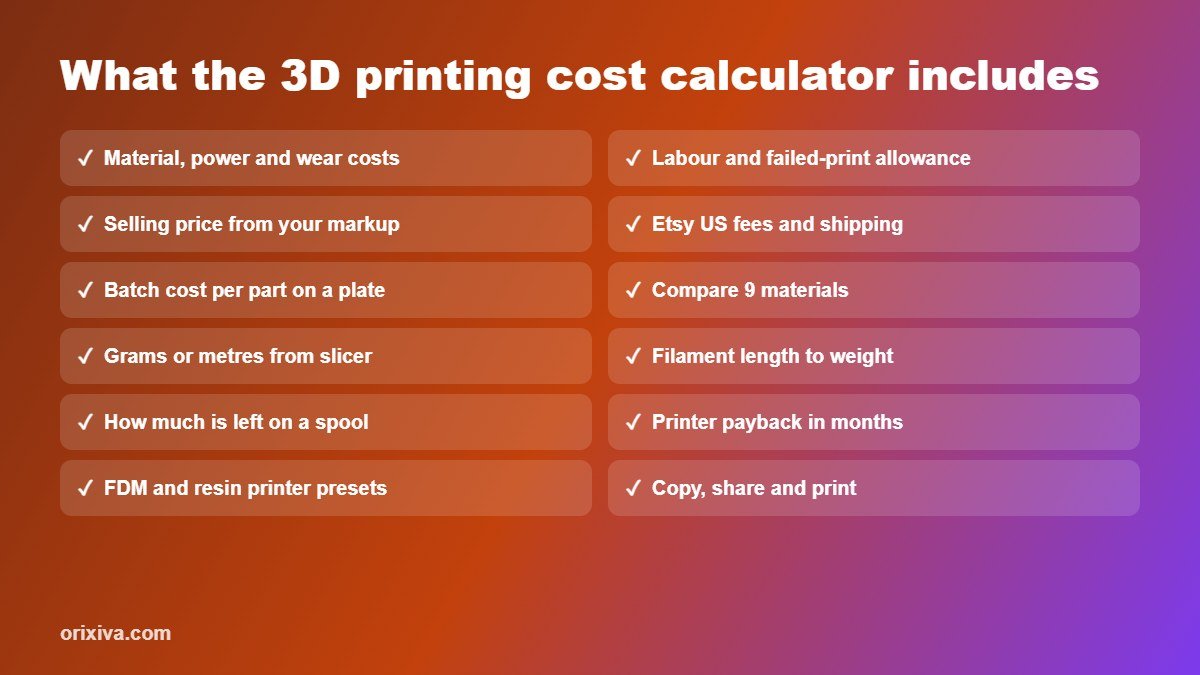
Most filament calculators only multiply grams by price. This 3D printing cost calculator counts everything that really goes into a print, so hobbyists know what their hobby costs and sellers know what to charge.
| Tool | What it does |
|---|---|
| Cost per print | Material, electricity, printer wear, maintenance, labour, extras and failed-print allowance, with a full cost breakdown. |
| Selling price | Works backwards from your profit goal to a price per item, including Etsy fees or your own marketplace fees and shipping. |
| Batch & plate | Cost per part when you print several parts on one plate, and how much that saves versus printing them one at a time. |
| Compare materials | The same model in PLA, PETG, ABS, ASA, TPU, nylon, PC, PLA-CF and resin, adjusted for each material's density. |
| Filament tools & ROI | Filament length to weight, how much is left on a spool, and how many months it takes a printer to pay for itself. |
How to calculate 3D printing cost
Each part of the cost has a simple formula. The calculator adds them together for you:
- Material: grams used × (spool price ÷ spool weight). Add a few percent for purge lines, brims and supports.
- Electricity: average watts × print hours ÷ 1,000 × your price per kWh.
- Printer wear: printer price ÷ expected lifetime hours × print hours.
- Maintenance: a small cost per hour for nozzles, belts, build plates or resin vat film.
- Labour: hands-on minutes ÷ 60 × your hourly rate, for slicing, removal and cleanup.
- Failed prints: if 5% of prints fail, every good print has to cover the material, power and wear of the failures.
If your slicer shows filament length instead of grams, switch the calculator to metres. For 1.75 mm PLA, one metre weighs about 2.98 g, so a 1 kg spool holds roughly 335 m.
Worked example: an 85 g PLA print
Here is the default example in the calculator: 85 g of PLA from a $20 spool, 5% waste, a 6.5-hour print on a 120 W printer at $0.17 per kWh, a $600 printer expected to last 5,000 hours, and 15 minutes of work at $15 an hour.
| Cost part | Amount |
|---|---|
| Material (89.3 g of PLA) | $1.79 |
| Electricity (0.78 kWh) | $0.13 |
| Printer wear (6.5 h × $0.12) | $0.78 |
| Maintenance | $0.33 |
| Labour (15 minutes) | $3.75 |
| Extras and failed-print allowance | $0.66 |
| Total cost per print | $7.43 |
The filament is only about a quarter of the real cost. Labour is half of it, which is why batching several parts on one plate makes such a difference for sellers.
How much electricity does a 3D printer use?
An FDM printer draws a lot of power for a few minutes while the bed and nozzle heat up, then settles to roughly 100 to 150 watts while printing. Resin printers are lower and steadier, typically around 30 to 60 watts. At 120 W, a 10-hour print uses 1.2 kWh, which costs about $0.24 at $0.20 per kWh. Electricity is usually one of the smallest costs, but it adds up for long prints, enclosed printers with heated chambers and expensive power. For an exact figure, plug your printer into an energy meter for one full print and type the average into the calculator.
How to price 3D prints
A common rule is to charge at least double your full cost (100% markup), then adjust for design time, demand and competition. The Selling price tab does the maths backwards: you choose the markup and it finds the price that leaves you that profit after fees and shipping.
If you sell on Etsy in the US, the calculator includes the main fees as of mid-2026: a $0.20 listing fee per item, a 6.5% transaction fee on the item price plus shipping, and 3% + $0.25 payment processing. Sales that come through Etsy's Offsite Ads carry an extra 15% fee (12% for shops above $10,000 a year), capped at $100 per order. On our example, a 100% markup needs a price of about $15.36 on your own site but about $18.00 on Etsy to keep the same $7.43 profit with $5 shipping. Fees vary by country, so check Etsy's fee page for your shop.
How to use the 3D printing cost calculator
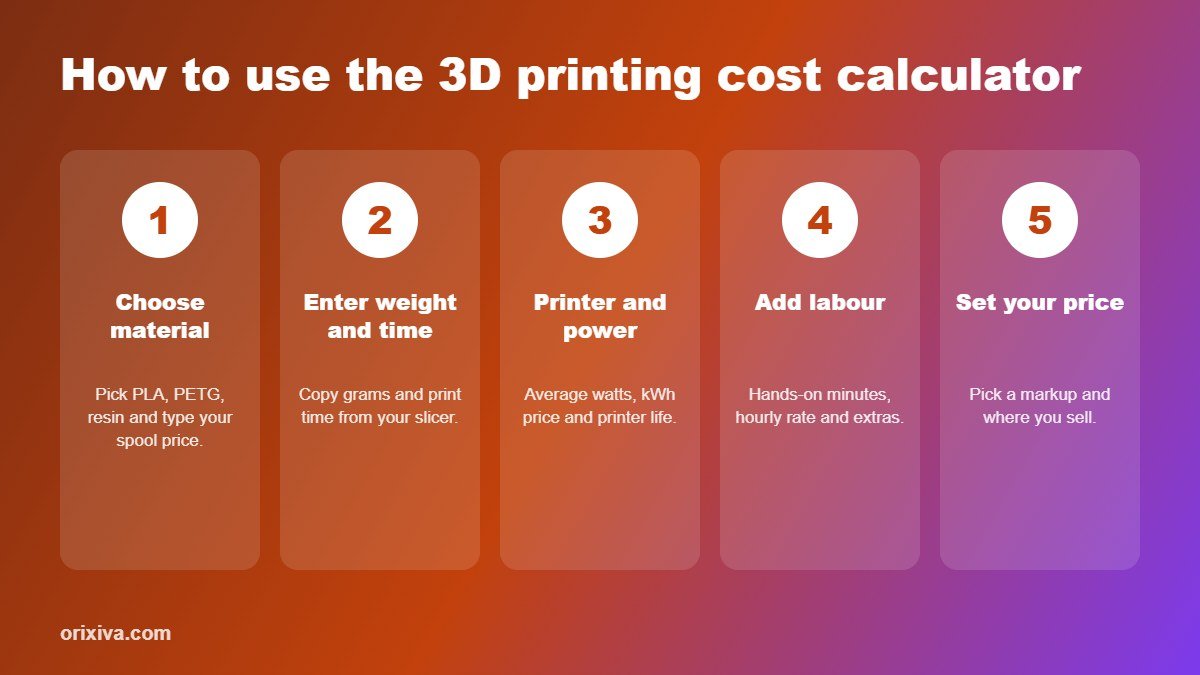
- Choose the material. Pick PLA, PETG, ABS, resin or another material and type what you paid for the spool or bottle.
- Enter weight and time. Copy the grams (or metres) and the print time from your slicer, plus waste and failure rates.
- Set printer and power. Pick a printer type or type its average watts, your electricity price, printer price and expected life.
- Add labour and extras. Enter your hands-on minutes, hourly rate and any parts like magnets or inserts.
- Set your price. Open the Selling price tab, choose your markup and where you sell, and copy the result.
Ways to lower your cost per print
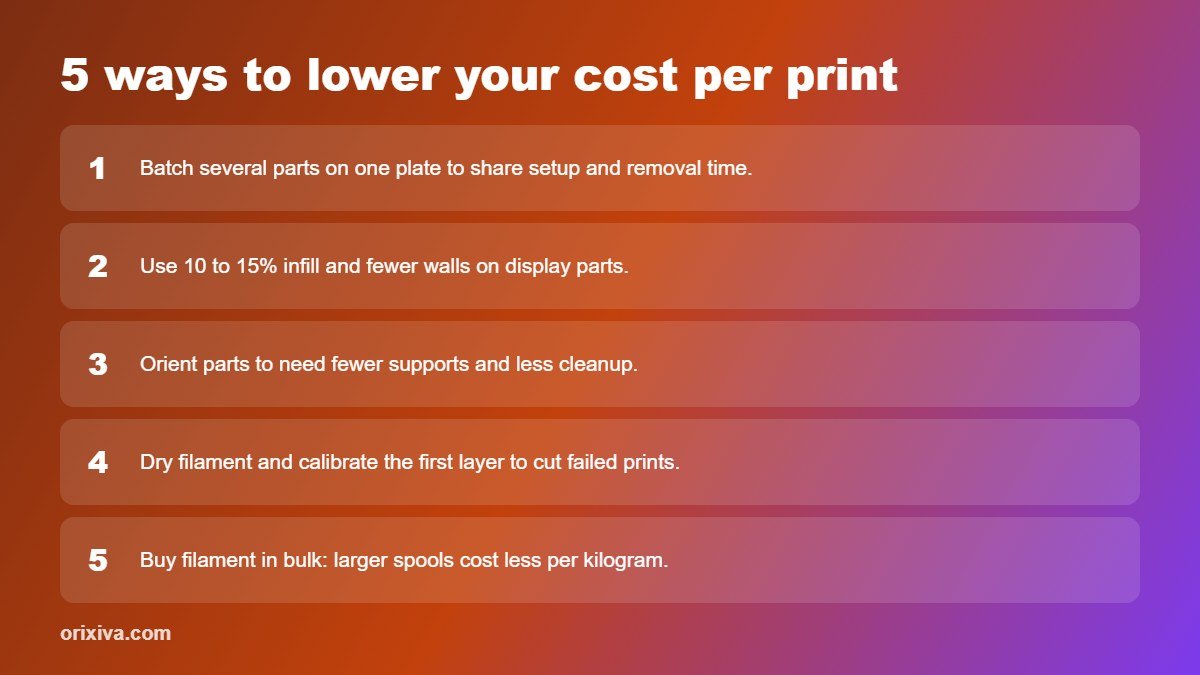
- Batch parts on one plate. Setup and removal happen once for the whole plate, so labour per part drops sharply.
- Reduce infill and walls where strength is not needed. 10 to 15% infill is enough for most display parts.
- Orient parts to need fewer supports. Supports waste filament and add cleanup time.
- Cut failed prints. Dry your filament, calibrate the first layer and keep the bed clean.
- Buy filament in bulk. Larger spools and multi-packs usually cost less per kilogram.
- Print more hours. Printer wear per hour falls when the same machine runs more prints.
Glossary
- FDM
- Fused deposition modelling: printing with melted plastic filament.
- MSLA / resin
- Printing with liquid resin hardened by UV light from a screen.
- Infill
- The internal pattern inside a print. Lower infill uses less material.
- Purge and brim
- Extra filament used to prime the nozzle or help parts stick to the bed.
- Markup
- Profit as a percentage of cost. 100% markup means price is double the cost.
- Margin
- Profit as a percentage of the selling price.
Privacy and accuracy
The 3D printing cost calculator runs entirely in your browser. Your prices and numbers are not sent to Orixiva.
Material densities are typical published values, and the prices per kilogram in the comparison table are examples you can edit. Printer power figures are typical averages; measuring your own printer gives the best result. Etsy fees were checked against 2026 fee guides and can change, so confirm on Etsy before setting prices. Results are estimates for planning and pricing.
Related free tools
Selling what you print? These Orixiva pages help with the rest of the business.
- Dimensional Weight Calculator for shipping box sizes and carrier billing.
- Business Calculator for margin, break-even and pricing.
- Electrical Calculator for power and energy use.
- Barcode Generator for product labels.
- Unit Converter for grams, metres and more.
- All free calculators in one place.
Share your feedback
What does your average print really cost, and was it more than you expected? Tell other makers in the comments, or suggest a feature we should add. Comments are reviewed before they appear.
Frequently asked questions
How do you calculate the cost of a 3D print?
Add material cost (grams used × spool price ÷ spool weight), electricity (watts × hours ÷ 1,000 × price per kWh), printer wear (printer price ÷ lifetime hours × print hours), maintenance, labour and extras, then add an allowance for failed prints. The calculator above does all of this from your slicer numbers.
How much does 1 gram of PLA filament cost?
Divide the spool price by its weight in grams. A $20 spool of 1 kg costs $0.02 per gram, so a 100 g print uses about $2 of filament. Premium or speciality filaments can cost $0.04 to $0.10 per gram.
How much electricity does a 3D printer use?
Most FDM printers average about 100 to 150 watts while printing, with short peaks while heating. Resin printers usually use 30 to 60 watts. A 10-hour print at 120 W uses 1.2 kWh, which costs about $0.24 at $0.20 per kWh.
How should I price 3D prints to sell?
Work out the full cost per print first, including labour and printer wear, then add a markup. Many sellers charge at least double their cost (100% markup) and add more for design work. The Selling price tab finds the price that keeps your profit after marketplace fees and shipping.
What fees does Etsy charge on 3D printed items?
For US sellers in 2026 the main fees are a $0.20 listing fee per item, a 6.5% transaction fee on the item price and shipping, and payment processing of 3% plus $0.25. Orders from Etsy Offsite Ads add 15% (12% for larger shops), capped at $100. Fees vary by country and can change.
How do I convert filament metres to grams?
Multiply the filament's cross-section area by the length and the material density. For 1.75 mm PLA (1.24 g/cm³), one metre weighs about 2.98 g. The Filament tools tab converts length and weight for any diameter and material.
Is resin printing more expensive than FDM?
Usually yes per part. Resin often costs $25 to $50 per litre and needs isopropyl alcohol, gloves and replacement vat film, while PLA is around $15 to $25 per kilogram. Resin printers use less electricity, but material and consumables usually make resin prints cost more.
Is this 3D printing cost calculator free and private?
Yes. It is free, needs no sign-up and runs entirely in your browser. Your prices and numbers are not sent to Orixiva.
Ready to price your next print? Scroll up to the 3D printing cost calculator, enter your slicer numbers and see your real cost and selling price.