Try our free AI tools – no sign-up needed!

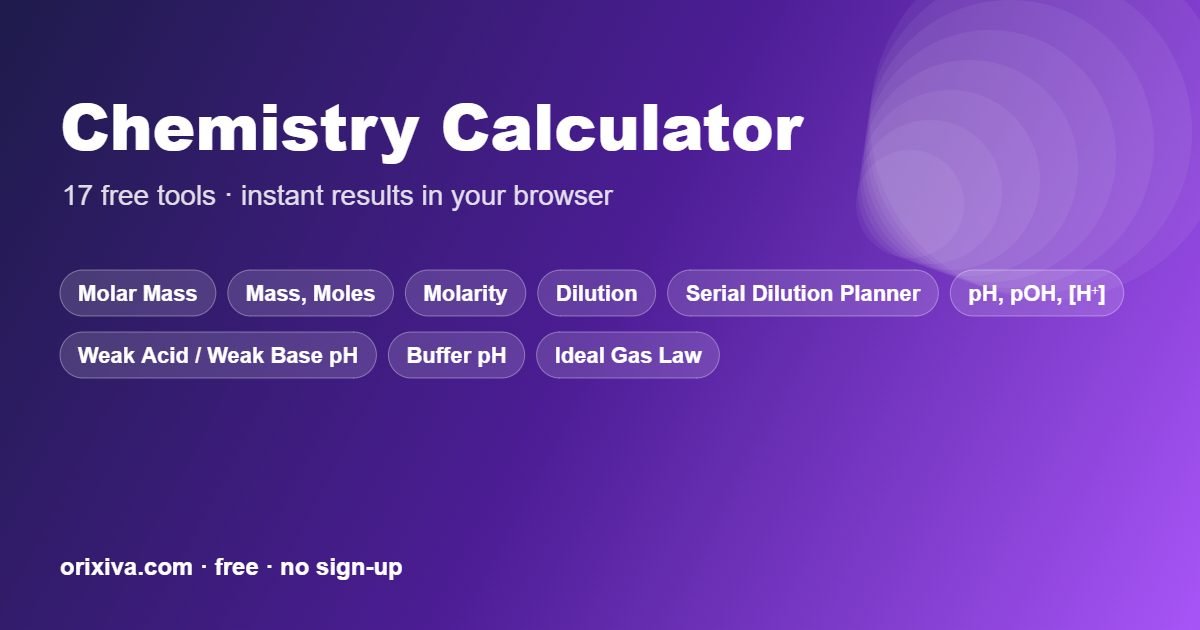
Quick answer: To use the chemistry calculator, pick one of the 17 tools in the menu above, enter your values with the right units and press Calculate. The result appears with notes, and you can copy or print it.
- 17calculators
- 0sign-ups needed
- 100%in your browser
- Freeforever
What the chemistry calculator includes
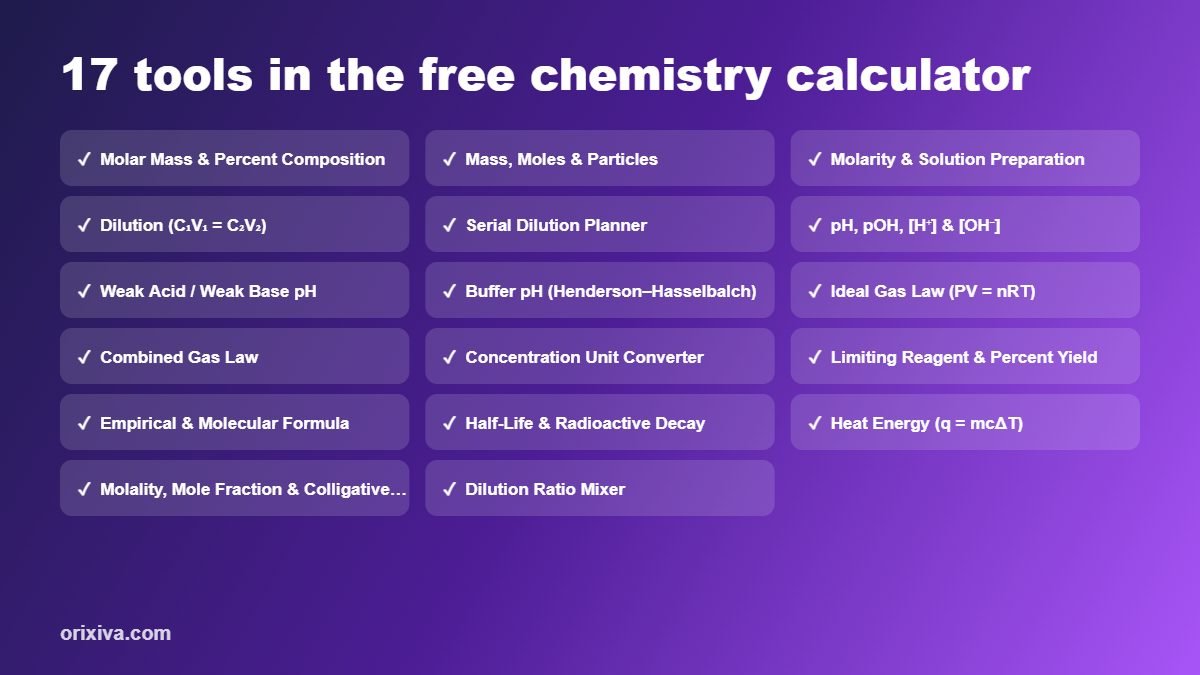
The chemistry calculator contains 17 separate tools. Choose one from the menu at the top of the page; each tool keeps its own inputs and explains the formula it uses.
| Calculator | What it does |
|---|---|
| Molar Mass & Percent Composition | Parse any formula (brackets, hydrates) for molar mass and mass percent of each element. |
| Mass, Moles & Particles | Convert grams ↔ moles ↔ particles ↔ gas volume at STP. |
| Molarity & Solution Preparation | Mass to weigh out, molarity from mass, or volume needed – with any units. |
| Dilution (C₁V₁ = C₂V₂) | Solve for any one of C₁, V₁, C₂ or V₂ and get the diluent volume. |
| Serial Dilution Planner | Concentration at each step of a serial dilution with transfer volumes. |
| pH, pOH, [H⁺] & [OH⁻] | Convert between pH, pOH and ion concentrations at a chosen temperature. |
| Weak Acid / Weak Base pH | Exact pH from Ka or Kb (quadratic solution) and percent ionisation. |
| Buffer pH (Henderson–Hasselbalch) | Buffer pH from pKa and concentrations, or the base/acid ratio for a target pH. |
| Ideal Gas Law (PV = nRT) | Solve for pressure, volume, moles or temperature with unit choices and gas density. |
| Combined Gas Law | P₁V₁/T₁ = P₂V₂/T₂ – solve for the final pressure, volume or temperature. |
| Concentration Unit Converter | Convert between ppm, ppb, mg/L, g/L, % w/v and molarity. |
| Limiting Reagent & Percent Yield | Find the limiting reactant, theoretical yield, excess left over and percent yield. |
| Empirical & Molecular Formula | Formula from percent composition (or masses), optionally scaled to a molar mass. |
| Half-Life & Radioactive Decay | Remaining amount, time to decay, decay constant and a decay curve. |
| Heat Energy (q = mcΔT) | Heat to warm or cool a substance, with built-in specific heats and phase change. |
| Molality, Mole Fraction & Colligative Properties | Molality, mole fraction, mass %, boiling point elevation and freezing point depression. |
| Dilution Ratio Mixer | Concentrate and water needed for a ratio like 1:4 or a target strength. |
How to use the chemistry calculator
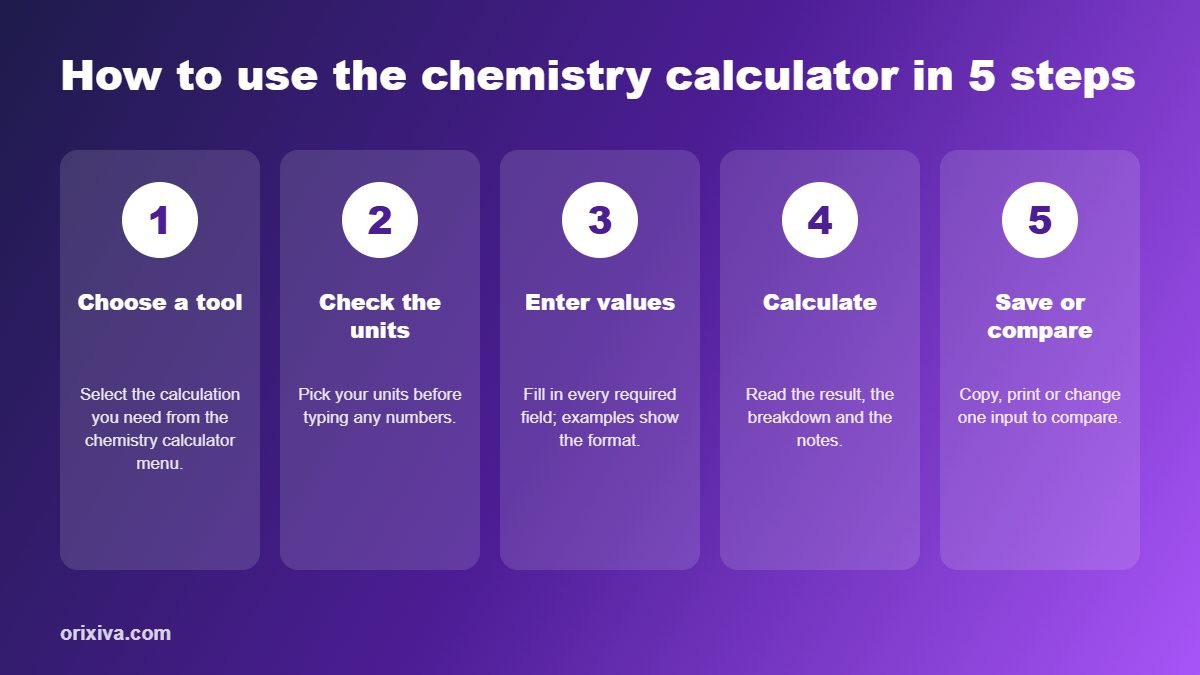
- Choose a tool. Select the calculation you need from the chemistry calculator menu.
- Check the units. Pick the units you are working in before typing numbers, so the formula uses the right values.
- Enter your values. Fill in every required field. Example values show the expected format.
- Calculate and review. Read the main result, the breakdown and any notes or charts under it.
- Save or compare. Copy, print or download the result, or change one input to compare scenarios.
Who uses this chemistry calculator?
- High school and university chemistry students.
- Lab technicians preparing solutions and dilutions.
- Teachers creating worked examples.
- Pharmacy, biology and food science students.
- Home brewers, gardeners and hobbyists mixing solutions.
Tips for accurate results with the chemistry calculator
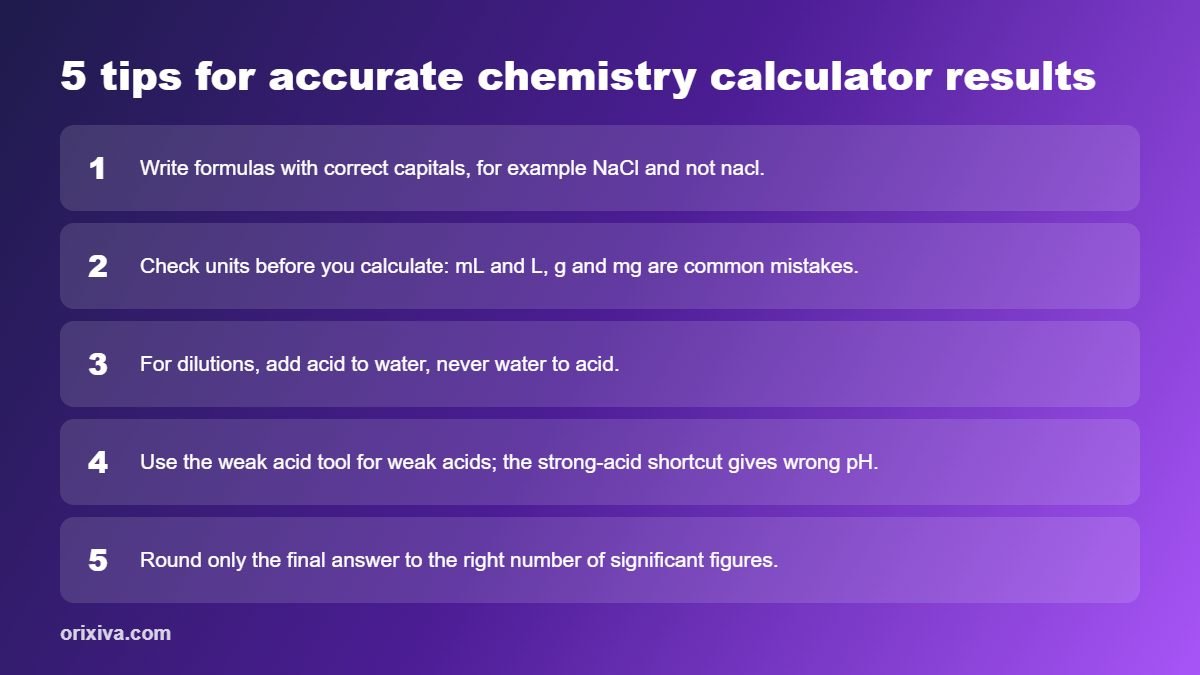
- Write formulas with correct capitals, for example NaCl and not nacl.
- Check units before you calculate: mL and L, g and mg are common mistakes.
- For dilutions, add acid to water, never water to acid.
- Use the weak acid tool for weak acids; the strong-acid shortcut gives wrong pH.
- Round only the final answer to the right number of significant figures.
Chemistry calculator guide: constants, worked examples and lab tips
Every tool in this chemistry calculator rests on a handful of constants and a few core formulas. This section lists the values the calculator uses, then works through six problems step by step so you can see exactly how each answer is built and check your own working.
Constants used by the chemistry calculator
| Constant | Value | Used in |
|---|---|---|
| Avogadro constant | 6.022 × 10²³ per mol | Moles to particles |
| Gas constant R | 0.08206 L·atm/(mol·K) or 8.314 J/(mol·K) | Ideal gas law |
| Molar volume at STP (0 °C, 1 atm) | 22.41 L/mol | Gas volume from moles |
| Molar volume at 25 °C, 1 atm | 24.47 L/mol | Room-temperature gases |
| Water ion product Kw at 25 °C | 1.0 × 10⁻¹⁴ | pH and pOH |
| Specific heat of water | 4.184 J/(g·°C) | Heat energy |
| Absolute zero | 0 K = −273.15 °C | Gas laws |
Worked example 1: grams to particles
How many molecules are in 9.0 g of water? The molar mass of H₂O is 2(1.008) + 16.00 = 18.02 g/mol, so 9.0 g is 9.0 ÷ 18.02 = 0.499 mol. Multiply by Avogadro's constant: 0.499 × 6.022 × 10²³ = 3.01 × 10²³ molecules. Each molecule has three atoms, so there are about 9.0 × 10²³ atoms in total. The Mass, Moles & Particles tool does both steps at once.
Worked example 2: limiting reagent and percent yield
Hydrogen burns in oxygen: 2H₂ + O₂ → 2H₂O. You react 4.0 g of H₂ with 16.0 g of O₂.
- Moles: 4.0 ÷ 2.016 = 1.98 mol H₂ and 16.0 ÷ 32.00 = 0.500 mol O₂.
- Compare with the equation: 0.500 mol O₂ needs 1.00 mol H₂, and you have 1.98 mol, so oxygen runs out first. O₂ is the limiting reagent.
- Theoretical yield: 0.500 mol O₂ gives 1.00 mol H₂O, which is 18.02 g.
- Excess: 1.98 − 1.00 = 0.98 mol H₂, or about 2.0 g, is left over.
- Percent yield: if you collect 15.3 g of water, the yield is 15.3 ÷ 18.02 × 100 = 84.9%.
Worked example 3: empirical and molecular formula
A sugar is 40.0% carbon, 6.7% hydrogen and 53.3% oxygen by mass. In 100 g there are 40.0 ÷ 12.01 = 3.33 mol C, 6.7 ÷ 1.008 = 6.65 mol H and 53.3 ÷ 16.00 = 3.33 mol O. Dividing by the smallest value gives a ratio of 1 : 2 : 1, so the empirical formula is CH₂O with a mass of 30.03 g/mol. If the molar mass is 180 g/mol, the molecule is 180 ÷ 30.03 = 6 times larger: C₆H₁₂O₆, glucose.
Worked example 4: half-life
Iodine-131 has a half-life of about 8.02 days. After 24 days, three half-lives have passed, so 1/2 × 1/2 × 1/2 = 1/8 of the sample remains: 100 mg becomes 12.5 mg. For times that are not whole half-lives, the calculator uses N = N₀ × (1/2)^(t ÷ t½). Carbon-14, used in radiocarbon dating, has a half-life of about 5,730 years.
Worked example 5: heat energy
Heating 250 g of water from 20 °C to 80 °C takes q = m × c × ΔT = 250 × 4.184 × 60 = 62,760 J, or about 62.8 kJ. Boiling it away needs much more: the latent heat of vaporisation of water is about 2,260 J/g, so turning those 250 g into steam takes another 565 kJ. That is why the heat energy tool treats phase changes as a separate step.
Worked example 6: converting concentration units
Drinking water with 0.3 mg/L of fluoride contains 0.3 ppm, because in dilute water solutions 1 mg/L is about 1 ppm. As a molarity, that is 0.0003 g/L ÷ 19.00 g/mol = 1.6 × 10⁻⁵ M. A 0.9% w/v saline solution has 9 g of NaCl per litre, which is 9 ÷ 58.44 = 0.154 M.
Significant figures and rounding
Report an answer with the same number of significant figures as the least precise measurement you started with. If you weigh 2.5 g (two significant figures) and the volume is 250.0 mL (four), your molarity should have two significant figures. The chemistry calculator keeps full precision during each step and only rounds the final value, which avoids rounding errors building up in multi-step problems.
Which chemistry tool should you use?
Start from what you know and what you need. If you have a mass and need a count of particles or a gas volume, use Mass, Moles & Particles. If you need to make a solution from a solid, use Molarity & Solution Preparation; if you are starting from a stronger stock solution, use Dilution or the Serial Dilution Planner.
For acids, pick pH for strong acids and bases, Weak Acid / Weak Base when you know Ka or Kb, and Buffer pH when both the acid and its conjugate base are present. Gas questions with one set of conditions use the ideal gas law; questions where pressure, volume or temperature change use the combined gas law. Reactions with two starting amounts always need the limiting reagent tool before you can trust a yield.
Good lab practice
- Check the formula of the reagent bottle, including water of crystallisation, before you calculate a mass.
- Use volumetric flasks for solutions and pipettes for transfers in a dilution.
- Record temperature with gas measurements, since volume changes about 0.37% per degree near room temperature.
- Calibrate a pH meter with two or three buffer standards before you compare it with the calculated pH.
For official atomic weights and definitions, see the IUPAC periodic table of the elements.
Privacy and accuracy
The chemistry calculator runs entirely in your browser. Numbers you type are not sent to Orixiva or stored on a server.
Results use standard published formulas and are rounded for display. They are estimates for planning, study and everyday decisions; for legal, medical, engineering or financial decisions, confirm them with a qualified professional. For background reading, see the IUPAC Gold Book.
Related free calculators
Need a different kind of calculation? These pages work the same way as this chemistry calculator.
- Aviation Fuel Calculator for flight time, fuel burn and nautical units.
- Construction Calculator for concrete, paint, tiles and bricks.
- Date Calculator for days between dates and age.
- Financial Calculator for loans, interest and ROI.
- Unit Converter for 14 measurement types.
- All free calculators in one place.
Share your feedback
Which chemistry calculator tool did you use, and was the result what you expected? Tell other readers in the comments, or suggest a calculator we should add next. Comments are reviewed before they appear.
Frequently asked questions
Is this chemistry calculator free?
Yes. All 17 chemistry tools are free with no sign-up.
How do I calculate molar mass?
Type a formula such as CuSO4·5H2O in Molar Mass & Percent Composition. Brackets and hydrates are supported.
How do I make a solution of a given molarity?
Use Molarity & Solution Preparation: enter the target molarity, volume and molar mass to get the mass to weigh out.
How does the dilution calculator work?
It solves C₁V₁ = C₂V₂ for the missing value and shows how much diluent to add.
Can it calculate pH of a buffer?
Yes. Buffer pH uses the Henderson–Hasselbalch equation with pKa and concentrations.
Which gas laws are included?
The ideal gas law (PV = nRT) and the combined gas law, with unit choices.
How do I convert grams to moles?
Moles = mass in grams / molar mass. Mass, Moles & Particles also converts moles to particles with Avogadro's number (6.022 x 10^23) and to gas volume at STP.
How do I plan a serial dilution?
Enter the stock concentration, dilution factor, number of steps and final volume in the Serial Dilution Planner. It lists the concentration at each step and the volume to transfer.
How do I convert pH to hydrogen ion concentration?
[H+] = 10^-pH, and at 25 degrees C pOH = 14 - pH. The pH, pOH, [H+] & [OH-] tool converts between all four and lets you choose the temperature.
Why can I not use the strong acid formula for acetic acid?
Weak acids only partly ionise. The Weak Acid / Weak Base tool solves the equilibrium with Ka or Kb exactly (quadratic formula) and shows the percent ionisation.
How do I make a buffer of a target pH?
Use the Buffer pH tool in reverse: enter the pKa and target pH, and it gives the base-to-acid ratio from the Henderson-Hasselbalch equation, pH = pKa + log([A-]/[HA]).
What units does the ideal gas law tool accept?
Pressure in atm, kPa, bar, mmHg or psi, volume in L, mL or m3, and temperature in degrees C, F or kelvin. It converts everything to consistent units before solving PV = nRT.
How do I use the combined gas law?
Enter the starting pressure, volume and temperature and two of the final values; the tool solves P1V1/T1 = P2V2/T2 for the missing one. Temperatures must be absolute, which the tool handles for you.
How do I convert ppm to molarity?
In dilute water solutions 1 ppm is about 1 mg/L. Divide mg/L by 1,000 to get g/L, then by molar mass to get mol/L. The Concentration Unit Converter does this between ppm, ppb, mg/L, g/L, % w/v and molarity.
How do I find the limiting reagent?
Convert each reactant to moles and divide by its coefficient in the balanced equation; the smallest value is limiting. The tool also gives theoretical yield, leftover excess and percent yield.
How do I find an empirical formula from percentages?
Assume 100 g, convert each element's grams to moles, divide by the smallest number of moles and round to whole numbers. The tool can also scale the result to a molecular formula using the molar mass.
How do I calculate how much of a radioactive sample is left?
Remaining = initial x (1/2)^(time / half-life). Half-Life & Radioactive Decay also solves for time and the decay constant (ln 2 / half-life) and draws a decay curve.
How much heat does it take to warm water?
q = m x c x delta T. Warming 1 kg of water by 10 degrees C takes about 41.8 kJ (c = 4.18 J/g per degree C). The Heat Energy tool has built-in specific heats and can include melting or boiling.
What is the difference between molarity and molality?
Molarity is moles per litre of solution; molality is moles per kilogram of solvent and does not change with temperature. The Molality tool also calculates mole fraction and boiling point elevation and freezing point depression.
How do I mix a 1:4 dilution ratio?
A 1:4 ratio means 1 part concentrate to 4 parts water, 5 parts in total. For 500 mL that is 100 mL concentrate and 400 mL water. The Dilution Ratio Mixer works for any ratio or target strength.
How should I write chemical formulas?
Use correct capital letters (Co is cobalt, CO is carbon monoxide), brackets for groups such as Ca(OH)2, and a dot or asterisk for hydrates such as CuSO4.5H2O.
Can I use the results in a lab report?
Yes, as long as you show your working and round to the correct significant figures. Always check results against your course or lab method.
Is my data private?
Yes. All chemistry calculations run in your browser and nothing you type is uploaded.
Ready to calculate? Scroll up to the chemistry calculator, choose a tool and get your answer in seconds.