Try our free AI tools – no sign-up needed!


Quick answer: To use the aviation fuel calculator, pick one of the 7 tools in the menu above, enter your values with the right units and press Calculate. The result appears with notes, and you can copy or print it.
- 7calculators
- 0sign-ups needed
- 100%in your browser
- Freeforever
What the aviation fuel calculator includes
The aviation fuel calculator contains 7 separate tools. Choose one from the menu at the top of the page; each tool keeps its own inputs and explains the formula it uses.
| Calculator | What it does |
|---|---|
| Fuel Consumption | Trip fuel and cost from distance, speed and burn rate in L/h, gallons/h, kg/h or lb/h. |
| Flight Time | Flight time from distance and ground speed, with wind component. |
| Boat Speed | Hull speed and boat speed from distance and time in knots. |
| Nautical Converter | Convert nautical miles, kilometres, statute miles, metres and feet, and knots to km/h or mph. |
| ETA Calculator | Estimated time of arrival from departure time, distance and speed. |
| Fuel Reserve | Required fuel including reserve and contingency minutes or percentage. |
| Distance · Speed · Time | Solve for any one of distance, speed or time in aviation and marine units. |

How to use the aviation fuel calculator
- Choose a tool. Select the calculation you need from the aviation fuel calculator menu.
- Check the units. Pick the units you are working in before typing numbers, so the formula uses the right values.
- Enter your values. Fill in every required field. Example values show the expected format.
- Calculate and review. Read the main result, the breakdown and any notes or charts under it.
- Save or compare. Copy, print or download the result, or change one input to compare scenarios.

Who uses this aviation fuel calculator?
- Student and private pilots planning cross-country flights.
- Boat owners estimating fuel for a passage.
- Flight schools and instructors preparing exercises.
- Marine and aviation hobbyists.
- Anyone converting knots and nautical miles.
Tips for accurate results with the aviation fuel calculator
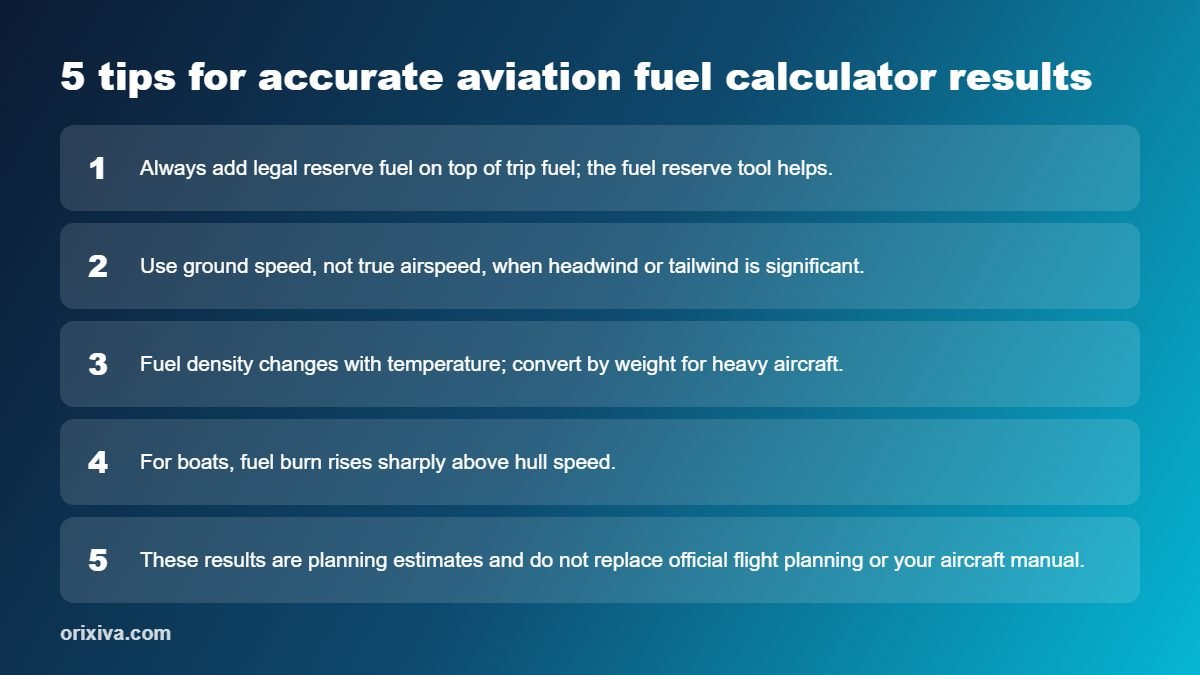
- Always add legal reserve fuel on top of trip fuel; the fuel reserve tool helps.
- Use ground speed, not true airspeed, when headwind or tailwind is significant.
- Fuel density changes with temperature; convert by weight for heavy aircraft.
- For boats, fuel burn rises sharply above hull speed.
- These results are planning estimates and do not replace official flight planning or your aircraft manual.
Aviation fuel calculator guide: formulas, units and worked examples
Pilots and skippers plan fuel the same way: work out how long the trip takes, multiply by how fast the engine burns fuel, then add a reserve. This guide explains each step behind the aviation fuel calculator, gives unit conversions and works through examples for an aircraft and a boat. It is a planning aid only; always follow your flight manual, vessel documentation and local rules.
The four core formulas
| What you need | Formula |
|---|---|
| Time | Distance ÷ Ground speed |
| Trip fuel | Time × Burn rate |
| Reserve fuel | Reserve time × Burn rate, or trip fuel × contingency % |
| Endurance | Usable fuel ÷ Burn rate |
| Hull speed (displacement boats) | 1.34 × √(waterline length in feet), in knots |
Fuel by volume and by weight
Small aircraft and boats plan fuel in litres or gallons, but aircraft performance depends on weight. Avgas weighs about 0.72 kg per litre (about 6 lb per US gallon) and Jet A about 0.80 kg per litre (about 6.7 lb per US gallon). Marine diesel is about 0.84 kg per litre and petrol about 0.74 kg per litre. Density falls as fuel warms, so a full tank on a hot day holds slightly less mass.
Worked example 1: light aircraft trip with wind
A trainer cruises at a true airspeed of 105 knots and burns 28 litres per hour. The trip is 180 nautical miles with a 15-knot headwind component.
- Ground speed: 105 − 15 = 90 knots.
- Time: 180 ÷ 90 = 2.0 hours.
- Trip fuel: 2.0 × 28 = 56 litres.
- Reserve: 45 minutes at 28 L/h = 21 litres.
- Taxi, climb and contingency: add about 10% of trip fuel, 5.6 litres, plus 3 litres for start and taxi.
- Total: 56 + 21 + 5.6 + 3 ≈ 86 litres, or about 62 kg of avgas.
The return leg with a 15-knot tailwind runs at 120 knots, takes 1.5 hours and needs only 42 litres of trip fuel. Wind changes time, and time changes fuel.
Worked example 2: endurance and range
With 120 litres of usable fuel and a burn of 28 L/h, endurance is 120 ÷ 28 = 4.3 hours. Keeping a 45-minute reserve leaves 3.5 hours of flying, which covers about 315 nautical miles at a ground speed of 90 knots, or 420 nautical miles at 120 knots.
Worked example 3: motor boat run
A planing boat cruises at 22 knots and burns 38 litres per hour. A 33 nautical mile run takes 1.5 hours and uses 57 litres each way, 114 litres for the round trip. Using the common rule of thirds, that should be no more than two thirds of what you carry, so plan for at least 171 litres on board. A 2-knot current against you on the way back adds about 10% to the time and fuel of that leg.
Worked example 4: hull speed
A displacement sailboat with a waterline length of 30 feet has a hull speed of about 1.34 × √30 = 7.3 knots. Pushing a displacement hull past that speed makes it climb its own bow wave, so fuel burn rises steeply for very little extra speed. Cruising at 6 knots instead of 7 can cut fuel use by a third or more.
Worked example 5: fuel cost
If avgas costs 2.80 per litre, the 86 litres in example 1 cost about 241. Jet A at 1.60 per litre for a turboprop burning 250 litres per hour costs 400 per flying hour in fuel alone. The fuel consumption tool shows cost per trip and per hour so you can compare routes and cruise settings.
Unit conversions used in fuel planning
- 1 nautical mile = 1.852 km = 1.1508 statute miles
- 1 knot = 1.852 km/h = 1.1508 mph
- 1 US gallon = 3.785 litres; 1 imperial gallon = 4.546 litres
- 1 kg = 2.2046 lb
- 1 foot = 0.3048 metres
Reserve rules at a glance
Under US rules, airplanes flying VFR need enough fuel to reach the first point of intended landing plus 30 minutes by day or 45 minutes at night. IFR flights need fuel to the destination, then to an alternate, plus 45 minutes. Other countries follow similar ICAO-based rules, and airlines add contingency and final reserve fuel by regulation. For boats there is no single legal rule in most places, which is why many skippers use the rule of thirds or keep at least 20% in reserve.
Planning tips
- Use your own measured burn rate at the power setting you actually fly or cruise at.
- Plan with forecast winds and currents, then update the plan on the day.
- Dip or sight-check tanks before departure instead of trusting the gauge alone.
- Write the planned fuel at each waypoint on your log and compare as you go.
The FAA Pilot's Handbook of Aeronautical Knowledge covers fuel planning, weight and balance and performance in more detail.
7 fuel planning mistakes the aviation fuel calculator helps you avoid
Most fuel problems in small aircraft and boats come from a few simple slips rather than hard maths. The aviation fuel calculator is built to catch them, but it helps to know what to look for.
- Mixing volume and weight. Fuel is sold in litres or gallons, but weight and balance uses pounds or kilograms. Avgas weighs about 6 lb per US gallon and Jet A about 6.7 lb per US gallon. Pick the right fuel type so the weight figure is correct.
- Planning with still-air time. A headwind lowers your ground speed and adds time, and time is what burns fuel. Always enter the wind or use ground speed, not true airspeed.
- Forgetting taxi and climb. Engines burn more fuel on the ground run and in the climb than in cruise. Add a fixed allowance for start, taxi and climb on every leg.
- Ignoring unusable fuel. Part of every tank cannot reach the engine. Subtract the unusable amount listed in the aircraft or boat manual before you work out endurance.
- Using the wrong gallon. An imperial gallon is about 1.2 US gallons. If your manual or fuel receipt is in imperial gallons, convert first.
- Treating the reserve as spare fuel. The reserve is for the unexpected, such as a diversion or a hold. Plan to land with it still in the tanks.
- Not rechecking in flight. Compare actual fuel used against the plan at each checkpoint. If burn is higher than planned, update the aviation fuel calculator with the real figure and decide early.
Quick check: one leg, start to finish
A light aircraft plans a 180 NM leg at 110 knots true airspeed with a 15 knot headwind. Ground speed is 95 knots, so the leg takes 180 ÷ 95 = about 1.89 hours (1 h 54 min). At 9 US gallons per hour that is about 17.1 gallons. Add 4.5 gallons for a 30-minute reserve and 1.5 gallons for taxi and climb, and the minimum fuel on board is about 23.1 US gallons, plus any unusable fuel.
Reserve rules depend on where and how you fly. In the United States, the FAA sets day VFR at 30 minutes and night VFR at 45 minutes in 14 CFR 91.151. Boaters often use the rule of thirds: one third out, one third back, one third in reserve. This aviation fuel calculator is a planning aid only; always follow your aircraft or boat manual and the rules that apply to you.
Privacy and accuracy
The aviation fuel calculator runs entirely in your browser. Numbers you type are not sent to Orixiva or stored on a server.
Results use standard published formulas and are rounded for display. They are estimates for planning, study and everyday decisions; for legal, medical, engineering or financial decisions, confirm them with a qualified professional. For background reading, see the Federal Aviation Administration.
Related free calculators
Need a different kind of calculation? These pages work the same way as this aviation fuel calculator.
- Statistics Calculator for t-tests, regression and probability.
- Chemistry Calculator for molarity, pH and gas laws.
- Cooking Calculator for recipes, cups to grams and baking.
- Electrical Calculator for Ohm’s law, wire size and physics.
- Fitness Calculator for BMI, TDEE and macros.
- All free calculators in one place.
Share your feedback
Which aviation fuel calculator tool did you use, and was the result what you expected? Tell other readers in the comments, or suggest a calculator we should add next. Comments are reviewed before they appear.
Frequently asked questions
Is this aviation fuel calculator free?
Yes. All seven aviation and marine tools are free with no sign-up.
How do I calculate fuel for a flight?
Enter distance, ground speed and fuel burn per hour. The calculator returns flight time and fuel needed; add reserve with the Fuel Reserve tool.
Can it convert knots to km/h?
Yes. The Nautical Converter converts knots to km/h, mph and m/s, and nautical miles to km and statute miles.
Does it work for boats?
Yes. Boat Speed, ETA and Fuel Consumption work for marine trips in knots and nautical miles.
Which fuel units are supported?
Litres, US gallons, imperial gallons, kilograms and pounds, with rates per hour.
Can I use it for official flight planning?
No. Use it for estimates and training. Always follow your aircraft manual and official procedures.
How does wind affect flight time?
A headwind lowers ground speed and a tailwind raises it. The Flight Time tool adds the wind component to true airspeed, so a 20-knot headwind turns 120 knots into 100 knots over the ground.
What fuel reserve should I plan?
In the US, VFR airplanes need at least 30 minutes of reserve by day and 45 minutes at night (14 CFR 91.151). The Fuel Reserve tool adds reserve and contingency by minutes or percentage.
What is hull speed?
For displacement boats, hull speed in knots is about 1.34 x the square root of the waterline length in feet. Fuel use rises sharply above it. The Boat Speed tool calculates it.
How do I convert nautical miles to kilometres?
One nautical mile is exactly 1.852 km and about 1.1508 statute miles; one knot is 1.852 km/h. The Nautical Converter handles distance and speed units.
How do I work out my arrival time?
Enter departure time, distance and speed in the ETA Calculator. It adds the trip time to your departure time and shows the arrival time.
How do I solve speed, distance or time?
Speed = distance / time. Enter any two values in the Distance · Speed · Time tool and it finds the third in aviation and marine units.
Can I calculate fuel cost too?
Yes. The Fuel Consumption tool multiplies trip fuel by your price per litre or gallon to give the cost of the trip.
How much does avgas weigh?
About 6 pounds per US gallon (0.72 kg per litre); Jet A is about 6.7 pounds per gallon. Convert by weight for weight and balance.
Does it work offline and on my phone?
It runs in your browser on phone, tablet or computer. Once the page has loaded, the calculations happen on your device.
Is my flight plan data stored?
No. Nothing you enter is sent to Orixiva or saved on a server.
Ready to calculate? Scroll up to the aviation fuel calculator, choose a tool and get your answer in seconds.