Try our free AI tools – no sign-up needed!

Free dimensional weight calculator for UPS, FedEx, USPS, DHL, Amazon FBA, air and sea freight with carrier comparison, box optimizer, CBM and pallet loading.
Quick answer: Dimensional weight = length × width × height ÷ the carrier's divisor. In inches and pounds, UPS, FedEx and USPS use 139; in centimetres and kilograms, DHL Express uses 5,000 and air cargo uses 6,000. You pay on whichever is higher, the actual weight or the dimensional weight. Enter your box in the dimensional weight calculator above to see your billable weight for every carrier at once.
- 8carrier rules
- 5tools in one page
- 20box types per shipment
- 0sign-ups needed
What the dimensional weight calculator includes
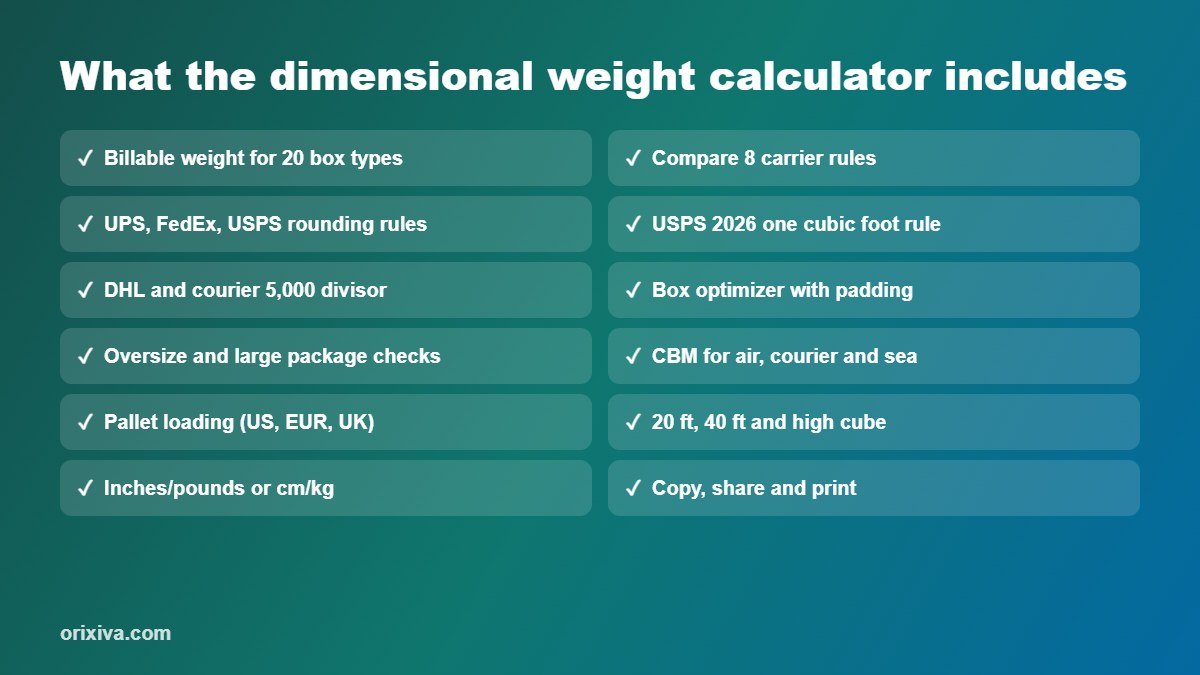
This dimensional weight calculator is built for online sellers, warehouse teams and anyone who ships boxes. It goes beyond a single formula and covers the whole journey of a parcel, from choosing the box to filling a container.
| Tool | What it does |
|---|---|
| Parcel DIM weight | Billable weight for up to 20 box types with quantities, using the exact rounding rules of the carrier you choose. Flags oversize and large-package limits. |
| Compare carriers | Runs the same packages through UPS, FedEx, USPS, DHL, Amazon FBA, courier and air freight rules side by side. |
| Box optimizer | Shows the break-even box volume for your product's weight and how each extra inch of padding changes the billable weight. |
| CBM & freight | Total cubic metres and chargeable weight for air freight, express courier and sea freight (LCL). |
| Pallet & container | How many cartons fit on a US, Euro or UK pallet, or in a 20 ft, 40 ft or 40 ft high cube container, with a to-scale layer drawing. |
What is dimensional weight?
Dimensional weight (also called DIM weight or volumetric weight) is a pricing method that charges for the space a package takes up, not just how heavy it is. A truck or plane fills up with large, light boxes long before it reaches its weight limit, so carriers turn a box's volume into a "weight" and bill you on that when it is higher than the scale weight.
The formula is the same everywhere; only the divisor changes:
dimensional weight = length × width × height ÷ divisor
The billable weight is the higher of the actual weight and the dimensional weight, after the carrier's rounding rules. That is the weight your shipping price is looked up on.
DIM divisors by carrier (October 2026)
| Carrier or service | Divisor | Rounding and rules |
|---|---|---|
| UPS (daily rates) | 139 in³/lb | Each side rounded up to the next inch, result rounded up to the next pound. |
| UPS (retail rates) | 166 in³/lb | Used at retail counters such as The UPS Store. |
| FedEx | 139 in³/lb | Domestic and international. Sides and weight round up. |
| USPS | 139 in³/lb | Only for packages over 1 cubic foot (1,728 in³) after rounding each side up. Changed on 12 July 2026. |
| DHL Express | 5,000 cm³/kg | Applies to all sizes. Weight is usually rounded up to the next 0.5 kg. |
| Amazon FBA (fees) | 139 in³/lb | Used for large standard and bulky size tiers when it is higher than unit weight. |
| Air freight (IATA) | 6,000 cm³/kg | About 167 kg per cubic metre. Some lanes use 5,000 or 7,000. |
| Sea freight (LCL) | 1 CBM = 1,000 kg | Charged per revenue ton: the greater of cubic metres or tonnes. |
Since 18 August 2025, UPS and FedEx round every fractional inch up to the next whole inch before applying the divisor, so a 12.1-inch side is billed as 13 inches. Negotiated contracts can use a different divisor, which you can enter with the Custom divisor option.
The USPS change in July 2026
On 12 July 2026 USPS lowered its dimensional weight divisor from 166 to 139 and started rounding every side up to the next whole inch, matching UPS and FedEx. The rule still only applies to packages larger than one cubic foot. The lower divisor alone raises the billable weight of DIM-priced parcels by about 19%, and the new rounding can push boxes that used to be just under one cubic foot over the line. Many online calculators still use the old 166 divisor; this one uses the current rule.
Worked examples
Example 1: a 16 × 12 × 8 inch box weighing 5 lb.
- Volume: 16 × 12 × 8 = 1,536 cubic inches.
- UPS or FedEx: 1,536 ÷ 139 = 11.05, rounded up to 12 lb. That is higher than 5 lb, so you pay for 12 lb.
- USPS: 1,536 in³ is under 1 cubic foot (1,728 in³), so USPS charges the actual weight of 5 lb.
Example 2: a 12.25-inch cube. With the 2026 USPS rule each side rounds up to 13 inches, so the billed volume is 13 × 13 × 13 = 2,197 in³. That is over 1 cubic foot, so the dimensional weight is 2,197 ÷ 139 = 15.8, billed as 16 lb, even if the box weighs much less.
How to use the dimensional weight calculator
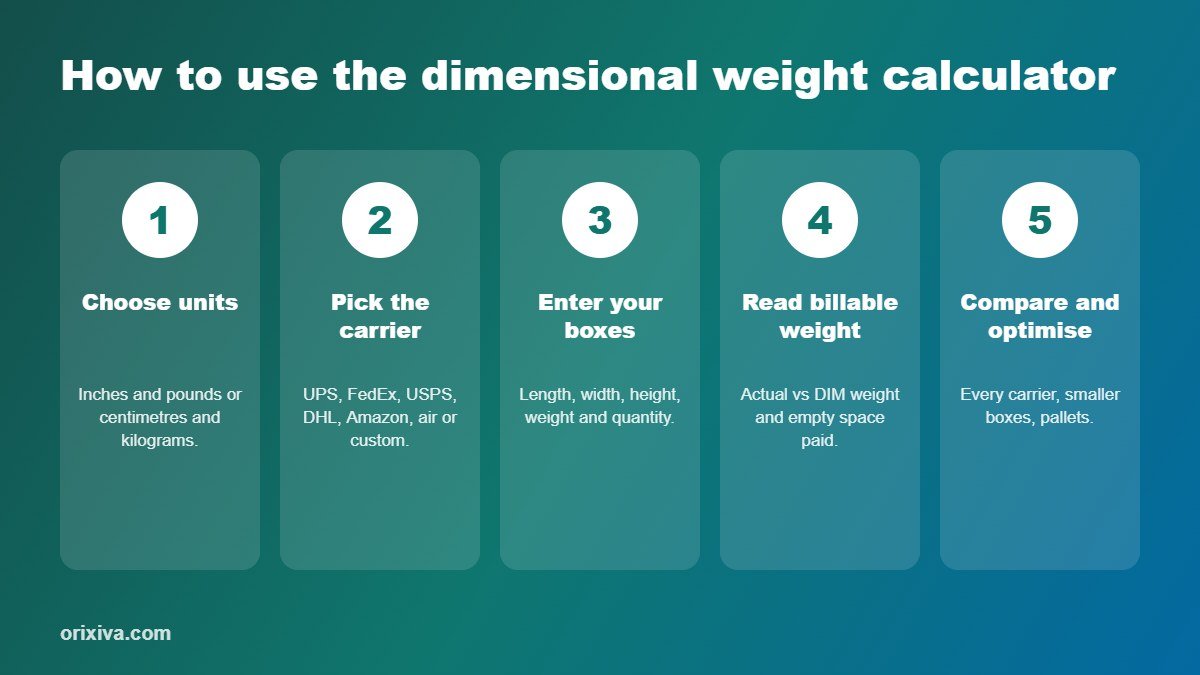
- Choose your units. Switch between inches and pounds or centimetres and kilograms; your numbers convert automatically.
- Pick the carrier. Select UPS, FedEx, USPS, DHL, Amazon FBA, a courier or air freight, or enter a custom divisor.
- Enter your boxes. Type length, width, height, weight and quantity. Add more box types for a mixed shipment.
- Read the billable weight. See actual versus DIM weight, how much you pay for empty space and any size warnings.
- Compare and optimise. Check every carrier, test smaller boxes in the optimizer, then plan pallets or containers.
How to lower your dimensional weight
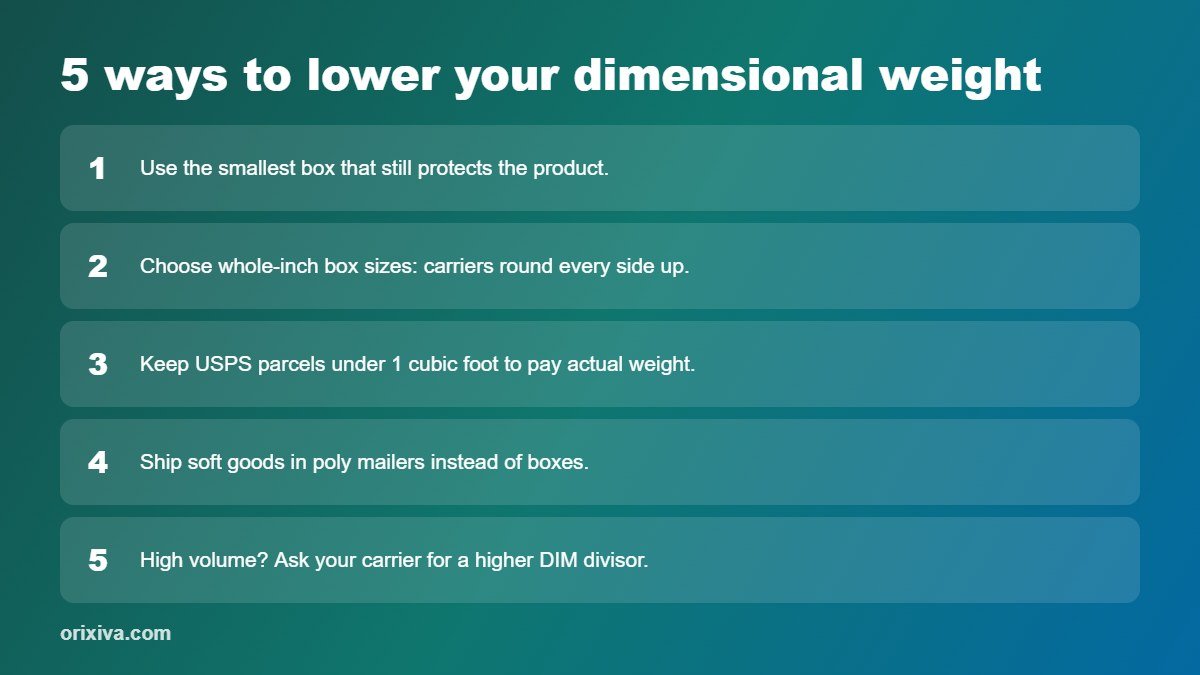
- Use the smallest box that protects the product. Every inch on each side adds volume fast. The box optimizer shows the exact cost of extra padding.
- Avoid fractions of an inch. UPS, FedEx and USPS round each side up, so a 12.1-inch box is billed as 13 inches. Choose box sizes in whole inches.
- Keep USPS parcels under 1 cubic foot. Up to 1,728 cubic inches after rounding, USPS charges actual weight only.
- Use poly mailers for soft goods. Clothing and textiles in mailers take up far less space than in boxes.
- Combine or split orders smartly. Two small boxes can sometimes cost less than one large, light box, and the reverse. Test both in the calculator.
- Ask about your divisor. High-volume shippers can often negotiate a higher divisor, which lowers dimensional weight.
CBM and freight shipping
For larger shipments, forwarders quote in cubic metres (CBM). One CBM is a space 1 m × 1 m × 1 m, about 35.3 cubic feet. In the CBM & freight tab, enter your carton size, weight and count to get total CBM and the chargeable weight for each mode:
- Air freight: carton volume in cm³ ÷ 6,000 per kg, compared with gross weight.
- Express courier: cm³ ÷ 5,000 per kg.
- Sea freight LCL: 1 CBM counts as 1,000 kg, and you pay on whichever is higher (weight or measure).
The Pallet & container tab then shows how many of those cartons fit on a pallet or in a container. As a rough guide, a 20 ft container holds about 33 m³ and a 40 ft high cube about 76 m³, so once an LCL shipment passes about 15 CBM it is worth asking for a full container quote.
Glossary
- DIM divisor
- The number a carrier divides package volume by to turn it into a weight.
- Billable weight
- The higher of actual and dimensional weight, after rounding. Your price is based on it.
- Length + girth
- Longest side plus twice the sum of the other two sides, used for size limits.
- CBM
- Cubic metre, the standard volume unit for freight.
- LCL
- Less than container load: your cargo shares a container with other shippers.
- W/M
- Weight or measure: sea freight is charged on the greater of tonnes or cubic metres.
Privacy and accuracy
The dimensional weight calculator runs entirely in your browser. Box sizes and weights you enter are not sent to Orixiva or any carrier.
Carrier rules were checked on 22 October 2026 from carrier announcements and shipping industry guides. Carriers can change divisors and surcharges, and account contracts often differ from published rules, so confirm with your carrier before you set shipping prices. Results show billable weight, not the final price, which also depends on zone, service level and surcharges. For official detail, see the UPS guide to dimensions and weight.
Related free tools
Running an online shop? These Orixiva pages help with the rest of your numbers.
- Business Calculator for margin, break-even and pricing.
- Unit Converter for length, weight and volume.
- Barcode Generator for EAN-13 and product labels.
- Construction Calculator for volume and materials.
- Financial Calculator for loans, interest and ROI.
- All free calculators in one place.
Share your feedback
Which carrier came out cheapest for your boxes? Tell other readers in the comments, or tell us which carrier or service we should add next. Comments are reviewed before they appear.
Frequently asked questions
How do you calculate dimensional weight?
Multiply length by width by height and divide by the carrier's divisor. In inches and pounds, UPS, FedEx and USPS use 139. In centimetres and kilograms, DHL Express uses 5,000 and air cargo uses 6,000. You pay on the higher of the dimensional weight and the actual weight.
What is the DIM divisor for UPS and FedEx in 2026?
Both use 139 cubic inches per pound for daily rates. UPS uses 166 at retail counters. Since 18 August 2025 both round each side up to the next whole inch before dividing.
Did USPS change its dimensional weight rules?
Yes. On 12 July 2026 USPS lowered its divisor from 166 to 139 and began rounding every side up to the next inch. Dimensional weight still only applies to packages larger than 1 cubic foot (1,728 cubic inches).
What is the volumetric weight formula in cm and kg?
Length × width × height in centimetres, divided by 5,000 for most express couriers such as DHL, or by 6,000 for standard air freight. The result is in kilograms.
What is billable or chargeable weight?
It is the weight your shipping price is based on: the higher of the actual weight and the dimensional weight, after the carrier's rounding rules.
How do I avoid paying dimensional weight?
Use the smallest box that protects the item, choose whole-inch box sizes, use poly mailers for soft goods and, for USPS, keep parcels at or under 1 cubic foot. The box optimizer tab shows the largest box you can use before DIM pricing starts.
How do I calculate CBM for a shipment?
Multiply carton length × width × height in metres, then multiply by the number of cartons. For example, 50 cartons of 60 × 40 × 40 cm is 0.096 × 50 = 4.8 CBM.
Is this dimensional weight calculator free?
Yes. It is free, needs no sign-up and runs entirely in your browser, so your box sizes are never uploaded.
Ready to check your boxes? Scroll up to the dimensional weight calculator, enter your package and see what every carrier will charge you for.