Try our free AI tools – no sign-up needed!


How Much Paint, Tiles or Concrete Do I Need? Easy Formulas and Examples
Planning a project? The free construction calculators work out paint, tiles, concrete and seven other materials, with waste and cost.
Jump to the free tool ↓Buy too little and the job stops halfway, with a second trip to the store and a colour or batch that may not match. Buy too much and money sits in the garage. Knowing how much paint, how many tiles and how much concrete you need comes down to three things: measuring correctly, using the right formula, and adding the right amount of waste.
Whether you are asking how much paint for one bedroom, how many tiles for a bathroom or how much concrete for a patio, this guide gives you the formulas in plain English, worked examples in metric and imperial units, and a quick way to check every number with the free Orixiva construction calculators, which run in your browser with no sign-up.
Key takeaways
- Paint: wall area minus doors and windows, divided by coverage, times the number of coats. Most wall paint covers roughly 10 m² per litre per coat.
- Tiles: floor area divided by the area of one tile plus its grout joint, then add 5–20% waste depending on the layout.
- Concrete: length × width × depth gives the wet volume; add 5–10% for waste and spillage.
- Always use the coverage and pack sizes printed on the product you will actually buy.
- Round up to whole tins, boxes and bags, and keep a little spare for repairs.
Before you calculate: how to measure a room
Every estimate is only as good as your measurements. Use a tape measure or laser measure and write everything down.
- Pick one unit system. Metres and centimetres, or feet and inches. Mixing them is the most common cause of wrong results.
- Measure wall lengths at floor level and the height from floor to ceiling.
- Note every opening: doors, windows, built-in cupboards. A standard door is about 2 m² (21 sq ft) and an average window 1–1.5 m².
- Split odd shapes into rectangles and triangles, calculate each, and add them up.
- Measure twice. A 10 cm error on every wall adds up quickly.
How much paint do I need?
To work out how much paint to buy, you need three parts: the area you will paint, how far a litre (or gallon) goes, and how many coats you need.
Wall area = room perimeter × wall height − doors − windows
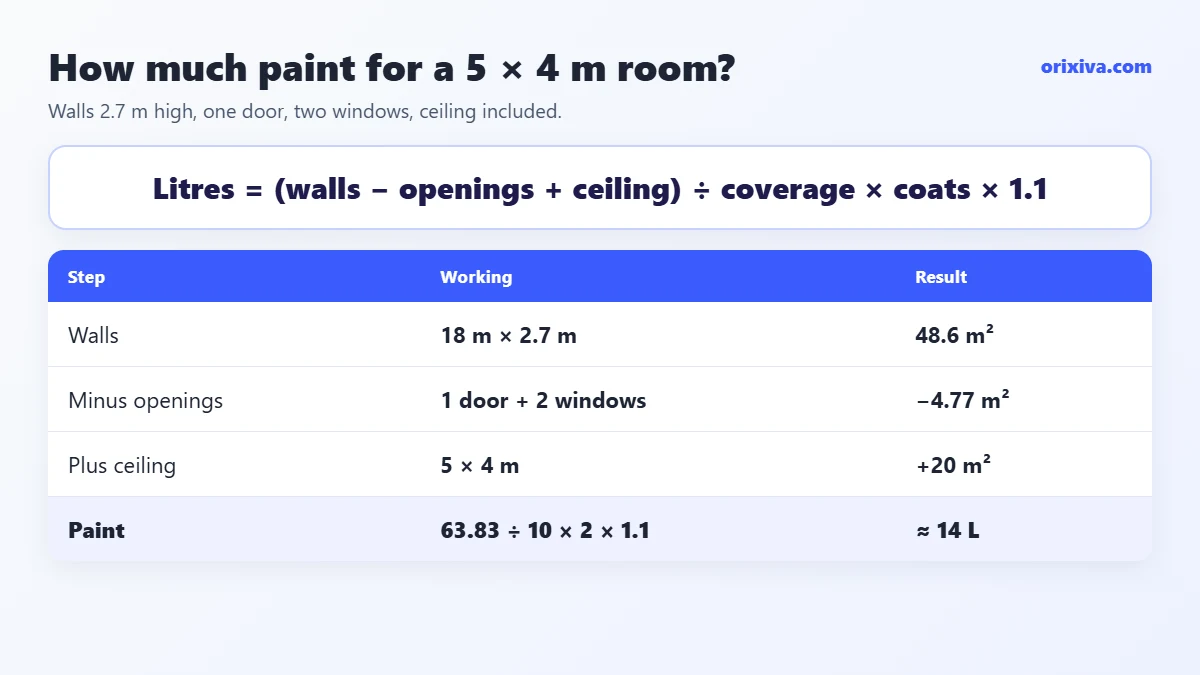
Litres = area ÷ coverage per litre × coats × (1 + extra %)
Litres = area ÷ coverage per litre × coats × (1 + extra %)
Worked example: a 5 × 4 m bedroom
- Perimeter: 5 + 4 + 5 + 4 = 18 m. Walls: 18 × 2.7 m = 48.6 m².
- Subtract one door (1.89 m²) and two windows (2 × 1.44 = 2.88 m²): 43.83 m² of wall.
- Add the ceiling: 5 × 4 = 20 m². Total: 63.83 m².
- At 10 m² per litre: 6.4 litres per coat. Two coats: 12.8 litres.
- Add 10% for waste and touch-ups: about 14 litres. Walls only would be about 9.6 litres.
So for this room you would buy three 5-litre tins for walls and ceiling together, or two 5-litre tins if the ceiling is a different colour and you buy that separately.
In feet and gallons
A gallon of interior paint typically covers about 350–400 sq ft per coat on smooth walls. A 12 × 12 ft room with 8 ft walls has 384 sq ft of wall; minus one door (21 sq ft) and one window (15 sq ft), that is 348 sq ft. Two coats need about 696 sq ft of coverage, roughly 2 gallons.
What changes the paint quantity
Surface
Textured walls and bare brick or concrete soak up more paint than smooth plaster. The calculator applies a surface factor for this.
Colour change
Going from dark to light usually needs a primer or an extra coat. New plaster almost always needs a mist coat or primer.
Product coverage
Coverage ranges widely between products. Use the number on the tin, not a general rule. Paint makers also publish coverage tools, such as the Behr paint calculator.
Method
Rollers on rough walls and sprayers use more paint than a brush on smooth plaster.
How many tiles do I need?
To work out how many tiles you need for a floor or wall, divide the floor (or wall) area by the area that one tile covers, including its grout joint, then add waste for cuts and breakage.
Tiles = area ÷ ((tile length + joint) × (tile width + joint)) × (1 + waste %)
Worked example: a 4.2 × 3.5 m floor with 60 × 60 cm tiles
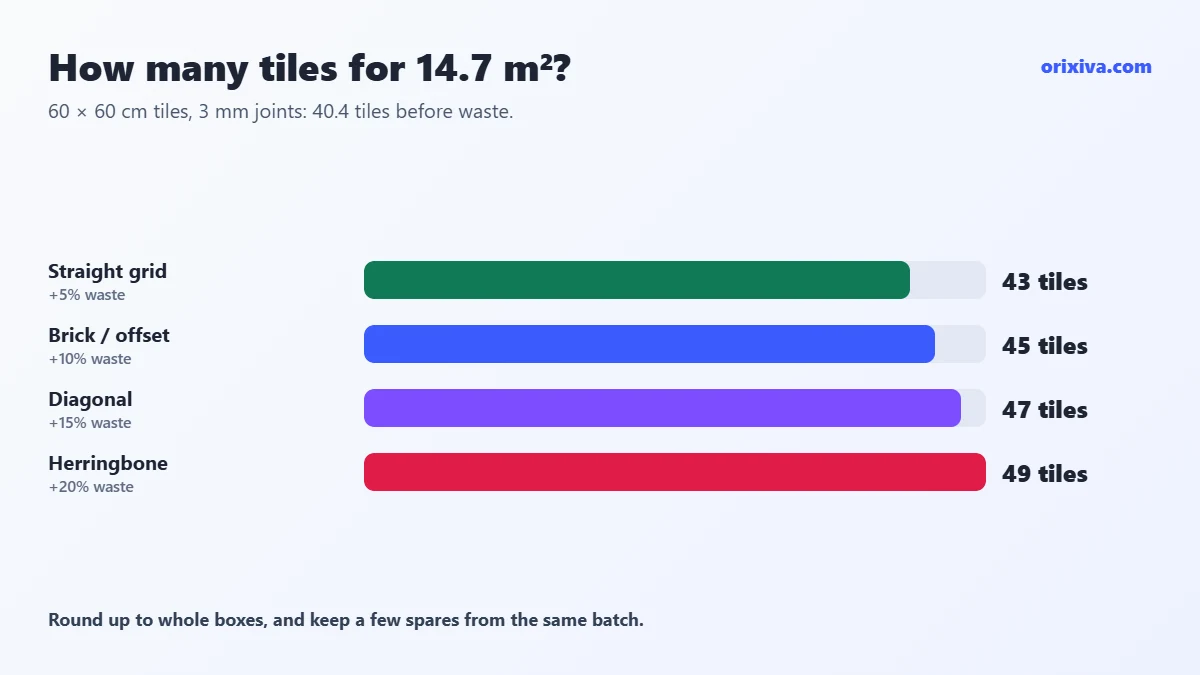
- Floor area: 4.2 × 3.5 = 14.7 m².
- One tile with a 3 mm joint covers 0.603 × 0.603 = 0.3636 m².
- Tiles before waste: 14.7 ÷ 0.3636 = 40.4.
- Straight layout (+5%): 42.5, so buy 43 tiles. Diagonal (+15%): 47 tiles.
Tiles come in boxes, so round up to whole boxes. If a box holds 4 tiles, 43 tiles means 11 boxes (44 tiles).
Waste by layout pattern
| Layout | Typical waste | Why |
|---|---|---|
| Straight grid | 5% | Cuts only at the edges |
| Brick / offset | 10% | Half tiles at the ends of rows |
| Diagonal | 15% | Triangle cuts along every wall |
| Herringbone | 20% | Many angled cuts |
Add a few percent more for an irregular room, natural stone or tiles you might need to replace later from the same batch.
Adhesive and grout
Adhesive depends on the trowel notch: roughly 3 kg/m² for a 6 mm notch up to about 6 kg/m² for a 12 mm notch with big tiles. For the 14.7 m² floor above with an 8 mm notch (about 4 kg/m²), that is roughly 59 kg of adhesive. Grout depends on the joint width and tile thickness; the calculator works it out for you in kilograms.
How much concrete do I need?
To know how much concrete to order, remember it is sold by volume: cubic metres (m³) or cubic yards. Multiply length × width × depth, using the same unit for all three.
Volume = length × width × thickness × number of pieces × (1 + waste %)
Worked example: a 5 × 3 m slab, 12 cm thick
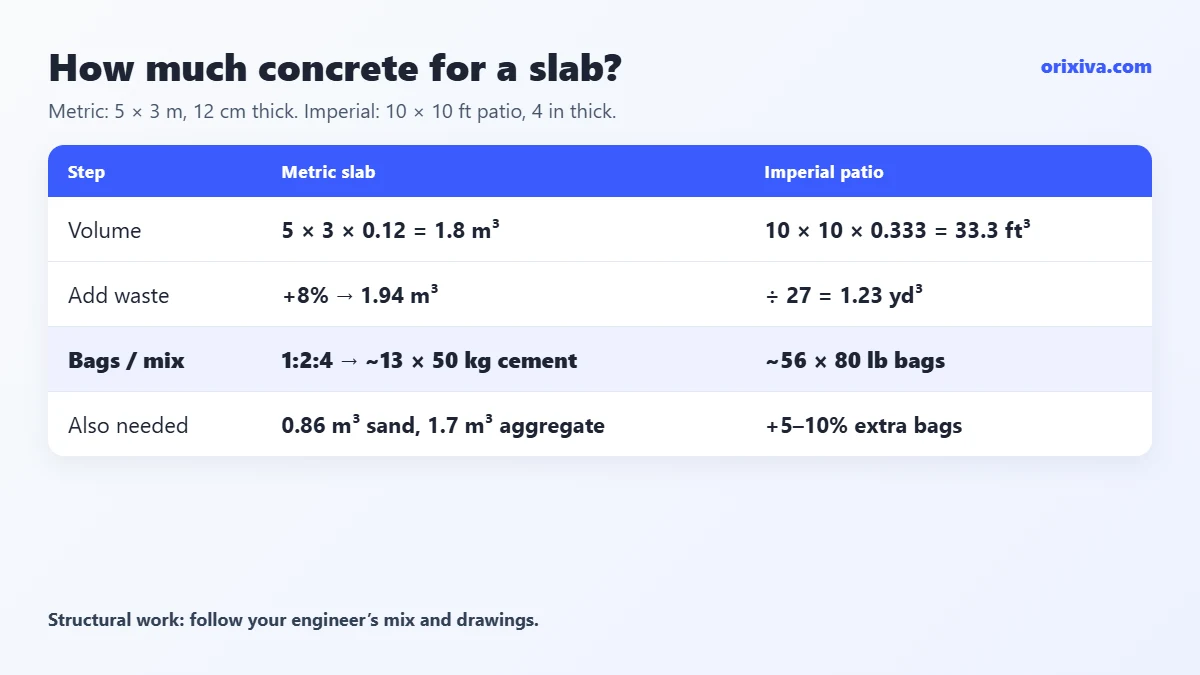
- Volume: 5 × 3 × 0.12 = 1.8 m³.
- Add 8% for waste and spillage: about 1.94 m³ of wet concrete.
- Mixing it yourself at 1 : 2 : 4 (cement : sand : aggregate)? The dry volume is about 1.54 × the wet volume, roughly 3.0 m³. That gives about 0.43 m³ of cement (around 13 bags of 50 kg), 0.86 m³ of sand and 1.7 m³ of aggregate.
In feet and yards: a 10 × 10 ft patio, 4 inches thick
- Volume: 10 × 10 × (4 ÷ 12) = 33.3 cubic feet.
- Divide by 27 to get cubic yards: 1.23 yd³.
- Bagged mix: an 80 lb bag makes about 0.6 cubic feet, so you need about 56 bags, plus 5–10% extra.
Structural work needs an engineerThese estimates help you budget and order. For footings, columns, retaining walls and anything load-bearing, follow your engineer’s drawings, the specified mix strength and your local building rules.
How much paint for a whole house?
For a whole home, work room by room and add the results. A quick check uses floor area: interior walls are often roughly 3 to 3.5 times the floor area of a room, before subtracting doors and windows. A 100 m² home might have around 300 m² of wall. At 10 m² per litre and two coats, that is about 60 litres for walls, plus ceilings if you paint them too.
Room-by-room is still more accurate, because hallways and small rooms have more wall per square metre of floor. In the calculator, use Identical rooms when several rooms share the same size, then add the different ones separately. Buy the same colour in one order, so all the tins come from the same batch.
How many tiles for bathroom walls?
Wall tiling works like a floor: measure each wall’s width and tiling height, multiply, add the walls together and subtract the bath, window and door. A bathroom with 9 m of wall tiled to 2.1 m has 18.9 m²; minus a 1.7 × 0.6 m bath side area that is not tiled (about 1 m²) and a 0.6 m² window, about 17.3 m². With 30 × 60 cm tiles and 2 mm joints, each tile covers about 0.1818 m², so you need 96 tiles before waste and about 105 with 10% for cuts around fittings. Enter the total in the calculator as a known area to see how many tiles and boxes to order.
How much concrete for posts and footings?
Round holes use the area of a circle: π × radius² × depth. A fence post hole 30 cm wide and 60 cm deep holds 3.1416 × 0.15² × 0.6 = 0.042 m³ (about 1.5 cubic feet). Subtract the post if it is thick, and multiply by the number of posts. For 12 posts, that is about 0.5 m³, or roughly 30 bags of 80 lb (36 kg) premix with a little extra. In the calculator, choose Round slab or pier base and set the number of identical pieces to answer how much concrete for many holes at once.
How to use the free construction calculator (step by step)
- Open the calculators. Go to the construction and home calculators and pick Paint Quantity, Tile Quantity & Waste or Concrete Volume from the menu.
- Choose units and currency. Select Metric (m, cm) or Imperial (ft, in), and your currency if you want a cost estimate.
- Enter your measurements. For paint: room length, width and wall height, doors, windows and the ceiling option. For tiles: floor size or total area, tile size, joint width and layout. For concrete: the shape (slab, round slab or column), sizes and thickness.
- Add product details. Coverage per litre, coats, surface type and primer for paint; tiles per box and adhesive bed for tiles; mix ratio and bag prices for concrete.
- Set waste. Keep the suggested waste or change it for your job.
- Calculate and review. Press Calculate. The result lists quantities, the working steps behind them, and the cost if you entered prices. Copy or print it for your shopping list.
The construction calculator shows how much paint, how many tiles and how much concrete in one place, and every calculation runs in your browser, with nothing uploaded or stored on a server.
How much extra should you buy?
Waste is not a mistake; it is part of every real job. Cuts, spills, breakages, uneven surfaces and future repairs all use material.
| Material | Typical extra | Keep a spare for |
|---|---|---|
| Paint | 10% | Touch-ups from the same batch |
| Floor and wall tiles | 5–20% by layout | Replacing a cracked tile years later |
| Concrete (ready-mix or bags) | 5–10% | Uneven ground and spillage |
| Flooring packs | 5–15% by layout | Damaged boards |
| Wallpaper | One extra roll | Pattern matching and mistakes |
When in doubt, ask the store about returns of unopened tins, boxes and bags. Many allow it, which makes buying a little extra low-risk.
7 more home project calculators in the same tool
The same page has ten calculators, so you can plan a whole renovation in one place:
- Flooring Pack Estimator: packs with layout waste, underlay, skirting and leftover.
- Wallpaper Rolls: rolls by the strip method with pattern repeat, openings and paste.
- Roof Pitch: angle, pitch, rafter length, roof area and a profile drawing.
- Stair Rise & Run: risers, going, angle and comfort checks with a drawing.
- Gravel / Aggregate Volume: volume, tonnes, truckloads and bags for driveways and paths.
- Brick Wall: bricks, mortar, cement bags and sand.
- Rebar / Steel Weight: reinforcement weight, mesh layouts, laps and stock bars.
Estimating the cost of your project
Add a price per litre, per tile or per bag in the calculator and it shows the material cost too. For a full budget, add up:
- materials from each calculator;
- tools and consumables (rollers, tape, trowels, spacers, mixer hire);
- delivery, especially for concrete, gravel and heavy tiles;
- labour, if you hire help;
- a contingency of about 10% for surprises.
Need help with the percentages? Our guide on how to calculate percentages covers adding 10% or working out discounts quickly.
Mistakes to avoid when estimating materials
Mixing units
Centimetres for tile size and metres for the room is fine in the calculator, but by hand it causes errors a hundred times too big. Convert everything first.
Forgetting the number of coats
Almost every paint job needs two coats. Estimating for one is the classic reason for a second shop visit.
Ignoring the grout joint
With small tiles, joints take up real space. Leaving them out overestimates the tiles slightly, while forgetting layout waste underestimates them badly.
Ordering concrete with zero spare
Ground is never perfectly flat. Running short while a slab is half poured is far more expensive than a small surplus.
Using general coverage numbers
Coverage, box sizes and bag yields vary by brand. Use the figures on the product label.
Your turn: How close was your last estimate: did you run short or end up with extra? Share the project and the numbers in the comments, and help other readers plan better.
Calculate your materials now, free
Work out paint, tiles, concrete and seven other materials with waste and cost, in metric or imperial. No sign-up, and nothing leaves your browser.
Open the free construction calculators → Looking for another calculator? Search on orixiva.comPaint, tile and concrete questions people often ask
How much paint do I need for a room?
Multiply the room perimeter by the wall height, subtract doors and windows, divide by the paint coverage per litre and multiply by the number of coats. A typical 5 × 4 m bedroom needs about 10 litres for two coats on the walls.
How much area does 1 litre of paint cover?
Often around 10 m² per coat on smooth walls, but it varies by product and surface. Check the coverage on the tin; textured and porous surfaces need more.
Do I need two coats of paint?
Usually yes, for even colour and durability. A big colour change or fresh plaster may need a primer as well.
How many tiles do I need for 10 square metres?
With 60 × 60 cm tiles and 3 mm joints, about 28 tiles before waste, so about 29–30 for a straight layout. Smaller tiles need many more; the calculator works it out for any size.
How much extra tile should I buy?
About 5% for a straight layout, 10% for offset, 15% for diagonal and 20% for herringbone, plus a few spares for future repairs.
How do I calculate concrete in cubic yards?
Multiply length × width × depth in feet to get cubic feet, then divide by 27. Add 5–10% for waste.
How many 80 lb bags of concrete make a cubic yard?
About 45, because each 80 lb bag yields roughly 0.6 cubic feet and a cubic yard is 27 cubic feet. Check the yield printed on your bag.
Does the calculator work in feet and inches?
Yes. Choose Imperial (ft, in) and enter your measurements; the results use the matching units.
Can the construction calculator estimate the cost?
Yes. Enter prices per litre, tile, bag or cubic metre and choose your currency; the result adds the material cost.
How much paint do I need for a ceiling?
Multiply the room length by the width for the ceiling area, divide by the coverage and multiply by the coats. A 5 × 4 m ceiling is 20 m², about 4 litres for two coats at 10 m² per litre.
How much concrete do I need for a 10 × 10 ft slab?
At 4 inches thick, about 33.3 cubic feet, which is 1.23 cubic yards or about 56 bags of 80 lb premix. Add 5–10% for waste.