Try our free AI tools – no sign-up needed!


How to Calculate GPA and Plan Your Study Week: 5 Easy Steps With Examples
Need the answer fast? The free GPA calculator and study planner do the maths and build your week for you. No sign-up.
Jump to the free tools ↓Your GPA decides scholarships, internships and sometimes which courses you can take next. Yet many students only find out how to calculate GPA when their transcript arrives. This guide shows the method step by step, with worked examples for a semester GPA, a cumulative GPA and the GPA you need next term. Then it shows how to turn that target into a realistic weekly study plan.
You can check every number with the free Orixiva Student & Teacher Toolkit, which includes a GPA calculator, a smart study planner, flashcards and 19 other tools, all in your browser.
Key takeaways
- GPA = total grade points ÷ total credit hours. Grade points = grade value × credits for each course.
- Cumulative GPA adds every term’s grade points and credits together; you cannot simply average the semester GPAs.
- To reach a target, work out the GPA you need next term. Sometimes the honest answer is that you need two terms, not one.
- A common guideline is 2–3 hours of study per credit hour each week. Plan it in short focus blocks.
- Grading scales differ between schools and countries, so always check your own university’s policy.
What is GPA and why do credit hours matter?
GPA (grade point average) turns all your course grades into one number, usually on a scale from 0 to 4.0. It is a weighted average: a 4-credit course counts twice as much as a 2-credit course, because it takes more of your time. That is why you cannot just add your grades and divide by the number of courses.
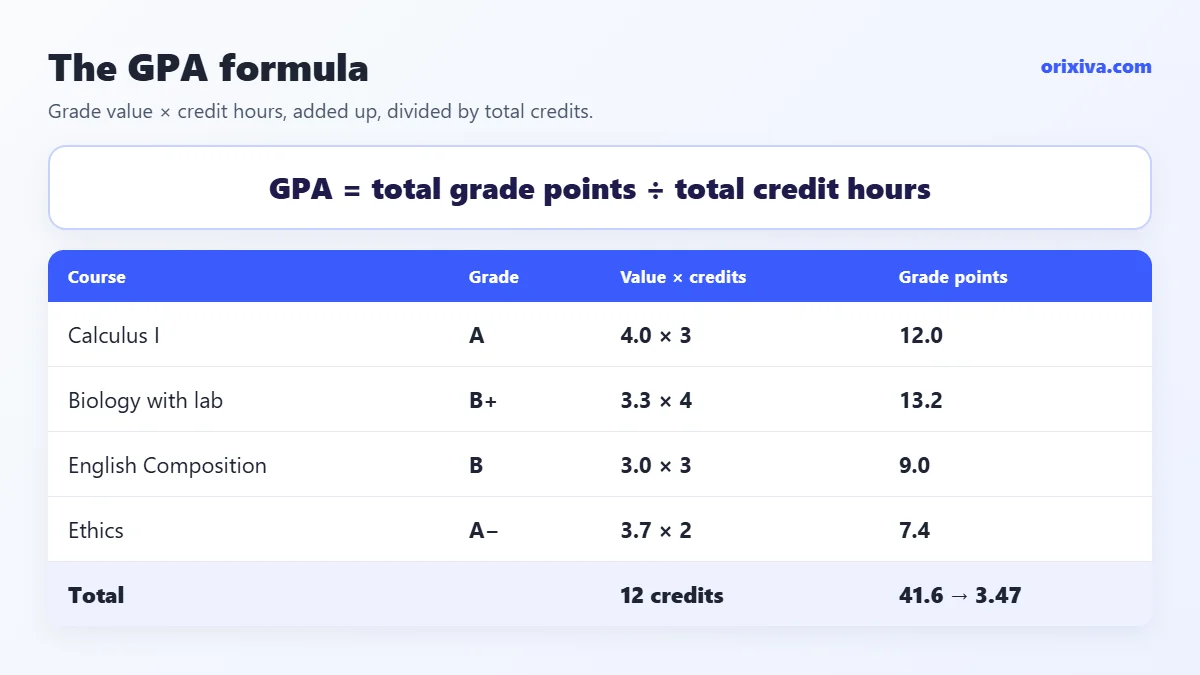
Each course gives you grade points: the value of your grade multiplied by the course’s credit hours. Your GPA is the total grade points divided by the total credit hours you attempted. Once you see it that way, learning how to calculate GPA takes about five minutes.
The 4.0 GPA scale most universities use
Many US and international universities use a scale like this one. Some give A+ a 4.3, and some do not use plus and minus grades at all, so treat this as a common example rather than a rule.
| Letter grade | Grade value | Typical percentage |
|---|---|---|
| A / A+ | 4.0 | 93–100% |
| A− | 3.7 | 90–92% |
| B+ | 3.3 | 87–89% |
| B | 3.0 | 83–86% |
| B− | 2.7 | 80–82% |
| C+ | 2.3 | 77–79% |
| C | 2.0 | 73–76% |
| D | 1.0 | 65–69% |
| F | 0.0 | Below 65% |
Other systems exist. Many universities in South Asia publish their own percentage-to-GPA tables, India often uses a 10-point CGPA, and the UK uses degree classifications. The toolkit’s GPA calculator can work from letter grades, percentages, or an HEC-style table used by many universities in Pakistan, but your official GPA always follows your university’s published scale. Ohio State University shows a clear official example of how a university calculates GPA.
How to calculate GPA in 5 steps
Here is how to calculate GPA for one semester by hand. The numbers come from the worked example below the steps.
- List your courses and credit hours. Take them from your transcript or course registration, not from memory. Credits are sometimes called units or credit points.
- Turn each grade into its grade value. Use your university’s scale. On the table above, a B+ is 3.3.
- Multiply value × credits for each course. This gives the grade points. A B+ in a 4-credit course is 3.3 × 4 = 13.2 grade points.
- Add up the grade points and the credits. Use only courses that count towards GPA. Pass/fail courses and withdrawals usually do not.
- Divide total points by total credits. Round to two decimals, as most transcripts do.
Worked example: one semester
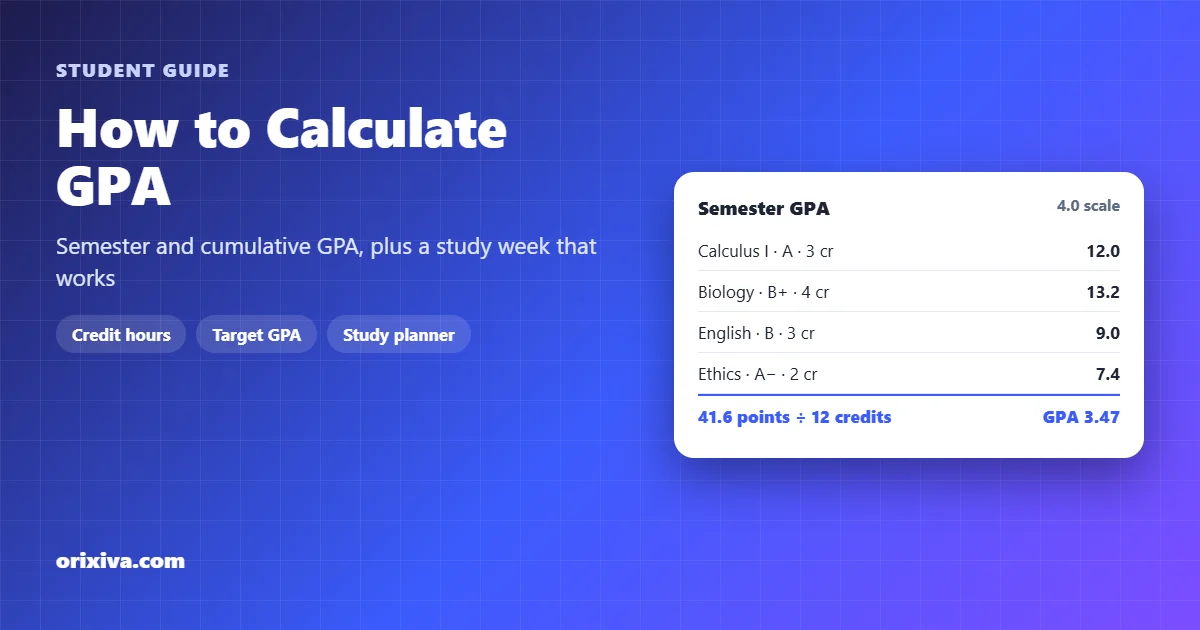
4 courses, 12 credit hours
4.0 scale4 courses, 12 credit hours
| Course | Grade | Value | Credits | Grade points |
|---|---|---|---|---|
| Calculus I | A | 4.0 | 3 | 12.0 |
| Biology with lab | B+ | 3.3 | 4 | 13.2 |
| English Composition | B | 3.0 | 3 | 9.0 |
| Ethics | A− | 3.7 | 2 | 7.4 |
| Total | 12 | 41.6 | ||
GPA = 41.6 ÷ 12 = 3.47. Averaging the four grade values instead would give 3.50, which is wrong because Ethics has fewer credits.
How to calculate cumulative GPA
Cumulative GPA covers every term so far. The mistake almost everyone makes is to average the semester GPAs. That only works when every semester had exactly the same number of credits. Use the totals instead:
Cumulative GPA = (old grade points + new grade points) ÷ (old credits + new credits)
ExampleBefore this semester you had a 3.10 GPA over 45 credits, which is 3.10 × 45 = 139.5 grade points. Add this semester’s 41.6 points and 12 credits: (139.5 + 41.6) ÷ (45 + 12) = 181.1 ÷ 57 = 3.18 cumulative GPA. A simple average of 3.10 and 3.47 would have given 3.29, which overstates it.
In the toolkit’s GPA calculator, enter your previous GPA and credits once, add the current courses, and it shows the semester and cumulative GPA side by side.
How to find the GPA you need next term
This is the most useful calculation for planning, and the one most students never do. Rearrange the cumulative formula:
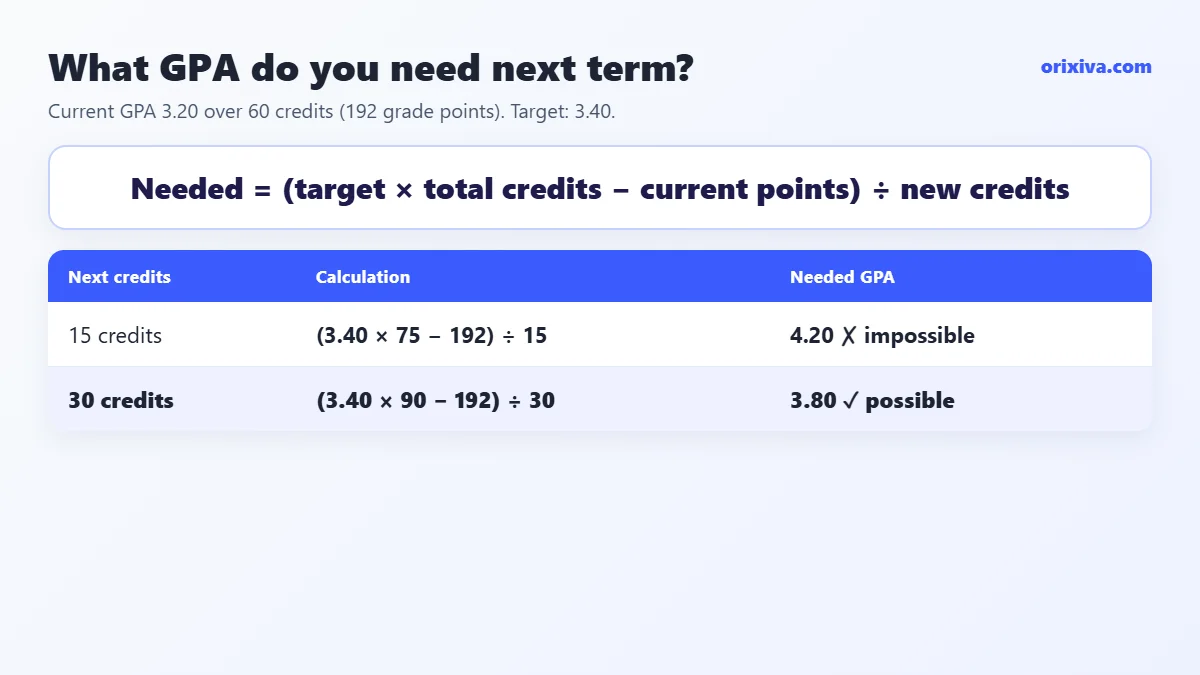
Needed GPA = (target GPA × total credits after next term − current grade points) ÷ next term’s credits
Example: is a 3.4 possible next term?Your GPA is 3.20 over 60 credits (192 grade points). You want 3.40. With 15 credits next term you would need (3.40 × 75 − 192) ÷ 15 = 4.20, which is impossible on a 4.0 scale. Over two terms (30 credits) you would need (3.40 × 90 − 192) ÷ 30 = 3.80: hard, but possible.
The calculator’s target feature does this for you and tells you straight away when a goal needs more than one term. That honest answer is useful: it lets you plan a realistic path instead of burning out chasing an impossible semester.
Weighted GPA, course grades and the final exam
Weighted GPA in high school
Many high schools add extra points for harder classes, often +0.5 for Honors and +1.0 for AP or IB, so an A in an AP class counts as 5.0. Policies vary, and many universities recalculate an unweighted GPA when you apply. The GPA calculator supports both weighted and unweighted scales.
What score do I need on my final exam?
Your course grade is usually a weighted mix of homework, quizzes and exams. Say homework counts 20% (your average is 85), quizzes 30% (72), the midterm 20% (78) and the final exam 30%. So far you have 0.2 × 85 + 0.3 × 72 + 0.2 × 78 = 54.2 points. To finish on 80%, you need (80 − 54.2) ÷ 0.3 = 86% on the final.
The weighted grade calculator in the toolkit does this in one step, can drop your lowest score in a category if your teacher does, and shows the final exam score you need.
Attendance can matter too
Some universities require a minimum attendance, such as 75% or 80%. If you have attended 30 of 40 classes (75%), you need to attend the next 10 in a row to reach 80%. The attendance calculator shows that number and how many classes you can still miss.
How to plan your study week around your GPA goal
Knowing how to calculate GPA tells you where you stand. A study plan gets you where you want to be. A common guideline at many universities is 2–3 hours of study outside class for every credit hour, so a 12-credit semester means roughly 24–36 hours a week. That sounds like a lot until you plan it.
- Block your fixed time first. Classes, work, travel, prayer, sport and sleep go in before study. The Study Timetable Planner builds a repeating week around these fixed commitments.
- Add your exams and deadlines. In Exam Countdown, enter each subject, the exam date, its topics and how confident you feel from 1 to 5. Add assignments to the Assignment & Deadline Manager.
- Let the planner share out the hours. In the Smart Study Assistant, set your free hours and rest days and press Build my plan. It gives more sessions to subjects with near exams and to the ones you marked as weak, and never schedules a subject after its exam.
- Give every session one job. “Active recall: close the book and write what you remember” beats “study biology”. The planner writes these jobs for you, and switches to timed past papers in the two days before an exam.
- Work in focus blocks and check progress. Run each session with the Pomodoro timer, tick sessions off, and look at the Progress Dashboard each Sunday.
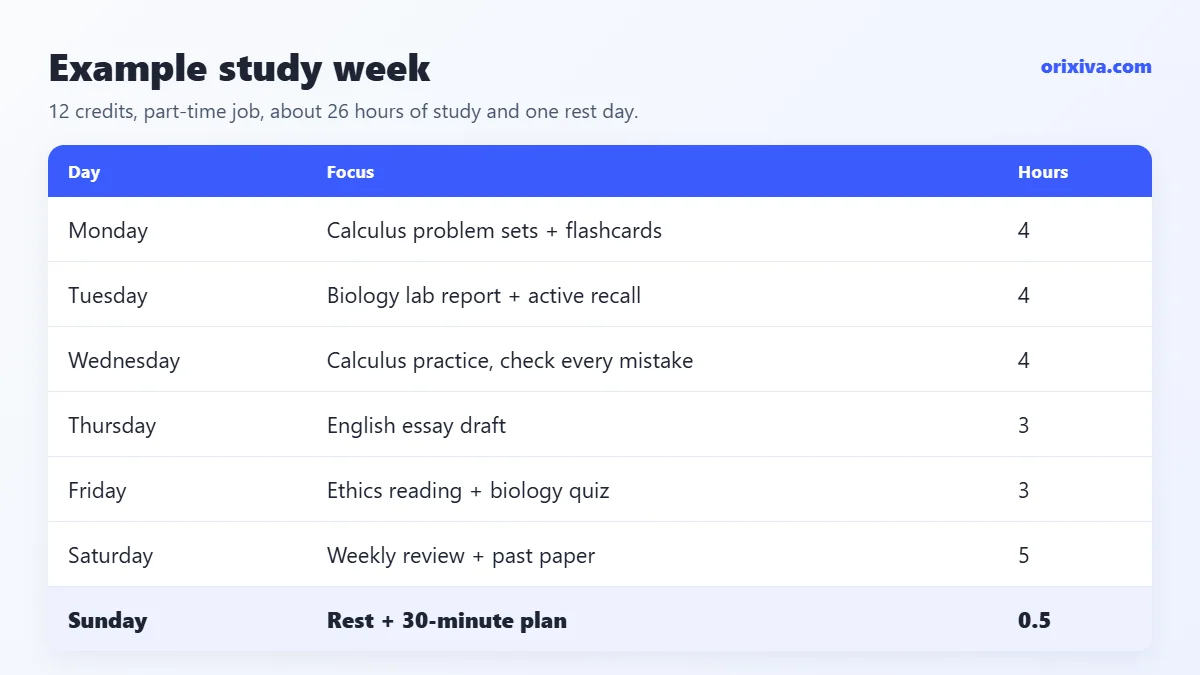
Example study week: 12 credits, part-time job
About 26 hours of study, one rest day
Mon–SunAbout 26 hours of study, one rest day
| Day | Focus | Hours |
|---|---|---|
| Monday | Calculus problem sets (weak subject) + flashcards | 4 |
| Tuesday | Biology lab report + active recall | 4 |
| Wednesday | Calculus practice questions, check every mistake | 4 |
| Thursday | English essay draft (work shift in the evening) | 3 |
| Friday | Ethics reading + biology quiz | 3 |
| Saturday | Weekly review, past paper, essay edit | 5 |
| Sunday | Rest, 30-minute plan for next week | 0.5 |
Export the plan to Google, Apple or Outlook calendar with the .ics file, or print it for your wall.
Revise smarter, not longer
Hours matter less than how you use them. Three methods with strong research support are built into the toolkit:
Pomodoro focus blocks
Focus for a set time, then take a short break, with a longer break every few blocks. The method comes from Francesco Cirillo. The timer logs your minutes towards a weekly goal.
Spaced repetition
Review each flashcard just before you would forget it. Rate it Again, Hard, Good or Easy and the next review is scheduled for you.
Practice testing
Testing yourself beats rereading. Make a quiz from your notes; it marks typed answers fairly and lets you retry only what you got wrong.
One dashboard
Marks, quiz scores, study minutes, open assignments and exam countdowns in one place, so Sunday planning takes minutes.
Writing a paper? The citation formatter creates references in APA, MLA, Chicago, Harvard and IEEE styles. Teachers can use the same toolkit to build question banks, worksheets, exam papers with answer keys, lesson plans and rubrics.
How to raise your GPA: 6 moves that actually work
Once you know how to calculate GPA, you can see which changes move it most. Credits are the lever: improving a 4-credit course from C to B adds 4 grade points, while the same jump in a 1-credit course adds only 1.
- Protect your biggest courses. Put your best study hours into the highest-credit subjects, especially if you are weak in them.
- Ask about retake and replacement rules. If your university replaces a failed grade, retaking one course can lift your cumulative GPA more than a whole term of small gains.
- Use the syllabus weights. If the final exam is 40% of the grade, two weeks of practice papers are worth more than polishing a 5% homework.
- Do not lose easy marks. Late penalties, missed quizzes and attendance rules quietly cost points. Put every deadline in the planner the day you get the syllabus.
- Get feedback early. Office hours in week 3 are worth more than panic in week 12.
- Track it every few weeks. Update your marks in the weighted grade calculator so you know which course needs attention while there is still time.
A 15-minute weekly review
Every Sunday: tick off finished sessions, move anything you missed, check the Progress Dashboard for weak subjects, and adjust next week’s study plan. Rebuild the plan whenever an exam date or deadline changes. This small habit keeps a study week realistic instead of a wish list.
6 GPA and study-planning mistakes
- Averaging semester GPAs. Always use total grade points and total credits.
- Using the wrong scale. A− is 3.7 at many schools but 3.67 at others. Check your handbook.
- Counting pass/fail courses. They usually add credits but no grade points.
- Ignoring retake rules. Some universities replace the old grade, others average both.
- Planning every free hour. A plan with no rest day breaks by Wednesday. Leave slack.
- Studying by rereading. Recall and practice questions beat highlighting.
Your turn: What study habit raised your GPA the most? Share your tip in the comments for students around the world. Please do not post personal grades or student ID numbers.
Calculate your GPA and build your week, free
Now you know how to calculate GPA by hand. Use the free toolkit to check your semester and cumulative GPA, find the GPA you need next term, and turn it into a day-by-day study plan. No sign-up, nothing uploaded.
Open the GPA calculator & study planner → 22 study and teaching tools · Search more student tools on orixiva.comGPA and study planning questions
How do I calculate my GPA quickly?
Multiply each course’s grade value by its credit hours, add the results, and divide by the total credit hours. A GPA calculator does the same in seconds.
How do I calculate GPA from percentages?
Convert each percentage to a letter grade or grade value using your university’s table, then use the normal GPA formula. The GPA calculator can do the conversion if you choose the matching scale.
Is a 3.5 GPA good?
A 3.5 on a 4.0 scale usually means mostly A and B grades, which is strong for most programmes. What counts as “good” depends on your field and the scholarship or school you are aiming for.
What is the difference between GPA and CGPA?
GPA usually means one term. CGPA or cumulative GPA covers all terms so far, calculated from total grade points and total credits.
Can I raise my GPA from 2.5 to 3.0 in one semester?
It depends on how many credits you already have. With 30 credits at 2.5 and 15 new credits, you would need a 4.0 term. With 60 credits you would need more than one term. Use the target GPA calculation to check.
Do failed courses count in my GPA?
Usually yes: an F adds credits with zero grade points. If you retake the course, your university decides whether the new grade replaces the old one.
How many hours should I study per week?
A common guideline is 2–3 hours per credit hour per week. Start with the lower number, plan it in focus blocks, and adjust after the first few weeks.
Can I add my study plan to Google Calendar?
Yes. The smart study planner and timetable planner export an .ics file that Google, Apple and Outlook calendars can import.
What GPA do I need for a scholarship?
It depends on the scholarship. Many merit awards ask for 3.0 to 3.5 or higher on a 4.0 scale, and competitive ones expect more. Check the exact rule and whether it uses your cumulative GPA.
Is my data private?
Yes. The toolkit runs in your browser and saves data on your own device. Use the backup option to move it to another device.
[…] plans: 45 minutes a day for 30 days is 1,350 minutes, or 22.5 hours. Our GPA and study planning guide shows how to plan those […]