Try our free AI tools – no sign-up needed!

Time Calculator Free Online: Convert Seconds, Minutes, Hours, Days and Years Without Signup
Need the answer now? The free time converter turns seconds into minutes, hours, days, weeks, months and years, with a days-hours-minutes breakdown and no signup.
Jump to the free tool ↓How many hours is 165 minutes? How long is a million seconds? What is 7.75 hours in hours and minutes for a timesheet? If you have ever searched for a time calculator free online without signing in, you know the maths is simple but easy to get wrong: there are 60 seconds in a minute and 60 minutes in an hour, yet 24 hours in a day and roughly 30.44 days in an average month.
This guide explains every common time conversion in plain English, shows how to turn decimal hours into hours and minutes, and walks through real examples for work, study, video, fitness and science. You can check each answer in the free Orixiva time converter. It works in your browser on PC or phone, with no signup, sign-in or login, and shows your value in all ten time units at once.
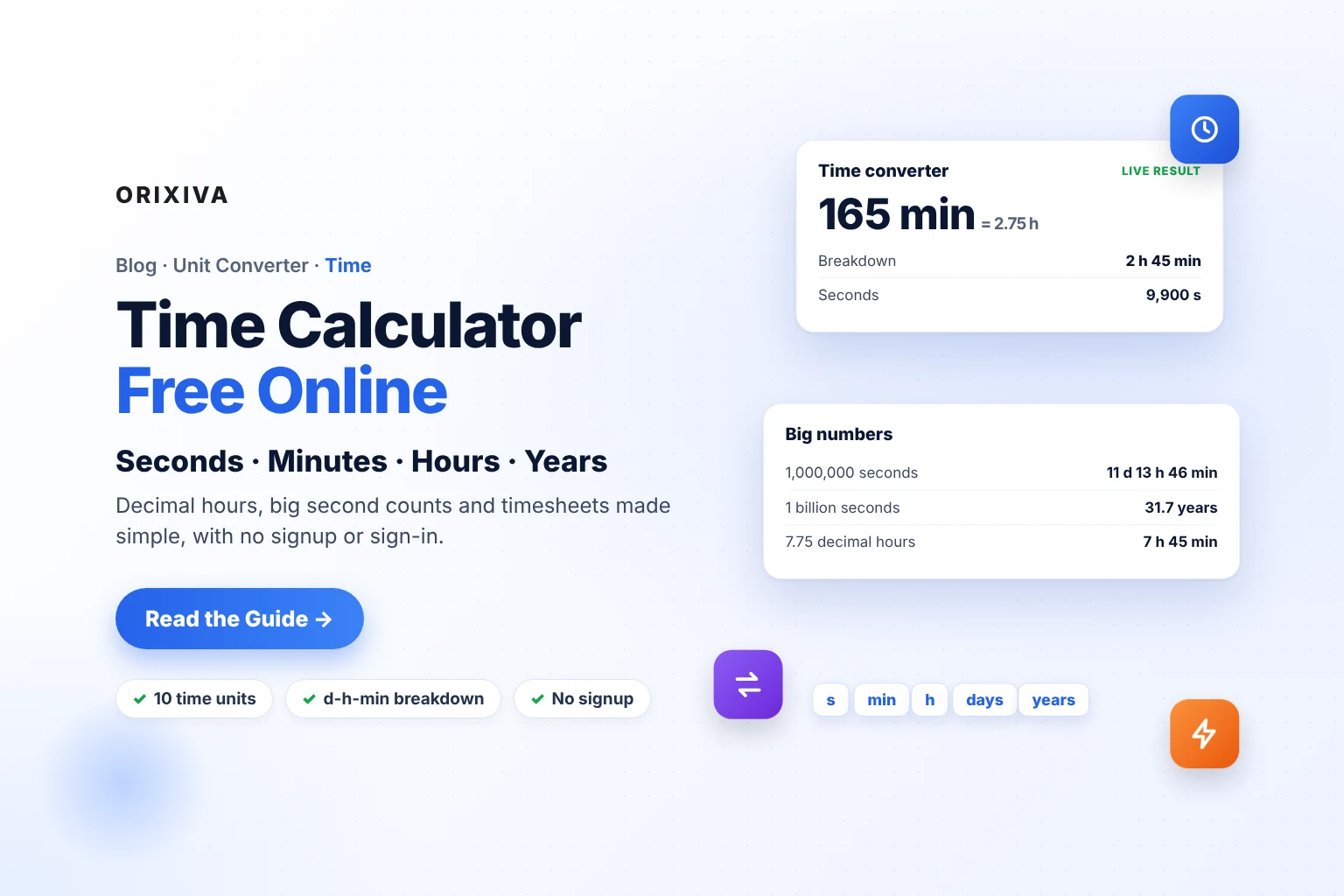
Key takeaways
- 1 minute = 60 seconds, 1 hour = 3,600 seconds and 1 day = 86,400 seconds.
- To turn decimal hours into minutes, multiply the decimal part by 60: 7.75 h = 7 h 45 min.
- An average month is 30.436875 days and an average year is 365.2425 days (the Gregorian calendar).
- The Orixiva time converter covers nanoseconds to years and adds a days-hours-minutes-seconds breakdown to every result.
- It is a free time calculator online: no signup, nothing to install, and nothing leaves your browser.
Time units at a glance
The second is the base unit of time. According to NIST’s page on the SI unit of time, the second is defined by the frequency of the cesium-133 atom: 9,192,631,770 cycles of a particular transition. Every other time unit in the converter is a fixed number of seconds:
| Unit | In seconds | Handy relation |
|---|---|---|
| Minute | 60 | 60 seconds |
| Hour | 3,600 | 60 minutes |
| Day | 86,400 | 24 hours |
| Week | 604,800 | 7 days |
| Month (average) | 2,629,746 | 30.436875 days |
| Year (Gregorian average) | 31,556,952 | 365.2425 days |
Because every unit is defined in seconds, the converter can move between any two of them in one step, from nanoseconds straight to years, without rounding along the way.
Below the second, the converter also includes the millisecond (1/1,000 s), microsecond (1/1,000,000 s) and nanosecond (1/1,000,000,000 s).
How to convert seconds, minutes and hours
minutes = seconds ÷ 60 · hours = minutes ÷ 60 · seconds = hours × 3,600
- 90 minutes = 90 ÷ 60 = 1.5 hours.
- 165 minutes = 2.75 hours = 2 h 45 min.
- 10,000 seconds = 166.67 minutes = 2 h 46 min 40 s.
- 2.5 hours = 150 minutes = 9,000 seconds.
The breakdown line does the splittingType 10000 with seconds selected and the converter shows “0 d 2 h 46 min 40 s” under the main result, so you never have to split hours and minutes by hand.
How to convert decimal hours to hours and minutes
Many apps and payroll systems show time as decimal hours, such as 7.75. Here is how to read it:
- Keep the whole number as hours: 7.
- Multiply the decimal part by 60: 0.75 × 60 = 45.
- Result: 7 hours 45 minutes.
Going the other way, divide the minutes by 60 and add them to the hours: 1 h 20 min = 1 + 20 ÷ 60 = 1.333 hours.
Decimal hours in minutes
Minutes = decimal part × 60.
0.1 h
6 min
0.25 h
15 min
0.333 h
20 min
0.5 h
30 min
0.75 h
45 min
A common mistake is reading 7.5 hours as 7 h 50 min. It is 7 h 30 min.
Flowchart: which time conversion do I need?
- Start with your time valueFrom a timer, app, timesheet or spec sheet
- Is it a decimal like 7.75 hours?YesDecimal part × 60 = minutesNoGo to the next question
- Is it a large count of seconds or minutes?YesUse the d-h-min-s breakdownNoConvert unit to unit
- Does it involve months or years?Remember these are averages: 30.44 days and 365.24 days
- Need a date or work-hours total?Use the date and time calculator for calendar maths
Days, weeks, months and years
- 1,000 hours = 41.67 days.
- 1 week = 168 hours = 604,800 seconds.
- 1 year = 8,765.82 hours = 525,949 minutes (using the average year).
- A 40-hour work week × 52 = 2,080 hours a year.
Why months and years are averages
Real months have 28, 29, 30 or 31 days, and years have 365 or 366. A converter needs one fixed value, so the Orixiva time converter uses the Gregorian calendar averages: 30.436875 days per month and 365.2425 days per year. That is ideal for estimates (“about how many months is 1,000 days?”) but not for exact calendar dates. For “what date is 90 days from today?” or “how many days between two dates?”, use the date and time calculators, and see our guide on how to calculate dates, work hours and running pace.
Countdowns and deadlines
To see how much time is left, convert the gap into the unit that feels most useful. A deadline 3 days away is 72 hours or 4,320 minutes; a 10-day trip is 240 hours. For the exact date of a deadline or the days between two dates, use a date calculator, since real months and weekends matter there.
Big numbers: a million and a billion seconds
Large second counts are hard to picture until you convert them:
How long are big numbers of seconds?
On a log-style scale: each step is 1,000 times longer.
1,000 s
16 min 40 s
1,000,000 s
11 d 13 h 46 min
1,000,000,000 s
31.7 years
A million seconds is under two weeks; a billion seconds is more than three decades.
Try it: choose seconds, type 1e9 and set the To unit to years. You get 31.69 years. A 30-year-old has lived about 946.7 million seconds, or roughly 10,957 days.

Milliseconds, microseconds and nanoseconds
Small time units matter in video, gaming, networking and electronics:
Video frames
At 24 frames per second each frame lasts 41.7 ms; at 60 fps, 16.7 ms.
Network ping
A 30 ms ping is 0.03 seconds for a round trip to the server and back.
Sport timing
Race results are often given to 1/100 s (10 ms); photo finishes go finer still.
Computers
Processor and memory timings are measured in nanoseconds: 1 ns = 0.000000001 s.
The converter shows very small results in scientific notation automatically, for example 1 ns = 1 × 10⁻⁹ s, and you can switch to standard decimals in Display options.
Time conversion chart
| Value | Minutes | Hours | Breakdown |
|---|---|---|---|
| 600 s | 10 | 0.167 | 10 min |
| 3,600 s | 60 | 1 | 1 h |
| 10,000 s | 166.7 | 2.778 | 2 h 46 min 40 s |
| 100,000 s | 1,666.7 | 27.78 | 1 d 3 h 46 min 40 s |
| 90 min | 90 | 1.5 | 1 h 30 min |
| 165 min | 165 | 2.75 | 2 h 45 min |
| 7.75 h | 465 | 7.75 | 7 h 45 min |
Timesheets, study time and work hours
Time conversions turn up every week at work and school:
- Payroll: 37.5 hours a week is 37 h 30 min, not 37 h 50 min. Multiply decimal hours by the hourly rate for pay.
- Billing: a 95-minute call billed in hours is 1.58 h. Many freelancers round up to the next 0.25 h, so 1.75 h.
- Study plans: 45 minutes a day for 30 days is 1,350 minutes, or 22.5 hours. Our GPA and study planning guide shows how to plan those hours.
- Invoices: list hours as decimals so totals multiply cleanly. See how to make an invoice for a worked example.

More real-world time examples
Video and audio
Editors and creators often need durations in seconds or frames. A 90-minute film is 5,400 seconds; at 24 frames per second that is 129,600 frames. A 45-minute podcast is 2,700 seconds. Type 90*60*24 into the converter with seconds selected to check the frame maths, then switch the unit to see the same length in hours.
Science
Sunlight takes on average about 499 seconds to reach Earth, which the converter shows as 8 min 19 s. Half-lives in chemistry and physics range from microseconds to millions of years, which is why the converter goes from nanoseconds up to years.
Turning a salary into an hourly rate
A full-time year of 40 hours a week for 52 weeks is 2,080 hours. A salary of 52,000 a year is therefore 52,000 ÷ 2,080 = 25 per hour. If you work 37.5 hours a week, the year is 1,950 hours and the rate rises to 26.67.
Rounding time for billing
Many professionals bill in fixed blocks of time. Six-minute blocks are 0.1 hour each, so a 47-minute task becomes 0.8 h (8 blocks, rounded up). Fifteen-minute blocks are 0.25 hour, so the same task becomes 1.0 h. Converting minutes to decimal hours first, then rounding to the block, keeps invoices consistent.
| Where | Usual unit | Typical example |
|---|---|---|
| Computing and networks | ms, µs, ns | 30 ms ping |
| Science and sport | seconds | 9.58 s sprint |
| Cooking and fitness | minutes | 45-minute workout |
| Work and travel | hours | 37.5-hour week |
| Projects and loans | days, weeks, months, years | 36-month contract |
Which time tool should you use?
“Time calculator” can mean three different jobs. Pick the tool that matches yours:
| Your question | Best tool |
|---|---|
| How many hours is 165 minutes? | Time converter (unit conversion) |
| What is 7.75 hours in hours and minutes? | Time converter (breakdown line) |
| What date is 90 days from today? | Date calculator |
| How many hours did I work from 8:45 to 17:15? | Work-hours calculator |
| How fast was my run? | Pace calculator or speed converter |
The date, work-hours and pace tools are part of the date and time calculators; the speed side is covered in the speed calculator guide.
How to use the free time converter (step by step)
- Open the time converter. Go to the Orixiva time converter. It opens on 90 minutes to hours as an example. No signup or login is needed.
- Type a value or a calculation. Decimals, fractions (3/4), scientific notation (1e9) and sums such as
8*5or45*30all work. - Choose From and To units. Nanosecond, microsecond, millisecond, second, minute, hour, day, week, month (average) or year (Gregorian).
- Read the result and the breakdown. The answer updates as you type, with both rates (1 min = 0.01667 h and 1 h = 60 min) and a “Breakdown” line in days, hours, minutes and seconds.
- Check the working. “How it was calculated” converts your value to seconds first, then to the target unit.
- Compare all ten units. The table shows the same duration in every unit at once.
- Save or share. Swap units, copy the result, download it as TXT or print it. Press Convert to keep it in Recent conversions and export the list as CSV.
So where do you find a time calculator free online without signin? Right here: the converter runs entirely in your browser, works on Windows, Mac, Android and iPhone, and needs no account.
Display options
Under Display options, choose significant figures (1–15) or decimal places (0–12), standard, scientific or engineering notation, and a thousands separator. Two decimal places suit timesheets; more suit lab or engineering work.
How to convert time in Excel or Google Sheets
Spreadsheets store time as a fraction of a day, which confuses many people. Useful formulas:
| Task | Formula |
|---|---|
| Minutes to hours | =A2/60 |
| Seconds to hours | =A2/3600 |
| Decimal hours to a time value | =A2/24 (format as [h]:mm) |
| Time value to decimal hours | =A2*24 |
| Hours to minutes with CONVERT | =CONVERT(A2,"hr","mn") |
In Microsoft’s CONVERT reference, time codes include “yr”, “day”, “hr”, “mn” and “sec”. Google Sheets accepts most of the same codes.
Mistakes to avoid when converting time
Reading decimals as minutes
7.5 hours is 7 h 30 min, not 7 h 50 min. Always multiply the decimal part by 60.
Using 30 days for every month
Over long periods, 30-day months drift. 1,000 days is 32.85 average months, not 33.33.
Using 365 days for every year
Leap years add a day roughly every four years. For ages and long durations, 365.2425 days is the accurate average.
Mixing durations and clock times
“2:30” can mean two and a half hours or half past two. Durations add; clock times need a date and time calculator.
Forgetting time zones for meetings
A time converter changes units, not time zones. Check the city and daylight saving rules when scheduling across countries.
Your turn: What time conversion do you do most: timesheets, study hours, video lengths or countdowns? Share your example in the comments and help other readers.
Use the free time calculator online now
Convert seconds, minutes, hours, days, weeks, months and years, see the days-hours-minutes breakdown and copy the working. Free online, without signup or sign-in, and nothing leaves your browser.
Open the free time converter → Looking for another converter or calculator? Search on orixiva.comRelated guides: speed calculator online, data transfer rate calculator, power calculator free online and how to convert units.
Time calculator questions people often ask
Where can I find a time calculator free online without signin?
The Orixiva time converter is free, needs no signup, sign-in or login, and runs in any browser on PC or phone.
How many seconds are in a day?
86,400 seconds: 24 hours × 60 minutes × 60 seconds.
How do I convert minutes to hours?
Divide by 60. 135 minutes ÷ 60 = 2.25 hours, which is 2 hours 15 minutes.
What is 7.75 hours in hours and minutes?
7 hours 45 minutes, because 0.75 × 60 = 45.
How long is a million seconds?
About 11.57 days: 11 days, 13 hours, 46 minutes and 40 seconds.
How many hours are in a year?
8,760 hours in a 365-day year, 8,784 in a leap year, and 8,765.82 using the average year.
How many days are in a month on average?
30.436875 days in the Gregorian calendar, which the converter uses for its month unit.
How many seconds are in a year?
31,536,000 in a 365-day year, 31,622,400 in a leap year, and 31,556,952 using the average year.
What is 0.1 hours in minutes?
6 minutes, because 0.1 × 60 = 6.
How many milliseconds are in a second?
1,000 milliseconds. One millisecond is a thousandth of a second, and 1 second is also 1,000,000 microseconds.
How do I convert hours to days?
Divide by 24. 100 hours ÷ 24 = 4.17 days, which the breakdown shows as 4 d 4 h.
Is a month 30 or 31 days?
Calendar months have 28 to 31 days. For conversions, the average Gregorian month of 30.436875 days gives the most accurate long-term results.
How many minutes are in a day?
1,440 minutes: 24 hours × 60 minutes.
How many weeks are in a year?
About 52.18 weeks in an average year (365.2425 ÷ 7), or 52 weeks and 1 or 2 days.
Can the time converter add dates or clock times?
No. It converts durations between units. For dates, days between dates or clock-time maths, use the Orixiva date and time calculators.