Try our free AI tools – no sign-up needed!


Quick answer: To use the electrical calculator, pick one of the 17 tools in the menu above, enter your values with the right units and press Calculate. The result appears with notes, and you can copy or print it.
- 17calculators
- 0sign-ups needed
- 100%in your browser
- Freeforever
What the electrical calculator includes
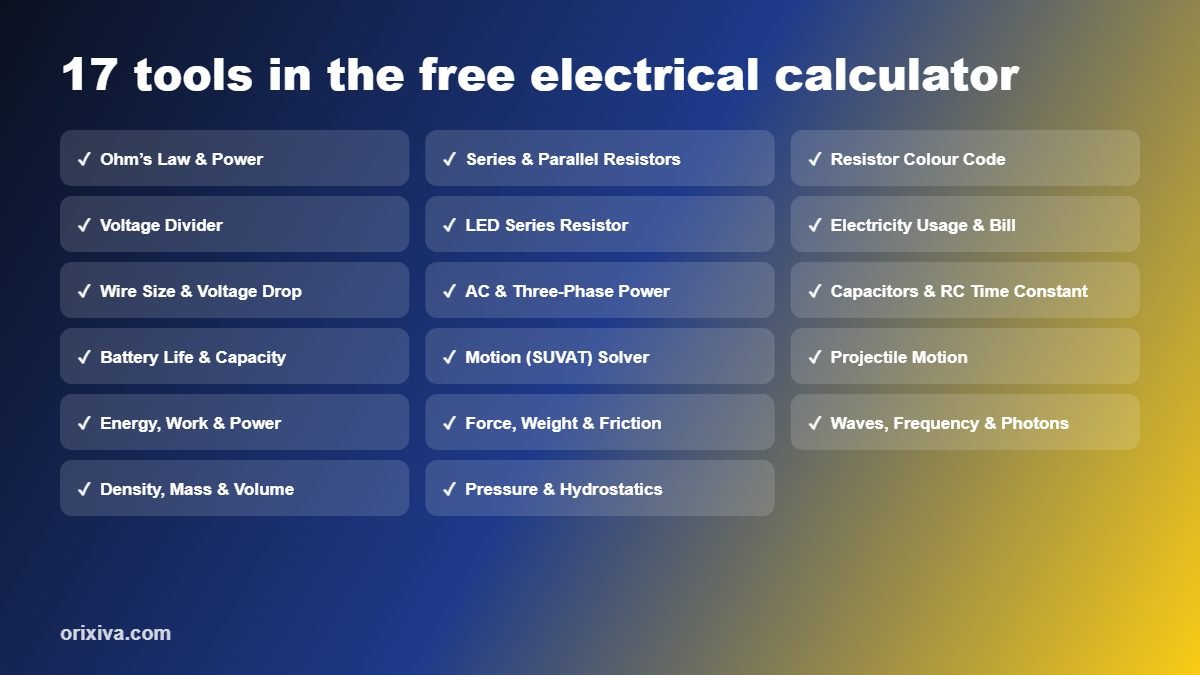
The electrical calculator contains 17 separate tools. Choose one from the menu at the top of the page; each tool keeps its own inputs and explains the formula it uses.
| Calculator | What it does |
|---|---|
| Ohm’s Law & Power | Enter any two of voltage, current, resistance and power to get the other two. |
| Series & Parallel Resistors | Total resistance for resistors in series or parallel, with current sharing. |
| Resistor Colour Code | Value, tolerance and range from 4-, 5- or 6-band colour codes. |
| Voltage Divider | Output voltage, or the resistor needed, with load effect and nearest standard values. |
| LED Series Resistor | Current-limiting resistor and its power rating for one or more LEDs in series. |
| Electricity Usage & Bill | Energy use and cost for appliances, with a list of devices and tariff. |
| Wire Size & Voltage Drop | Voltage drop for a cable, and the minimum size for a drop limit (mm² and AWG). |
| AC & Three-Phase Power | Real, apparent and reactive power, current and power-factor correction. |
| Capacitors & RC Time Constant | Series/parallel capacitance, RC time constant, charge curve and stored energy. |
| Battery Life & Capacity | Runtime from capacity and load, or the battery size needed, including inverter losses. |
| Motion (SUVAT) Solver | Constant-acceleration motion: solve any unknowns from three known values. |
| Projectile Motion | Range, maximum height, flight time and trajectory for a launch speed and angle. |
| Energy, Work & Power | Kinetic, potential and total mechanical energy, work done and power. |
| Force, Weight & Friction | Newton’s second law, weight on planets, friction and incline forces. |
| Waves, Frequency & Photons | Speed, frequency, wavelength and period; photon energy for light. |
| Density, Mass & Volume | Solve density, mass or volume and compare with common materials; buoyancy check. |
| Pressure & Hydrostatics | Pressure from force and area, fluid depth pressure and unit conversions. |
How to use the electrical calculator
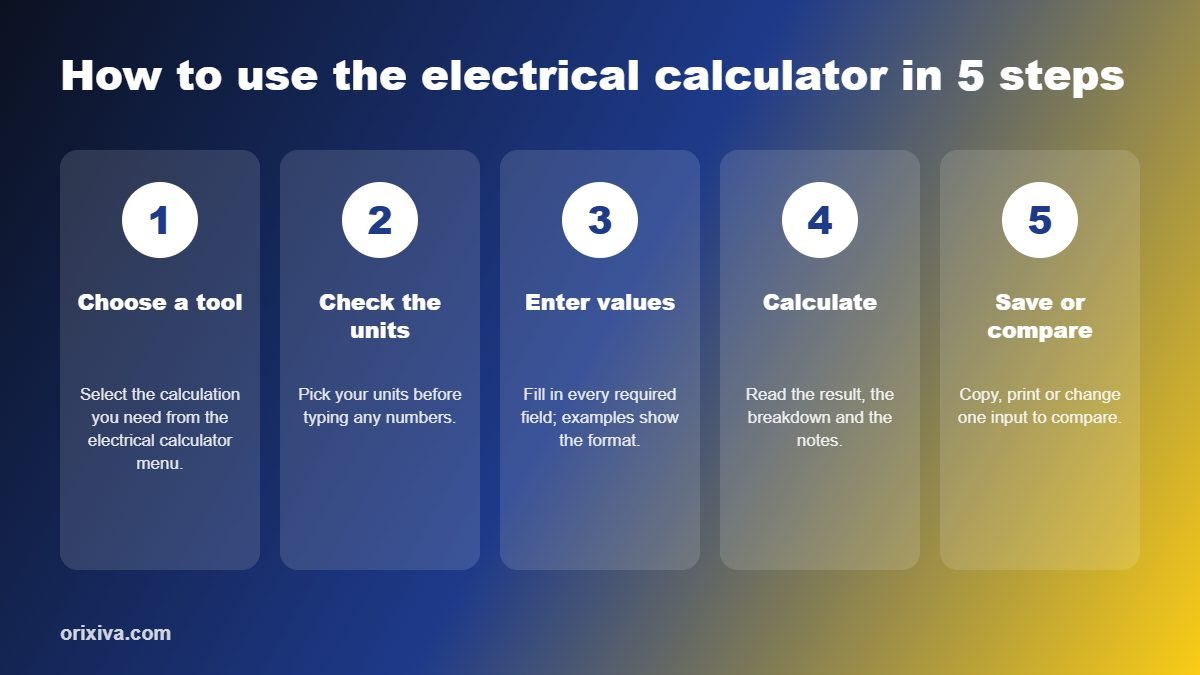
- Choose a tool. Select the calculation you need from the electrical calculator menu.
- Check the units. Pick the units you are working in before typing numbers, so the formula uses the right values.
- Enter your values. Fill in every required field. Example values show the expected format.
- Calculate and review. Read the main result, the breakdown and any notes or charts under it.
- Save or compare. Copy, print or download the result, or change one input to compare scenarios.
Who uses this electrical calculator?
- Electricians checking wire size and voltage drop.
- Electronics hobbyists choosing resistors and LED values.
- Engineering and physics students.
- Homeowners estimating appliance electricity cost.
- Solar and battery users sizing backup systems.
Tips for accurate results with the electrical calculator
- Ohm’s law: V = I × R, and power P = V × I.
- Keep voltage drop under about 3–5% for most circuits.
- Use the next standard resistor value above the calculated one for LEDs.
- Batteries rarely deliver full rated capacity; allow for inverter losses.
- Always follow local electrical codes; calculators do not replace a qualified electrician.

Electrical calculator guide: formulas, reference values and worked examples
This electrical calculator covers circuits, home energy, cables, batteries and basic physics. The guide below lists the core formulas, gives reference values you can check against and works through examples for hobby electronics and household wiring.
Core electrical formulas
| Quantity | Formula | Units |
|---|---|---|
| Ohm's law | V = I × R | volts, amps, ohms |
| Power | P = V × I = I² × R = V² ÷ R | watts |
| Series resistors | R = R₁ + R₂ + … | ohms |
| Parallel resistors | 1/R = 1/R₁ + 1/R₂ + … | ohms |
| Voltage divider | Vout = Vin × R₂ ÷ (R₁ + R₂) | volts |
| Energy | kWh = watts × hours ÷ 1,000 | kilowatt-hours |
| RC time constant | τ = R × C | seconds |
| Three-phase power | P = √3 × V × I × PF | watts |
Worked example 1: LED resistor
A red LED with a forward voltage of 2.0 V runs from a 5 V supply at 20 mA. The resistor must drop 5 − 2 = 3 V, so R = 3 ÷ 0.020 = 150 Ω. It dissipates 3 × 0.020 = 0.06 W, so a standard 1/4 W resistor is plenty. If 150 Ω is not in your kit, pick the next value up, such as 180 Ω, which gives about 16.7 mA and a slightly dimmer LED.
Worked example 2: resistors in parallel
A 100 Ω and a 220 Ω resistor in parallel give 1 ÷ (1/100 + 1/220) = 68.75 Ω. The combined value is always lower than the smallest resistor. With 12 V across them, the 100 Ω resistor carries 120 mA and the 220 Ω resistor about 55 mA, for a total of 175 mA.
Worked example 3: voltage divider for a sensor
To read a 12 V signal with a 3.3 V microcontroller input, choose R₁ = 27 kΩ and R₂ = 10 kΩ. The output is 12 × 10 ÷ 37 = 3.24 V, just under the 3.3 V limit. Keep the resistors in the kilo-ohm range so the divider draws little current, but not so high that the input's own resistance pulls the voltage down. The voltage divider tool shows this loading effect.
Worked example 4: electricity bill
A 2,000 W heater used for 3 hours a day uses 6 kWh a day and 180 kWh in a 30-day month. At a tariff of 0.20 per kWh, that costs 36 a month. A 10 W LED bulb left on for 8 hours a day uses only 2.4 kWh a month, which costs about 0.48. Standby power adds up too: ten devices at 2 W each use about 175 kWh a year.
Worked example 5: cable size and voltage drop
Voltage drop in a two-wire cable is 2 × length × current × resistance per metre, which is the formula the voltage drop calculator uses. A 30 m run of 2.5 mm² copper, which has about 0.0074 Ω per metre, carrying 16 A drops 2 × 30 × 16 × 0.0074 ≈ 7.1 V. On a 230 V circuit that is 3.1%, within the 3 to 5% limit many wiring rules allow. On a 12 V system the same drop would be fatal to the circuit, which is why low-voltage runs need much thicker cable. Always follow your local wiring regulations and use a qualified electrician for mains work.
Worked example 6: battery backup time
A 12 V, 100 Ah battery stores 1,200 Wh. With a 300 W load through an inverter that is 90% efficient, the battery supplies 333 W. Lead-acid batteries should only be discharged to about 50%, giving 600 Wh ÷ 333 W ≈ 1.8 hours. A lithium iron phosphate battery can use about 90% of its capacity, giving roughly 3.2 hours from the same size.
Worked example 7: RC time constant
A 10 kΩ resistor and a 100 µF capacitor give τ = 10,000 × 0.0001 = 1 second. The capacitor charges to 63% of the supply voltage after one time constant and to more than 99% after five, so about 5 seconds here. The same maths sets the delay in simple timer circuits and the smoothing in power supplies.
Worked example 8: motion with constant acceleration
A car accelerating from rest at 3 m/s² for 8 seconds reaches v = u + at = 24 m/s (86 km/h) and covers s = ut + ½at² = 96 m. The SUVAT solver in this physics calculator finds any missing quantity from three known values, and the same equations describe a ball dropped from a height, with a = 9.81 m/s².
Worked example 9: three-phase motor current
A 15 kW three-phase motor on a 400 V supply with a power factor of 0.85 and 90% efficiency draws about 15,000 ÷ (√3 × 400 × 0.85 × 0.90) ≈ 28 A. Adding a capacitor bank that raises the power factor to 0.95 cuts the current to about 25 A, which lowers cable losses and can reduce demand charges on business electricity bills. The AC and three-phase power tool shows the capacitor size needed for a target power factor.
Resistor colour code reference
The colours from 0 to 9 are black, brown, red, orange, yellow, green, blue, violet, grey and white. A four-band resistor coloured yellow, violet, red and gold reads 4, 7 and a multiplier of 100: 4,700 Ω, or 4.7 kΩ, with a 5% tolerance. Gold as a tolerance band means ±5% and silver ±10%.
Safety reminders
- Switch off and isolate mains circuits before working on them.
- Choose resistors and cables rated well above the calculated power and current.
- Fuse battery systems close to the battery, since even 12 V can deliver very high currents.
- Check results with a multimeter before connecting sensitive parts.
- Use a residual current device (RCD or GFCI) on circuits near water, such as kitchens, bathrooms and outdoor sockets.
- Label every circuit in your distribution board so the right one can be switched off quickly in an emergency.
For SI units and the definitions of the volt, ampere and ohm, see the NIST guide to SI units.
Privacy and accuracy
The electrical calculator runs entirely in your browser. Numbers you type are not sent to Orixiva or stored on a server.
Results use standard published formulas and are rounded for display. They are estimates for planning, study and everyday decisions; for legal, medical, engineering or financial decisions, confirm them with a qualified professional. For background reading, see the NIST guide to SI units.
Related free calculators
Need a different kind of calculation? These pages work the same way as this electrical calculator.
- Aviation Fuel Calculator for flight time, fuel burn and nautical units.
- Computer Calculator for subnets, storage and download time.
- Data Analysis Calculator for z-scores, weighted averages and CSV.
- Financial Calculator for loans, interest and ROI.
- Unit Converter for 14 measurement types.
- All free calculators in one place.
Share your feedback
Which electrical calculator tool did you use, and was the result what you expected? Tell other readers in the comments, or suggest a calculator we should add next. Comments are reviewed before they appear.
Frequently asked questions
Is this electrical calculator free?
Yes. All 17 electrical and physics tools are free with no sign-up.
How do I use Ohm’s law?
Enter any two of voltage, current, resistance and power; the calculator finds the other two.
How do I choose a wire size?
Wire Size & Voltage Drop finds the minimum cable size in mm² and AWG for your current, length and allowed voltage drop.
Can it calculate three-phase power?
Yes. AC & Three-Phase Power calculates real, apparent and reactive power and current.
How much does my appliance cost to run?
Electricity Usage & Bill uses power, hours of use and your tariff to estimate cost.
Does it include physics formulas?
Yes. Motion, projectile, energy, force, waves, density and pressure solvers are included.
How do I use Ohm's law?
V = I x R and P = V x I. Enter any two of voltage, current, resistance and power in the Ohm's Law & Power tool and it calculates the other two.
How do I add resistors in parallel?
For parallel resistors, 1/R total = 1/R1 + 1/R2 + ...; two 100-ohm resistors in parallel make 50 ohms. In series you simply add them. The tool also shows how current is shared.
How do I read a resistor colour code?
Choose 4, 5 or 6 bands and select each colour. The Resistor Colour Code tool shows the value, tolerance and the minimum and maximum resistance.
How does a voltage divider work?
Vout = Vin x R2 / (R1 + R2). The Voltage Divider tool also accounts for a load on the output and suggests the nearest standard resistor values.
What resistor do I need for an LED?
R = (supply voltage - LED forward voltage x number of LEDs) / LED current. For a 5 V supply, one 2 V LED at 20 mA needs 150 ohms. The tool also gives the resistor power rating.
How do I calculate an appliance's electricity cost?
kWh = watts x hours / 1,000, and cost = kWh x tariff. A 2,000 W heater running 3 hours a day uses 6 kWh a day. Electricity Usage & Bill adds up a list of devices.
What size wire do I need?
Wire Size & Voltage Drop calculates the voltage drop for a cable length, current and size, and finds the minimum size in mm2 or AWG for your drop limit. Always follow your local wiring code.
What is power factor?
Power factor = real power (kW) / apparent power (kVA). AC & Three-Phase Power calculates real, apparent and reactive power and the capacitor needed for power-factor correction.
What is an RC time constant?
Tau = R x C. A capacitor charges to about 63% in one time constant and is almost fully charged after five. The tool also gives series and parallel capacitance and stored energy.
How long will a battery last?
Runtime = battery capacity in Wh x usable fraction / load in W. Battery Life & Capacity also includes inverter losses and can size the battery for a runtime you need.
What are the SUVAT equations?
They describe motion with constant acceleration using s, u, v, a and t. Enter any three known values in the Motion Solver and it finds the other two.
How far does a projectile go?
On level ground without air resistance, range = v^2 x sin(2 x angle) / g, so 45 degrees gives the longest range. Projectile Motion also gives maximum height, flight time and the path.
How do I calculate kinetic and potential energy?
Kinetic energy = 1/2 x m x v^2 and potential energy = m x g x h. The Energy, Work & Power tool also calculates work and power.
How much would I weigh on Mars?
Weight = mass x gravity; Mars gravity is about 3.71 m/s2, so about 38% of your Earth weight. The Force, Weight & Friction tool also handles friction and inclines.
How do I calculate wavelength from frequency?
Wavelength = wave speed / frequency. For light, photon energy = Planck's constant x frequency. The Waves tool solves speed, frequency, wavelength and period.
Will an object float?
If its density is lower than the fluid's density it floats. Density, Mass & Volume compares your material with common materials and water.
How is water pressure at depth calculated?
Pressure = density x g x depth. At 10 m in fresh water that is about 98 kPa, almost one extra atmosphere. Pressure & Hydrostatics also converts pressure units.
Is it safe to use for real electrical work?
Use it for learning and planning. For mains wiring, follow local electrical codes and use a qualified electrician.
Ready to calculate? Scroll up to the electrical calculator, choose a tool and get your answer in seconds.