Try our free AI tools – no sign-up needed!


Free Online Math Tool
Angle Converter: Convert Degrees, Radians and Gradians Online
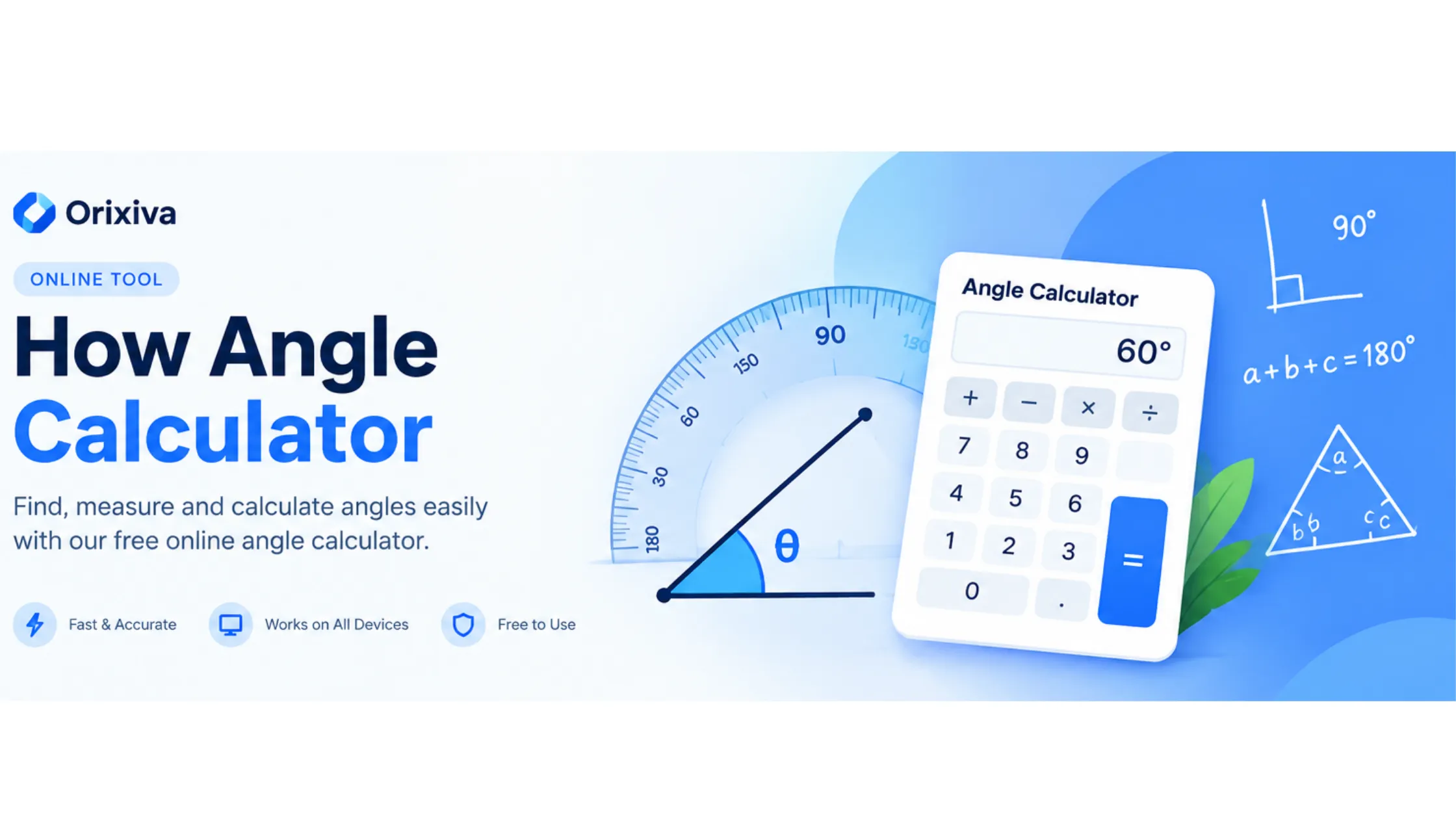
Convert angles between degrees, radians, gradians, and other units supported by the calculator. This easy guide explains common units, formulas, examples, and mistakes in simple English for students, teachers, engineers, programmers, and everyday users.
Enter an angle, choose the starting and target units, and check the result. No complicated steps are needed.
Quick conversion
Change units without doing the formula by hand.
Easy examples
Learn common angle conversions step by step.
Useful worldwide
Helpful for maths, science, design, and technical tasks.
What Is an Angle Converter?
An angle converter is an online calculator that changes an angle value from one unit to another. Common units include degrees (°), radians (rad), gradians (gon), and turns. Some converters also support arcminutes, arcseconds, milliradians, or degrees-minutes-seconds (DMS). Use only the units shown in your live calculator.
A right angle is 90 degrees, equal to π/2 radians, 100 gradians, or one-quarter turn. These are different ways to write the same angle.
Try the Angle Converter
Enter your value, choose the original and target units, then check the converted answer and its precision.
Open Angle ConverterCommon Angle Units
| Unit | Symbol | Full circle | Common use |
|---|---|---|---|
| Degrees | ° | 360° | Geometry, maps, everyday angles |
| Radians | rad | 2π rad | Trigonometry, physics, programming |
| Gradians | gon | 400 gon | Surveying and technical work |
| Turns | turn | 1 turn | Rotation and motion |
| Arcminutes / arcseconds | ′ / ″ | 21,600′ / 1,296,000″ | Astronomy and precise measurements |
How to Use an Online Angle Converter
- Enter the angle. Type the value you want to convert.
- Choose the starting unit. For example, degrees.
- Choose the target unit. For example, radians.
- Press Convert or Calculate. Check the output.
- Review the unit and precision. Keep the unit label with the answer.
Angle Conversion Flowchart
Enter angle value
↓
Select original unit
↓
Select target unit
↓
Convert and check result
Who Uses an Angle Converter?
- Students: check geometry, trigonometry, and physics homework.
- Teachers: prepare examples and explain angle units.
- Engineers: compare values in technical measurements.
- Surveyors and builders: work with angles on plans and measurements.
- Programmers: check whether functions need degrees or radians.
- Designers and hobbyists: work with rotations, drawing, robotics, and 3D models.
Tips for Accurate Conversion
- Always check whether a formula expects degrees or radians.
- Keep the unit symbol beside the result.
- Avoid rounding too early in multi-step calculations.
- Check which units the converter actually supports.
- For engineering or scientific work, follow the required precision rules.
Helpful tip
Many programming libraries use radians in trigonometric functions. A correct angle in the wrong unit can cause a wrong result later.
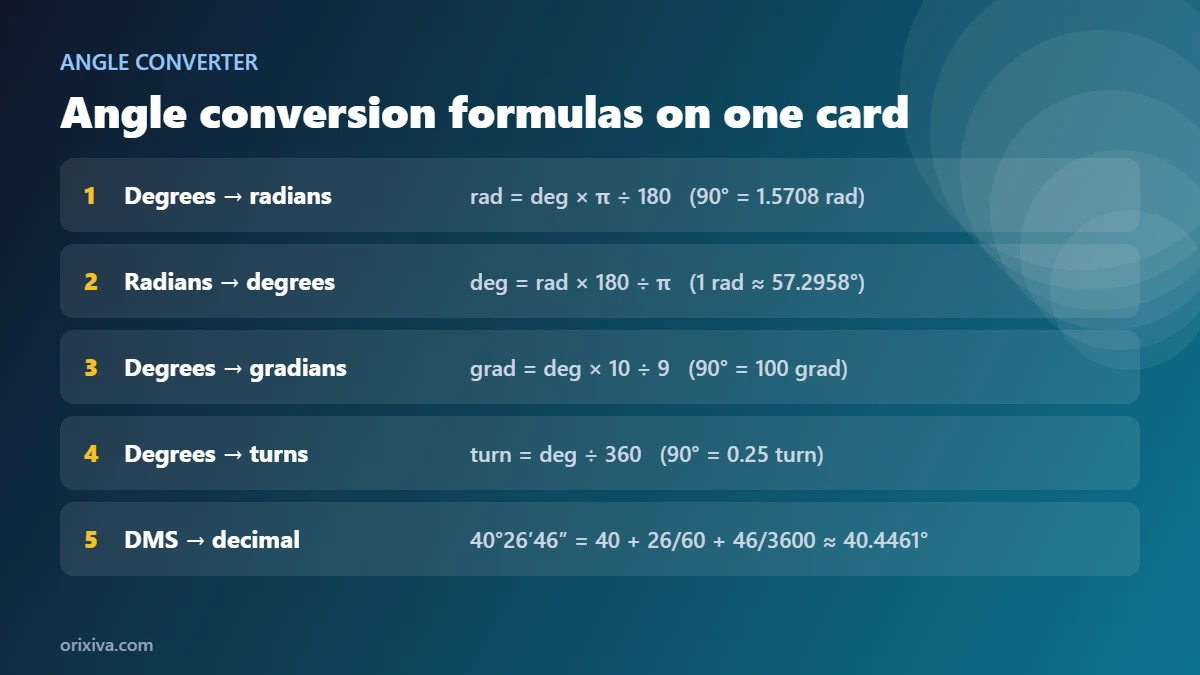
Angle Conversion Formulas Made Simple
Angle conversion changes the unit, not the angle itself. The same rotation can be expressed in degrees, radians, gradians, or turns.
Degrees and radians
- Degrees to radians: radians = degrees × π ÷ 180
- Radians to degrees: degrees = radians × 180 ÷ π
| Degrees | Radians | Meaning |
|---|---|---|
| 30° | π/6 ≈ 0.5236 | Acute angle |
| 45° | π/4 ≈ 0.7854 | Acute angle |
| 90° | π/2 ≈ 1.5708 | Right angle |
| 180° | π ≈ 3.1416 | Straight angle |
| 360° | 2π ≈ 6.2832 | Full turn |
Degrees and gradians
A full circle is 360° or 400 gradians (gon).
- Degrees to gradians: gradians = degrees × 10 ÷ 9
- Gradians to degrees: degrees = gradians × 9 ÷ 10
Example: 90° × 10 ÷ 9 = 100 gon.
Degrees and turns
- Degrees to turns: turns = degrees ÷ 360
- Turns to degrees: degrees = turns × 360
Example: 180° ÷ 360 = 0.5 turn.
Degrees, arcminutes, and arcseconds
One degree equals 60 arcminutes and 3,600 arcseconds. One arcminute equals 60 arcseconds. These smaller units can be useful in astronomy, navigation, and precise angle descriptions.
Visual Guide: Parts of a Circle
90°
Quarter turn
180°
Half turn
360°
Full turn
These illustrations are learning aids, not precision measurement diagrams.
Worked Examples
- 45° to radians: 45 × π ÷ 180 = π/4 ≈ 0.7854 rad.
- π radians to degrees: π × 180 ÷ π = 180°.
- 200 gon to degrees: 200 × 9 ÷ 10 = 180°.
- 0.25 turn to degrees: 0.25 × 360 = 90°.
- 2° to arcminutes: 2 × 60 = 120′.
Formula Selection Flowchart
Choose your source unit
↓
Degrees ↔ Radians
Use π and 180
Degrees ↔ Gon
Use 10/9 or 9/10
Degrees ↔ Turns
Use 360
↓
Check result, unit, and precision
Common Mistakes to Avoid
- Mixing degrees and radians: programming libraries often expect radians.
- Leaving out the unit: label the result with °, rad, gon, or the correct unit.
- Rounding too early: keep enough digits during intermediate calculations.
- Assuming every tool supports every unit: check the available unit list.
- Using rounded results in precision work: follow the accuracy standard for your project.
Ready to Convert an Angle?
Use the online calculator to check a value, then return to the examples if you want to understand the formula.
Use the Free Angle ConverterDegrees or radians: which unit should you use?
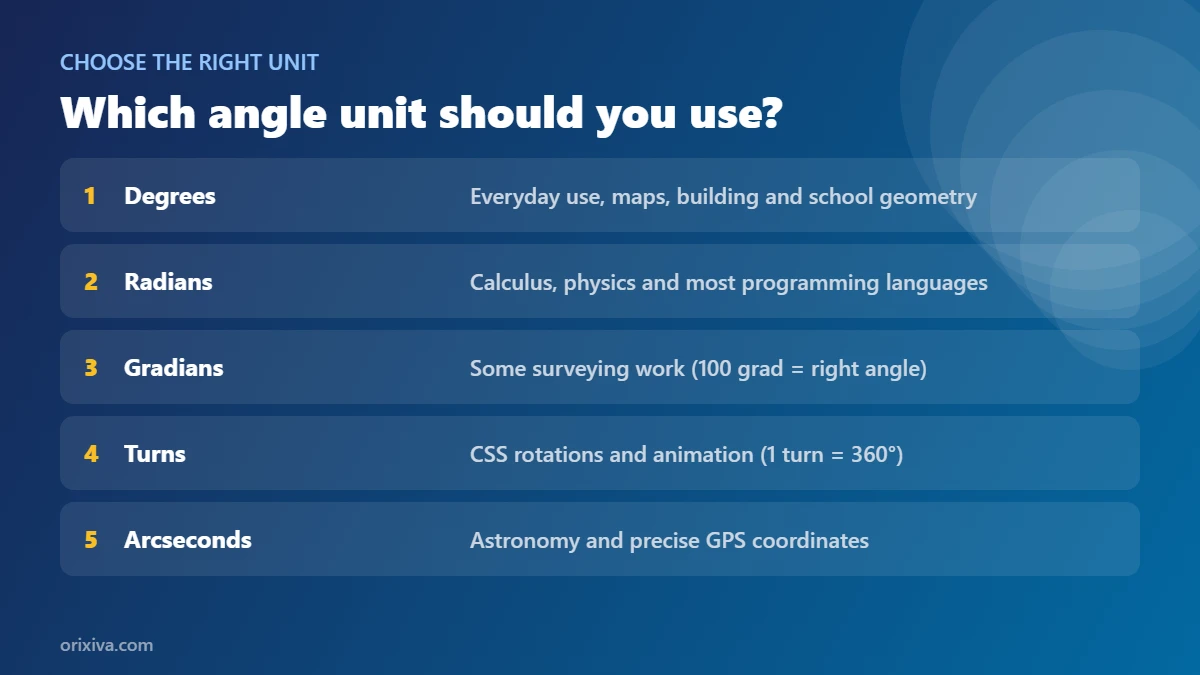
Use degrees when you talk to people. They are easy to picture, and most maps, building plans, school textbooks and compass apps use them. Use radians when you do maths or write code, because calculus formulas and nearly every programming language are built around them. Gradians are mainly found in some surveying instruments, turns are handy for CSS rotations and animations, and arcseconds appear in astronomy and very precise GPS work.
If you are not sure which unit a value is in, look at its size. An angle written as 1.57 is almost certainly in radians, because 1.57 degrees is a tiny angle. A value like 90 or 45 is usually in degrees. When in doubt, check the source, then use the angle converter to switch units before you calculate.
Angle converter table: common angles in every unit
Many angles come up again and again in maths, design and engineering. Keep this angle converter table nearby, or bookmark this page, so you can check a value without typing it in.
| Degrees | Radians (exact) | Radians (decimal) | Gradians | Turns |
|---|---|---|---|---|
| 0° | 0 | 0 | 0 | 0 |
| 30° | π/6 | 0.5236 | 33.333 | 0.0833 |
| 45° | π/4 | 0.7854 | 50 | 0.125 |
| 60° | π/3 | 1.0472 | 66.667 | 0.1667 |
| 90° | π/2 | 1.5708 | 100 | 0.25 |
| 120° | 2π/3 | 2.0944 | 133.333 | 0.3333 |
| 180° | π | 3.1416 | 200 | 0.5 |
| 270° | 3π/2 | 4.7124 | 300 | 0.75 |
| 360° | 2π | 6.2832 | 400 | 1 |
Decimal radians are rounded to four places. One radian is about 57.2958 degrees, which is the angle you get when the arc along a circle is as long as its radius. The radian is the SI unit for angles, which is why most maths and programming tools expect it.
Angle converter in real life: slopes, roofs, maps and compasses
Angles are not only for maths homework. You meet them every time you read a road sign, a building plan or a map. An angle converter helps you move between the way a value is written and the unit you actually need.
Road and ramp slopes
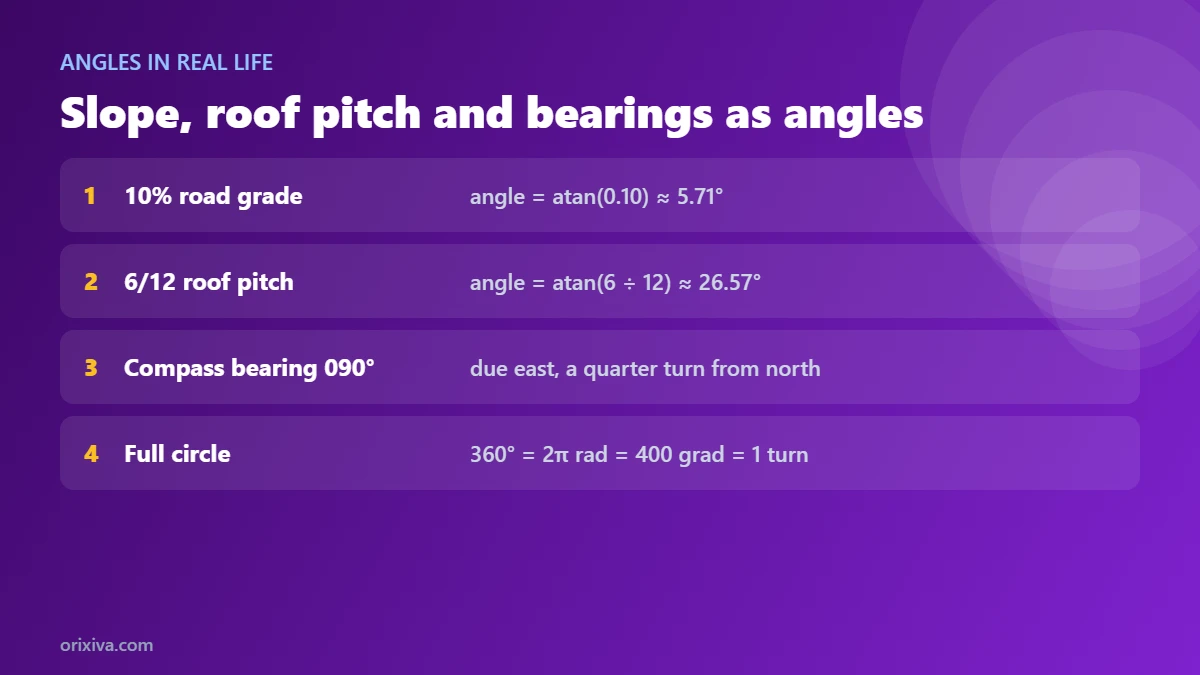
Road signs often show slope as a percentage grade, not degrees. A 10% grade means the road rises 10 metres for every 100 metres across. To turn it into an angle, take the inverse tangent: atan(0.10) ≈ 5.71°. Steep-looking hills are often smaller angles than people expect.
Roof pitch
Builders in many countries describe roof pitch as rise over run, such as 6/12. That means 6 units up for every 12 across, so the angle is atan(6 ÷ 12) ≈ 26.57°. Once you have degrees, the angle converter can give you radians for a design app or gradians for a surveying tool.
Map coordinates
Latitude and longitude are angles too. GPS apps usually show decimal degrees, while older maps use degrees, minutes and seconds. For example, 40°26′46″ = 40 + 26/60 + 46/3600 ≈ 40.4461°. One arcminute is 1/60 of a degree and one arcsecond is 1/3600 of a degree.
Compass bearings and surveying
A compass bearing of 090° points due east, which is a quarter turn from north. In some countries surveyors use gradians, where a right angle is exactly 100 grad. That makes slope and percentage maths a little easier on the field, and the angle converter switches between both systems in one step.
Angle converter tips for programmers and spreadsheet users
A very common bug in code is passing degrees to a function that expects radians. Here is how popular tools handle angles:
- JavaScript:
Math.sin()andMath.cos()use radians.Math.sin(30)is not 0.5; useMath.sin(30 * Math.PI / 180)instead. - Python: the
mathmodule also uses radians. Convert withmath.radians(30)and back withmath.degrees(). - Excel and Google Sheets:
SIN()expects radians, so write=SIN(RADIANS(30)).DEGREES()converts back. - CSS: rotations accept
deg,rad,gradandturn, sorotate(0.25turn)is the same asrotate(90deg). See the MDN guide to CSS angle units.
When a result looks wrong, check the unit first. Paste the value into the angle converter, switch it to radians, and compare it with what your code is using. Need other units such as length, area or speed? Use the full unit converter, or read our guide on how to convert units. For trigonometry with your converted value, the scientific calculator has sin, cos and tan in both degree and radian modes.
Frequently Asked Questions About Angle Conversion
Using the converter
1. How angle converter online free without email?
Open the Angle Converter page, enter your angle, select the starting and target units, then press Convert or Calculate. If the tool does not ask for an email, you can use it without entering one.
2. What is an angle converter?
It changes an angle value from one unit to another, such as degrees to radians.
3. Is an online angle converter free?
This page is intended as a free online angle conversion tool. Check the live page for current access details.
4. Do I need to install an app?
A browser-based converter can be used directly in a web browser without installing a separate app.
5. Can I use it on my phone?
Yes, if the page is responsive. Use an up-to-date mobile browser and check that all input fields and results fit the screen.
6. Why do I need to choose the source and target units?
The source unit explains how to read your input. The target unit defines the unit used for the result.
7. Why does the result show decimals?
Some conversions produce long or irrational decimal values. The displayed answer may be rounded.
8. Does conversion change the angle itself?
No. It changes only the unit used to express the same angle.
9. Which units does this converter support?
Use the options shown in the live tool. Common units include degrees, radians, gradians, turns, arcminutes, and arcseconds, but not every tool supports all of them.
10. What should I do if my result looks wrong?
Check the input, source unit, target unit, sign, and rounding. Test a familiar value such as 180° = π radians.
Degrees and radians
11. How do I convert degrees to radians?
Multiply degrees by π and divide by 180. For example, 90° equals π/2 radians.
12. How do I convert radians to degrees?
Multiply radians by 180 and divide by π. For example, π radians equals 180°.
13. How many radians are in 180 degrees?
180 degrees equals π radians, about 3.14159 radians.
14. How many radians are in 90 degrees?
90 degrees equals π/2 radians, about 1.5708 radians.
15. How many degrees are in one radian?
One radian is 180/π degrees, about 57.2958°.
16. What is π/4 radians in degrees?
π/4 radians equals 45 degrees.
17. Why are radians used in maths and science?
Radians connect angles with circle geometry and are widely used in trigonometry, calculus, physics, and computing.
18. Do programming languages use degrees or radians?
Check the function documentation. Many programming languages and scientific libraries expect radians for trigonometric functions.
Gradians, turns, and smaller units
19. What is a gradian?
A gradian, also called gon, uses 400 units for a full circle. A right angle is 100 gon.
20. How do I convert degrees to gradians?
Multiply degrees by 10/9. For example, 90° equals 100 gon.
21. How do I convert gradians to degrees?
Multiply gradians by 9/10. For example, 200 gon equals 180°.
22. What is one turn?
One turn is one complete rotation, equal to 360 degrees or 2π radians.
23. How many degrees are in half a turn?
Half a turn equals 180 degrees.
24. How many degrees are in a quarter turn?
A quarter turn equals 90 degrees.
25. What is an arcminute?
An arcminute is one-sixtieth of a degree, shown with the symbol ′.
26. What is an arcsecond?
An arcsecond is one-sixtieth of an arcminute, or one 3,600th of a degree, shown with ″.
27. How many arcminutes are in a degree?
There are 60 arcminutes in one degree.
28. How many arcseconds are in a degree?
There are 3,600 arcseconds in one degree.
Examples and accuracy
29. What is 45 degrees in radians?
45° equals π/4 radians, about 0.785398 radians.
30. What is 30 degrees in radians?
30° equals π/6 radians, about 0.523599 radians.
31. What is 360 degrees in radians?
360° equals 2π radians, about 6.283185 radians.
32. What is 100 gradians in degrees?
100 gon equals 90 degrees, a right angle.
33. What is 0.5 turn in degrees?
0.5 turn equals 180 degrees.
34. Why might two converters show slightly different answers?
They may use different display precision or rounding. Compare the unit and decimal places.
35. How many decimal places should I use?
Use the precision required by your task or assignment. Keep enough digits during intermediate steps.
36. Is rounding safe for engineering work?
Follow your project's precision rules and avoid relying on a rounded display for high-precision work without checking it.
37. Can an angle be negative?
Yes. In many maths contexts, a negative angle represents rotation in the opposite direction. Check how your converter handles negative values.
38. Can an angle be greater than 360 degrees?
Yes. It can represent multiple rotations. Some tools normalize values, so check the output and available settings.
Learning and work
39. Can students use this tool for homework?
Yes. It can check conversions, but students should also learn the formula and show working when asked.
40. Can teachers use it in lessons?
Yes. It can demonstrate how the same angle can be written in different units.
41. Is it useful for physics?
Yes. Physics formulas may require degrees or radians, so always use the unit expected by the equation.
42. Is it useful for engineering?
It can help with routine conversions. Engineering work should follow the relevant measurement standards and tolerances.
43. Is it useful for surveying?
It can help compare supported units, but users should verify instrument settings and applicable standards.
44. Can programmers use an angle converter?
Yes. It can help check values used in trigonometry, graphics, and rotation calculations.
45. Does an angle converter replace a scientific calculator?
No. It focuses on unit conversion unless the tool also includes other calculation functions.
46. What is the easiest way to check a conversion?
Try a known value such as 90° = π/2 radians or 360° = one full turn, then compare the output.
Ready to Convert an Angle?
Enter your value, choose the units, and check the result in the online converter.
Try the Angle Converter Free