Try our free AI tools – no sign-up needed!


Energy Calculator Online: Convert kWh, Calories, Joules and BTU (With Real Examples)
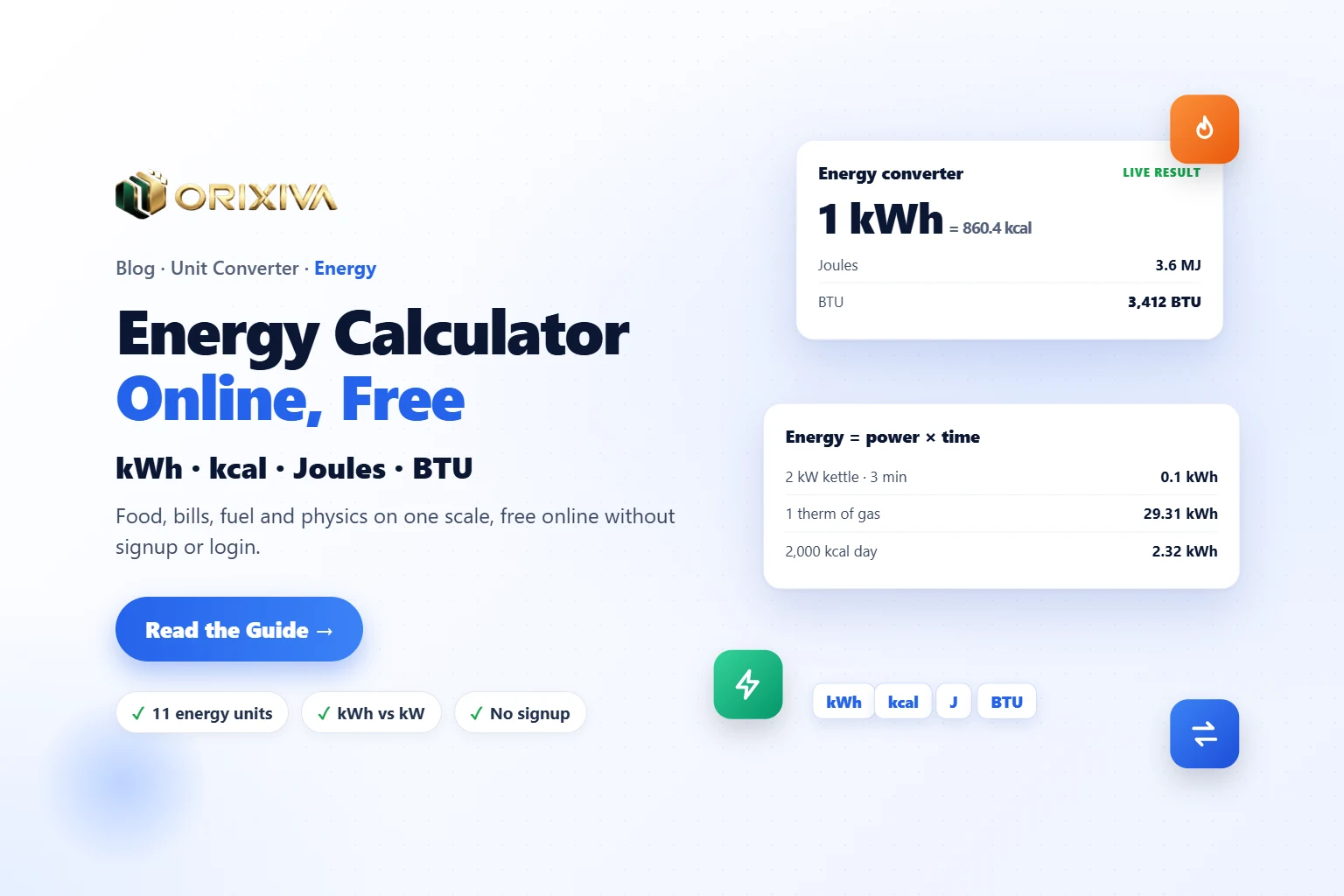
Need the number now? The free energy converter changes kWh to kcal, joules to calories, therms to kWh and 8 more units instantly, with no login and the working shown.
Jump to the free tool ↓Your electricity bill is in kWh, your gas bill in therms, a food label in kcal or kJ, an air conditioner in BTU and a physics worksheet in joules. They all measure the same thing: energy. An energy calculator online puts them on one scale, so you can compare a meal with a phone charge, or a gas bill with an electric one.
This guide explains each unit in simple English, shows the difference between energy and power, and works through real examples from food, home bills, fuel and science. You can check every result with the free Orixiva energy converter, which is free online, needs no signup or login, and shows all 11 energy units at once.
Key takeaways
- The joule (J) is the SI unit of energy. 1 kWh = 3.6 million J = 3.6 MJ.
- 1 kcal (a food “Calorie”) = 4.184 kJ, and 1 kWh = 860.4 kcal.
- 1 kWh = 3,412 BTU, and 1 therm = 100,000 BTU = 29.31 kWh.
- Energy = power × time. A 2 kW kettle running for 3 minutes uses 0.1 kWh.
- The Orixiva energy converter covers J, kJ, MJ, cal, kcal, Wh, kWh, BTU, therm, foot-pound and electronvolt.
Energy units explained
Joule (J, kJ, MJ)
The SI unit. Lifting a 100 g apple by 1 metre takes about 1 J. Food labels in many countries show kJ.
Calorie (cal, kcal)
1 cal = 4.184 J. The “Calories” on food labels are kilocalories: 1 kcal = 1,000 cal.
Watt-hour (Wh, kWh)
Electricity. 1 kWh is 1,000 watts for one hour. Bills charge per kWh.
BTU and therm
Heat energy in the US and UK. 1 BTU ≈ 1,055 J; 1 therm = 100,000 BTU, used on gas bills.
Foot-pound (ft·lbf)
Imperial work unit. 1 ft·lbf = 1.356 J. Also familiar from torque wrenches, though torque is a different quantity.
Electronvolt (eV)
Tiny: 1.602 × 10⁻¹⁹ J. Used in atomic and particle physics and for photon energies.
The US Energy Information Administration describes a BTU as the heat needed to raise one pound of water by 1 °F, and lists 1 kWh as 3,412 BTU, the same factor the converter uses.
Energy vs power: kWh is not kW
energy = power × time · kWh = kW × hours · J = W × seconds
Power is how fast energy is used, measured in watts (W) or kilowatts (kW). Energy is the total amount used, measured in kWh or joules. A 2,000 W (2 kW) kettle running for 3 minutes (0.05 h) uses 2 × 0.05 = 0.1 kWh, which is 360 kJ or 86 kcal.
Power (rate)
Watts, kW, horsepower, BTU per hour.
2 kW
- How hard something works right now
- Use the power converter
Energy (amount)
Joules, kWh, kcal, BTU, therms.
0.1 kWh
- How much is used over time
- Use the energy converter
Air conditioners are a common source of confusion: a “12,000 BTU” unit really means 12,000 BTU per hour, which is power (about 3.5 kW of cooling). In the energy converter, 12,000 BTU of energy is 3.52 kWh.
Flowchart: pick the right energy unit
- What are you measuring?Food, electricity, gas, fuel or physics
- Is it food or exercise?YesUse kcal or kJNoGo to the next question
- Is it electricity or a battery?YesUse Wh or kWhNo, heating or gasUse BTU, therm or kWh
- Is it a physics or chemistry problem?Use joules; eV for atoms and photons
- Convert to comparePut everything in kWh or MJ to compare sources fairly
Food energy: kcal and kJ
kJ = kcal × 4.184 · kcal = kJ ÷ 4.184
Food labels in the US use Calories (kcal); labels in Australia, the EU and many other places show kJ as well. Examples:
- A banana (about 105 kcal) = 439 kJ.
- A 250 kcal snack bar = 1,046 kJ.
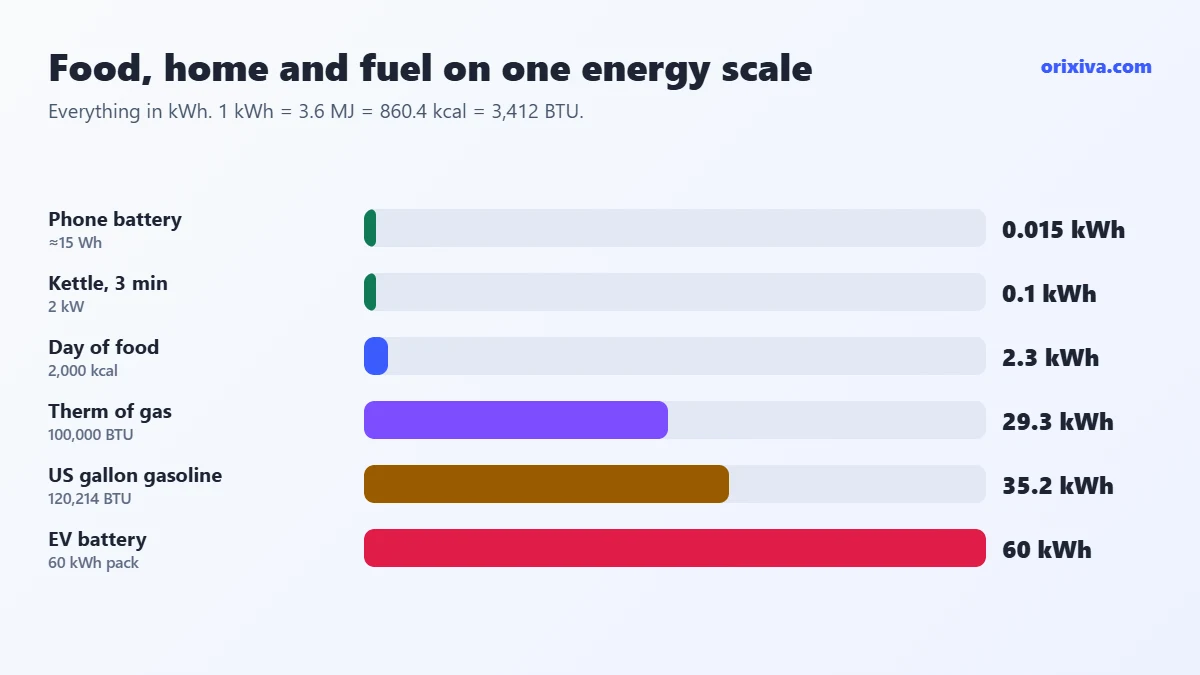
- A 2,000 kcal day = 8,368 kJ = 8.37 MJ = 2.32 kWh.
That last line surprises many people: a whole day of food is about the same energy as running a 2 kW heater for just over an hour. For daily energy needs, see BMI vs body fat vs TDEE and the health and fitness calculators.
Home energy: kWh, therms and BTU
Comparing gas and electricity bills
Gas may be billed in therms, cubic metres or kWh; electricity in kWh. Convert gas to kWh to compare:
- 1 therm = 29.31 kWh.
- A 50-therm month = 1,465 kWh of heat energy.
- 100 cubic feet of natural gas (about 103,600 BTU, using EIA’s average) ≈ 30.4 kWh.
Example: cost per kWh of heatGas at $1.50 per therm costs 1.50 ÷ 29.31 = $0.051 per kWh of heat. Electricity at $0.15 per kWh costs about three times as much per unit of energy, though heat pumps can deliver several kWh of heat per kWh of electricity. Our electricity cost guide shows how to price each appliance.
Comparing appliances in BTU and kWh
Heaters in the US are sometimes sold by BTU output. A 1,500 W electric heater running for 4 hours uses 6 kWh, which is about 20,500 BTU of heat. Converting both sides to kWh makes a gas heater and an electric heater easy to compare.
Small everyday amounts
- Boiling 1 liter of water from 20 °C takes about 335 kJ (0.093 kWh) of heat.
- A phone battery of about 15 Wh holds 54 kJ, roughly 13 kcal.
- A 60 kWh electric car battery holds 216 MJ, about 51,600 kcal.
Turning energy into cost
cost = energy used × price per unit
Convert everything to the unit your tariff uses, then multiply. A heater using 3 kWh a day at $0.15 per kWh costs $0.45 a day, or about $13.50 a month. A home using 60 therms of gas in a winter month at $1.50 per therm pays $90 for 1,758 kWh of heat.
Heat pumps and efficiency
A heat pump moves heat instead of making it, so it can deliver more heat energy than the electricity it uses. Its coefficient of performance (COP) describes this: with a COP of 3, 1 kWh of electricity gives about 3 kWh of heat. Compare heating options by the cost per kWh of heat delivered, not per kWh bought.
Which units appear on bills?
- Electricity: kWh almost everywhere.
- Gas: therms or hundreds of cubic feet in the US; kWh on many UK and European bills, converted from the cubic metres the meter records.
- Food: kcal in the US; kJ and kcal together in the EU, Australia and many other countries.
Fuels compared in kWh
Energy content in kWh
Approximate, using EIA average heat contents.
1 US gal diesel137,381 BTU
40.3 kWh
1 US gal gasoline120,214 BTU
35.2 kWh
1 therm natural gas100,000 BTU
29.3 kWh
1 US gal propane91,452 BTU
26.8 kWh
2,000 kcal of foodone day’s diet
2.3 kWh
Bars to scale. Heat content is not the same as useful work: engines and boilers lose part of it.
A US gallon of gasoline holds about 35.2 kWh, about 9.3 kWh per liter. For running costs on the road, see EV vs petrol running cost.
Batteries and solar panels
From mAh to Wh
Phone and power bank batteries are labelled in milliamp-hours (mAh), which measure charge, not energy. To get energy, multiply by the battery voltage:
Wh = mAh × volts ÷ 1,000
- A 4,000 mAh phone battery at 3.85 V: 4,000 × 3.85 ÷ 1,000 = 15.4 Wh.
- A 20,000 mAh power bank at 3.7 V: 74 Wh. Airlines usually state carry-on limits in Wh, so this conversion is useful before a flight.
Once you have Wh, the energy converter turns it into kJ, kcal or BTU.
Solar panel output
A panel’s rating in watts is power. Energy depends on sunshine: a 400 W panel that gets the equivalent of 4.5 hours of full sun produces about 0.4 × 4.5 = 1.8 kWh in a day, or about 54 kWh in a 30-day month. Real output varies with location, season, shading and panel angle.
Worked example: which heating fuel is cheapest?
Convert each fuel to cost per kWh of heat, using EIA heat contents. Prices below are examples only; use your own.
| Fuel | Example price | Energy per unit | Cost per kWh of heat |
|---|---|---|---|
| Natural gas | $1.50 per therm | 29.31 kWh | $0.051 |
| Propane | $2.50 per US gallon | 26.80 kWh | $0.093 |
| Heating oil | $3.80 per US gallon | 40.59 kWh | $0.094 |
| Electricity | $0.15 per kWh | 1 kWh | $0.150 |
Before boiler or heat-pump efficiency. A boiler at 90% efficiency raises the effective cost by about 11%; a heat pump with a COP of 3 cuts the electricity figure to about $0.05.
Science: joules, foot-pounds and electronvolts
- Lifting work: raising 10 kg by 2 m takes mass × g × height = 10 × 9.81 × 2 = 196 J, only 0.047 kcal.
- Imperial work: 1 J = 0.7376 ft·lbf, and 1 ft·lbf = 1.356 J.
- Atomic scale: 1 eV = 1.602 × 10⁻¹⁹ J. 1 kWh is about 2.25 × 10²⁵ eV, so the converter switches to scientific notation automatically.
For work, power and other physics formulas, the electrical and physics calculator includes an Energy, Work & Power tool.
Energy units from smallest to largest
How big is each unit?
Value in joules, on a log-style scale (each step is a multiple).
Electronvolt (eV)
1.6 × 10⁻¹⁹ J
Joule (J)
1 J
Foot-pound
1.36 J
Calorie (cal)
4.18 J
BTU
1,055 J
Watt-hour (Wh)
3,600 J
Kilocalorie (kcal)
4,184 J
Kilowatt-hour
3.6 MJ
Therm
105.5 MJ
The span is enormous: one therm is about 6.6 × 10²⁶ electronvolts.
Energy conversion chart
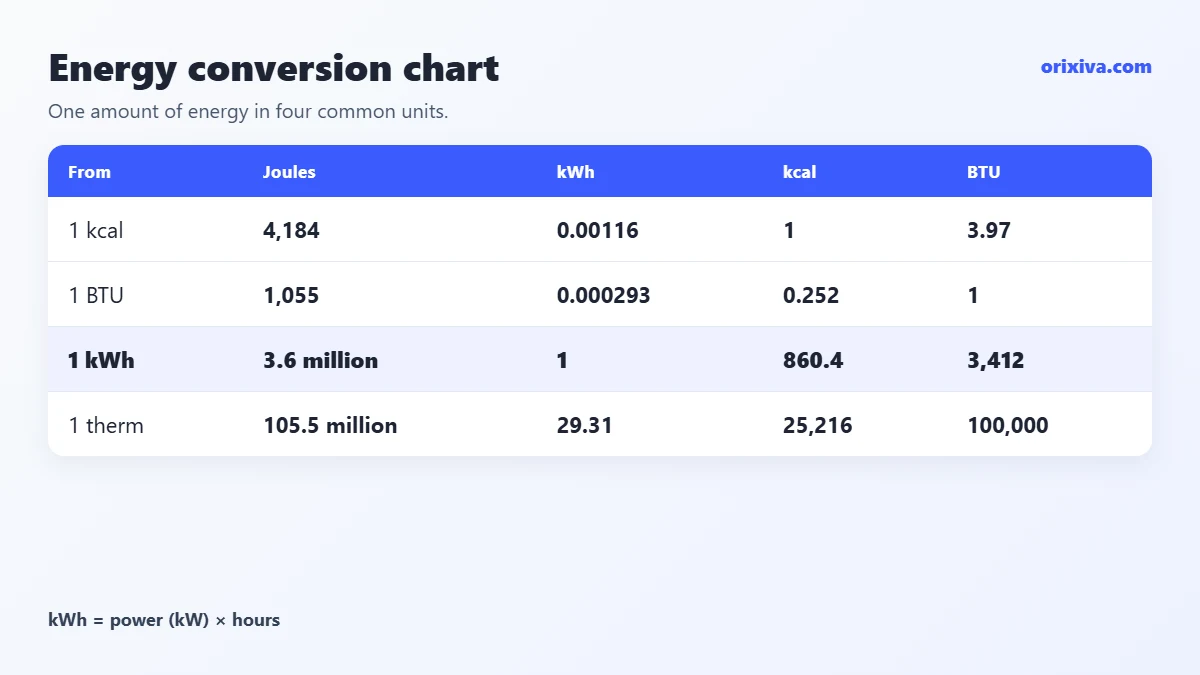
| From | Joules | kWh | kcal | BTU |
|---|---|---|---|---|
| 1 kJ | 1,000 | 0.000278 | 0.239 | 0.948 |
| 1 kcal | 4,184 | 0.001162 | 1 | 3.966 |
| 1 BTU | 1,055.06 | 0.000293 | 0.252 | 1 |
| 1 Wh | 3,600 | 0.001 | 0.860 | 3.412 |
| 1 MJ | 1,000,000 | 0.2778 | 239.0 | 947.8 |
| 1 kWh | 3,600,000 | 1 | 860.4 | 3,412.1 |
| 1 therm | 105,505,585 | 29.31 | 25,216 | 100,000 |
How to convert energy in Excel or Google Sheets
The CONVERT function covers several energy units. In Microsoft’s CONVERT reference, “cal” is the International Table calorie (4.1868 J), while the Orixiva converter uses the thermochemical calorie (4.184 J), the value used for food energy. The difference is under 0.07%.
| Conversion | Formula |
|---|---|
| kWh to BTU | =CONVERT(A2,"kWh","BTU") |
| Joules to BTU | =CONVERT(A2,"J","BTU") |
| kcal to kJ (food) | =A2*4.184 |
| Therms to kWh | =A2*29.3071 |
How to use the free energy converter (step by step)
- Open the energy converter. Go to the Orixiva energy converter. It opens on 1 kWh to kcal.
- Type a value or E = P × t. Enter an amount such as 2000, or a power-times-time sum with kWh selected, such as
2*3/60for a 2 kW kettle running 3 minutes. - Choose From and To units. Joule, kilojoule, megajoule, calorie, kilocalorie, watt-hour, kilowatt-hour, BTU, therm, foot-pound force or electronvolt.
- Read the result. It updates as you type, with both rates (1 kWh = 860.4 kcal and 1 kcal = 0.001162 kWh), the scientific form and full precision.
- Check the working. “How it was calculated” converts your value into joules first, then into the target unit.
- Compare all 11 units. The table shows one amount of energy in every unit at once.
- Save or share. Swap, copy, download TXT or print. Press Convert to keep it in Recent conversions and export as CSV.
The energy calculator is free online, without signup, sign-in or login, and runs entirely in your browser on PC or mobile.
Mistakes to avoid when converting energy
Confusing kW and kWh
kW is power; kWh is energy. A 1 kW heater uses 1 kWh only if it runs for an hour.
Mixing calories and kilocalories
Food “Calories” are kilocalories. A 200-Calorie snack is 200 kcal, or 200,000 small calories.
Treating BTU/h as BTU
Air conditioner and heater ratings in BTU are usually BTU per hour (power). Multiply by hours of use to get energy.
Mixing up the calorie definitions
Thermochemical calories (4.184 J) and International Table calories (4.1868 J) differ slightly. For food and everyday use the difference does not matter, but check which one a scientific source uses if you need many decimal places.
Comparing heat content with useful energy
A gallon of gasoline holds 35 kWh of heat, but a car engine turns only part of it into motion. Compare sources fairly by including efficiency.
Your turn: Which energy unit appears on your bills: kWh, therms or cubic metres? Share it in the comments with your country to help others compare.
Use the free energy calculator online now
Convert kWh, kcal, joules, BTU, therms and more, work out energy from power and time, and copy the working. Free, without login or signup, and nothing leaves your browser.
Open the free energy converter → Looking for another converter or calculator? Search on orixiva.comRelated guides: pressure calculator online, speed calculator online, Celsius to Fahrenheit and how to convert units.
Energy calculator questions people often ask
Is the energy calculator free online without login or signup?
Yes. The Orixiva energy converter is free, needs no login, sign-in or signup, and runs in your browser.
How many kcal are in 1 kWh?
1 kWh = 860.4 kcal.
How do I convert kcal to kJ?
Multiply by 4.184. For example, 500 kcal × 4.184 = 2,092 kJ.
How many BTU are in a kWh?
About 3,412 BTU.
How many kWh are in a therm?
1 therm = 100,000 BTU = 29.31 kWh.
What is the difference between kW and kWh?
kW measures power (a rate); kWh measures energy (an amount). Energy in kWh = power in kW × hours.
How many joules are in one BTU?
About 1,055 J. 1,000 BTU is about 1.055 MJ or 0.293 kWh.
How many kWh are 500 kcal?
500 ÷ 860.4 = 0.58 kWh. A 500 kcal workout uses about as much energy as a 1 kW heater running for 35 minutes.
How many kJ are in a kWh?
3,600 kJ. One kilowatt-hour is 1,000 joules per second for 3,600 seconds.
How many joules are in a kWh?
3,600,000 joules. It is a large number because a joule is a small amount of energy.
How many MJ are in a kWh?
Exactly 3.6 MJ, because 1 kWh = 1,000 W × 3,600 s = 3,600,000 J.
What is a therm?
A therm is 100,000 BTU, about 105.5 MJ or 29.31 kWh. It is used on natural gas bills, mainly in the US.
Is a food Calorie the same as a calorie?
No. A food Calorie (capital C) is a kilocalorie, 1,000 small calories or 4.184 kJ.
How do I convert mAh to Wh?
Multiply mAh by the battery voltage and divide by 1,000. 5,000 mAh at 3.7 V is 18.5 Wh.
How much energy does a 1,000 W appliance use?
1 kWh for every hour it runs at full power, which is 3.6 MJ or 860 kcal.
How many joules are in a calorie?
1 calorie = 4.184 J, and 1 kilocalorie (food Calorie) = 4,184 J.



[…] Energy Calculator Online: Convert kWh, Calories, Joules and BTU (With Real Examples) […]