Try our free AI tools – no sign-up needed!


Orixiva • Practical conversion guide
How to Convert Units: A Simple Guide to Everyday Measurements
Need to change metres into feet, Celsius into Fahrenheit, GB into GiB, or Mbps into MB/s? This easy guide explains how to convert units, with examples, formulas, and simple flowcharts. Use the Orixiva Unit & Conversion tool to calculate results in your browser.
14 converter categoriesFormula-led resultsBrowser-basedBeginner-friendly
What is a unit converter?
A unit converter changes a measurement from one unit to another without changing the quantity being measured. For example, 1 kilometre equals 1,000 metres, and 0°C equals 32°F. A good converter uses a clear conversion factor or formula and shows the unit beside every result.
Unit conversions are useful in school, travel, cooking, construction, science, engineering, fitness, internet-speed checks, energy planning, and daily work. The main challenge is that different systems use different units. This guide helps you select the right conversion and understand the result.
How to convert units with the Orixiva unit converter
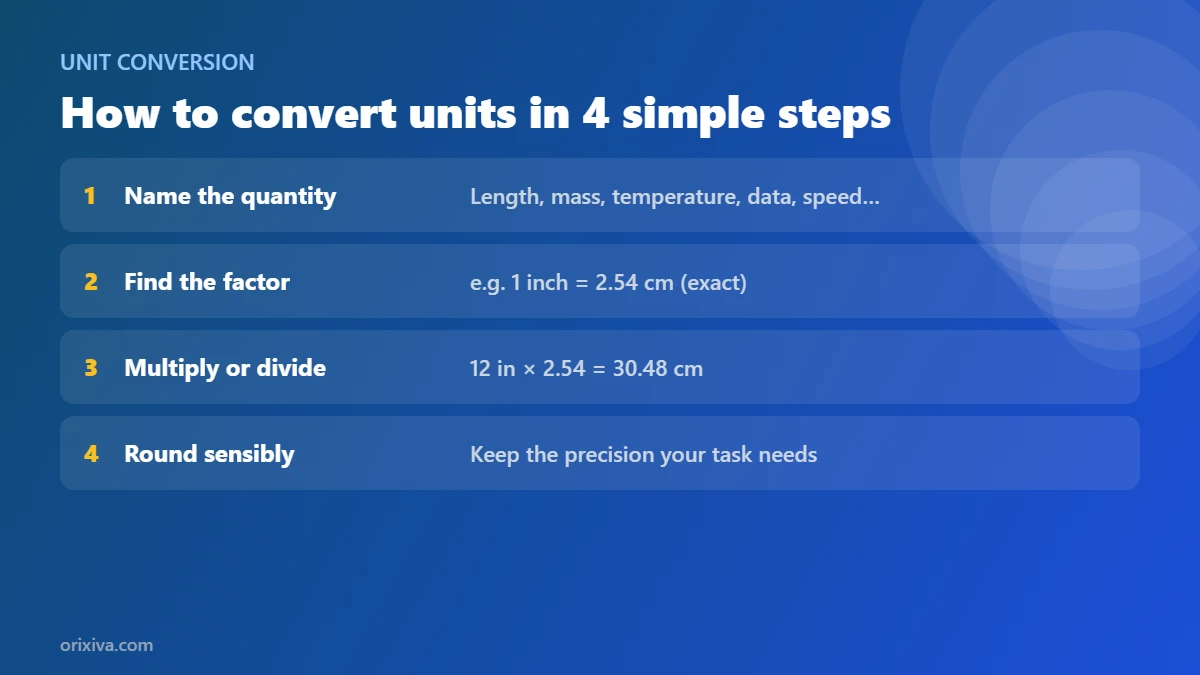
- Choose a converter category, such as Length, Temperature, or Digital Storage.
- Enter a number or a simple expression such as
5/2or3+4. - Select the starting unit in From.
- Select the required unit in To.
- Choose precision and number format if needed.
- Select Convert and review the result, unit table, and calculation steps.
- Copy, download, or print the result when you need a record.
Helpful tip: Always read the unit symbol after the number. A result of 20 MB/s is not the same as 20 Mbps.
Explore all 14 unit converter categories
The tool includes the following categories. Each one solves a different type of conversion problem.
1Length Converter
Convert nanometres, micrometres, millimetres, centimetres, metres, kilometres, inches, feet, yards, miles, nautical miles, astronomical units, and light-years.
Example: 1 metre = 100 centimetres = about 3.28084 feet.
Useful for school, DIY projects, construction, travel distances, and science.
2Weight / Mass Converter
Convert micrograms, milligrams, grams, kilograms, metric tonnes, ounces, pounds, stones, US short tons, UK long tons, carats, grains, troy ounces, tola, and maund.
Example: 1 kilogram is about 2.20462 pounds.
Mass units can vary by local convention. Check the stated standard for regional units.
3Temperature Converter
Convert Celsius, Fahrenheit, Kelvin, Rankine, and Réaumur. The tool also supports converting a temperature difference separately from an absolute temperature reading.
Example: 25°C = 77°F.
Important: temperature readings use offsets; temperature differences do not.
4Area Converter
Convert square millimetres, square centimetres, square metres, hectares, square kilometres, square inches, square feet, square yards, acres, square miles, marla, and kanal.
Example: 1 hectare = 10,000 square metres.
Marla and kanal definitions may differ by region; this tool uses the Punjab standard described in its notes.
5Volume Converter
Convert millilitres, litres, cubic metres, cubic centimetres, cubic inches, cubic feet, US teaspoons and tablespoons, US fluid ounces, cups, pints, quarts, gallons, imperial fluid ounces, pints, quarts, gallons, and oil barrels.
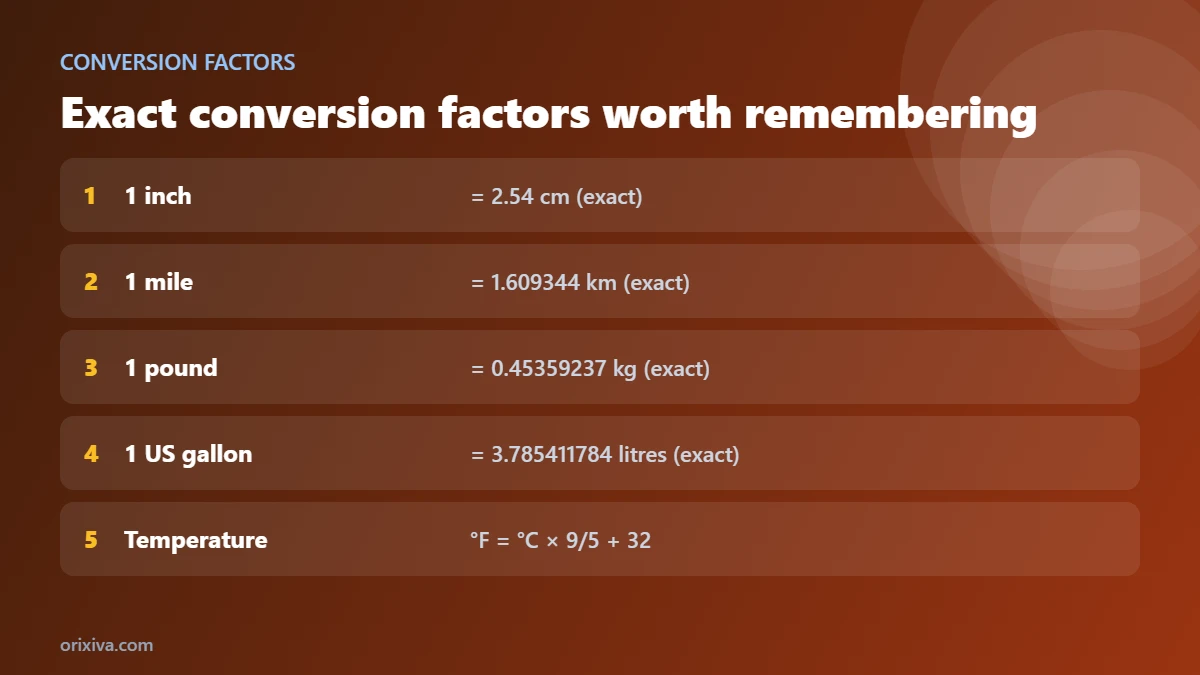
Example: 1 US gallon = 3.785411784 litres.
Do not confuse US customary and imperial liquid measures.
6Speed Converter
Convert metres per second, kilometres per hour, miles per hour, knots, feet per second, Mach at the tool's stated reference condition, and the speed of light.
Example: 100 km/h is about 62.14 mph.
Mach depends on local sound speed, which changes with air conditions.
7Digital Storage Converter
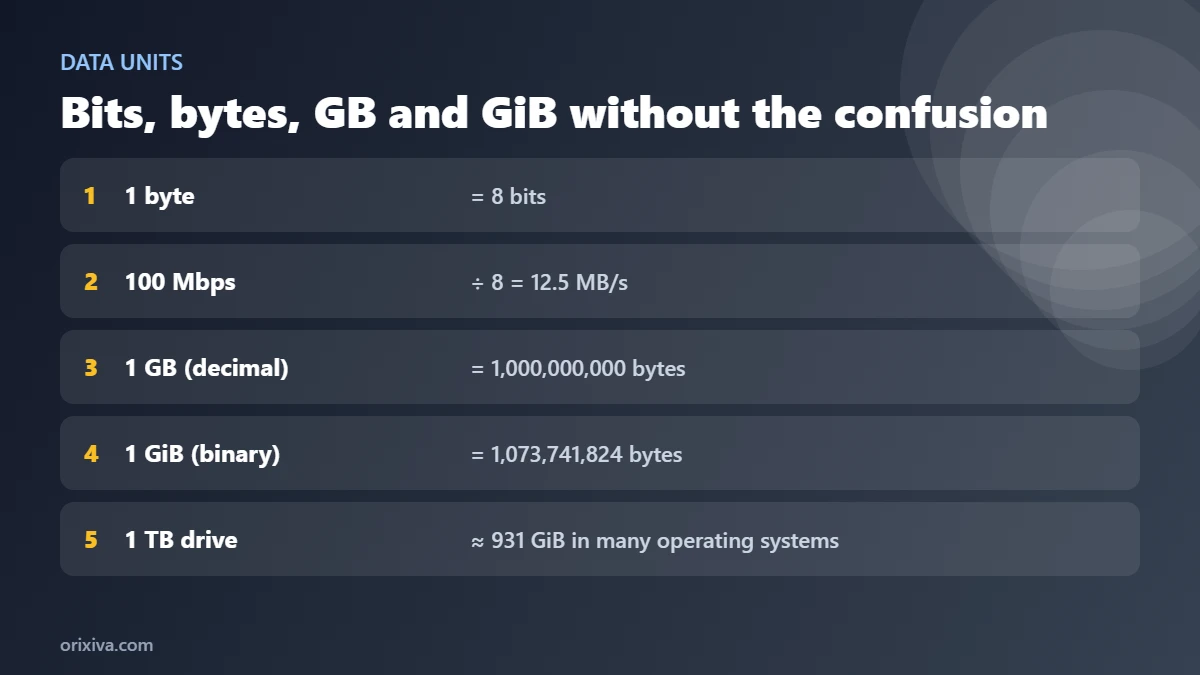
Convert bits, bytes, kilobits, megabits, gigabits, decimal kB/MB/GB/TB/PB, and binary KiB/MiB/GiB/TiB/PiB.
Example: 500 GB is about 465.66 GiB when comparing decimal and binary byte units.
SI units use powers of 1,000; IEC binary units use powers of 1,024.
8Pressure Converter
Convert pascals, hectopascals, kilopascals, megapascals, bar, millibar, standard atmospheres, psi, mmHg, inHg, torr, and kilogram-force per square centimetre.
Example: 1 bar = 100,000 pascals.
The converter changes units; it does not decide whether a pressure reading is safe for a device.
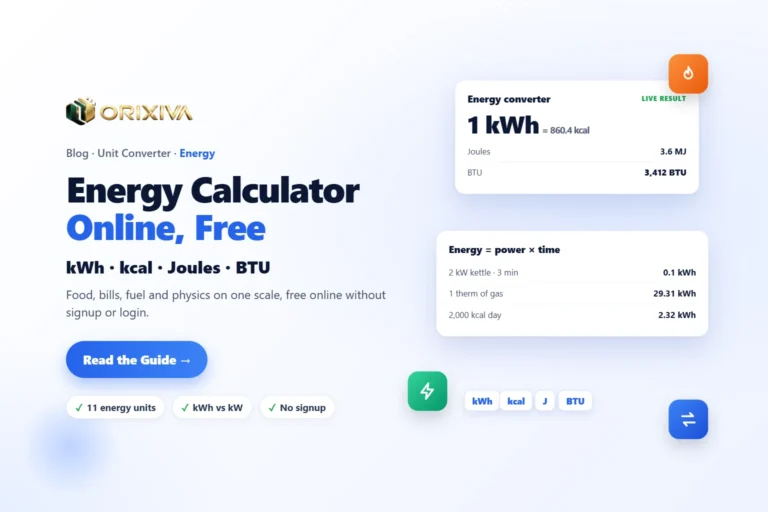
9Energy Converter
Convert joules, kilojoules, megajoules, calories, kilocalories, watt-hours, kilowatt-hours, BTU, therms, foot-pound force, and electronvolts.
Example: 1 kWh = 3.6 million joules.
Food Calories usually mean kilocalories, not small calories.
10Time Converter
Convert nanoseconds, microseconds, milliseconds, seconds, minutes, hours, days, weeks, average Gregorian months, and Gregorian years. A breakdown into days, hours, minutes, and seconds is also available.
Example: 90 minutes = 1.5 hours.
Months have different lengths; the tool uses an average month for this conversion category.
11Power Converter
Convert milliwatts, watts, kilowatts, megawatts, mechanical horsepower, metric horsepower, BTU per hour, kilocalories per hour, foot-pound force per second, and refrigeration tons.
Example: 1 kW = 1,000 watts.
Electrical power and energy are different quantities: kW measures power; kWh measures energy.
12Angle Converter
Convert degrees, radians, gradians, arc-minutes, arc-seconds, and full turns. The tool can also show degrees, minutes, and seconds.
Example: 180° = π radians.
Check whether your formula or calculator expects degrees or radians.
13Fuel Economy Converter
Convert litres per 100 kilometres, kilometres per litre, miles per US gallon, and miles per imperial gallon.
Example: 10 L/100 km = 10 km/L? No. These units are inversely related: 10 L/100 km = 10 km per litre? The correct relationship is 100 ÷ 10 = 10 km/L.
US mpg and UK mpg differ because their gallon sizes differ. Lower L/100 km means better fuel economy.
14Data Transfer Rate
Convert bits per second, kbps, Mbps, Gbps, bytes per second, kB/s, MB/s, GB/s, KiB/s, and MiB/s.
Example: 100 Mbps equals 12.5 MB/s before network overhead.
Internet providers usually advertise bits per second; file transfer displays often use bytes per second.
How to convert units: quick examples
| Conversion | Example | What to remember |
|---|---|---|
| Length | 2 km = 2,000 m | Multiply kilometres by 1,000. |
| Mass | 5 kg ≈ 11.023 lb | Use a precise factor for accurate work. |
| Temperature | 20°C = 68°F | °F = (°C × 9/5) + 32. |
| Area | 2 ha = 20,000 m² | Area factors are squared units. |
| Volume | 2 L = 2,000 mL | Confirm US or imperial units where relevant. |
| Speed | 36 km/h = 10 m/s | Divide km/h by 3.6 to get m/s. |
| Storage | 1 kB = 1,000 bytes | 1 KiB = 1,024 bytes. |
| Pressure | 2 bar = 200 kPa | 1 bar = 100 kPa. |
| Energy | 2 kWh = 7.2 MJ | 1 kWh = 3.6 MJ. |
| Time | 2 hours = 7,200 seconds | 1 hour = 3,600 seconds. |
| Power | 2 kW = 2,000 W | Power is not the same as energy. |
| Angle | 90° = π/2 radians | Use radians for many maths formulas. |
| Fuel economy | 8 L/100 km = 12.5 km/L | These values are inversely related. |
| Data rate | 80 Mbps = 10 MB/s | Divide bits per second by 8 for bytes per second. |
Examples are rounded where needed. Displayed results can vary with selected precision and notation.
Flowchart 1: Choose the right converter
What measurement do you have?
↓
Physical measurement
Length, mass, area, volume, temperature, speed, pressure, angle
Length, mass, area, volume, temperature, speed, pressure, angle
Digital or technical value
Storage, data rate, energy, power, time, fuel economy
Storage, data rate, energy, power, time, fuel economy
↓
Select the matching category and source unit
↓
Choose the target unit, enter the value, and convert
↓
Check the result unit and calculation steps
Flowchart 2: Convert a value safely
Start with a known value and unit
↓
Are both units measuring the same quantity?
↓
Yes
Continue with the conversion
Continue with the conversion
No / not sure
Check the unit type first (for example, kW vs kWh)
Check the unit type first (for example, kW vs kWh)
↓
Apply the correct factor or formula
↓
Set rounding only after calculating
↓
Review, copy, or export the answer
Flowchart 3: Why does a result look different?
Does your answer look unexpected?
↓
Check spelling, decimal point, and source value
↓
Check the exact unit: US vs UK, GB vs GiB, bits vs bytes
↓
Check conversion mode: absolute temperature or temperature difference
↓
Increase precision and compare the formula
↓
If it still seems wrong, report the issue with the input and expected result
Accuracy: formulas, rounding, and important limits
Use enough precision
Rounding makes numbers easier to read, but early rounding can cause small errors. Keep more digits during intermediate calculations and round the final result to the precision you need. Orixiva offers significant-figure and decimal-place options, along with standard, scientific, and engineering notation.
Most everyday conversion factors are defined exactly by the International System of Units (SI). You can check official definitions in the BIPM guide to measurement units and the NIST page on SI units.
Understand special conversion rules
- Temperature: absolute readings need an offset; temperature differences use scale factors only.
- Fuel economy: L/100 km and km/L are inversely related.
- Digital storage: decimal and binary units use different base values.
- Data transfer: bits and bytes differ by a factor of eight; real network speed can be lower than the theoretical rate.
- Regional units: local definitions of marla, kanal, tola, and maund may differ. Confirm the local standard for legal or commercial work.
- Mach and speed of light: Mach is condition-dependent, while the speed of light is a physical constant. Treat them according to the tool's stated definitions.
Safety note: For medical, aviation, engineering, construction, legal, or other safety-critical decisions, verify conversions against an appropriate authoritative source and qualified professional. A unit converter does not validate whether the original measurement is correct.
Why use an online unit converter?
- Less manual work: convert common values without looking up every factor.
- Transparent steps: review how the value was converted.
- Many categories in one place: switch between everyday and technical units.
- Flexible output: choose precision and notation, then copy, download, or print results.
- Browser-based calculation: the supplied tool performs conversions locally in the browser and does not need an external conversion API.
For best results, keep the source measurement, units, and assumptions clear. The tool can calculate a conversion, but it cannot correct a wrong measurement or decide which unit standard applies to your situation.
Ready to convert your measurements?
Open the Orixiva calculator, choose one of the 14 categories, and get a result with formulas and a full unit table.
Open Unit Converter Online →Explore All Free CalculatorsFrequently asked questions about unit conversion
1. What is the best free unit converter online?
A useful converter supports the units you need, explains the formula, handles rounding clearly, and works well on mobile. Orixiva's tool covers 14 categories, including length, temperature, storage, pressure, energy, and data rates.
2. How do I convert units manually?
Identify the source and target units, find the correct conversion factor, apply multiplication or division, and include the target unit in your answer. For temperature and fuel economy, use the correct formula rather than a simple multiplier.
3. Is the Orixiva unit converter free?
The supplied Unit & Conversion tool is presented as a free browser-based tool. Check the live page for the current access terms.
4. Does the converter work on mobile phones?
The interface includes responsive layouts for smaller screens. Open the live page on your device and make sure the fields and result table fit your screen.
5. Does it need an API or third-party service?
The provided code performs the conversions in browser JavaScript and does not call an external conversion API.
6. Can I convert metres to feet?
Yes. Choose Length, enter the value, select metres in From and feet in To, then convert. One metre equals approximately 3.28084 international feet.
7. How many centimetres are in one metre?
There are 100 centimetres in one metre.
8. How do I convert kilograms to pounds?
Multiply kilograms by approximately 2.20462262 to get pounds. The converter can perform this calculation and display the selected precision.
9. Is weight the same as mass?
In everyday speech, people often use the words interchangeably. Technically, mass is measured in kilograms or pounds-mass, while weight is a force. This tool converts mass units, not force.
10. How do I convert Celsius to Fahrenheit?
Use °F = (°C × 9/5) + 32. For example, 25°C equals 77°F.
11. What is the difference between temperature and temperature difference?
An absolute temperature conversion uses an offset, such as adding 32 when converting Celsius to Fahrenheit. A temperature change uses only the scale ratio: a 10°C rise equals an 18°F rise.
12. Can Kelvin be below zero?
In ordinary thermodynamic temperature scales, absolute temperature cannot be below 0 K. The tool checks conversions against absolute zero.
13. How do I convert square metres to acres?
Select Area, choose square metres as the source and acres as the target. One acre is 4,046.8564224 square metres.
14. Are US gallons and UK gallons the same?
No. A US gallon is about 3.785 litres, while an imperial gallon is 4.54609 litres. Select the correct gallon type before converting.
15. How do I convert litres to millilitres?
Multiply litres by 1,000. For example, 1.5 litres equals 1,500 millilitres.
16. How do I convert km/h to mph?
Multiply kilometres per hour by approximately 0.621371. For example, 100 km/h is about 62.14 mph.
17. What is Mach speed?
Mach compares an object's speed with the local speed of sound. Since sound speed changes with air temperature and conditions, Mach conversions depend on the reference condition used.
18. Why is 500 GB shown as about 465.66 GiB?
GB is decimal and uses powers of 1,000. GiB is binary and uses powers of 1,024. A drive labelled 500 GB contains 500 billion bytes, which is about 465.66 GiB.
19. What is the difference between MB and MiB?
One MB is 1,000,000 bytes in the decimal system. One MiB is 1,048,576 bytes in the binary system.
20. Why is my internet speed in Mbps but downloads show MB/s?
Internet speed is commonly advertised in megabits per second (Mbps), while downloads often show megabytes per second (MB/s). Eight bits make one byte, so divide Mbps by eight for a theoretical MB/s value before overhead.
21. Is 100 Mbps equal to 100 MB/s?
No. 100 Mbps is 12.5 MB/s before protocol overhead and other network limits.
22. How do I convert kWh to joules?
Multiply kilowatt-hours by 3,600,000. One kWh equals 3.6 million joules.
23. What is the difference between kW and kWh?
kW measures power, or the rate of energy use. kWh measures energy used over time. They are related but are not interchangeable units.
24. How do I convert degrees to radians?
Multiply degrees by π/180. For example, 180° equals π radians and 90° equals π/2 radians.
25. How do I convert L/100 km to km/L?
Divide 100 by the L/100 km value. For example, 8 L/100 km equals 12.5 km/L. The conversion is inverse, so a lower L/100 km value means better fuel economy.
26. Does the converter support scientific notation?
Yes. The input accepts values such as 1.2e3, which means 1,200, and the display options include scientific and engineering notation.
27. Can I enter a fraction or simple sum?
Yes. The provided input parser supports simple expressions such as 5/2, 3+4.5, and bracketed arithmetic. It does not execute arbitrary code.
28. Can I copy or save conversion results?
Yes. After a successful conversion, use Copy result, Download TXT, or Print. Recent conversions can also be exported as a CSV file from the current browser session.
29. Does the tool save my conversion history permanently?
The supplied code keeps recent conversions in an in-memory list while the page is open. It does not include persistent history storage, so refreshing the page clears that list.
30. Why do my results change when I change precision?
Precision controls how many significant figures or decimal places are displayed. It changes the presentation of the answer, not the underlying conversion factor.
31. Why can local land units differ?
Some regional units have more than one local definition. The tool's notes state the convention it uses, but you should confirm the local standard for a land transaction or official document.
32. Can I use this tool for safety-critical calculations?
Use it as a helpful calculation aid, not as the only authority. Verify results with a trusted standard or qualified professional when errors could affect safety, health, legal compliance, or major financial decisions.
33. What if a unit I need is missing?
Choose the closest supported category and check the available units. If the exact unit is not listed, use a trusted reference to convert through a recognised base unit or send Orixiva a clear feature request.
34. How can I report an incorrect conversion?
Share the converter category, input value, source unit, target unit, result shown, and the expected result with the site owner. Include the unit standard or source you used so the issue can be checked.
35. Is this unit converter suitable for students?
It can help students check homework and understand conversion steps. Students should still learn the formulas and follow their teacher's required rounding and working format.
36. Does the converter cover data transfer rate and digital storage?
Yes. It includes a Data Transfer Rate converter and a separate Digital Storage converter, so you can convert network speeds as well as bits, bytes, GB, and GiB.
37. What is an engineering number format?
Engineering notation expresses a value using a power of ten whose exponent is a multiple of three. It can be convenient for electrical, scientific, and technical values.
38. Why should I check the unit label after converting?
The number alone may be misleading. Confirm that the output unit is the one you need, especially when comparing similar labels such as MB and Mb, or kW and kWh.
Help improve this guide
Have you found a confusing unit, a missing conversion, or an example that could be clearer? Send a genuine suggestion through the site's contact or feedback page. Helpful feedback can make the tool easier for students, professionals, and readers around the world.
No user reviews or testimonials are claimed in this article. Publish only genuine, permission-based feedback, and do not add personal or sensitive information to a public comment.
[…] Need other units such as length, area or speed? Use the full unit converter, or read our guide on how to convert units. For trigonometry with your converted value, the scientific calculator has sin, cos and tan in both […]
[…] Unit converter guide: 14 conversion tools […]
[…] Related guides: digital storage calculator, time calculator free online, speed calculator online and how to convert units. […]