Try our free AI tools – no sign-up needed!


Molarity, Dilution and pH Calculations: A Step-by-Step Guide With Worked Examples
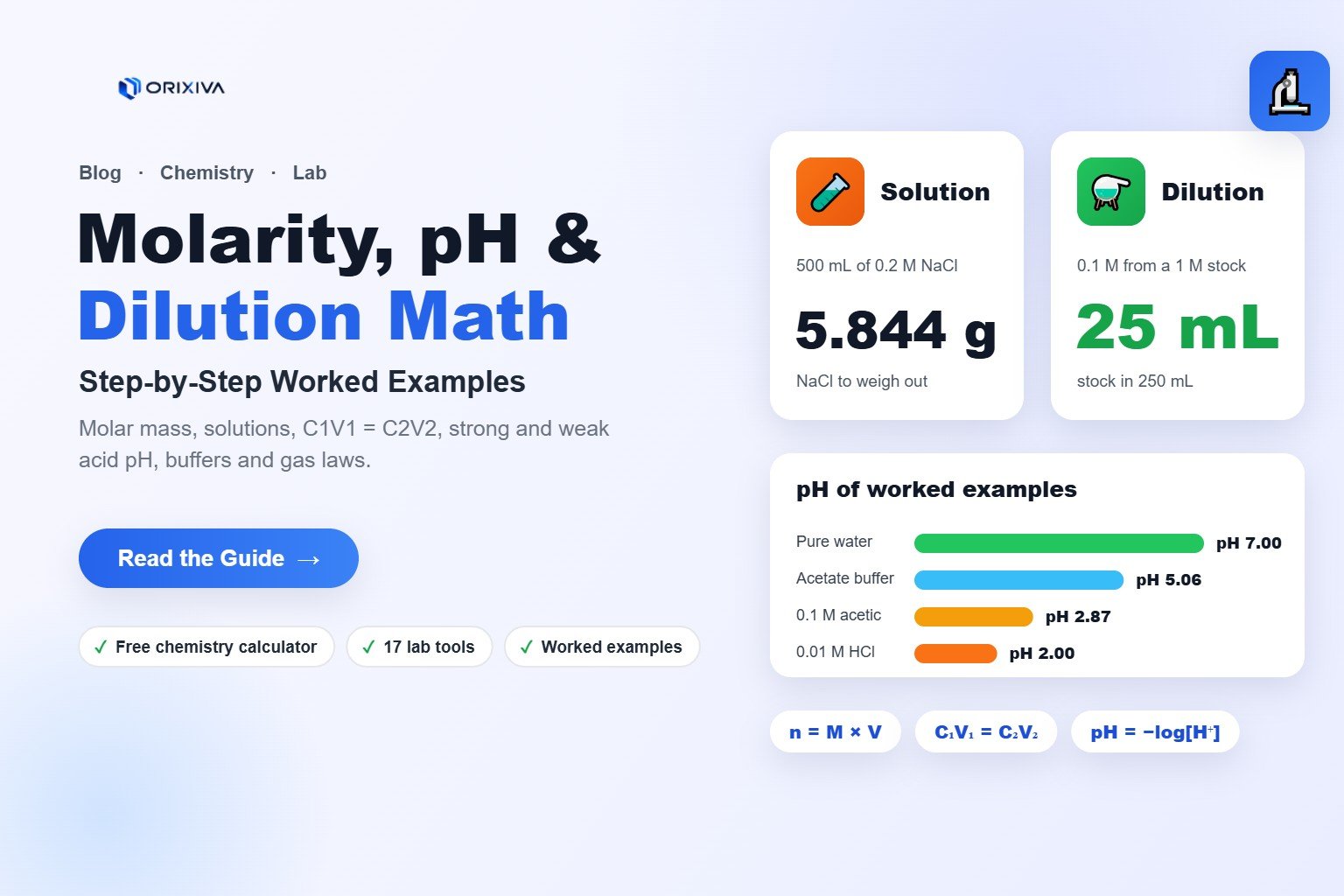
Short answer: Molarity is moles of solute per litre of solution, so mass to weigh = molarity × volume in litres × molar mass. To dilute, use C₁V₁ = C₂V₂. For pH, pH = −log₁₀[H⁺]. Example: 500 mL of 0.2 M NaCl needs 0.2 × 0.5 × 58.44 = 5.844 g of NaCl, and 250 mL of 0.1 M from a 1 M stock needs 25 mL of stock made up to 250 mL. The free Orixiva chemistry calculator has 17 tools for these and more.
Key takeaways
- Always convert mL to L before using molarity formulas.
- Molar mass comes from the formula, including water in hydrates such as CuSO₄·5H₂O.
- C₁V₁ = C₂V₂ works with any volume unit as long as both sides use the same one.
- Strong and weak acids need different pH methods: weak acids only partly ionise.
- Add acid to water, never water to acid, when you dilute.
Step 1: Find the molar mass
Add up the atomic masses of every atom in the formula. Sodium chloride, NaCl: 22.99 + 35.45 = 58.44 g/mol.
Hydrates include the water. Copper(II) sulfate pentahydrate, CuSO₄·5H₂O: CuSO₄ is about 159.6 g/mol and 5 H₂O is about 90.1 g/mol, so the total is about 249.7 g/mol. Weighing anhydrous CuSO₄ when the recipe means the pentahydrate gives a solution about 56% too strong.
Shortcut: type any formula, with brackets or hydrates, into the Molar Mass & Percent Composition tool of the chemistry calculator to get the molar mass and the mass percent of each element.
Step 2: Molarity and making a solution
moles = molarity (mol/L) × volume (L) and mass = moles × molar mass
Example: 500 mL of 0.2 M NaCl.
- Convert volume: 500 mL = 0.500 L.
- Moles: 0.2 × 0.500 = 0.100 mol.
- Mass: 0.100 × 58.44 = 5.844 g.
- Make up: dissolve the 5.844 g in less water, then add water up to the 500 mL mark in a volumetric flask.
Step 3: Dilution with C₁V₁ = C₂V₂
Example: you need 250 mL of 0.1 M from a 1 M stock.
- V₁ = C₂V₂ ÷ C₁ = 0.1 × 250 ÷ 1 = 25 mL of stock.
- Diluent: 250 − 25 = 225 mL of water, or simply make up to 250 mL.
Serial dilution: repeating a 1:10 dilution three times takes a 1 M stock to 0.1 M, 0.01 M and 0.001 M. Each step uses, for example, 1 mL of the previous solution plus 9 mL of diluent. The Serial Dilution Planner lists the concentration and transfer volume at every step.
| Concentration unit | Equivalent in dilute water solutions |
|---|---|
| 1 ppm | 1 mg/L |
| 1 ppb | 1 µg/L |
| 1% w/v | 10 g/L |
| 0.1 M NaCl | 5.844 g/L, or about 0.58% w/v |
Step 4: pH of strong and weak acids
Strong acid: it ionises completely, so [H⁺] equals the acid concentration. 0.01 M HCl has [H⁺] = 0.01 M and pH = −log(0.01) = 2.00. At 25 °C, pOH = 14 − pH = 12.00.
Weak acid: only part ionises, so you need the acid constant Ka. For 0.1 M acetic acid, Ka = 1.8 × 10⁻⁵. Solving x² ÷ (0.1 − x) = Ka gives [H⁺] ≈ 1.33 × 10⁻³ M, so pH ≈ 2.87 and only about 1.3% of the acid is ionised. Using the strong-acid shortcut would give pH 1.00, which is badly wrong.
Step 5: Buffer pH with Henderson–Hasselbalch
pH = pKa + log₁₀([A⁻] ÷ [HA])
An acetate buffer with 0.10 M sodium acetate and 0.05 M acetic acid (pKa 4.76) has pH = 4.76 + log(2) = 5.06. To hit a target pH, rearrange for the ratio: for pH 5.06 you need twice as much base form as acid form.
Step 6: Gas laws in one example
The ideal gas law is PV = nRT, with R = 0.08206 L·atm/(mol·K). One mole of gas at 1 atm takes up about 22.41 L at 0 °C and 24.47 L at 25 °C. Always use kelvin: K = °C + 273.15. For a fixed amount of gas that changes conditions, use the combined gas law P₁V₁/T₁ = P₂V₂/T₂.
Other calculations in the chemistry calculator
Limiting reagent and yield
Finds which reactant runs out first, the theoretical yield, the excess left over and your percent yield.
Empirical formula
Turns percent composition or masses into the simplest formula, and scales it to a molecular formula.
Half-life
Remaining amount after any time, time to decay to a level, and the decay constant.
Heat energy
q = mcΔT with built-in specific heats, plus phase changes such as melting and boiling.
Common chemistry calculation mistakes
- Using mL instead of L in molarity, which makes answers 1,000 times off.
- Forgetting water of crystallisation in hydrates.
- Using the strong-acid shortcut for a weak acid.
- Using °C instead of kelvin in gas laws.
- Rounding too early. Keep full precision and round only the final answer to the right significant figures.
Lab safety: when diluting acids, always add acid slowly to water, wear eye protection and follow your lab's safety rules. Calculations do not replace a supervised procedure.
Do your next calculation in seconds
17 chemistry tools: molar mass, molarity, dilution, pH, buffers, gas laws, stoichiometry, half-life and more. Free, private and no sign-up.
Open the chemistry calculator →Frequently asked questions
How do you calculate molarity?
Molarity = moles of solute / litres of solution. To find the mass to weigh out, multiply molarity by volume in litres and by molar mass: 0.2 M x 0.5 L x 58.44 g/mol = 5.844 g of NaCl.
How do I use C1V1 = C2V2?
Multiply the starting concentration by the volume you take, and set it equal to the final concentration times the final volume. To make 250 mL of 0.1 M from 1 M stock: V1 = 0.1 x 250 / 1 = 25 mL of stock, made up to 250 mL.
How do you calculate pH?
pH = -log10 of the hydrogen ion concentration. For a strong acid, [H+] equals the acid concentration, so 0.01 M HCl has pH 2. Weak acids need Ka because they only partly ionise.
How do you find the pH of a weak acid?
Solve x squared / (C - x) = Ka for x, the hydrogen ion concentration, then take -log10(x). For 0.1 M acetic acid with Ka 1.8 x 10^-5 the pH is about 2.87.
What is the Henderson-Hasselbalch equation?
pH = pKa + log10([A-] / [HA]). It gives the pH of a buffer from the pKa and the ratio of base to acid. Equal amounts give pH = pKa; twice as much base raises pH by about 0.30.
What volume does one mole of gas occupy?
About 22.41 L at 0 degrees C and 1 atm, and about 24.47 L at 25 degrees C and 1 atm, from PV = nRT with temperature in kelvin.
How do I calculate the molar mass of a hydrate?
Add the molar mass of the salt and of all the water molecules. CuSO4.5H2O is about 159.6 + 5 x 18.02 = 249.7 g/mol. The Molar Mass tool accepts formulas with brackets and hydrates.
Over to you
Which chemistry calculation do you find hardest: dilutions, pH or stoichiometry? Tell us in the comments and we may add a worked example for it. Comments are reviewed before they appear.
Related guides and tools
- Chemistry calculator: 17 free lab tools
- T-test and p-value explained for lab results
- Statistics calculator for experiments
- Unit converter for mass, volume and temperature
- Scientific calculator with logs and exponents
Sources: IUPAC Gold Book: compendium of chemical terminology · CIAAW: standard atomic weights.