Try our free AI tools – no sign-up needed!


BMI vs Body Fat vs TDEE: Which Number Actually Matters for Your Goal?
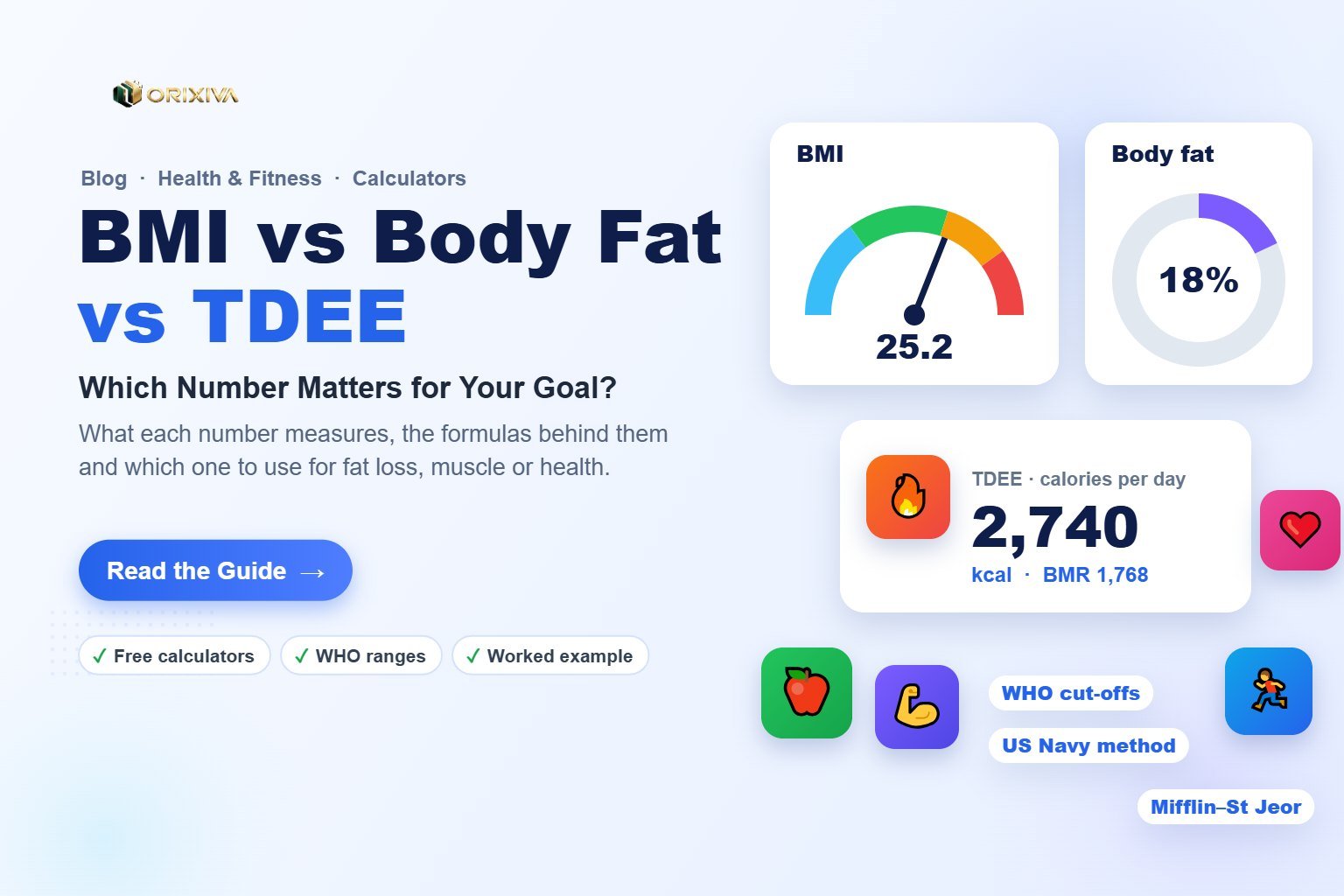
Short answer: BMI is a quick screening number based on height and weight. Body fat percentage tells you how much of your weight is fat, so it is better for tracking body composition. TDEE (total daily energy expenditure) is the number of calories you burn per day, so it is the number to use for planning how much to eat. For weight loss or muscle gain, use TDEE to set calories and body fat (plus waist size) to track progress. You can work out all three with the free Orixiva fitness calculator.
Key takeaways
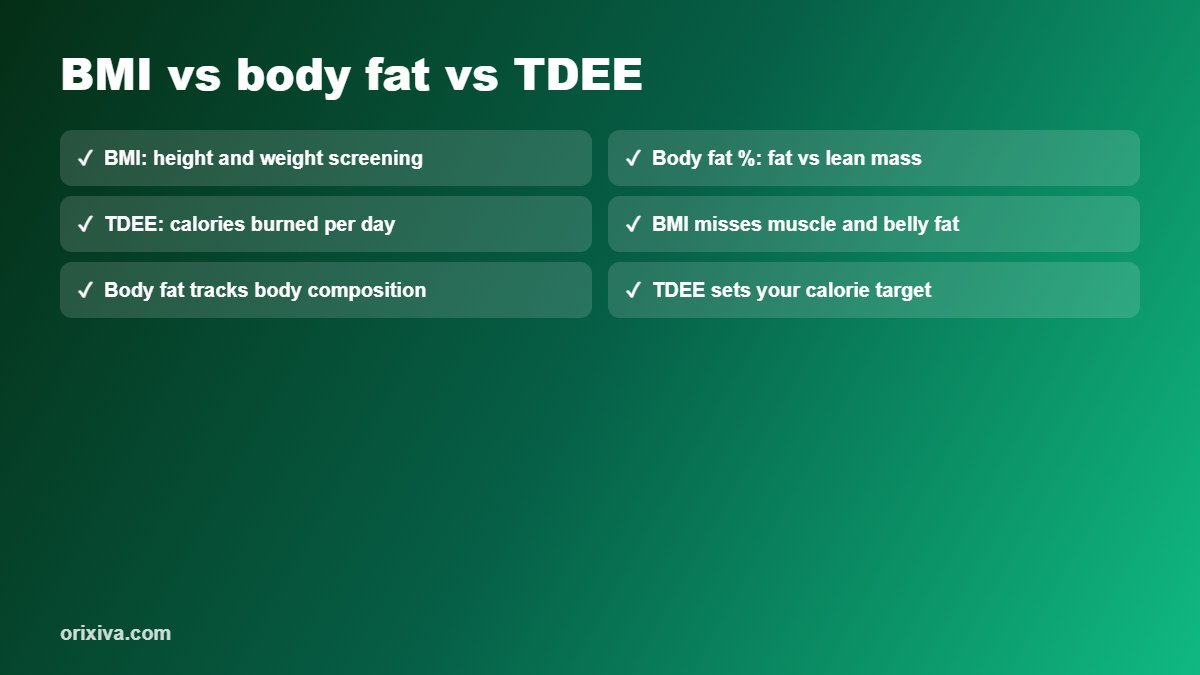
- BMI screens risk across large groups but cannot tell fat from muscle.
- Body fat % shows composition and is the best progress measure if you lift weights.
- TDEE turns your goal into a daily calorie target.
- Waist-to-height ratio is a simple extra check for belly fat; under 0.5 is a common guide.
- These are estimates for general information, not a diagnosis. Talk to a doctor for medical advice.
BMI vs body fat vs TDEE at a glance
| BMI | Body fat % | TDEE | |
|---|---|---|---|
| Answers | Is my weight in a typical range for my height? | How much of my weight is fat? | How many calories do I burn a day? |
| You need | Height, weight | Tape measurements (waist, neck, hip) or a scan | Age, sex, height, weight, activity |
| Best for | Quick screening | Tracking body composition | Setting a calorie target |
| Main limit | Ignores muscle and fat distribution | Estimates vary by method | Activity level is a guess at first |
BMI: useful screening, limited detail
Body mass index is your weight in kilograms divided by your height in metres squared: BMI = kg ÷ m². For adults, the World Health Organization uses these categories:
| BMI | Category (WHO) |
|---|---|
| Below 18.5 | Underweight |
| 18.5 – 24.9 | Healthy weight |
| 25.0 – 29.9 | Overweight |
| 30.0 and above | Obesity |
Some health bodies use lower action points for people of Asian background, often 23 for increased risk and 27.5 for high risk. The Orixiva BMI tool lets you choose WHO or Asian cut-offs.
Where BMI falls short: a muscular athlete and a sedentary person can share the same BMI with very different health. BMI also says nothing about where fat is stored, and belly fat carries more health risk. That is why BMI works best as a first check, not a final answer.
Body fat percentage: what your weight is made of
Body fat percentage is the share of your total weight that is fat. Two people at 80 kg can look and perform very differently at 15% and 30% body fat. A practical home method is the US Navy tape method, which estimates body fat from height, neck and waist (plus hip for women).
| Category (commonly used ranges) | Women | Men |
|---|---|---|
| Essential fat | 10–13% | 2–5% |
| Athletes | 14–20% | 6–13% |
| Fitness | 21–24% | 14–17% |
| Average | 25–31% | 18–24% |
| Above average | 32% + | 25% + |
Measuring tip: measure at the same time of day, on bare skin, with the tape snug but not tight. Take the average of two readings. Consistency matters more than the exact method.
TDEE and BMR: the calorie numbers
BMR (basal metabolic rate) is the energy your body uses at complete rest. TDEE adds everything else: walking, work, exercise and digesting food. A common way to estimate BMR is the Mifflin–St Jeor equation:
- Men: BMR = 10 × weight (kg) + 6.25 × height (cm) − 5 × age + 5
- Women: BMR = 10 × weight (kg) + 6.25 × height (cm) − 5 × age − 161
Then multiply BMR by an activity factor to estimate TDEE:
| Activity level | Multiplier |
|---|---|
| Sedentary (desk job, little exercise) | × 1.2 |
| Lightly active (1–3 workouts a week) | × 1.375 |
| Moderately active (3–5 workouts a week) | × 1.55 |
| Very active (6–7 workouts a week) | × 1.725 |
| Extra active (physical job plus training) | × 1.9 |
The BMR & TDEE calculator compares Mifflin–St Jeor, Harris–Benedict and Katch–McArdle, which uses lean body mass and works better if you know your body fat.
Worked example: one person, three numbers
Take a 30-year-old man who is 178 cm tall, weighs 80 kg, trains 4 times a week and measures 18% body fat.
- BMI: 80 ÷ (1.78 × 1.78) = 25.2, just inside "overweight".
- Body fat: 18% puts him in the average-to-fitness range for men, and he carries about 65.6 kg of lean mass.
- BMR: 10 × 80 + 6.25 × 178 − 5 × 30 + 5 = 1,768 kcal.
- TDEE: 1,768 × 1.55 = about 2,740 kcal a day.
Here BMI alone would suggest he should lose weight, while body fat shows he is in a reasonable range. If his goal is to lean out, a modest deficit from his TDEE, for example around 2,240–2,490 kcal a day, is a sensible place to start and review after two to three weeks.
Which number should you focus on for your goal?
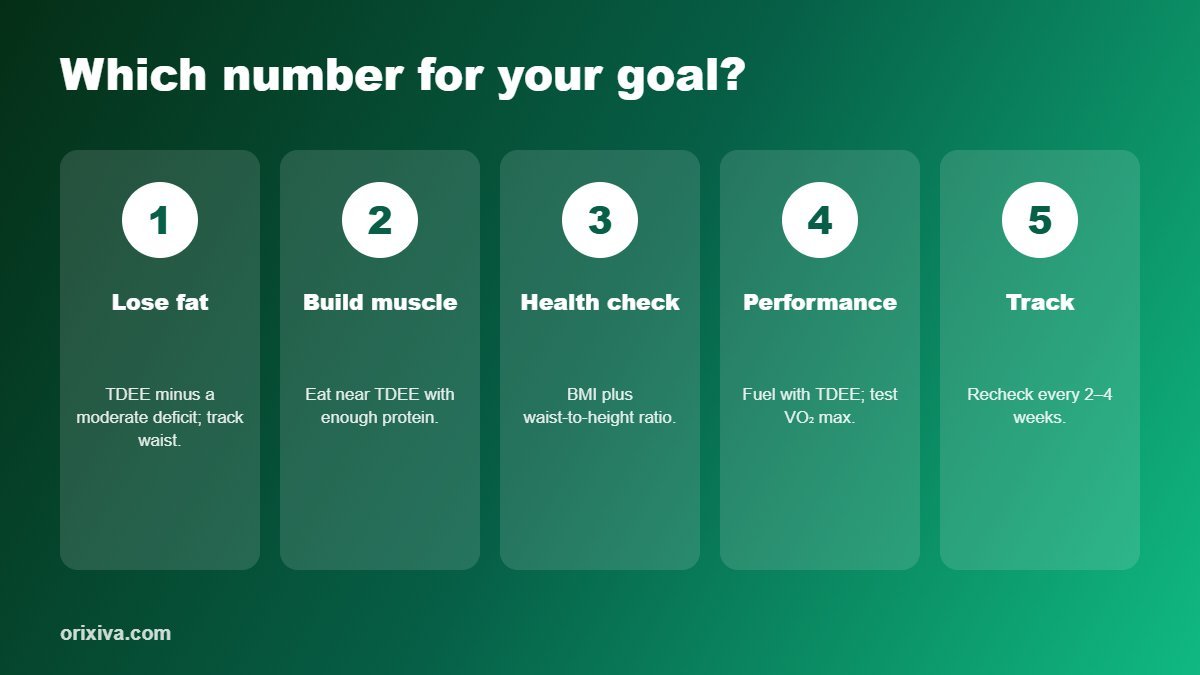
🔥 Losing fat
Set calories from TDEE with a moderate deficit; track waist and body fat every 2–4 weeks.
💪 Building muscle
Eat around or slightly above TDEE with enough protein; watch body fat so gains stay lean.
🩺 General health check
Start with BMI and waist-to-height ratio, then discuss results with a healthcare professional.
🏃 Performance
Use TDEE to fuel training and body fat plus fitness tests such as VO₂ max to track progress.
How to track progress without obsessing
- Weigh weekly averages, not single days; water and food change daily weight.
- Measure waist and body fat every 2–4 weeks under the same conditions.
- Recalculate TDEE after every 3–5 kg of change, because a lighter body burns fewer calories.
- Watch how you feel and perform: energy, sleep, strength and endurance are progress too.
- Avoid extreme deficits. Very low calories make it harder to keep muscle and stick with the plan.
Important: these calculators give estimates for healthy adults. If you are pregnant, under 18, have a medical condition, or have a history of disordered eating, speak to a doctor or registered dietitian before changing how you eat.
Calculate your numbers in one place
BMI, body fat, waist ratios, BMR and TDEE, macros, protein and more: 16 free health tools with formulas explained. Nothing is uploaded.
Open the free fitness calculator →Frequently asked questions
Is BMI or body fat percentage more accurate?
Body fat percentage describes body composition more accurately because it separates fat from lean mass. BMI is simpler and useful for screening, but it cannot tell muscle from fat.
What is a healthy BMI for adults?
The World Health Organization classes a BMI of 18.5 to 24.9 as a healthy weight range for adults. Some guidelines use lower thresholds for people of Asian background.
What is the difference between BMR and TDEE?
BMR is the energy your body uses at rest. TDEE is your total daily energy use, including activity and exercise, and is usually 1.2 to 1.9 times your BMR.
How many calories should I eat to lose weight?
A common starting point is a moderate deficit below your TDEE, then adjusting based on progress over two to three weeks. Individual needs vary, so seek professional advice if you have health conditions.
Can I have a high BMI but low body fat?
Yes. People with a lot of muscle, such as athletes and lifters, can have a BMI in the overweight range while having low or average body fat.
How do I measure body fat at home?
Use the US Navy tape method: measure height, neck and waist (and hips for women) and enter them in a body fat calculator. Keep measuring conditions the same each time.
What is a good waist-to-height ratio?
A waist measurement less than half your height (a ratio under 0.5) is a widely used general guide for lower health risk from central fat.
Are online fitness calculators medical advice?
No. They provide estimates for general information. For medical decisions, consult a doctor or registered dietitian.
Over to you
Which number do you track most: weight, BMI, body fat or calories? Share what has worked for you, or ask a question about any of the formulas, in the comments. We read every comment and update this guide with common questions.
Related guides and tools
- Free fitness calculator: BMI, body fat, TDEE and macros
- How to calculate running pace and sleep times
- Cooking calculator for recipes and portions
- All 200+ free calculators
Sources: WHO: Obesity and overweight fact sheet · CDC: Body Mass Index · Mifflin MD, St Jeor ST et al., "A new predictive equation for resting energy expenditure in healthy individuals", American Journal of Clinical Nutrition, 1990. Body fat ranges are commonly used fitness-industry guidelines and vary by source.
[…] about the same energy as running a 2 kW heater for just over an hour. For daily energy needs, see BMI vs body fat vs TDEE and the health and fitness […]