Try our free AI tools – no sign-up needed!

Free AI API cost calculator: estimate and compare LLM token costs for GPT, Claude, Gemini, Grok, DeepSeek and Mistral, with caching, batch discounts and a budget planner.
Quick answer: AI API cost = (input tokens × input price + output tokens × output price) ÷ 1,000,000, multiplied by the number of requests. Enter your tokens per request and requests per day in the AI API cost calculator above, pick a model, and you get the cost per request, per day, per month and per year, plus a ranking of every other model for the same workload.
- 35models priced
- 6AI providers
- 5tools in one page
- 0sign-ups needed
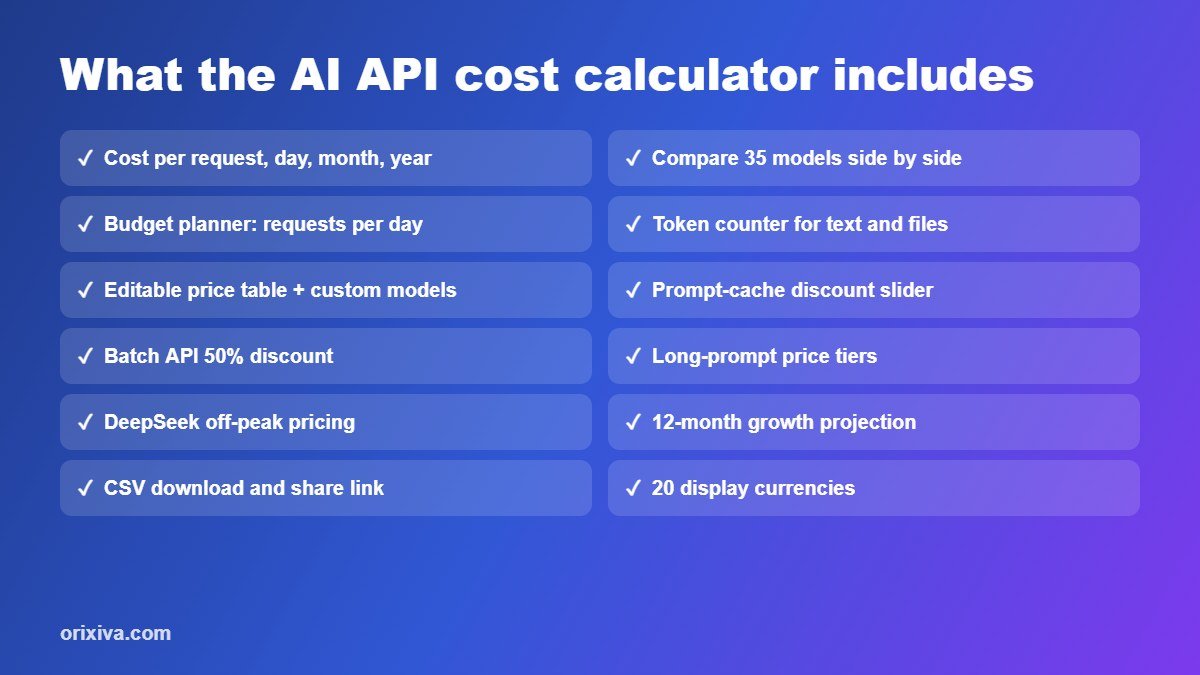
What the AI API cost calculator includes
This AI API cost calculator is built for developers, founders and product teams who need to know what a large language model (LLM) feature will cost before it ships. It has five tools on one page, and every tool shares the same workload, so you only type your numbers once.
| Tool | What it does |
|---|---|
| Cost estimator | Cost per request, per 1,000 requests, per day, per month and per year for one model, with a cost breakdown and a 12-month growth projection. |
| Compare all models | Ranks all 35 models from cheapest to most expensive for your exact workload, with a chart and CSV download. |
| Budget planner | Turns a monthly budget into the number of requests per day each model can handle. |
| Token counter | Estimates tokens from pasted text or a dropped file, with presets for English, code, CJK and other scripts. |
| Price table | Shows every input, cached and output price per 1 million tokens. You can edit prices or add your own custom or fine-tuned model. |
It also handles the pricing rules that simple token calculators miss: prompt-cache discounts, the 50% Batch API discount, DeepSeek off-peak pricing, higher long-prompt tiers and announced future price changes. You can show results in 20 currencies by typing today's exchange rate.
How AI API pricing works
AI providers charge per token. A token is a small piece of text: in English, one token is roughly four characters or three quarters of a word, so 1,000 tokens is about 750 words. Prices are quoted in US dollars per 1 million tokens (often written as $/1M or $/MTok).
Every request has two sides, and they are priced differently:
- Input tokens are everything you send: the system prompt, the user's message, chat history and any documents. Input is the cheaper side.
- Output tokens are everything the model writes back, including hidden reasoning or "thinking" tokens on reasoning models. Output usually costs 3 to 8 times more than input.
The formula the calculator uses for one request is:
cost = (uncached input × input price + cached input × cached price + (output + reasoning) × output price) ÷ 1,000,000
Multiply by requests per day and active days to get the monthly bill. Because output is so much more expensive, a chatbot that writes long answers can cost more than one that reads long documents.
Worked example: a customer-support chatbot
Say your chatbot sends 1,500 input tokens and gets 400 output tokens back, 1,000 times a day, and 30% of the input (the system prompt) is served from the prompt cache. On Claude Sonnet 5.5 ($2 input, $0.10 cached, $10 output per 1M tokens):
- Uncached input: 1,050 tokens × $2 ÷ 1,000,000 = $0.0021
- Cached input: 450 tokens × $0.10 ÷ 1,000,000 = $0.000045
- Output: 400 tokens × $10 ÷ 1,000,000 = $0.004
- Per request: $0.006145, so 1,000 requests a day for 30 days is about $184 a month.
Without caching the same workload costs $210 a month, and running it through the Batch API would cut it in half again. The comparison tab shows that small models such as GPT-6 Luna or Claude Haiku 5.5 handle this workload for under $10 a month, so it is worth testing whether a cheaper model is good enough for your task.
AI API prices compared (October 2026)
These are the list prices per 1 million tokens used in the AI API cost calculator, checked on 22 October 2026. Prices change often, so always confirm on the provider's pricing page before you commit a budget.
| Model | Provider | Input | Cached input | Output |
|---|---|---|---|---|
| GPT-6 Astra | OpenAI | $10.00 | $1.00 | $50.00 |
| GPT-6.1 Sol | OpenAI | $2.00 | $0.10 | $10.00 |
| GPT-6 Luna | OpenAI | $0.10 | $0.01 | $0.50 |
| Claude Opus 5.5 | Anthropic | $4.00 | $0.20 | $20.00 |
| Claude Sonnet 5.5 | Anthropic | $2.00 | $0.10 | $10.00 |
| Claude Haiku 5.5 | Anthropic | $0.10 | $0.01 | $0.50 |
| Gemini 4 Argon | $2.00 | $0.10 | $10.00 | |
| Gemini 3.8 Flash | $0.75 | $0.075 | $3.75 | |
| Grok 4.6 | xAI | $2.00 | $0.50 | $6.00 |
| DeepSeek V4 Pro | DeepSeek | $1.32 | $0.044 | $3.96 |
| Mistral Large 3 | Mistral | $0.50 | - | $1.50 |
A few rules change these numbers in practice. OpenAI charges more once a prompt goes above about 272,000 tokens, Gemini 3.1 Pro above 200,000, xAI from 200,000 and Claude Haiku 5.5 above 100,000. Google has announced that Gemini 4 Argon doubles in price from 1 December 2026, and Gemini 3.8 Flash and 3.6 Flash from 1 January 2027. DeepSeek prices above are peak-hour rates; off-peak hours are 50% cheaper. The calculator applies all of these automatically. Official sources: Anthropic pricing, Gemini API pricing, OpenAI API pricing.
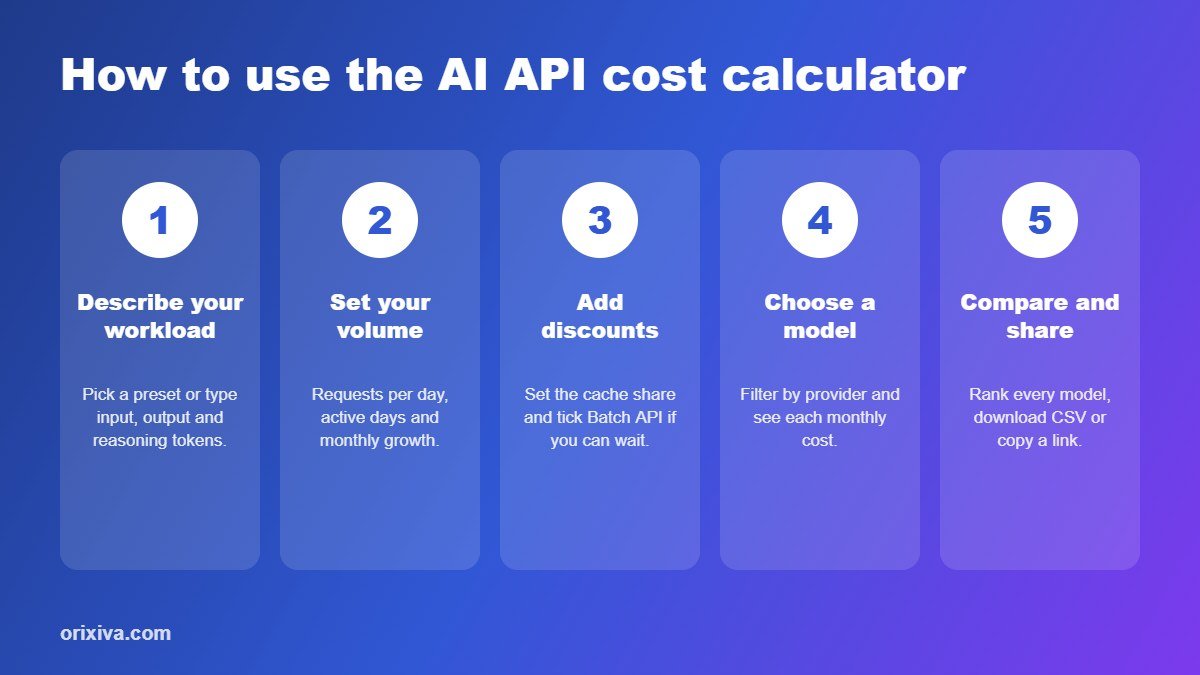
How to use the AI API cost calculator
- Describe your workload. Pick a preset such as Chatbot, Document Q&A or Coding agent, or type your own input, output and reasoning tokens per request.
- Set your volume. Enter requests per day, active days per month and expected monthly growth.
- Add discounts. Move the cache slider to the share of input your prompt cache will serve, and tick Batch API if your job can wait up to 24 hours.
- Choose a model. Filter by provider or search by name. The list shows each model's monthly cost for your workload.
- Compare and share. Open Compare all models to rank every option, download a CSV, or copy a share link with all your settings.
Not sure how many tokens your prompt uses? Paste it into the Token counter tab and press "Use as input tokens". For the most accurate numbers, check the usage figures returned by the API after a few real test calls and type those in.
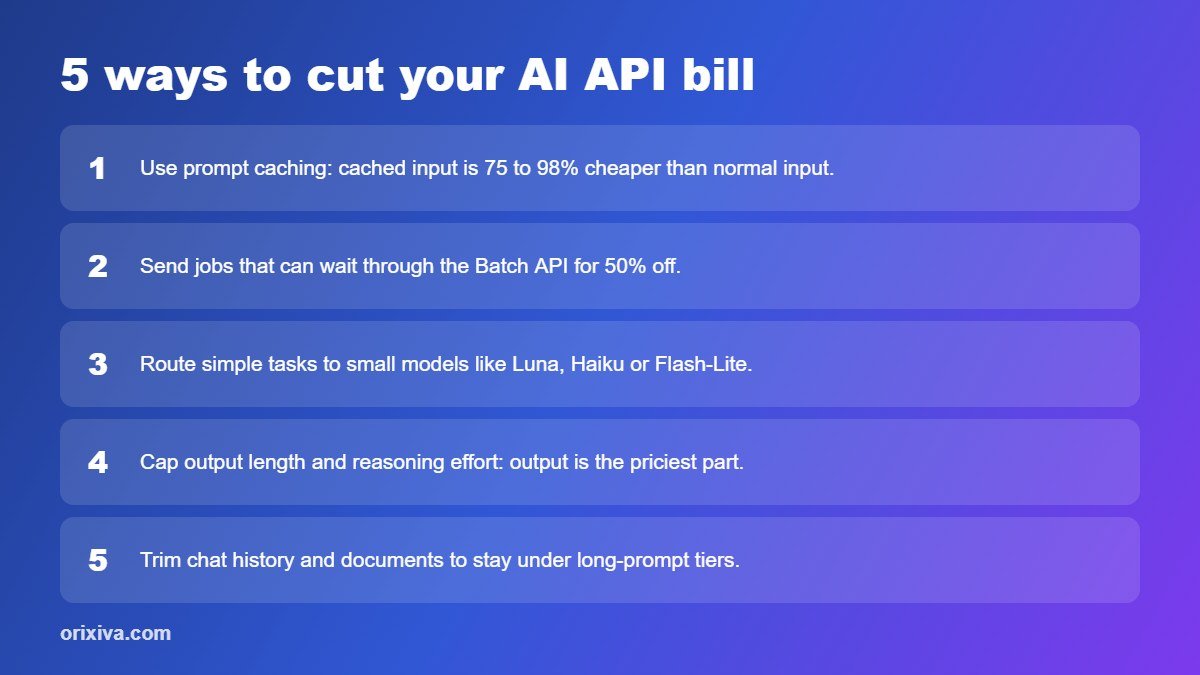
7 ways to cut your AI API bill
- Use prompt caching. Cached input costs about 75 to 98% less than normal input, depending on the provider. Put fixed instructions and documents at the start of the prompt so they can be cached.
- Batch work that can wait. OpenAI, Anthropic and Google offer 50% off through their Batch APIs for jobs that finish within 24 hours.
- Route easy tasks to small models. Classification, extraction and short replies often work just as well on Luna, Haiku or Flash-Lite models at a fraction of the price.
- Limit output length. Set a maximum output tokens value and ask for short answers. Output is the most expensive part of most bills.
- Control reasoning effort. Reasoning tokens are billed as output. Use low effort settings when the task does not need deep thinking.
- Trim the context. Send only the chat history and document chunks the model needs, and stay under long-prompt thresholds.
- Schedule DeepSeek jobs off-peak. DeepSeek charges half price outside its weekday peak hours.
Hidden costs to plan for
Reasoning tokens
Reasoning models can "think" for thousands of tokens before answering. You pay for them as output even though you never see them.
Cache writes
Anthropic charges 1.25 times the input price to write a prompt into the 5-minute cache. Reads are cheap, but the first write is not.
Long-prompt tiers
Some models double the price of the whole request once the prompt passes a threshold, not just the tokens above it.
Tools and retries
Web search, code execution and failed calls that you retry all add cost. Add a 10 to 20% buffer to your estimate.
Glossary
- Token
- A chunk of text the model reads or writes, about four English characters.
- $/1M tokens
- The price for one million tokens, the standard unit on pricing pages.
- Context window
- The maximum number of tokens a model can read in one request.
- Prompt caching
- Reusing a stored prompt prefix at a large discount instead of paying full input price.
- Batch API
- An asynchronous way to send many requests at once for a 50% discount.
- Reasoning tokens
- Hidden thinking tokens a reasoning model produces before its answer, billed as output.
Privacy and accuracy
The AI API cost calculator runs entirely in your browser. Text you paste into the token counter and the numbers you type are never sent to Orixiva or to any AI provider.
Prices were checked on 22 October 2026. Anthropic and Google prices come from their official pricing pages; OpenAI, xAI, DeepSeek and Mistral prices were cross-checked against recent pricing trackers. Token counts are estimates because each provider uses its own tokenizer. Use the results for planning, and confirm current prices with the provider before you sign a contract or set a budget. If a price has changed, you can edit it in the Price table tab.
Related free tools
Building an AI product? These Orixiva pages help with the rest of the job.
- Developer Tools for JSON, API testing and CSV.
- Business Calculator for margin, break-even and SaaS metrics.
- Computer Calculator for storage, bandwidth and data usage.
- Financial Calculator for loans, interest and ROI.
- Data Analysis Calculator for percentages and weighted averages.
- All free calculators in one place.
Share your feedback
Which model came out cheapest for your workload, and did the estimate match your real bill? Tell other readers in the comments, or tell us which model or provider we should add next. Comments are reviewed before they appear.
Frequently asked questions
How much does an AI API cost per month?
It depends on tokens per request and volume. A chatbot with 1,500 input and 400 output tokens per request, 1,000 requests a day and 30% caching costs about $9 a month on GPT-6 Luna or Claude Haiku 5.5 and about $184 a month on Claude Sonnet 5.5, using prices checked on 22 October 2026.
How do I calculate LLM API cost?
Multiply input tokens by the input price and output tokens by the output price, add them and divide by 1,000,000. Then multiply by your number of requests. Cached input uses the lower cached price, and reasoning tokens count as output.
How many tokens is 1,000 words?
About 1,300 to 1,400 tokens in English. Code, numbers and non-English text usually use more tokens per word. Use the token counter tab for an estimate of your own text.
Which AI API is the cheapest?
For a typical chatbot workload, the lowest list prices on 22 October 2026 were Ministral 8B, GPT-6 Luna and Claude Haiku 5.5. The cheapest model changes with your mix of input and output tokens, so use the Compare all models tab with your own numbers.
Why do output tokens cost more than input tokens?
The model has to generate output one token at a time, which takes much more computing work than reading input. Output usually costs 3 to 8 times more than input.
How much does prompt caching save?
Cached input is about 75 to 98% cheaper than normal input, depending on the provider. It works best when the same system prompt or documents are sent at the start of many requests.
Does the Batch API really cut costs in half?
Yes. OpenAI, Anthropic and Google give 50% off input and output tokens for requests sent through their Batch APIs, in return for results within 24 hours instead of instantly.
Are the prices in this calculator up to date?
Prices were checked on 22 October 2026 and the date is shown on the calculator. Providers change prices often, so confirm on the official pricing page. You can edit any price in the Price table tab.
Is my text sent to any AI provider?
No. The calculator and token counter run entirely in your browser. Nothing you type or paste is uploaded to Orixiva or to an AI company.
Ready to plan your AI budget? Scroll up to the AI API cost calculator, describe your workload and compare every model in seconds.