Try our free AI tools – no sign-up needed!


Ohm’s Law and Electricity Cost Explained Simply (With Everyday Examples)
Want the answer now? The free electrical calculator solves Ohm’s law, appliance running costs and 15 more electrical and physics problems.
Jump to the free tool ↓Why does a heater cost so much more to run than a phone charger? Which resistor stops an LED from burning out? Both questions come down to a few simple relationships between volts, amps, ohms and watts. Once you know them, working out the electricity cost of any appliance takes about a minute.
This guide explains Ohm’s law without heavy maths, shows how to turn watts into kilowatt-hours and money, and walks through real examples for home, hobby electronics and solar backup. You can check every result with the free Orixiva electrical calculator, which has 17 tools and runs in your browser.
Key takeaways
- Ohm’s law: voltage = current × resistance (V = I × R).
- Power: watts = volts × amps (P = V × I). It also equals I² × R and V² ÷ R.
- Energy in kWh = watts × hours ÷ 1,000. Your bill charges per kWh.
- Electricity cost = kWh × price per kWh, plus any fixed charges and taxes.
- Appliances that heat or cool (heaters, kettles, air conditioners) use the most energy; LEDs and chargers use very little.
Volts, amps, ohms and watts in plain English
A water pipe is the classic comparison. It is not perfect, but it makes the four units easy to remember.
Voltage (V, volts)
The “pressure” that pushes electricity. Homes use about 230 V in most of the world and 120 V in North America.
Current (I, amps)
How much electricity flows, like litres per second in a pipe. Fuses and breakers are rated in amps.
Resistance (R, ohms Ω)
How hard it is for current to flow, like a narrow section of pipe. Resistors, heating wires and long cables all have resistance.
Power (P, watts)
How fast energy is used. A 2,000 W kettle uses energy 200 times faster than a 10 W LED bulb.
What is Ohm’s law?
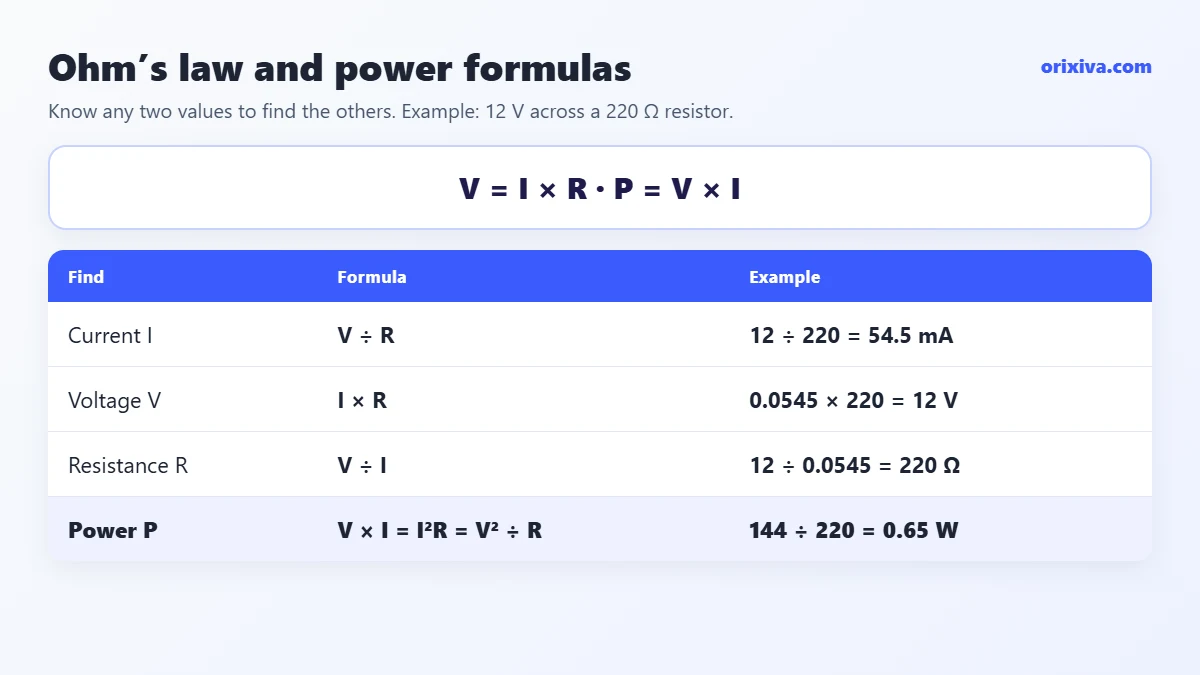
Ohm’s law says that the current through a conductor is proportional to the voltage across it, for a fixed resistance. Written as a formula:
V = I × R · I = V ÷ R · R = V ÷ I
Double the voltage across the same resistor and the current doubles. Double the resistance at the same voltage and the current halves. If you know any two of the three values, you can always find the third.
The Ohm’s law triangle
Draw a triangle with V at the top and I and R side by side at the bottom. Cover the value you want to find: V is I next to R (multiply), I is V over R (divide), and R is V over I (divide).
Power: how watts connect to volts and amps
Power ties Ohm’s law to your electricity bill:
P = V × I · P = I² × R · P = V² ÷ R
These let you find the current an appliance draws from its wattage: I = P ÷ V. A 2,000 W kettle on 230 V draws about 8.7 A; the same power on 120 V would draw about 16.7 A, which is why North American kettles are usually around 1,500 W (12.5 A).
Ohm’s law examples you can use
Example 1: current through a resistor
A 220 Ω resistor across 12 V: I = 12 ÷ 220 = 0.0545 A, or 54.5 mA. Power: P = V² ÷ R = 144 ÷ 220 = 0.65 W. A small ¼ W resistor would overheat; choose at least a 1 W part, and preferably 2 W. The electrical calculator suggests a rating of at least twice the power the resistor dissipates.
Example 2: an LED series resistor
A red LED needs about 2 V and 20 mA, powered from 5 V. The resistor must drop 5 − 2 = 3 V at 0.02 A: R = 3 ÷ 0.02 = 150 Ω. Power: 3 × 0.02 = 0.06 W, so a ¼ W resistor is fine. The calculator’s LED Series Resistor tool also handles several LEDs in a row.
Example 3: the resistance of a heater
A 1,000 W heater on 230 V: R = V² ÷ P = 52,900 ÷ 1,000 = 52.9 Ω, and it draws 1,000 ÷ 230 = 4.35 A.
Example 4: will it trip the circuit?
On a 230 V circuit with a 16 A breaker, the maximum is about 230 × 16 = 3,680 W. A 2,000 W kettle plus a 1,500 W heater (3,500 W) is close to the limit; adding a 1,000 W microwave would trip it.
From watts to kilowatt-hours (kWh)
Watts tell you how fast energy is used. Your energy supplier charges for how much energy you used in total, measured in kilowatt-hours. One kWh is 1,000 watts for one hour.
kWh = watts × hours of use ÷ 1,000
- A 2,000 W kettle for 6 minutes (0.1 h): 2,000 × 0.1 ÷ 1,000 = 0.2 kWh.
- A 10 W LED bulb for 10 hours: 10 × 10 ÷ 1,000 = 0.1 kWh.
- A 1,500 W air conditioner for 8 hours: 1,500 × 8 ÷ 1,000 = 12 kWh.
The wattage is usually on a label on the back or bottom of the appliance, or in the manual. Appliances like fridges and air conditioners cycle on and off, so their real use is lower than “watts × 24 hours”; the energy label’s kWh per year is more accurate. The US Department of Energy explains the same method for estimating appliance use.
How to calculate electricity cost
Electricity cost = kWh × price per kWh × (1 + fixed charges and taxes %)
Find your price per kWh on your bill. It is often called the unit rate or energy charge, and it may change with the time of day or how much you use. Prices vary widely between countries and suppliers, so the examples below use $0.15 per kWh to keep the maths simple. Use your own rate.
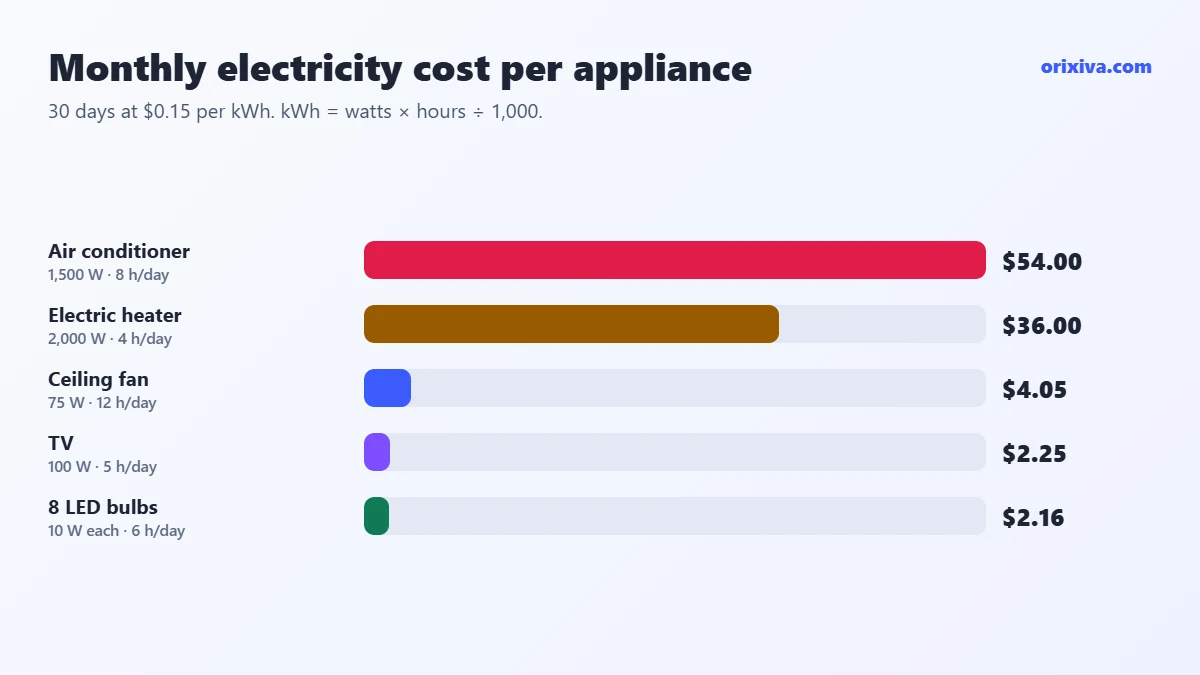
| Appliance | Watts | Use per day | kWh per month | Cost at $0.15 |
|---|---|---|---|---|
| Air conditioner | 1,500 | 8 h | 360 | $54.00 |
| Electric heater | 2,000 | 4 h | 240 | $36.00 |
| Ceiling fan | 75 | 12 h | 27 | $4.05 |
| TV | 100 | 5 h | 15 | $2.25 |
| 8 LED bulbs | 10 each | 6 h | 14.4 | $2.16 |
| Phone charger | 10 | 3 h | 0.9 | $0.14 |
30-day month. Real use depends on settings, thermostats and how often the appliance cycles.
The same table helps you compare choices. Running the 75 W ceiling fan for 8 hours instead of the air conditioner uses 0.6 kWh a day, or 18 kWh a month: about $2.70 instead of $54. It also helps when you shop. A fridge rated 300 kWh a year costs about 300 × $0.15 = $45 a year to run, so a model rated 450 kWh costs $22.50 more every year you own it.
A whole-home example: where does the money go?
Add the appliances above: 360 + 240 + 27 + 15 + 14.4 + 0.9 = 657.3 kWh a month. At $0.15 per kWh that is $98.60. With 15% fixed charges and taxes, the bill comes to about $113.
The air conditioner and heater make up over 90% of the energy. That is the general rule: anything that heats or cools (air conditioners, heaters, water heaters, ovens, dryers, kettles) dominates the bill, while lights and electronics are small. Cutting two hours a day from the air conditioner saves 90 kWh, worth more than running all the LEDs for six months.
Standby adds up tooA device that draws 5 W on standby all year uses 5 × 24 × 365 ÷ 1,000 = 43.8 kWh. At $0.15, that is about $6.57 a year for one device. Ten such devices cost over $65 a year doing nothing.
Electricity cost of charging an e-bike or electric car
The same formula works for batteries: energy needed × price per kWh. Add about 10% for charging losses.
- E-bike: a 500 Wh battery is 0.5 kWh. A full charge with losses is about 0.55 kWh, which costs around $0.08 at $0.15 per kWh.
- Electric car: adding 40 kWh to the battery needs about 44 kWh from the wall, which costs about $6.60 at $0.15. Public fast chargers usually cost much more per kWh than home electricity.
To compare with petrol or diesel, see our guide to EV vs petrol running costs.
Voltage drop: why long cables waste power
Cables have resistance too, so Ohm’s law applies to them. A long, thin cable carrying a large current loses voltage along the way, and the lost energy becomes heat. For example, a copper cable of 2.5 mm² over a 20 m run (40 m there and back) has about 0.0172 × 40 ÷ 2.5 = 0.275 Ω. At 16 A, the drop is 16 × 0.275 = 4.4 V, about 1.9% of 230 V. Many wiring rules limit voltage drop to a few percent, which is why long runs need thicker cable. The Wire Size & Voltage Drop tool calculates the drop and the minimum cable size in mm² and AWG.
How to use the free electrical calculator (step by step)
- Open the electrical calculator. Go to the electrical calculator and pick a tool from the menu of 17.
- For Ohm’s law, choose what you know. In Ohm’s Law & Power, select the pair you have: voltage and resistance, voltage and current, current and resistance, or power with voltage, current or resistance. Resistance accepts shorthand such as 4.7k.
- Enter the values and calculate. The tool returns the other two values, the power, and a suggested resistor rating, with the formula steps shown.
- For your bill, open “Electricity Usage & Bill”. Type one appliance per line: name, watts, hours per day and quantity (for example “LED lights, 10, 6, 8”).
- Add your tariff. Enter the number of days, your price per kWh and any fixed charges and taxes as a percentage, and choose your currency.
- Read the breakdown. You see the kWh and cost for each appliance and the total, so the biggest users stand out at once. Copy or print the result.
Everything runs in your browser, with no sign-up and nothing uploaded.
How to lower your electricity cost
- Turn the thermostat by 1–2 °C (warmer in summer, cooler in winter). Heating and cooling are the biggest loads.
- Switch remaining bulbs to LED. A 10 W LED gives about the same light as a 60 W incandescent bulb.
- Use timers and smart plugs for heaters, water heaters and anything left on by habit.
- Turn devices fully off at the wall or with a power strip to stop standby use.
- Use off-peak hours for washing machines and dishwashers if your tariff has cheaper night rates.
- Compare before you buy. Two fridges can differ by 100+ kWh a year; the energy label shows it.
More electrical and physics tools in the same calculator
The electrical calculator has 17 tools, so students, hobbyists and technicians can solve most everyday problems in one place:
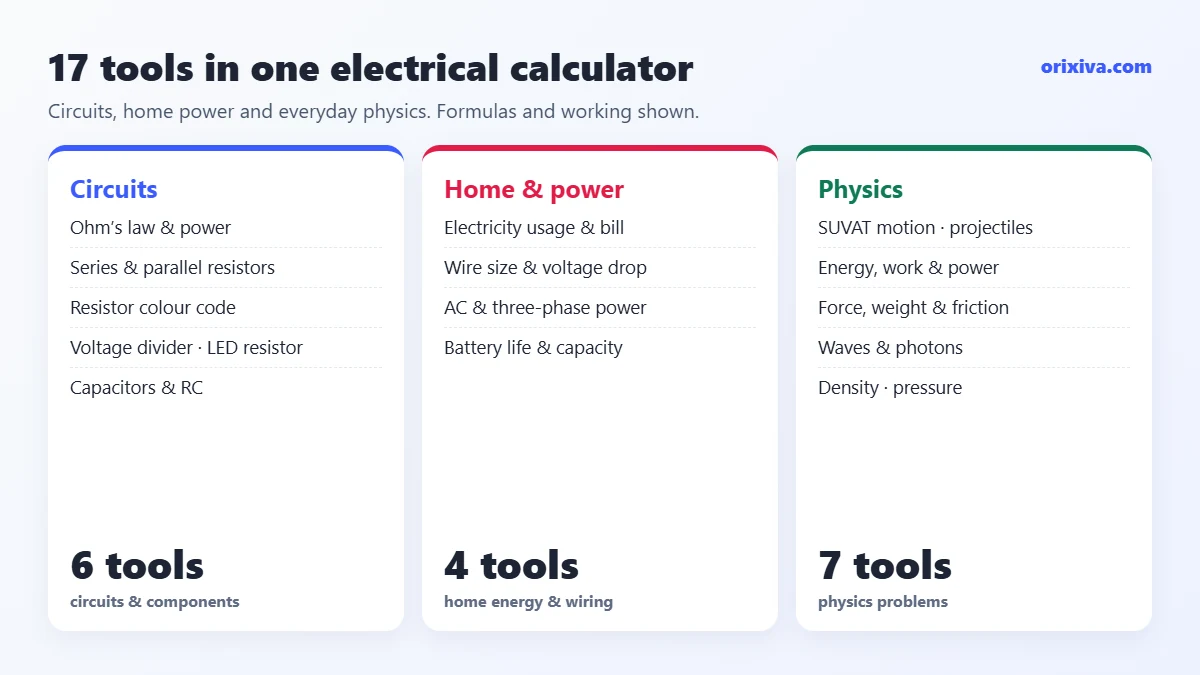
| Group | Tools |
|---|---|
| Circuits | Ohm’s Law & Power, Series & Parallel Resistors, Resistor Colour Code (4, 5 or 6 bands), Voltage Divider, LED Series Resistor, Capacitors & RC Time Constant |
| Home and power | Electricity Usage & Bill, Wire Size & Voltage Drop (mm² and AWG), AC & Three-Phase Power, Battery Life & Capacity |
| Physics | Motion (SUVAT) Solver, Projectile Motion, Energy, Work & Power, Force, Weight & Friction, Waves, Frequency & Photons, Density, Mass & Volume, Pressure & Hydrostatics |
Example: how long will a battery last?
A 12 V, 100 Ah battery stores about 1,200 Wh. Running a 200 W load through an inverter that is 90% efficient: 1,200 × 0.9 ÷ 200 = about 5.4 hours. Lead-acid batteries should not be fully drained, so for them plan on roughly half of that. The Battery Life & Capacity tool works this out and can also size the battery you need.
Safety notes
Mains electricity can killUse these calculations to understand, plan and budget. Wiring, sockets, breakers and anything connected to mains power should be installed or checked by a qualified electrician, following your local regulations.
- Never exceed the current rating of a cable, plug, extension lead or breaker.
- Resistors and wires get hot: choose ratings with a safety margin.
- Batteries store a lot of energy; short circuits can start fires. Use fuses close to the battery.
Your turn: Which appliance surprised you most when you calculated its running cost? Share it in the comments with your country and price per kWh, and help readers around the world compare.
Calculate Ohm’s law and electricity cost now, free
Solve volts, amps, ohms and watts, price every appliance on your bill, and use 15 more electrical and physics tools. No sign-up, and nothing leaves your browser.
Open the free electrical calculator → Looking for another calculator? Search on orixiva.comOhm’s law and electricity cost questions people often ask
What is Ohm’s law in simple words?
The current through a conductor equals the voltage across it divided by its resistance: I = V ÷ R. More voltage pushes more current; more resistance lets less through.
How do I calculate amps from watts?
Divide the watts by the voltage: I = P ÷ V. A 1,000 W appliance on 230 V draws about 4.3 A; on 120 V about 8.3 A.
How do I calculate the electricity cost of an appliance?
Multiply its watts by the hours of use and divide by 1,000 to get kWh, then multiply by your price per kWh. A 1,500 W heater for 3 hours uses 4.5 kWh; at $0.15 it costs $0.68.
What is a kilowatt-hour?
One kilowatt-hour (kWh) is the energy used by a 1,000 W appliance running for one hour. It is the unit on your electricity bill.
Which appliances use the most electricity?
Usually those that heat or cool: air conditioners, heaters, water heaters, ovens, tumble dryers and kettles. Lights, chargers and most electronics use far less.
Why is my real bill different from my estimate?
Appliances cycle on and off, tariffs change by time or usage band, and bills add fixed charges and taxes. Use your exact unit rate and the charges percentage for a closer estimate.
How do I choose a resistor for an LED?
Subtract the LED’s forward voltage from the supply voltage and divide by the LED current. For a 2 V LED at 20 mA from 5 V: (5 − 2) ÷ 0.02 = 150 Ω.
Is Ohm’s law true for all components?
No. It holds for ordinary resistors and wires at a steady temperature. LEDs, diodes and transistors are non-ohmic, which is why an LED needs a series resistor.
Can I use the electrical calculator for school physics?
Yes. It includes SUVAT motion, projectiles, energy and power, forces, waves, density and pressure, each with the formula and working shown.
How much does it cost to run a fridge?
Look for the kWh per year on its energy label and multiply by your price per kWh. A fridge using 300 kWh a year costs about $45 a year at $0.15 per kWh.
Does turning appliances off at the wall save money?
Yes, a little for each device. Standby power of a few watts, around the clock, adds up to several kWh a month across a home.