Try our free AI tools – no sign-up needed!


EV vs Petrol Car: How to Calculate the Real Running Cost per Kilometre (or Mile)
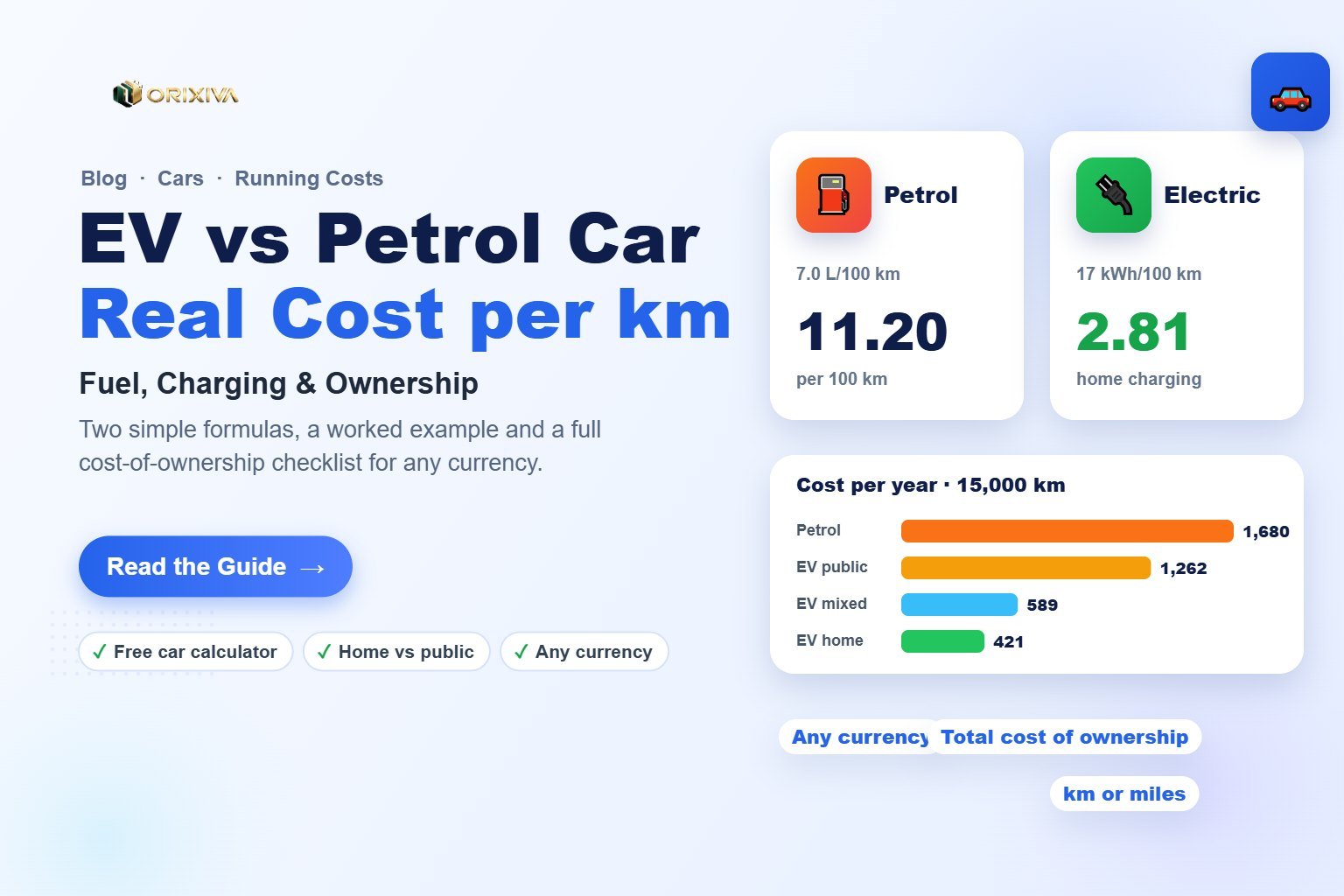
Short answer: To compare an electric car with a petrol car, work out the energy cost per 100 km for each: petrol car = litres per 100 km × fuel price; EV = kWh per 100 km × electricity price, plus about 10% for charging losses. Multiply by your yearly distance, then add insurance, servicing, tyres and depreciation for the full picture. The free Orixiva car calculator has EV vs petrol, EV charging and total cost of ownership tools that do this for your own numbers.
Key takeaways
- Where you charge matters most. Home charging is usually far cheaper per kWh than public fast charging.
- Use your real consumption, not brochure figures; winter, motorway speed and short trips raise it.
- Energy is only part of the cost. Purchase price, depreciation and insurance often matter more.
- Do the maths in any currency. The formulas are the same; only the prices change.
The two formulas you need
⛽ Petrol or diesel car
Cost per 100 km = L/100 km × price per litre
For miles: cost per mile = price per gallon ÷ mpg
🔌 Electric car
Cost per 100 km = kWh/100 km × price per kWh × 1.10
(the 1.10 allows for roughly 10% charging losses)
Charging losses vary with the charger, temperature and battery, but 10% is a reasonable planning figure. If your car reports consumption "from the wall", you can skip the extra 10%.
Worked example: 15,000 km a year
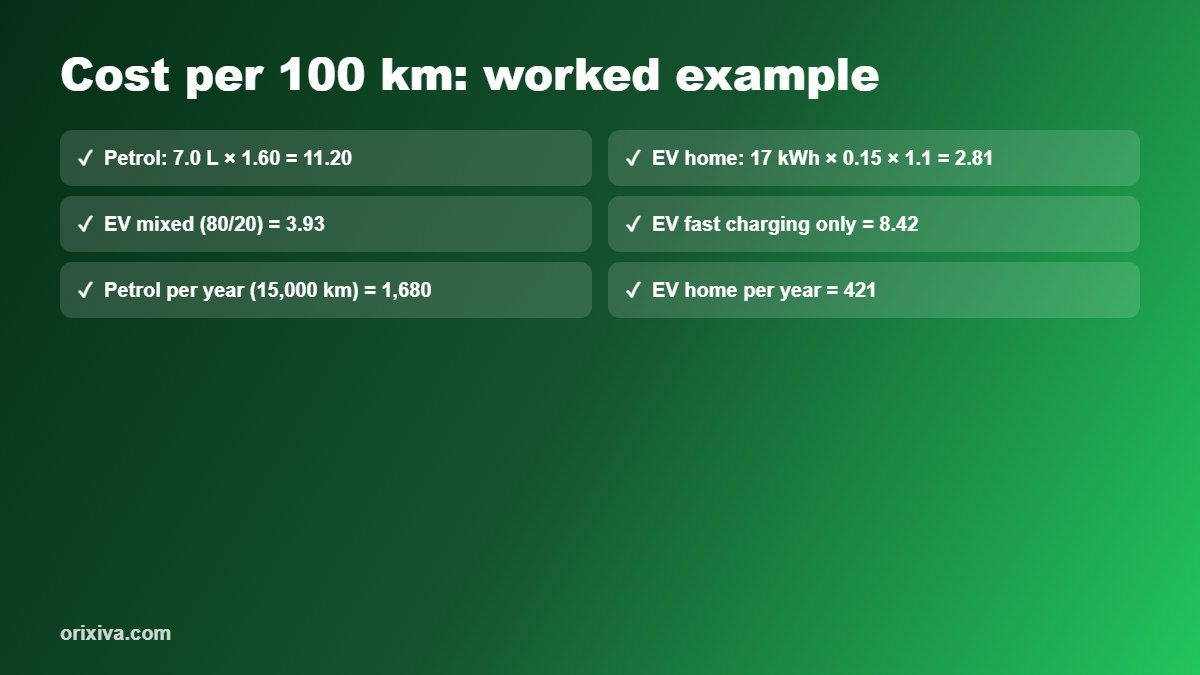
Assume a petrol car using 7.0 L/100 km with fuel at 1.60 per litre, and an EV using 17 kWh/100 km. Prices are in any currency unit.
| Cost per 100 km | Cost per year (15,000 km) | |
|---|---|---|
| Petrol car (7.0 L × 1.60) | 11.20 | 1,680 |
| EV, home charging at 0.15 per kWh | 2.81 | 421 |
| EV, mixed (80% home, 20% public at 0.45) | 3.93 | 589 |
| EV, public fast charging only at 0.45 per kWh | 8.42 | 1,262 |
In this example, an EV charged mostly at home costs about a quarter of the petrol car's fuel bill. If you rely only on fast chargers, the saving shrinks a lot. That is why your charging pattern is the most important input.
Quick check: the EV cost per 100 km is 17 × 0.15 × 1.10 = 2.805, rounded to 2.81. Mixed charging: 0.8 × 2.81 + 0.2 × 8.42 ≈ 3.93.
Home vs public charging: what you actually pay
| Charging type | Typical speed | Cost per kWh | Best for |
|---|---|---|---|
| Home socket or wallbox (off-peak tariff) | Overnight | Lowest | Daily driving |
| Workplace or destination AC | A few hours | Low to medium (sometimes free) | Top-ups while parked |
| Public DC fast charging | 20–60 minutes for a large top-up | Highest | Long trips |
The EV Charging Time & Cost tool estimates how long a charge takes, including the slowdown as the battery fills, and how much energy and money it uses.
Total cost of ownership: the full comparison
Fuel or electricity is often not the biggest cost. For a fair comparison, add up the yearly cost of everything:
- Depreciation: the value the car loses each year, often the largest single cost for new cars.
- Finance: interest on a car loan.
- Insurance and tax: these vary a lot by country, model and driver.
- Servicing and repairs: EVs have no oil changes and fewer moving parts, so routine servicing is often cheaper.
- Tyres: heavier EVs can wear tyres faster, especially with brisk driving.
- Home charger installation, if you need one.
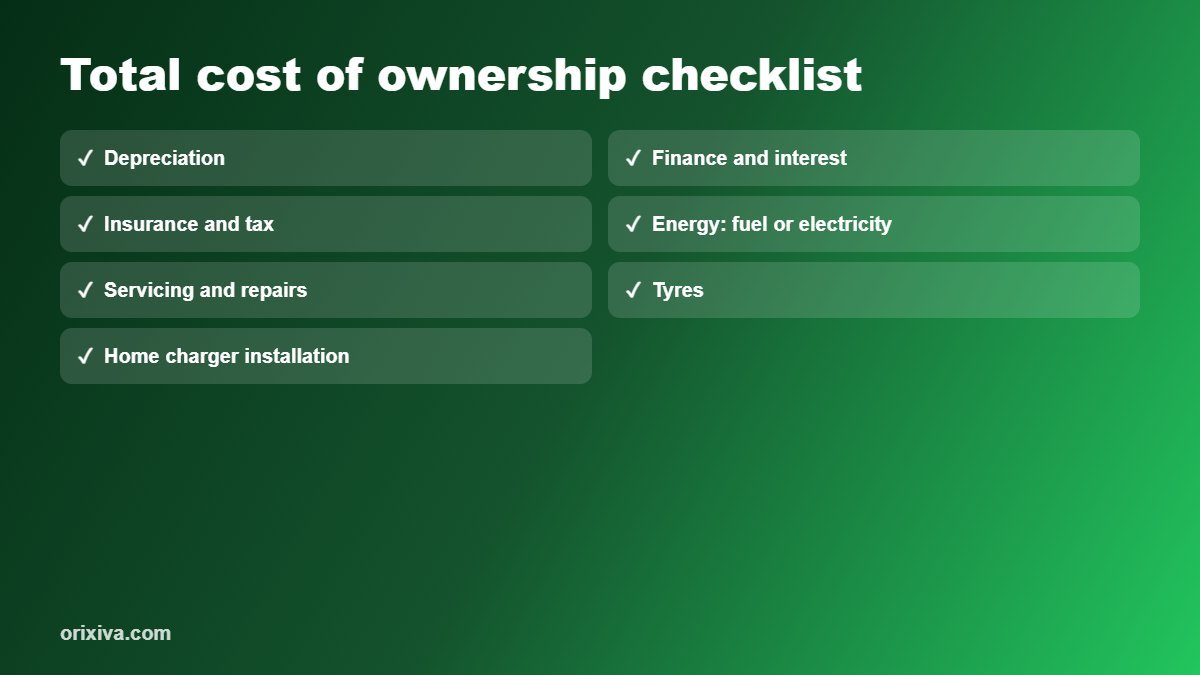
Divide the total by the distance you drive to get the all-in cost per km. The Total Cost of Ownership tool does this for you, and the Vehicle Depreciation and Car Loan tools fill in the first two lines.
What changes the result
- Cold weather: EVs use more energy for heating and battery warming, so winter consumption can be noticeably higher.
- Speed: motorway driving raises consumption for both, but especially for EVs.
- Trip type: petrol cars are least efficient on short, cold trips; EVs are efficient in town traffic.
- Local prices: fuel and electricity prices change, so re-run the numbers when they move.
- Yearly distance: the more you drive, the more a cheaper running cost pays back a higher purchase price.
How to compare your own cars in 5 minutes
- Find real consumption. Use your trip computer, or divide fuel used by distance over a few fill-ups. The Fuel Economy Converter switches between L/100 km, km/L and mpg.
- Enter local prices for fuel and electricity, including your home tariff and typical public charging price.
- Set your charging mix, such as 80% home and 20% public.
- Enter yearly distance and compare energy costs in the EV vs Petrol tool.
- Add ownership costs in the Total Cost of Ownership tool to see the all-in cost per km and the payback time.
Compare your EV and petrol costs
EV vs petrol, EV charging, fuel economy, trip cost, car loan, depreciation and total cost of ownership: 16 free car tools in one place.
Open the free car calculator →Frequently asked questions
Is an electric car cheaper to run than a petrol car?
Usually yes when charged mainly at home on a reasonable tariff, because electricity per kilometre costs less than petrol. Relying only on public fast charging can reduce or remove the saving.
How do I calculate EV cost per km?
Multiply consumption in kWh per km by the price per kWh, then add about 10% for charging losses. For example, 0.17 kWh/km × 0.15 × 1.10 ≈ 0.028 per km.
How do I calculate petrol cost per km?
Multiply litres per km by the price per litre. A car using 7 L/100 km with petrol at 1.60 per litre costs 0.112 per km.
How much electricity does an EV use per 100 km?
Many cars use roughly 14–22 kWh per 100 km depending on size, speed and weather. Use your own car's figure for accurate results.
Are EVs cheaper to maintain?
Routine servicing is often cheaper because there are no oil changes and fewer moving parts, but tyres, insurance and repairs depend on the model.
What is total cost of ownership for a car?
It is the sum of depreciation, finance, insurance, tax, energy, servicing, tyres and other costs over a period, often shown per year and per kilometre.
Does cold weather affect EV running costs?
Yes. Heating and battery warming increase energy use in winter, which raises the cost per kilometre.
Can I use the calculator in miles and gallons?
Yes. The car calculator converts between L/100 km, km/L, US mpg and UK mpg, and the formulas work in any currency.
Over to you
What does your car really cost per kilometre or mile? Share your car, consumption and local prices in the comments. Real reader numbers help everyone make better comparisons.
Related guides and tools
- Free car calculator: EV, fuel, loans and ownership
- Financial calculators guide: loans, interest and ROI
- Electrical calculator: electricity usage and bills
- Unit converter
Sources: fueleconomy.gov: All-electric vehicles · IEA: Global EV Outlook. Example prices are illustrative only; use your local prices.

[…] EV vs petrol: real running cost per kilometre […]
[…] petrol with electric running costs? See EV vs petrol running cost per kilometre. For flights and boats, the trip fuel guide uses burn rates instead of MPG, and the volume […]
[…] A US gallon of gasoline holds about 35.2 kWh, about 9.3 kWh per liter. For running costs on the road, see EV vs petrol running cost. […]