Try our free AI tools – no sign-up needed!


How Much Does YouTube Pay per 1,000 Views in 2026? Real Rates, Easy Examples
Want your own number? The free YouTube earnings calculator estimates ad revenue, Shorts pay and sponsor rates for your channel. No sign-up.
Jump to the free tool ↓Search “how much does YouTube pay” and you will see everything from “$1 per 1,000 views” to “$30 per 1,000 views”. Both can be true. YouTube does not pay a fixed rate per view; it shares ad revenue, and that revenue depends on your topic, your viewers’ countries, the time of year and the type of video.
This guide explains how YouTube pay really works in 2026, shows typical rates by niche, and walks through worked examples. You can test your own channel with the free Orixiva YouTube earnings calculator.
Key takeaways
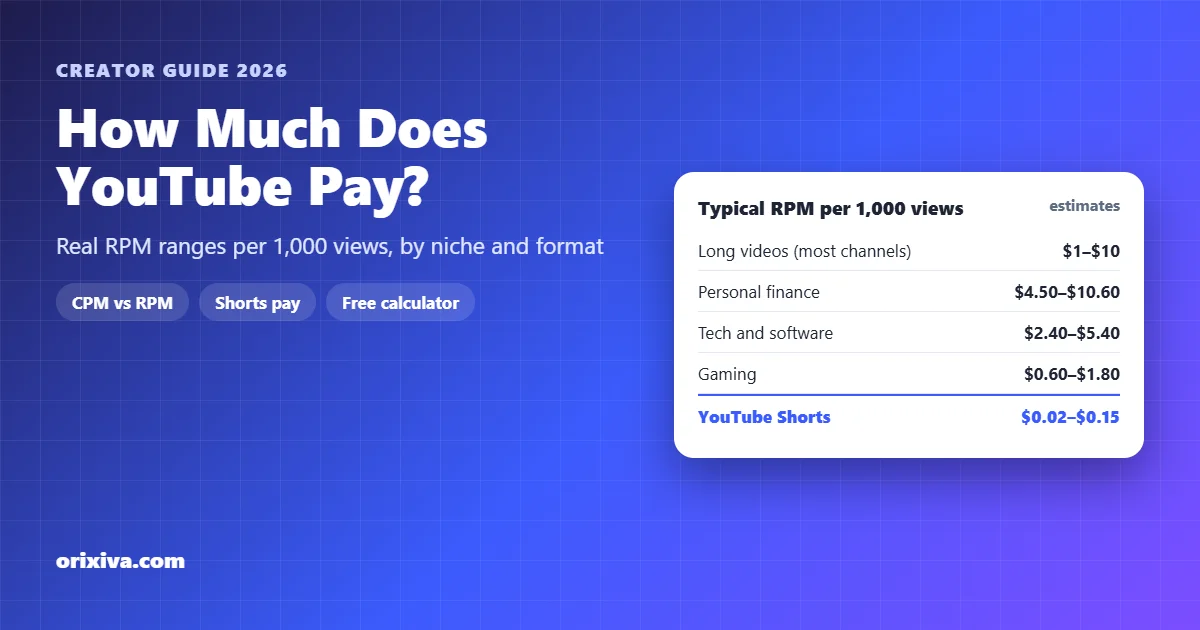
- Most monetized long-form channels earn roughly $1–$10 per 1,000 views (RPM), and many sit around $2–$5.
- YouTube Shorts pay far less: typically about $0.02–$0.15 per 1,000 views.
- On long videos creators keep 55% of ad revenue. On Shorts they receive 45% of their share of the Shorts pool.
- Niche and audience country move your rate the most. Finance and business pay several times more than gaming or music.
- Sponsorships, memberships and affiliate links often earn more than AdSense for small channels.
How much does YouTube pay per 1,000 views? The short answer
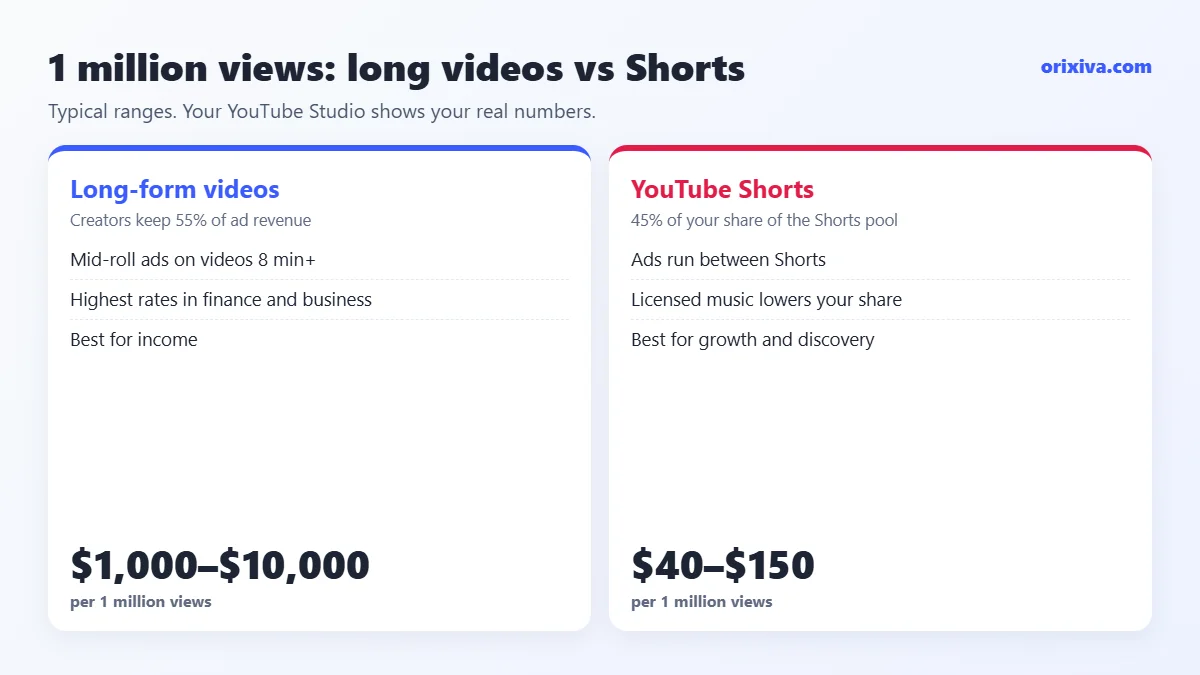
For long videos, a realistic range is about $1 to $10 per 1,000 views, with many channels between $2 and $5. That means 1 million long-form views typically earns somewhere between $1,000 and $10,000, and more in top niches such as personal finance. For Shorts, 1 million views usually earns tens of dollars to around $150.
The formula behind any estimate is simple:
Ad earnings = views ÷ 1,000 × RPM
The hard part is knowing your RPM. That depends on the five factors in the rest of this guide.
CPM vs RPM: the difference that confuses everyone
You will see two numbers in YouTube Studio, and mixing them up is the most common reason people overestimate how much YouTube pays.
CPM (cost per mille)
What advertisers pay for 1,000 ad impressions, before YouTube takes its share. It only counts views that showed an ad.
RPM (revenue per mille)
What you earn per 1,000 views, after YouTube’s share and including the views that showed no ad. This is the number to plan with.
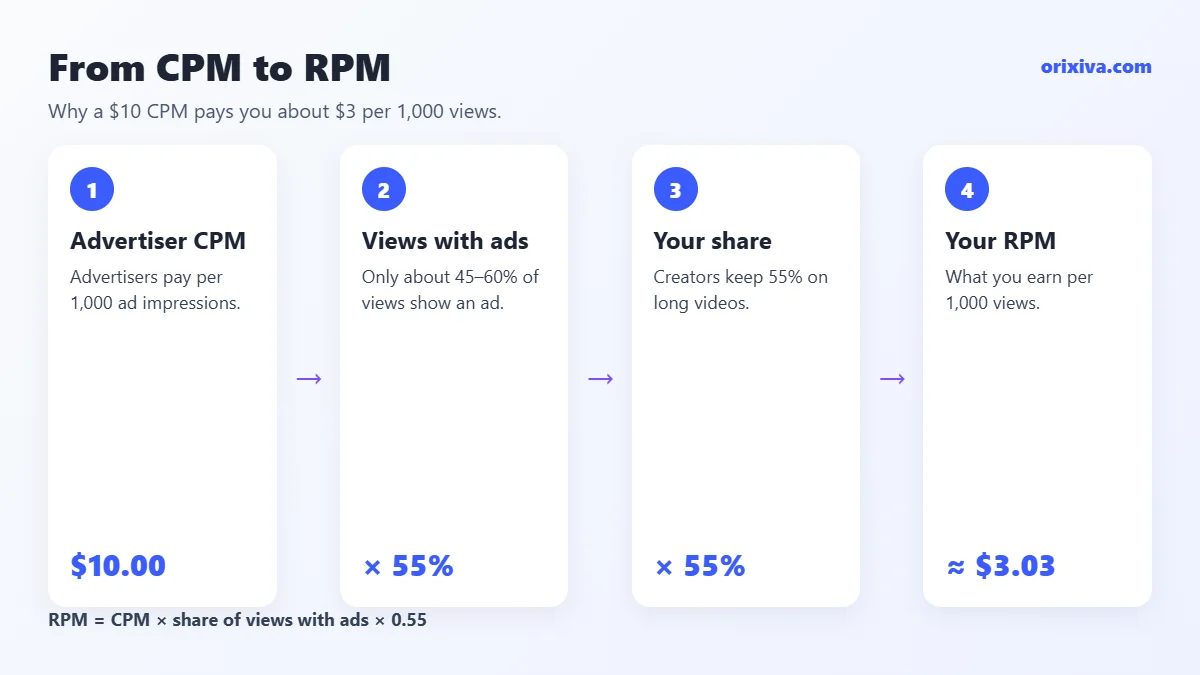
On long videos you keep 55% of ad revenue. Not every view shows an ad (some viewers use ad blockers, some videos are not suitable for every advertiser, some sessions skip ads), so the share of “monetized playbacks” is often around 45–60%. The calculator uses this formula:
RPM = CPM × share of views with ads × 0.55
So a $10 CPM with ads on 55% of views gives an RPM of about $3.03. That is why your RPM is usually only 30–40% of your CPM.
How much does YouTube pay by niche?
Advertisers pay more to reach viewers who are about to spend money. A video about choosing a credit card attracts banks; a video about a video game attracts cheaper ads. These are typical ranges for a mostly US audience, used as defaults in the calculator:
| Niche | Typical US CPM | Typical RPM |
|---|---|---|
| Personal finance and investing | $15–$35 | $4.50–$10.60 |
| Real estate | $12–$28 | $3.60–$8.50 |
| Business and marketing | $10–$25 | $3.00–$7.60 |
| Tech and software | $8–$18 | $2.40–$5.40 |
| Education and how-to | $6–$14 | $1.80–$4.20 |
| Health and fitness | $6–$12 | $1.80–$3.60 |
| Food and cooking | $4–$9 | $1.20–$2.70 |
| Gaming | $2–$6 | $0.60–$1.80 |
| Music | $1.50–$4 | $0.45–$1.20 |
These are estimates built from public creator-reported ranges, not official YouTube figures. Some finance creators report RPMs well above $20; some gaming channels report below $1. Your YouTube Studio shows your real numbers.
How much does YouTube pay by audience country?
Where your viewers live matters as much as your topic. Advertisers pay most for viewers in the United States, the UK, Canada and Australia, followed closely by Western and Northern Europe. Rates in Eastern Europe and Latin America are often a third to a half of that, and viewers in South Asia, much of Southeast Asia and Africa often bring a fifth to a tenth of top-tier rates.
Tip for creators outside the USYou do not need to live in a high-paying country; your viewers do. Making videos in English on topics with a global audience, such as software tutorials or study skills, can raise your RPM even if you live in Pakistan, India or the Philippines.
Season and video length
Ad prices also follow the calendar. The October–December holiday season usually brings the highest CPMs, and January is often the lowest. Long videos of 8 minutes or more can show mid-roll ads, which can raise earnings per view when viewers keep watching.
How much does YouTube Shorts pay?
Shorts work differently. Ads run between Shorts in the feed, so the money goes into a shared pool. YouTube works out each creator’s share from their Shorts views, reduces it where licensed music was used, and creators receive 45% of the allocated amount.
The result is low pay per view: roughly $0.02 to $0.15 per 1,000 Shorts views. One million Shorts views typically earns around $40–$150. Shorts are great for reaching new viewers and growing subscribers, but if income is your goal, use them to send viewers to your long videos, where RPM is many times higher.
Creating Shorts, Reels and TikToks from one video? Our guide to making Shorts, Reels and TikTok videos for free walks through it.
When does YouTube start paying you?
You earn ad revenue only in the YouTube Partner Program (YPP). According to YouTube’s official YPP overview, there are two levels:
| Level | Requirements | What it unlocks |
|---|---|---|
| Early access (fan funding) | 500 subscribers, 3 public uploads in 90 days, and 3,000 watch hours in 12 months or 3 million Shorts views in 90 days | Channel memberships, Super Thanks, Super Chat, Super Stickers, shopping |
| Full ad revenue | 1,000 subscribers and 4,000 public watch hours in 12 months, or 10 million public Shorts views in 90 days | Ad revenue on long videos and Shorts, plus everything above |
You also need a linked AdSense account, 2-step verification, no active Community Guidelines strikes, and content that follows YouTube’s monetization policies. Channels that mostly reuse other people’s content or upload repetitive, mass-produced videos are often rejected. Requirements can vary by country, so check YouTube Studio for your channel. The calculator’s Partner Program check tells you how far you are from each threshold.
4 worked examples: how much YouTube pays real channels
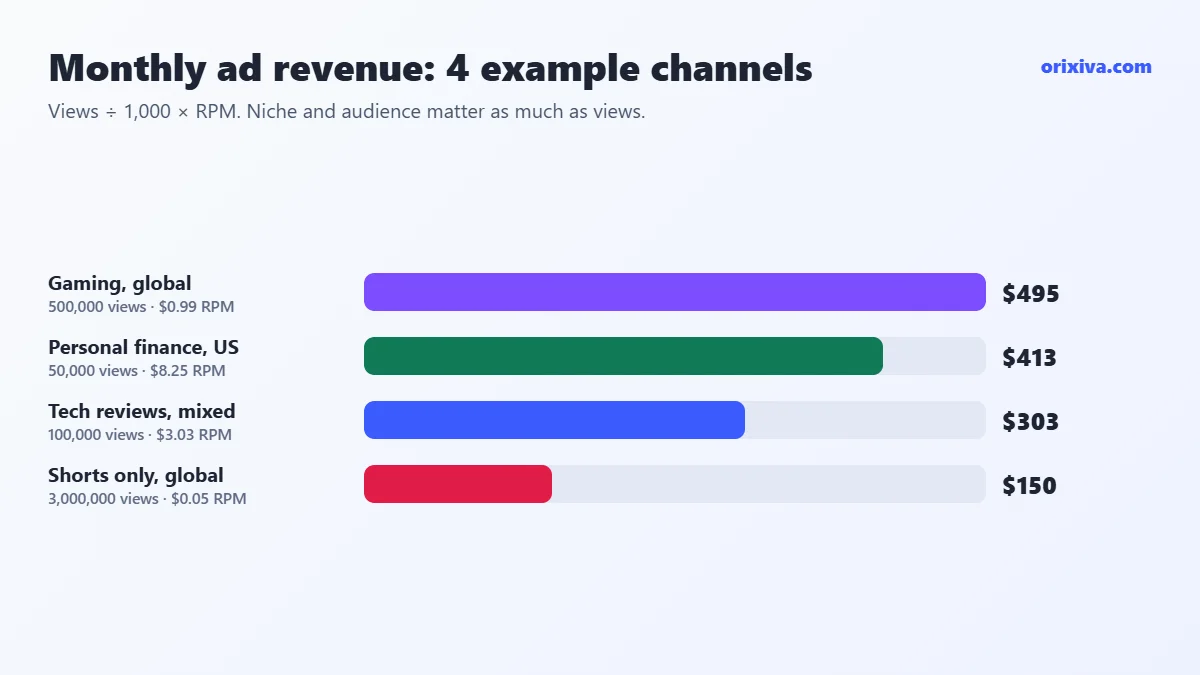
Each example uses the same formula as the calculator: views ÷ 1,000 × CPM × share of views with ads × 0.55.
Monthly ad revenue estimates
Long-form unless stated
USDLong-form unless stated
| Channel | Views / month | CPM | Ads shown | RPM | Revenue |
|---|---|---|---|---|---|
| Tech reviews, mixed audience | 100,000 | $10 | 55% | $3.03 | $303 |
| Personal finance, US audience | 50,000 | $25 | 60% | $8.25 | $413 |
| Gaming, global audience | 500,000 | $4 | 45% | $0.99 | $495 |
| Shorts only, global | 3,000,000 | — | — | $0.05 | $150 |
The finance channel earns more from 50,000 views than the tech channel from 100,000, and the Shorts channel needs 3 million views to earn $150.
The lesson: views are not everything. A smaller channel in a valuable niche with an English-speaking audience can out-earn a much bigger channel in a low-CPM niche.
4 myths about how much YouTube pays
- “YouTube pays per subscriber.” It does not. Only views (and the ads on them) earn ad money. Subscribers matter because they bring views.
- “Every view earns money.” Only views that show an ad earn ad revenue, plus a share of YouTube Premium. That is why RPM is lower than CPM.
- “Longer videos always pay more.” Mid-roll ads help only if viewers keep watching. A padded video loses viewers and can earn less.
- “Big channels earn the same everywhere.” Two channels with identical views can earn ten times different amounts because of niche and audience country.
How to estimate your own YouTube earnings
- Enter your views and uploads. Use your monthly views from YouTube Studio and how many videos you post per month.
- Choose your niche and main audience. The calculator sets a realistic CPM range from 16 niche ranges and 10 audience regions.
- Set season and length. Choose the quarter (October–December is the peak) and whether your videos are over 8 minutes, so mid-rolls are included.
- Adjust monetized playbacks. 45–60% is typical. If you know your own figure from YouTube Studio, use it.
- Add other income. Sponsors, memberships, Super Thanks, affiliate links and merch, then read the 12-month projection and the low-to-high range.
The calculator also has tabs for YouTube Shorts (including the effect of licensed music), Instagram and TikTok engagement rates and brand deal pricing, Facebook, and Twitch, plus an income goal planner that shows the views you need for a monthly target.
How to earn more than AdSense on YouTube
For many small and medium channels, ads are not the biggest income. These often pay more per viewer:
Sponsorships
Brands often pay for a short integration, commonly quoted at around $10–$40 per 1,000 views, depending on niche and audience. The calculator’s one-page media kit PDF suggests rates from your numbers.
Memberships and Super Thanks
Viewers pay you directly. YouTube keeps a share; creators keep 70% of the net revenue from these features.
Affiliate links
A small share of viewers clicking and buying can beat ad revenue in tech, software and product review niches.
Merch and products
Your own products keep most of the profit. Planning to sell online? Our Amazon FBA profit calculator shows the real margin after fees.
Raise your RPM
- Make videos that solve money-related problems in your niche (best tools, how to choose, cost comparisons).
- Write titles and topics that attract viewers in high-CPM countries.
- Keep videos advertiser-friendly: heavy swearing, violence and shocking topics limit ads.
- Make longer videos only when the content deserves it; mid-rolls on a dull video just lose viewers.
- Use Shorts to grow, and link each Short to a related long video.
How YouTube pay compares with Instagram, TikTok, Facebook and Twitch
Many creators post the same idea on several platforms. Each one pays in a different way, so it helps to know what to expect before you decide where to put your effort.
| Platform | How creators earn | What the calculator estimates |
|---|---|---|
| YouTube long-form | 55% of ad revenue, plus fan funding | RPM, monthly and yearly revenue, sponsors, projection |
| YouTube Shorts | 45% of your share of the Shorts pool | Shorts RPM, effect of licensed music, eligibility |
| Mainly brand deals | Engagement rate by followers and reach, estimated rate card | |
| TikTok | Creator Rewards for videos over one minute, brand deals, LIVE gifts | Engagement rate by views, share rate, earnings range |
| Content Monetization (by invitation or application) and Stars | Earnings per 1,000 views by audience, Stars income | |
| Twitch | Subscriptions, ads, Bits and tips | Monthly income from subs, ad minutes and Bits |
On Instagram and TikTok, brands look at engagement rate more than follower count. A smaller account with loyal viewers often gets better deals than a big account with silent followers. Put your figures into the YouTube earnings calculator’s Instagram and TikTok tabs to see your engagement rate against typical benchmarks for your follower tier.
How and when YouTube pays you
Your earnings build up in YouTube Studio during the month and are finalised in AdSense early the next month. Once your balance passes the payment threshold for your country, AdSense pays by bank transfer, usually around the 21st–26th. Make sure your address is verified, your tax information is submitted and your bank details are correct, or payments are held.
Tax and take-home pay
If you live outside the US, YouTube may withhold US tax on the part of your earnings that came from US viewers. Once your tax information is in AdSense, the rate is often 0–30% of US earnings, depending on whether your country has a tax treaty with the US. If you do not submit tax information, YouTube can withhold up to 24% of your total earnings worldwide. YouTube Help explains the US tax rules.
The calculator’s tax tab estimates withholding from the share of US viewers and shows your take-home pay in USD, PKR, INR, BDT, EUR, GBP, AED, SAR or CAD. Income tax in your own country is separate, so check with a local tax adviser.
Your turn: What RPM does your channel get, and in which niche? Share a range in the comments (no channel stats screenshots needed). Real numbers from creators around the world help everyone set realistic goals.
Calculate how much YouTube could pay you
Enter your views, niche and audience to see your estimated RPM, monthly and yearly ad revenue, Shorts pay, sponsor rates and take-home pay after tax. Free, private and no sign-up.
Open the YouTube earnings calculator → YouTube, Shorts, Instagram, TikTok, Facebook and Twitch · Search more calculators on orixiva.comYouTube pay questions people ask
How much does YouTube pay for 1 million views?
For long videos, usually about $1,000 to $10,000, and more in top niches such as finance. For Shorts, 1 million views typically earns around $40 to $150.
How much does YouTube pay per view?
Roughly $0.001 to $0.01 per long-form view, and well under a tenth of a cent per Shorts view. YouTube pays per 1,000 views, not per view, through your RPM.
What is a good RPM on YouTube?
Above $5 is strong for most niches. Finance and business channels with US audiences can reach $10 or more; gaming and music channels often stay under $2.
Does YouTube pay for views before monetization?
No. You only earn from ads after you join the YouTube Partner Program. Views before that do not earn money, but they count towards the watch hours and subscriber thresholds.
How much do YouTubers with 100,000 subscribers make?
Subscribers do not earn money; views do. A channel with 100,000 subscribers might get 50,000 or 1 million views a month, so ad income can range from under $100 to several thousand dollars.
Why did my RPM drop in January?
Advertisers spend most in October–December and least in January, so CPM and RPM usually fall at the start of the year and recover over the following months.
When does YouTube pay creators?
Through AdSense, usually once a month around the 21st–26th, after your balance reaches the payment threshold for your country.
Do Shorts views count for monetization?
Yes. 10 million public Shorts views in 90 days (with 1,000 subscribers) qualifies for full YPP, and 3 million for the early access level.
Is the YouTube earnings calculator accurate?
It gives a realistic low-to-high range based on public creator data, but only YouTube Studio shows your actual earnings. Use the estimate for planning, not as a promise.