Try our free AI tools – no sign-up needed!

Free Amazon FBA, Shopify and Etsy profit calculator with 2026 fees, dimensional weight, ads, returns, margin, ROI and break-even price. No sign-up.

Quick answer: Profit per unit = selling price − product cost − freight − packaging − platform fees − shipping − ads − returns. On Amazon the big fees are the referral fee (usually 15%) and the FBA fulfillment fee, which depends on size tier and the higher of real and dimensional weight. On Shopify you pay card processing (2.5–2.9% + 30¢) plus your plan. On Etsy you pay a 6.5% transaction fee, 3% + 25¢ processing and a 20¢ listing fee. Enter your product above to see all three side by side.
- 7sales channels compared
- 10Amazon fee categories
- 4pricing targets
- 0sign-ups needed
What the profit calculator includes
This Amazon FBA, Shopify and Etsy profit calculator is built for product sellers who want the real number after every fee, not just the gross margin. Change any input and every result, chart and comparison updates at once.
| Feature | What it does |
|---|---|
| Amazon FBA fees | Referral fee by category, 2026 FBA fulfillment fee by size tier (Small and Large Standard, Small Bulky, Large Bulky and Extra-large weight bands) and price band, monthly storage, peak season and the 3.5% fuel surcharge, Professional or Individual plan. |
| Shopify fees | Basic, Shopify and Advanced plan rates, Shopify Payments or a third-party gateway, apps and theme cost per order, shipping charged and label paid. |
| Etsy fees | Listing fee, 6.5% transaction fee on item plus shipping, 3% + 25¢ payment processing, Offsite Ads at 15% or 12% and Etsy Plus. |
| New Amazon fees | Inbound placement fee (Amazon-optimized, partial or minimal split), low-inventory-level fee, aged inventory surcharge and returns processing fee. |
| FBA vs FBM and more channels | Amazon FBM, Walmart Marketplace (seller or WFS fulfilled), eBay final value and per-order fees and TikTok Shop referral fee plus creator commission. |
| Marketplaces and currency | Amazon US, UK, Germany, Canada, UAE and India with local currency, your exchange rate, VAT or GST in the price and the local seller plan. |
| Landed cost | Supplier price in USD, CNY, EUR, GBP or INR, freight per CBM, import duty on FOB or CIF value and clearance costs, copied into the calculator in one click. |
| Dimensional weight | DIM weight, billable weight, cubic feet and the Amazon size tier from your box size, in inches/pounds or centimetres/kilograms. |
| Profit metrics | Net profit per unit, margin, ROI on stock, monthly profit and yearly profit after income tax. |
| Pricing targets | The price needed for your target margin, the break-even price and the most you can spend on ads before a sale loses money. |
| Goal planner | Works back from a monthly profit target to the units you need to sell, the price you need at your current sales and the stock cash you need. |
| Comparison and chart | Seven sales channels in one table, and a chart of Amazon FBA, Shopify and Etsy profit per unit at every price from half to 1.6 times your price. |
| Bulk CSV, report and share | Profit for up to 500 SKUs from a CSV with a downloadable results file, a printable PDF report and a share link that reopens your exact numbers. |

Amazon, Shopify and Etsy seller fees in 2026
These are the US fee rules the calculator uses. Amazon changed its FBA fulfillment fees on 15 January 2026 and added a 3.5% fuel and logistics surcharge on fulfillment fees from 17 April 2026.
| Platform | Fee | Rate used |
|---|---|---|
| Amazon | Referral fee | 15% for most categories, 8% electronics and computers, tiered for clothing, jewelry, beauty, grocery and furniture, $0.30 minimum |
| Amazon | FBA fulfillment | From $3.32 (small standard, 2 oz, $10–$50 price). Lower under $10, higher over $50 |
| Amazon | Monthly storage | $0.78 per cubic foot Jan–Sep, $2.40 Oct–Dec (standard size) |
| Amazon | Selling plan | $39.99 per month or $0.99 per item |
| Shopify | Card processing | 2.9% + 30¢ Basic, 2.7% + 30¢ Shopify, 2.5% + 30¢ Advanced |
| Shopify | Third-party gateway | Extra 2%, 1% or 0.6% depending on plan |
| Etsy | Listing + transaction | $0.20 per listing and 6.5% of item price plus shipping |
| Etsy | Payment processing | 3% + $0.25 (US) |
| Etsy | Offsite Ads | 15%, or 12% for shops over $10,000 a year, capped at $100 per order |
Fees change often. If Seller Central shows a different FBA fee for your product, type it into the FBA fee override field and the calculator uses your number.
Worked example
A product sells for $29.99, costs $6.50 to make, $1.20 to ship to the warehouse and $0.40 to pack. The box is 10 × 7 × 3 inches and weighs 1.1 lb. Ads cost 10% of sales, 4% of orders come back and you sell 300 a month.
| Per unit | Amazon FBA | Shopify | Etsy |
|---|---|---|---|
| Revenue | $29.99 | $34.98 (with $4.99 shipping) | $34.98 |
| Main platform fees | $4.50 referral + $5.77 FBA | $1.31 processing + $0.33 plan and apps | $4.30 listing, transaction, processing and Offsite Ads |
| Shipping label | Included in FBA | $6.80 | $6.80 |
| Net profit | $8.10 | $15.24 | $12.58 |
| Margin | 27.0% | 43.6% | 36.0% |
Shopify looks best on paper because there is no referral fee, but you have to bring every visitor yourself. If your Shopify ads cost 25% of sales instead of 10%, profit drops to about $10.74. Use the ad spend field to test what each channel really costs you.
How to use the profit calculator
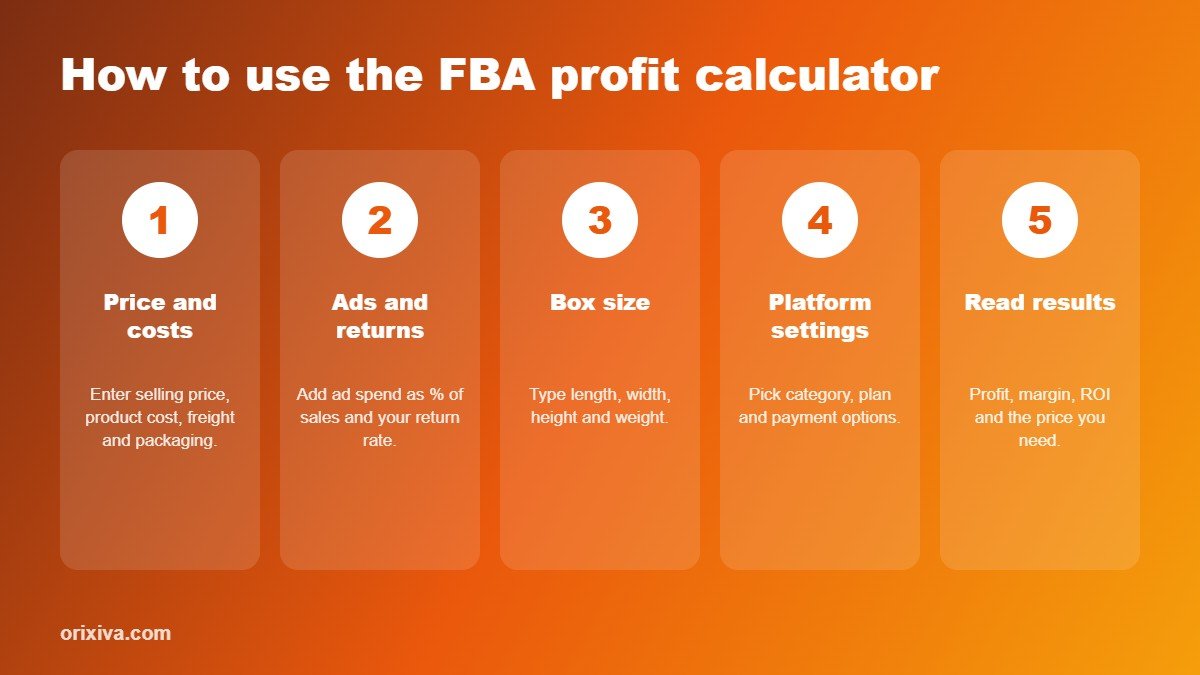
- Enter price and costs. Add your selling price, monthly units, product cost, freight and packaging.
- Add ads and returns. Type your ad spend as a share of sales and your usual return rate.
- Enter the box size. Length, width, height and packed weight give the dimensional weight and the Amazon size tier.
- Pick each platform's settings. Choose the Amazon category, your Shopify plan and your Etsy shipping and Offsite Ads share.
- Read the results. Compare net profit, margin and ROI, then set a target margin to see the price you need.
Why box size changes your profit
Amazon and most carriers charge on the higher of the real weight and the dimensional weight (length × width × height ÷ 139 in inches and pounds). A light product in a big box pays for air. In the example above, the 1.1 lb product is billed as 1.51 lb because of its box. For a full breakdown by carrier, use the Dimensional Weight Calculator, and read 9 ways to cut dimensional weight charges.
How to raise your margin
- Shrink the box. Getting under 0.75 inches tall and 1 lb moves an Amazon item into small standard, the cheapest tier.
- Test prices near fee breaks. Amazon charges lower FBA fees under $10, and many referral fees change at $10, $15 or $20.
- Bundle units. Fixed fees such as the Etsy listing fee, the 30¢ card fee and the FBA fee are paid once per order.
- Watch the break-even ad spend. If your ad spend is above it, every ad sale loses money.
- Avoid peak storage. Send less stock in October to December, when storage costs three times more.

Glossary
- Referral fee
- Amazon's commission on each sale, a percentage of the price that depends on the category.
- FBA fee
- What Amazon charges to pick, pack and ship one unit, based on size tier and weight.
- TACoS
- Total advertising cost of sale: ad spend divided by all sales, not just ad sales.
- Margin
- Net profit divided by revenue.
- ROI
- Net profit divided by what you paid for the stock, freight and packaging.
- Break-even price
- The lowest price where profit is zero after every fee.
Related free tools
- Dimensional Weight Calculator for billable weight by carrier.
- Business Calculator for margin, markup and break-even.
- 3D Printing Cost Calculator for pricing printed products.
- Barcode Generator for EAN-13 and product labels.
- Financial Calculators for loans, interest and ROI.
- All free calculators in one place.
Privacy and accuracy
The calculator runs in your browser. Your prices and costs are saved only on your own device so they are still there next time, and nothing is uploaded. Fee rules are for the US marketplaces and are estimates. Check Seller Central, your Shopify admin and your Etsy payment account for the exact amounts on your orders.
Share your feedback
Which platform gave you the best margin? Tell other sellers in the comments, or tell us which marketplace we should add next. Comments are reviewed before they appear.
Frequently asked questions
How do I calculate Amazon FBA profit?
Take the selling price and subtract the product cost, freight to Amazon, packaging, the referral fee, the FBA fulfillment fee, monthly storage, your selling plan, ad spend and expected returns. What is left is your net profit per unit.
How much does Amazon take per sale?
Usually 15% of the price as a referral fee, plus the FBA fee if Amazon ships the order. For a typical 1 to 2 lb product priced at $20 to $30, total Amazon fees are often 30 to 40% of the price.
What are Etsy fees in 2026?
A $0.20 listing fee, a 6.5% transaction fee on the item price plus shipping, and 3% + $0.25 payment processing in the US. Offsite Ads add 15% (or 12% for larger shops) on orders that come from those ads.
Is selling on Shopify cheaper than Amazon?
Shopify fees per order are lower because there is no referral fee, but you pay a monthly plan and must bring all of your own traffic. Once you add ad costs, the gap is often smaller than it looks.
What is a good profit margin for online sellers?
Many sellers aim for 20% or more net margin after all fees and ads. Under 10% leaves little room for price drops, returns or higher ad costs.
Does dimensional weight affect FBA fees?
Yes. For large standard and bulky items, Amazon uses the higher of the unit weight and the dimensional weight (length × width × height ÷ 139). Small standard items use unit weight only.
Is this profit calculator free?
Yes. It is free, needs no sign-up and runs in your browser.
What is the Amazon referral fee?
A percentage of the selling price that Amazon charges on every sale, set by product category. It is 15% for many categories, lower for some, with a minimum fee per item. Choose your category in the calculator and it applies the matching rate.
How is the FBA fulfillment fee worked out?
Amazon charges a fulfillment fee per unit based on the product size tier, shipping weight and price band. The calculator finds the size tier from your box size and weight and applies the 2026 fee table.
Professional or Individual seller plan: which is cheaper?
The Professional plan has a monthly subscription, while the Individual plan charges a fee per item sold instead. If you sell more than about 40 units a month, Professional is usually cheaper. The calculator spreads either cost across your units.
Does the calculator include monthly storage and peak fees?
Yes. It adds monthly storage based on your product volume, the higher October to December peak storage rate and the fuel surcharge listed in the 2026 fee settings.
How are Shopify fees calculated?
Shopify takes a card rate per order that depends on your plan when you use Shopify Payments, and an extra transaction fee if you use a third-party gateway. The calculator also spreads app and theme costs across your orders and compares shipping charged with the label you pay.
Does it include Etsy Offsite Ads?
Yes. Turn on Offsite Ads and choose 15% or 12% (for shops above $10,000 a year). The fee is charged only on orders that come from those ads and is capped at $100 per order.
What is TACoS and how does ad spend affect profit?
TACoS is total ad spend divided by total sales. At 10% TACoS on a $30 product, ads cost $3 per unit sold, which comes straight off your profit. The calculator also shows the most you can spend on ads before a sale loses money.
How are returns counted in the profit?
Enter your return rate and the loss per return, such as the return label and damaged stock. The calculator spreads that loss across every unit sold.
What is the difference between margin and ROI?
Margin is profit as a percentage of the selling price. ROI is profit as a percentage of what you paid for the stock. A $10 profit on a $40 sale with $15 product cost is a 25% margin and about a 67% ROI.
What is the break-even price?
The lowest price at which all fees and costs are covered and profit is zero. The calculator also finds the price you need for your target margin.
Can I compare Amazon with Shopify, Etsy, Walmart, eBay and TikTok Shop?
Yes. The comparison table runs the same product and price through Amazon FBA, Amazon FBM, Shopify, Etsy, Walmart, eBay and TikTok Shop and highlights the channel that keeps the most profit. The chart shows Amazon FBA, Shopify and Etsy profit per unit from half to 1.6 times your price.
Does it work in centimetres and kilograms?
Yes. Switch the package units between inches and pounds or centimetres and kilograms, and pick the dimensional weight divisor that matches your carrier.
Can I include income tax?
Yes. Enter your income tax rate and the calculator shows monthly and yearly profit after tax as well as before tax.
Are the fees exact?
They are estimates from published 2026 US fee rules. Amazon, Shopify and Etsy change fees and some depend on your account, so check Seller Central or your platform dashboard before setting prices.
Should I use FBA or FBM?
Open the Amazon FBM tab and enter your own label and pick-and-pack cost. FBM removes the FBA fulfillment, storage and placement fees but you ship every order yourself. The comparison table shows FBA and FBM profit side by side for the same price, so you can see which one keeps more per unit.
How are Walmart, eBay and TikTok Shop fees calculated?
Walmart takes a referral fee by category (15% for most items, 8% for electronics, 6% for computers) and has no monthly fee; you can ship yourself or use an estimate for Walmart Fulfillment Services. eBay charges a final value fee on the total including shipping (13.6% for most categories) plus $0.40 per order, or $0.30 at $10 or less. TikTok Shop charges a referral fee that includes payment processing (enter 6% or 8% to match Seller Center) plus any creator commission.
Does it work for Amazon UK, Germany, Canada, UAE and India?
Yes. Pick the marketplace to switch the currency, the seller plan and the VAT or GST included in your price. Referral fees use the same category rates, and the FBA fulfillment fee is converted from US rates at your exchange rate, so type the exact fee from Seller Central in the override box for a precise result.
How do I work out landed cost?
In the Landed cost card, enter the supplier price and currency, the units in the shipment, the volume in cubic metres (CBM), the freight rate per CBM, the duty rate and any customs or broker costs. The calculator splits freight and clearance across every unit, adds duty on the product value (FOB, as in the US) or product plus freight (CIF, as in the UK, EU and India) and copies the result into product cost and freight with one click.
What are the inbound placement, low-inventory and aged inventory fees?
Inbound placement is a per-unit fee for sending stock to fewer Amazon sites: free with the Amazon-optimized split, lower for a partial split and highest for a minimal split. The low-inventory-level fee applies when you hold less than 28 days of supply. The aged inventory surcharge is charged each month on units stored more than 180 days, by cubic foot with a per-unit minimum after 365 days.
What is the returns processing fee?
Amazon charges a returns processing fee on returned units in categories with high return rates, such as apparel and shoes. Turn it on and the calculator charges about one fulfillment fee per returned standard-size unit, or $6.74 plus $0.32 per pound for bulky items, multiplied by your return rate.
Which products count as Small Bulky?
Items over the Large Standard limits (18 x 14 x 8 inches or 20 pounds) that are no more than 37 x 28 x 20 inches, 50 pounds, and 130 inches in length plus girth. The 2026 fee starts at $6.78 under $10 or $7.55 at $10 and above, plus $0.38 per pound over the first pound. Bigger items move to Large Bulky or Extra-large, which has weight bands at 50, 70 and 150 pounds.
How many sales do I need for a monthly profit goal?
Type your target in the Goal planner. It works out the units you need to sell each month at your current price, the price you would need at your current sales and the cash you need for that much stock each month.
Can I calculate many products at once?
Yes. Paste or upload a CSV with sku, price, cost, length, width, height and weight (units and category are optional) into the Bulk SKU calculator. It runs up to 500 products through your current platform and fee settings, flags SKUs that lose money and lets you download the results as a CSV.
Can I save a PDF report or share my numbers?
Click PDF report to open a one-page report with your inputs, profit, cost breakdown and platform comparison, then save it as a PDF from the print window. Share link copies a link that reopens the calculator with your exact numbers.