Try our free AI tools – no sign-up needed!


How to Reduce Dimensional Weight Charges: 9 Ways to Cut Shipping Costs in 2026
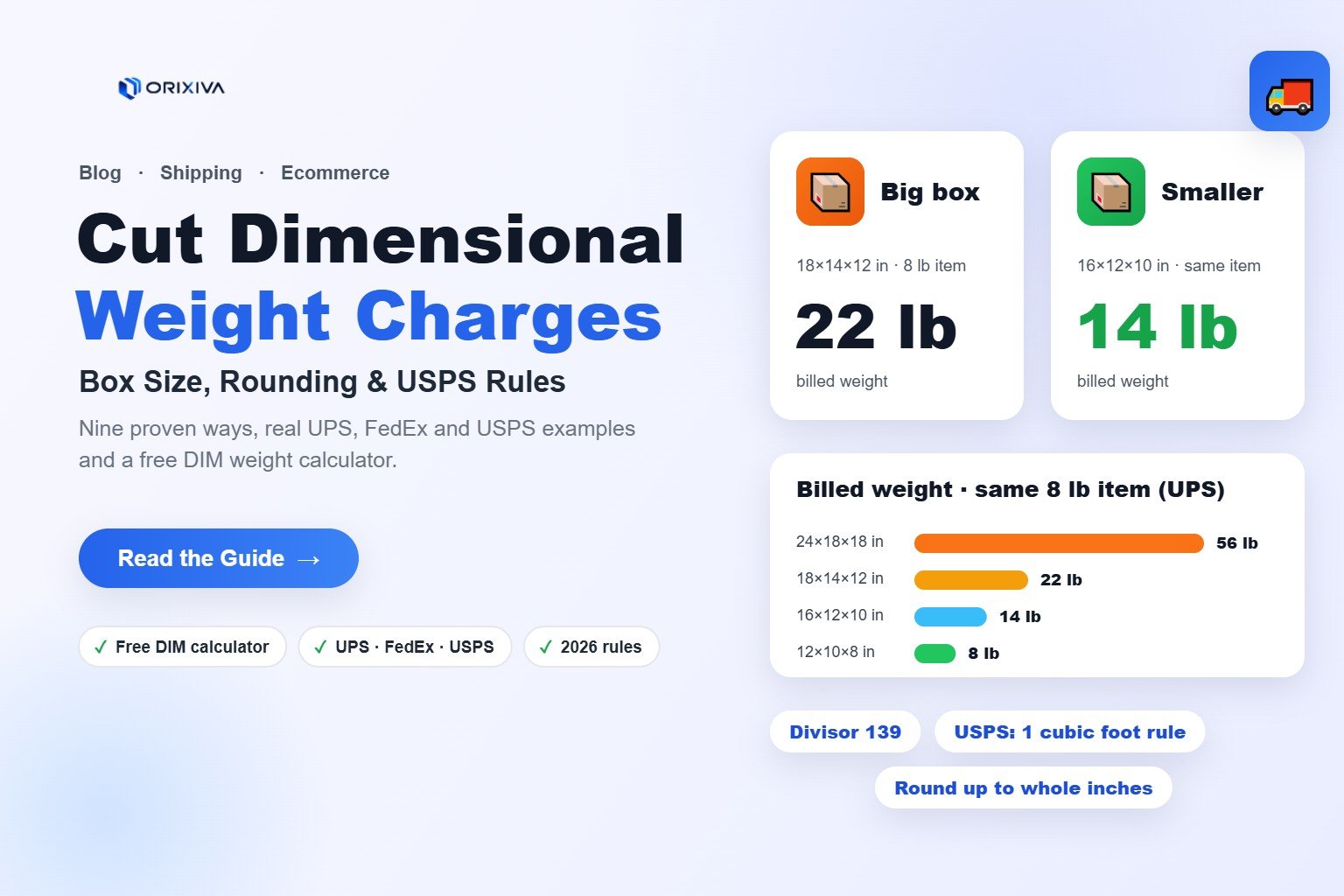
Short answer: Carriers bill large, light parcels on dimensional weight: length × width × height ÷ 139 for UPS, FedEx and (since July 2026) USPS. To pay less, use the smallest box that protects the product, choose box sizes in whole inches, keep USPS parcels under one cubic foot, ship soft goods in poly mailers and compare carriers for each box size. Moving an 8 lb item from an 18 × 14 × 12 inch box to a 16 × 12 × 10 inch box cuts the billed weight from 22 lb to 14 lb. The free Orixiva dimensional weight calculator shows the billable weight for every carrier at once.
Key takeaways
- You pay for the bigger of two numbers: the scale weight or the dimensional weight, after rounding.
- UPS, FedEx and USPS all use 139 for inches and pounds in 2026, so a big, light box is expensive with every major US carrier.
- Every side is rounded up to the next whole inch, so a 12.1-inch side is billed as 13 inches.
- USPS only applies DIM pricing above 1 cubic foot (1,728 cubic inches), which makes small boxes cheaper there.
- Box size is the biggest lever: one inch less on each side can save several billed pounds per parcel.
Why big, light boxes cost more
A delivery truck or plane runs out of space long before it runs out of weight. So carriers turn the volume of every parcel into a "weight" and charge you on that whenever it is higher than what the box really weighs. That is dimensional weight, also called DIM weight or volumetric weight.
dimensional weight = length × width × height ÷ divisor
Take an 8 lb item in an 18 × 14 × 12 inch box. The volume is 3,024 cubic inches. Divided by 139 that is 21.8, rounded up to 22 lb. Because 22 lb is more than 8 lb, the carrier bills 22 lb. You are paying for 14 lb of empty space.
Dimensional weight divisors in 2026
| Carrier | Divisor | When it applies |
|---|---|---|
| UPS (daily rates) | 139 in³/lb | All packages. Sides and weight round up. |
| FedEx | 139 in³/lb | All packages. Sides and weight round up. |
| USPS | 139 in³/lb | Only packages over 1 cubic foot (1,728 in³). Lowered from 166 on 12 July 2026. |
| DHL Express | 5,000 cm³/kg | All sizes, in centimetres and kilograms. |
| Amazon FBA fees | 139 in³/lb | Large standard and bulky size tiers. |
USPS changed in July 2026: the divisor dropped from 166 to 139 and each side is now rounded up to the next whole inch. On its own the lower divisor raises the DIM weight of large USPS parcels by about 19%. Many online calculators still use the old number.
9 ways to reduce dimensional weight charges
1. Use the smallest box that protects the product
Volume grows fast when every side grows. Our 8 lb item in a 16 × 12 × 10 inch box is 1,920 cubic inches, or 13.8 rounded up to 14 lb. That is 8 billed pounds less than the 18 × 14 × 12 box, on every single parcel. Keep three or four box sizes in stock so you are never forced into a box that is far too big.
2. Choose box sizes in whole inches
UPS and FedEx (since August 2025) and USPS (since July 2026) round each side up to the next whole inch before they calculate. A 12.1 × 10 × 8 inch box is billed as 13 × 10 × 8: 1,040 cubic inches and 8 lb. A true 12 × 10 × 8 box is 960 cubic inches and 7 lb. Buy standard whole-inch boxes and measure them yourself; a bulging lid counts too.
3. Keep USPS parcels under one cubic foot
USPS only charges dimensional weight when the box is larger than 1,728 cubic inches after rounding. A 12 × 12 × 12 inch box is exactly one cubic foot, so USPS charges the actual weight. Make it 12 × 12 × 12.5 and the last side rounds to 13: now it is 1,872 cubic inches and billed at 14 lb, even if it weighs 3 lb. For small, light products this rule often makes USPS the cheapest choice.
4. Ship soft goods in poly mailers
Clothes, textiles and other items that do not break rarely need a box. A hoodie in a 14 × 10 × 4 inch box is billed at 5 lb by UPS. In a flat mailer of about 14 × 12 × 2 inches it is 3 lb, and with USPS it is simply its real weight, because it is far below one cubic foot.
5. Cut the empty space, not the protection
Every extra inch of padding on each side adds volume on all three sides. Growing the 16 × 12 × 10 box by one inch per side to 17 × 13 × 11 takes it from 14 lb to 18 lb. Use thinner, better padding such as air pillows or molded inserts instead of more box.
6. Test one box against two
Two items in one large, light box can cost more than two small boxes, and sometimes the opposite is true because each parcel has its own base charge. Run both options before you choose a default for multi-item orders.
7. Compare carriers for each box size
The same parcel can be billed very differently. A 16 × 12 × 8 inch box that weighs 5 lb is billed at 12 lb by UPS and FedEx, but at its actual 5 lb by USPS because 1,536 cubic inches is under one cubic foot. Use the cheapest carrier for each box size instead of one carrier for everything.
8. Ask for a better divisor
High-volume shippers can often negotiate a higher divisor with UPS or FedEx. At 166 instead of 139, our 18 × 14 × 12 box drops from 22 lb to 19 lb. If you ship hundreds of parcels a month, ask your account manager or a shipping platform about it.
9. Measure correctly every time
Measure the longest side as length, measure the outside of the box, and include any bulge. If your declared size is smaller than what the carrier scans, you pay the difference plus a correction fee. Record your standard box sizes once, accurately, in your shipping software.
Shortcut: the Box optimizer tab in the dimensional weight calculator shows the largest box you can use before DIM weight kicks in, and how much each extra inch costs you.
Dimensional weight cheat sheet for common boxes
Billed DIM weight at a divisor of 139, after rounding. If your item weighs more than the number shown, you pay the actual weight instead.
| Box (inches) | Cubic inches | UPS and FedEx | USPS |
|---|---|---|---|
| 10 × 8 × 6 | 480 | 4 lb | Actual weight |
| 12 × 10 × 8 | 960 | 7 lb | Actual weight |
| 12 × 12 × 12 | 1,728 | 13 lb | Actual weight |
| 16 × 12 × 10 | 1,920 | 14 lb | 14 lb |
| 18 × 14 × 12 | 3,024 | 22 lb | 22 lb |
| 20 × 16 × 12 | 3,840 | 28 lb | 28 lb |
| 24 × 18 × 18 | 7,776 | 56 lb | 56 lb |
How to check dimensional weight before you ship
- Measure the packed box: outside length, width and height, rounded up to whole inches.
- Multiply the three sides to get cubic inches.
- Divide by the divisor: 139 for UPS, FedEx and USPS (USPS only above 1,728 cubic inches).
- Round up to the next pound and compare with the real weight.
- Use the higher number to look up your rate, then try a smaller box or another carrier.
Or enter the box once in the dimensional weight calculator and see UPS, FedEx, USPS, DHL and Amazon FBA side by side.
Dimensional weight mistakes to avoid
- Using the old USPS divisor of 166. Since 12 July 2026 it is 139 for parcels over one cubic foot.
- Measuring the product instead of the packed box. The carrier measures the outside of the parcel.
- Forgetting the round-up. Fractions of an inch become a whole inch on each side.
- Charging customers flat shipping without checking the billed weight of your real boxes.
- Ignoring size limits. Very large parcels also trigger additional handling or large package surcharges.
Check your boxes in one minute
Billable weight for every carrier, box optimizer, CBM and pallet loading. Free, private and no sign-up.
Open the dimensional weight calculator →Frequently asked questions
What is dimensional weight?
Dimensional weight, also called DIM weight or volumetric weight, is a billing weight based on the size of a parcel. Carriers multiply length, width and height and divide by a divisor such as 139. You pay on whichever is higher, the dimensional weight or the actual weight.
How do I calculate dimensional weight for UPS and FedEx?
Round each side up to the next whole inch, multiply length by width by height, divide by 139 and round up to the next pound. Compare that with the actual weight and use the higher number. An 18 x 14 x 12 inch box is 3,024 cubic inches, so it is billed at 22 lb.
Does USPS charge dimensional weight?
Yes, but only for packages larger than one cubic foot (1,728 cubic inches) after each side is rounded up. Since 12 July 2026 USPS uses a divisor of 139, the same as UPS and FedEx. Smaller parcels are charged on their actual weight.
How can I avoid dimensional weight charges?
Use the smallest box that protects the product, choose box sizes in whole inches, keep USPS parcels under one cubic foot, ship soft goods in poly mailers and compare carriers for each box size. Large shippers can also negotiate a higher divisor.
Is a poly mailer cheaper than a box?
Usually, for items that cannot break. A hoodie in a 14 x 10 x 4 inch box is billed at 5 lb by UPS, but at about 3 lb in a flat mailer, and at its real weight with USPS because the mailer is far below one cubic foot.
Can I negotiate my dimensional weight divisor?
High-volume shippers can often ask UPS or FedEx for a higher divisor in their contract. A higher divisor lowers the dimensional weight: at 166 instead of 139, an 18 x 14 x 12 inch box drops from 22 lb to 19 lb.
Does DHL use dimensional weight?
Yes. DHL Express uses length x width x height in centimetres divided by 5,000 to get volumetric weight in kilograms, and it applies to all parcel sizes.
Over to you
Which box size costs you the most to ship, and did a smaller box or a different carrier fix it? Share your numbers in the comments so other sellers can learn from them. Comments are reviewed before they appear.
Related guides and tools
- Dimensional weight calculator: UPS, FedEx, USPS, DHL and Amazon FBA
- How to price 3D prints for profit
- Business calculator: margin, break-even and pricing
- Unit converter for inches, centimetres, pounds and kilograms
- Free barcode generator for product labels
Sources: UPS: shipping dimensions and weight · DCL: USPS DIM weight changes take effect July 12, 2026 · Ship.com: new USPS dimensional weight rules (July 2026). Carrier rules checked 22 October 2026; contracts can differ.