Try our free AI tools – no sign-up needed!


Break-Even Point and Profit Margin Explained (With Easy Examples)
Need the numbers for your business now? The free business calculator works out break-even, margin and markup, plus 15 more business tools.
Jump to the free tool ↓“How many do I need to sell before I stop losing money?” and “How much do I actually keep from each sale?” are the two questions every business owner asks sooner or later. The answers are the break-even point and the profit margin, and you can work out both with simple maths.
This guide explains each idea in plain English, walks through real examples for a product business and a service, and shows you how to check your numbers with the free Orixiva business calculator, which has 17 tools and runs entirely in your browser.
Key takeaways
- Break-even point in units = fixed costs ÷ (price − variable cost per unit).
- Price − variable cost is the contribution margin: what each sale adds towards fixed costs and profit.
- Profit margin is profit as a share of the selling price; markup is profit as a share of cost. They are not the same.
- A 40% margin needs a 66.7% markup. Mixing them up is the most common pricing mistake.
- Discounts eat into the contribution margin fast: a 20% discount can double the sales you need.
First, split your costs: fixed and variable
Every break-even calculation starts by sorting costs into two groups.
Fixed costs
Costs that stay the same whatever you sell in a period: rent, salaries, software subscriptions, insurance, loan payments.
Variable costs
Costs that rise with every unit sold: materials, packaging, shipping, payment fees, sales commission.
Some costs are mixed. A phone plan with a fixed fee plus usage, or a delivery van with lease and fuel. Split them into the fixed part and the per-unit part as best you can; small errors here do not change the big picture.
What is the break-even point?
The break-even point is the level of sales where total revenue equals total costs. You make no profit and no loss. Below it you lose money; above it every extra sale adds profit.
The US Small Business Administration uses the same definition in its guide to calculating startup costs: break-even is where total cost and total revenue are equal. Lenders and investors often ask for this number in a business plan, because it shows how much you must sell before the business pays for itself. Work it out before you launch, then check it again whenever your prices, rent or supplier costs change.
The key idea is the contribution margin: the money left from each sale after paying its variable costs. That money “contributes” towards fixed costs first. Once the fixed costs are covered, the rest is profit.
Break-even point formula with an example
Contribution margin per unit = price − variable cost per unit
Break-even units = fixed costs ÷ contribution margin per unit
Break-even sales = break-even units × price
Break-even units = fixed costs ÷ contribution margin per unit
Break-even sales = break-even units × price
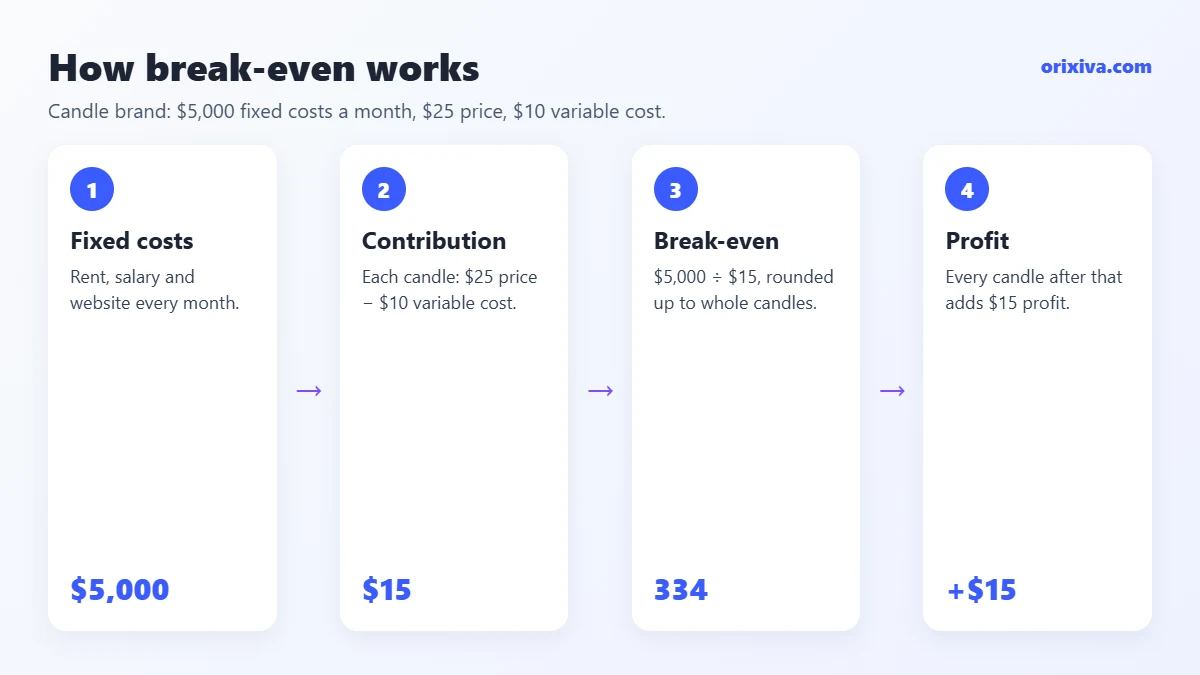
Worked example: a small candle brand
- Fixed costs: $5,000 a month (workshop rent, one part-time salary, website).
- Selling price: $25 per candle. Variable cost: $10 (wax, jar, wick, packaging, payment fee).
- Contribution margin: $25 − $10 = $15 per candle.
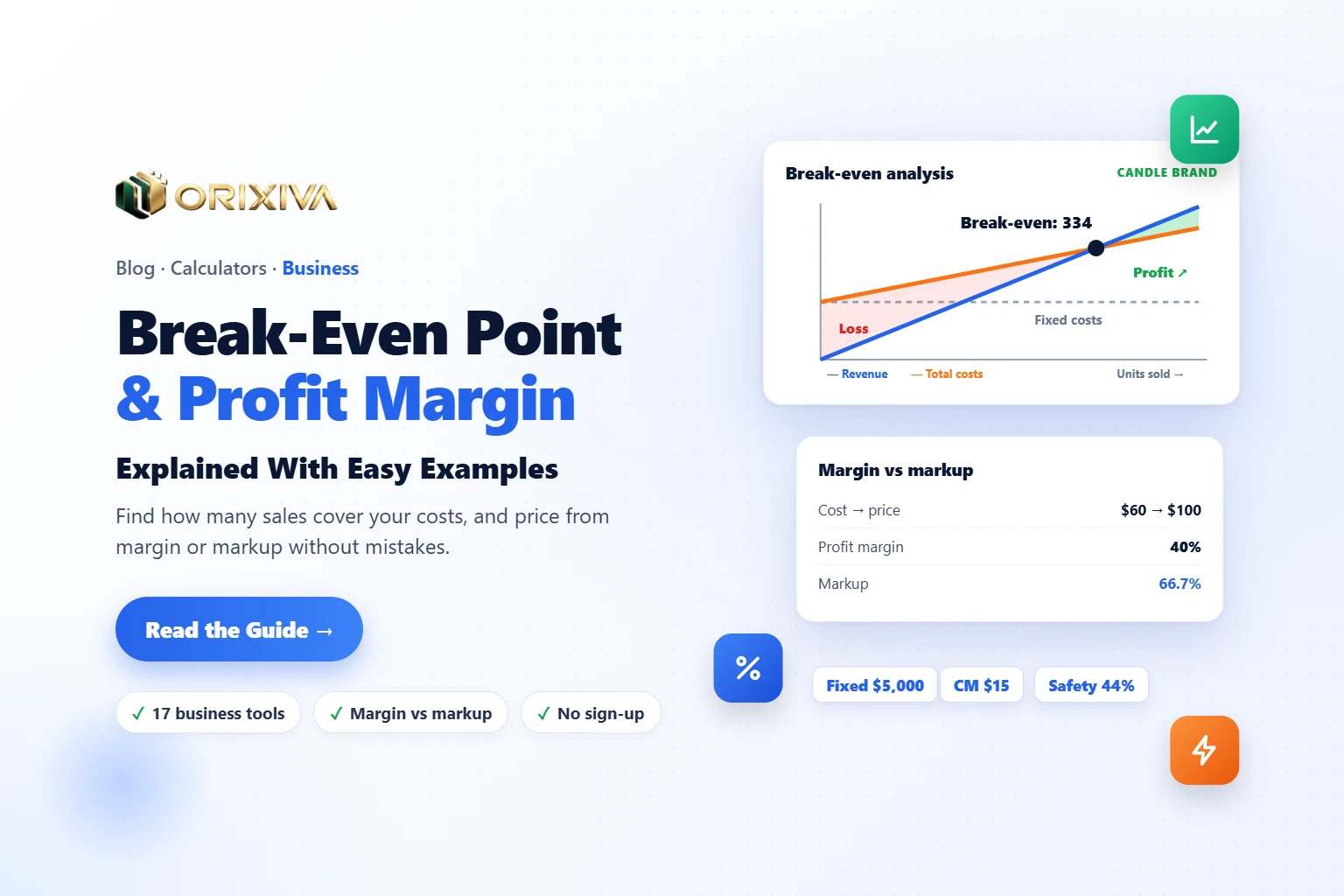
- Break-even: $5,000 ÷ $15 = 333.3, so 334 candles a month, about $8,350 in sales.
Every candle after the 334th adds $15 of profit. Sell 400 and the profit is about $1,000 (66 × $15).
Break-even in sales value
If you sell many products at different prices, use the contribution margin ratio instead: $15 ÷ $25 = 60%. Break-even sales = fixed costs ÷ ratio = $5,000 ÷ 0.60 = $8,333 a month.
How many units for a target profit?
Break-even tells you when you stop losing money. To plan for a profit, add your target to the fixed costs.
Units for target profit = (fixed costs + target profit) ÷ contribution margin
For the candle brand to make $3,000 profit a month: ($5,000 + $3,000) ÷ $15 = 533.3, so 534 candles. That is 200 more than break-even, a useful reality check before setting goals.
Margin of safety: how close are you to a loss?
The margin of safety shows how far sales can fall before you hit break-even.
Margin of safety = (expected sales − break-even sales) ÷ expected sales
If the candle brand expects to sell 600 candles, the margin of safety is (600 − 333.3) ÷ 600 = 44%. Sales could fall by almost half before the business makes a loss. A margin of safety under 10–15% means a slow month could easily push you into the red.
What is profit margin?
Profit margin tells you what share of each sale you keep as profit. There are a few versions:
| Type | Formula | Shows |
|---|---|---|
| Gross margin | (price − cost of goods) ÷ price | Profit from the product itself |
| Contribution margin ratio | (price − all variable costs) ÷ price | What each sale adds after fees, shipping and commission |
| Operating margin | operating profit ÷ revenue | Profit after fixed costs like rent and salaries |
| Net margin | net profit ÷ revenue | What is left after everything, including tax and interest |
When people say “profit margin” about a product price, they usually mean gross margin. For the candle, if the wax, jar and wick cost $7, the gross margin is ($25 − $7) ÷ $25 = 72%. After packaging and fees ($10 in total), the contribution margin ratio is 60%.
Profit margin vs markup: the difference that costs money
Margin and markup use the same profit but divide it by different numbers.
Margin = profit ÷ selling price
Markup = profit ÷ cost
Markup = profit ÷ cost
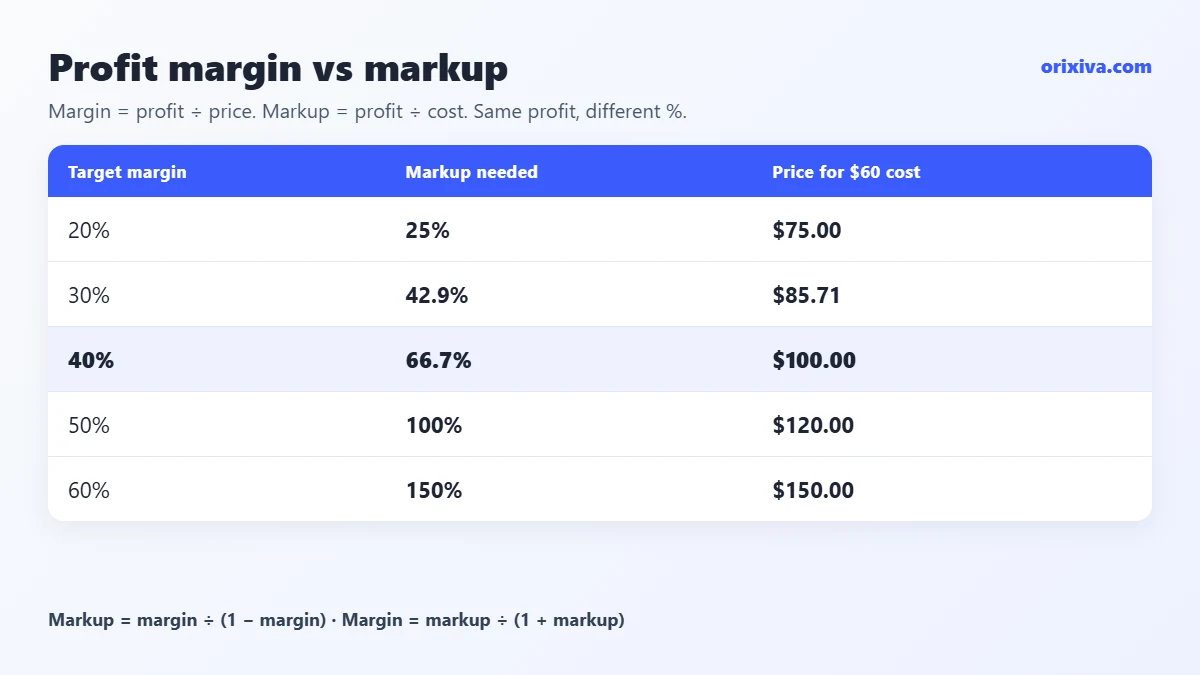
A product that costs $60 and sells for $100 makes $40 profit. The margin is 40% ($40 ÷ $100), but the markup is 66.7% ($40 ÷ $60). If you want a 40% margin and add 40% to cost instead, you sell for $84 and get only a 28.6% margin.
| Target margin | Markup needed | Price for $60 cost |
|---|---|---|
| 20% | 25% | $75.00 |
| 30% | 42.9% | $85.71 |
| 40% | 66.7% | $100.00 |
| 50% | 100% | $120.00 |
| 60% | 150% | $150.00 |
Conversion: markup = margin ÷ (1 − margin), and margin = markup ÷ (1 + markup).
How to set a price from a target margin (including fees)
To hit a target margin, divide the cost by (1 − margin). If a marketplace or payment provider takes a percentage of the price, subtract that too:
Price = cost ÷ (1 − target margin − fee %)
Example: cost $60, target margin 40%, payment fee 3%. Price = $60 ÷ (1 − 0.40 − 0.03) = $60 ÷ 0.57 = $105.26. Check: the fee is $3.16, profit is $105.26 − $3.16 − $60 = $42.10, and $42.10 ÷ $105.26 = 40%.
The business calculator’s Price, Markup & Margin tool does exactly this. Pick a pricing method (target margin, target markup, or “I know the selling price”), add the payment or platform fee and sales tax or VAT, and round to a charm price such as …99 if you like. Selling on Amazon? Our guide to Amazon FBA fees and real profit shows how marketplace fees change the picture.
How discounts change your break-even point
A discount comes straight out of the contribution margin, so you need more sales just to stand still.
Units needed after discount = current units × current margin per unit ÷ new margin per unit
Example: price $100, variable cost $60, 500 units a month. The margin is $40 per unit, or $20,000 in total. With a 20% discount the price is $80 and the margin falls to $20, so you must sell 1,000 units, twice as many, to earn the same $20,000.
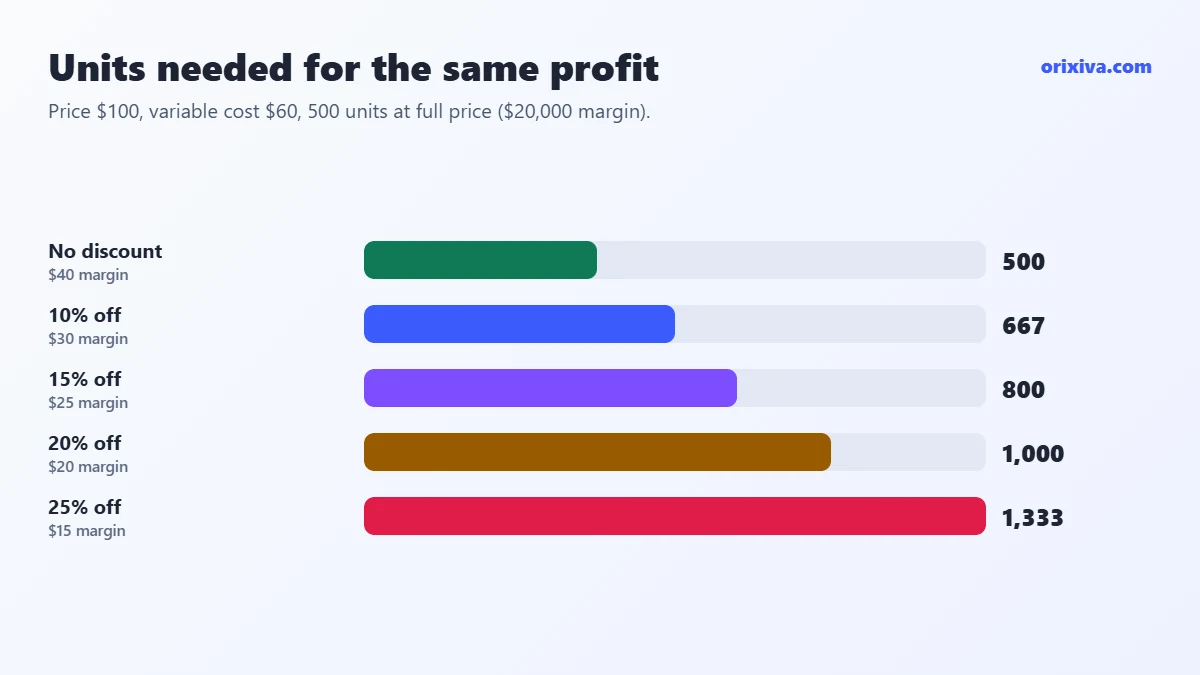
The calculator’s Discount Impact on Profit tool shows the extra sales needed for any discount. Use it before every sale or promo code.
Break-even formula cheat sheet
Keep these formulas handy. Every one of them is built into the business calculator, with the working shown.
| What you want | Formula |
|---|---|
| Contribution margin | price − variable cost per unit |
| Contribution margin ratio | contribution margin ÷ price |
| Break-even point (units) | fixed costs ÷ contribution margin |
| Break-even point (sales) | fixed costs ÷ contribution margin ratio |
| Units for a target profit | (fixed costs + target profit) ÷ contribution margin |
| Margin of safety | (expected sales − break-even sales) ÷ expected sales |
| Profit margin | profit ÷ selling price |
| Markup | profit ÷ cost |
| Price for a target margin | cost ÷ (1 − margin − fee %) |
How to use the free business calculator (step by step)
- Open the business calculator. Go to the business calculator and choose Break-Even Analysis from the menu of 17 tools.
- Pick your currency. Dollars, pounds, euros, rupees, dirhams, riyals and more are available, or none.
- Enter your costs. Type your fixed costs for the period, the price per unit and the variable cost per unit.
- Add goals (optional). Enter a target profit and your expected sales to see the units needed for that profit and your margin of safety.
- Calculate. Press Calculate to see the contribution margin, break-even units and sales, a cost–volume chart, and the working steps.
- Test your price. Switch to Price, Markup & Margin to set a price from a target margin, then to Discount Impact on Profit before planning a sale.
- Copy or print. Copy the result into your plan or print it for a meeting. Nothing is uploaded; every result is worked out in your browser.
14 more tools on the same page
The business calculator also covers inventory turnover, EOQ and reorder points, revenue targets and sales funnels, conversion funnels, customer acquisition cost and payback, customer lifetime value, churn and retention, MRR/ARR growth, cash runway and burn rate, working capital ratios, true employee cost, capacity and staffing, PERT project estimates, and price elasticity of demand.
Example: break-even for a service business
Break-even works for services too; the “unit” is an hour, a project or a client. A freelance designer has fixed costs of $2,400 a month (software, co-working desk, insurance and a basic salary for herself). Each project has about $50 of variable costs (stock images, fonts, payment fees) and she charges $450.
- Contribution margin: $450 − $50 = $400 per project.
- Break-even: $2,400 ÷ $400 = 6 projects a month.
- For a $2,000 profit on top: ($2,400 + $2,000) ÷ $400 = 11 projects.
If 11 projects a month is not realistic, the answer is to raise the price, cut fixed costs or find higher-value projects, not just to work longer.
Example: break-even for an online store with ad spend
Online shops often forget that advertising can behave like a variable cost. Imagine a store selling phone cases:
- Price: $30. Product and packaging: $8. Shipping: $5. Payment and platform fees: 5% of price, $1.50.
- Advertising: about $6 for every order (cost per acquisition).
- Variable cost per order: $8 + $5 + $1.50 + $6 = $20.50. Contribution margin: $9.50.
- Fixed costs: $1,900 a month (store platform, apps, part-time help).
- Break-even point: $1,900 ÷ $9.50 = 200 orders a month.
Without counting ads, the margin looks like $15.50 and break-even only 123 orders, a dangerously optimistic number. If you can lower the cost per order to $4 or raise the price to $32, the break-even point drops to about 166 or 167 orders. The business calculator’s Customer Acquisition Cost & Payback tool helps you track that ad cost properly.
5 ways to lower your break-even point
- Raise prices carefully. A small price rise goes straight to the contribution margin. Test it on one product first.
- Cut variable costs. Cheaper packaging, better shipping rates or fewer returns raise the margin on every sale.
- Reduce fixed costs. Cancel unused subscriptions and renegotiate rent or software plans.
- Sell a better mix. Promote products with a higher contribution margin, and bundle low-margin items with high-margin ones.
- Increase order value. Add-ons and bundles spread shipping and ad costs over more profit per order.
After each change, run the numbers again in the break-even tool to see the new break-even point and profit margin side by side.
Mistakes to avoid
Confusing margin and markup
Adding 40% to cost does not give a 40% margin. Use the table above or the calculator.
Forgetting hidden variable costs
Payment fees, packaging, returns and free shipping are per-unit costs. Leaving them out makes the break-even point look lower than it really is.
Not paying yourself
If your own salary is not in the fixed costs, “break-even” still means working for free.
Using yearly fixed costs with monthly sales
Keep the time period the same for every number.
Treating break-even as the goal
Break-even is the floor, not the target. Plan for a profit and a healthy margin of safety.
Your turn: What is your break-even point, in units or in sales, and what surprised you when you worked it out? Share your business type and margin in the comments (no private figures needed) to help other readers compare.
Work out your break-even point now, free
Calculate break-even units and sales, margin of safety, price from margin or markup, discount impact, plus 14 more business tools. No sign-up, and nothing leaves your browser.
Open the free business calculator → Looking for a different calculator? Search on orixiva.comBreak-even and profit margin questions people often ask
How do I calculate the break-even point?
Divide fixed costs by the contribution margin per unit (price minus variable cost per unit). The result is the number of units you must sell to cover all costs.
What is a contribution margin?
It is the selling price minus the variable cost per unit. It is the amount each sale contributes towards fixed costs and then profit.
What is the difference between profit margin and markup?
Margin divides profit by the selling price; markup divides it by the cost. A $40 profit on a $100 price with $60 cost is a 40% margin but a 66.7% markup.
What is a good profit margin?
It depends on the industry. Grocery and fuel run on thin margins, while software and services often have high gross margins. Compare with businesses like yours and make sure the margin covers your fixed costs.
How do I calculate break-even in sales value?
Divide fixed costs by the contribution margin ratio (contribution margin ÷ price). With $5,000 fixed costs and a 60% ratio, break-even sales are $8,333.
How do I calculate the price for a 30% margin?
Divide the cost by 0.70. A $60 cost needs a $85.71 price. Subtract any percentage fees from the 0.70 first.
Does a discount change the break-even point?
Yes. A discount lowers the contribution margin, so you need more units to cover the same fixed costs. A 20% discount on a 40% margin product doubles the units needed for the same profit.
Can I use the business calculator for services?
Yes. Treat an hour, a project or a client as the unit, and enter its price and variable cost.
Is my business data saved or uploaded?
No. Every result is calculated in your browser, with no sign-up and no upload.
How often should I recalculate my break-even point?
Whenever prices, suppliers, rent or ad costs change, and at least once a quarter. Small changes in variable costs can move the break-even point a lot.