Try our free AI tools – no sign-up needed!


Amazon FBA Fees 2026: How to Calculate Real Profit in 6 Easy Steps
Have a product in mind? The free Amazon FBA profit calculator shows every fee, your margin, ROI and break-even price. No sign-up.
Jump to the free tool ↓Many new sellers look at a $25 selling price and a $5 product cost and think they will make $20. After Amazon FBA fees, shipping, ads and returns, the real number is often closer to $6, and sometimes it is negative. This guide explains every Amazon FBA fee that matters in 2026, shows how to calculate real profit step by step, and works through a full example.
You can check any product in seconds with the free Orixiva Amazon FBA profit calculator, which also compares Shopify, Etsy, Walmart, eBay and TikTok Shop.
Key takeaways
- The two biggest Amazon FBA fees are the referral fee (15% for most categories) and the FBA fulfillment fee, which depends on size tier, weight and price.
- Amazon updated US fulfillment fees on 15 January 2026 and added a 3.5% fuel and logistics surcharge on fulfillment fees from 17 April 2026.
- Storage costs about three times more in October–December than in the rest of the year.
- Real profit = price − product cost − freight − all Amazon fees − ads − returns. Margin under about 15–20% leaves little room for mistakes.
- Fees change often. Always confirm a product’s exact FBA fee in Seller Central.
The Amazon FBA fees you pay in 2026
“FBA” (Fulfillment by Amazon) means Amazon stores your stock, packs each order, ships it and handles returns. You pay for that service on top of the normal selling fees. These are the main US Amazon FBA fees:
| Fee | What it is | 2026 US example |
|---|---|---|
| Selling plan | Monthly subscription or per-item fee | Professional $39.99/month, or Individual $0.99 per item sold |
| Referral fee | A share of the sale price, by category | 15% for most categories, $0.30 minimum |
| FBA fulfillment fee | Pick, pack and ship one unit | From $3.32 for a small standard item up to 2 oz priced $10–$50 |
| Fuel and logistics surcharge | Added to the fulfillment fee from 17 April 2026 | 3.5% of the fulfillment fee |
| Monthly storage | Space your stock uses in the warehouse | $0.78 per cubic foot Jan–Sep, $2.40 Oct–Dec (standard size) |
| Inbound placement | Cost of spreading stock across warehouses | $0 with Amazon-optimized splits; a per-unit fee if you choose fewer locations |
| Low-inventory-level fee | Charged when you keep too little stock | Per unit when you have under 28 days of supply |
| Aged inventory surcharge | Stock stored a long time | Starts at 181 days in storage and rises with age |
| Returns processing | Handling returned units | Above a category return-rate threshold; on every return for apparel and shoes |
Amazon publishes the current rules on its seller pricing page. Rates above are the US marketplace; the UK, EU, Canada, UAE and India have their own fee schedules.
Amazon referral fees by category
The referral fee is a percentage of the total sale price (item price plus any shipping or gift wrap you charge). Most categories pay 15%, but several are lower or tiered:
Most categories: 15%
Home, kitchen, toys, sports, pet supplies, office products and many more.
Electronics and computers: 8%
Lower rates for consumer electronics and computers, with a minimum fee per item.
Tiered by price
Beauty, grocery and baby products pay a lower rate on cheap items and 15% above a price limit. Clothing uses three bands.
Higher or split
Jewelry pays 20% up to $250 and 5% above. Furniture pays 15% up to $200 and 10% above.
The calculator includes ten referral fee categories with these tiers, so choose yours before reading the result.
How the FBA fulfillment fee is calculated
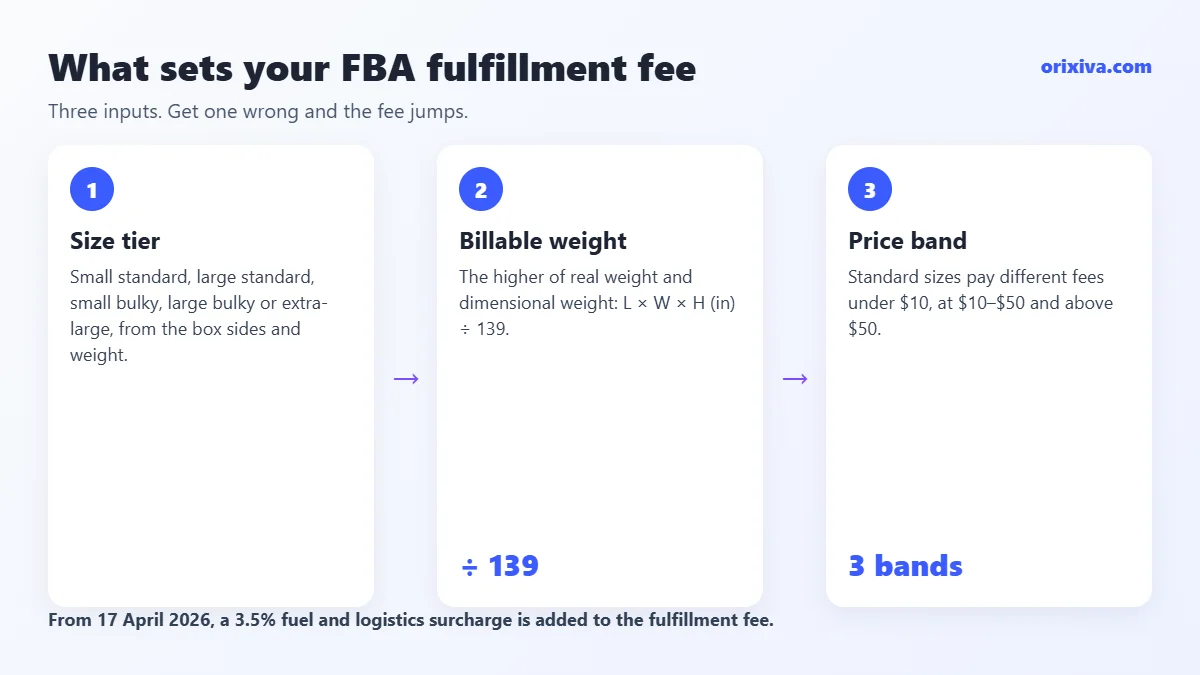
The fulfillment fee depends on three things: the product’s size tier, its shipping weight and, for standard sizes, its price band (under $10, $10–$50, over $50).
Size tier
Amazon sorts products into small standard, large standard, small bulky, large bulky and extra-large, based on the longest side, the other sides and the weight. A small change in packaging can move a product into a more expensive tier.
Shipping weight: real or dimensional, whichever is higher
For larger standard-size and bulky items, Amazon charges on the higher of the real weight and the dimensional weight: length × width × height in inches ÷ 139. A light but bulky box can cost as much as a heavy one. Our dimensional weight calculator works this out, and our guide to reducing dimensional weight charges shows how to fix it.
Price band
From 15 January 2026, a small standard item weighing up to 2 oz costs $2.43 to fulfil if priced under $10, $3.32 at $10–$50, and $3.58 above $50, before the 3.5% surcharge. Heavier and larger items cost more.
Storage and inventory fees most sellers forget
- Monthly storage: for standard-size items, $0.78 per cubic foot from January to September and $2.40 from October to December. A shoebox-sized product of 0.4 cubic feet costs about $0.31 per unit per month most of the year and $0.96 in Q4.
- Aged inventory surcharge: stock that sits more than 181 days pays extra, and the charge grows the longer it stays. Order in amounts you can sell.
- Low-inventory-level fee: running too low (under 28 days of supply) can add a per-unit fee, for example $0.89 per unit for a small standard item with under 14 days of stock.
- Inbound placement fee: letting Amazon split your shipment across several warehouses is usually free; sending everything to one location costs extra per unit.
Planning stock for the holiday season
Q4 brings the most sales and the most expensive storage. Send stock early enough to be checked in before the rush, but only as much as you expect to sell by the end of December. Anything left in January has paid peak storage for nothing and moves closer to the aged inventory surcharge. Run the calculator with the Oct–Dec season selected to see how peak fees change your profit per unit before you place the order.
Watch the balanceToo much stock costs storage and aging fees; too little costs the low-inventory fee and lost sales. Many sellers aim for about 30–60 days of supply.
How to calculate Amazon FBA profit in 6 steps
- Find your landed cost per unit. Product cost + freight to the warehouse + import duty + packaging and prep. The calculator’s landed cost section works this out from your supplier price (in USD, CNY, EUR, GBP or INR), freight per CBM and duty.
- Enter the package size and weight. Use the packed box, not the bare product. This sets the dimensional weight, billable weight and size tier.
- Add the Amazon FBA fees. Referral fee for your category, fulfillment fee (or your exact fee from Seller Central in the override box), storage for your average months in stock, and the surcharge.
- Add advertising. Enter your ad spend as a share of sales (TACoS). Many new products run 10–20% while they build reviews.
- Add returns. Your return rate × the loss on each return (return label, damaged or unsellable stock).
- Read profit, margin and ROI. Net profit per unit, profit margin, return on the cash you put into stock, and monthly and yearly profit after income tax.
Net profit = price − landed cost − referral fee − FBA fee − storage − ads − returns
Worked example: a $24.99 kitchen product
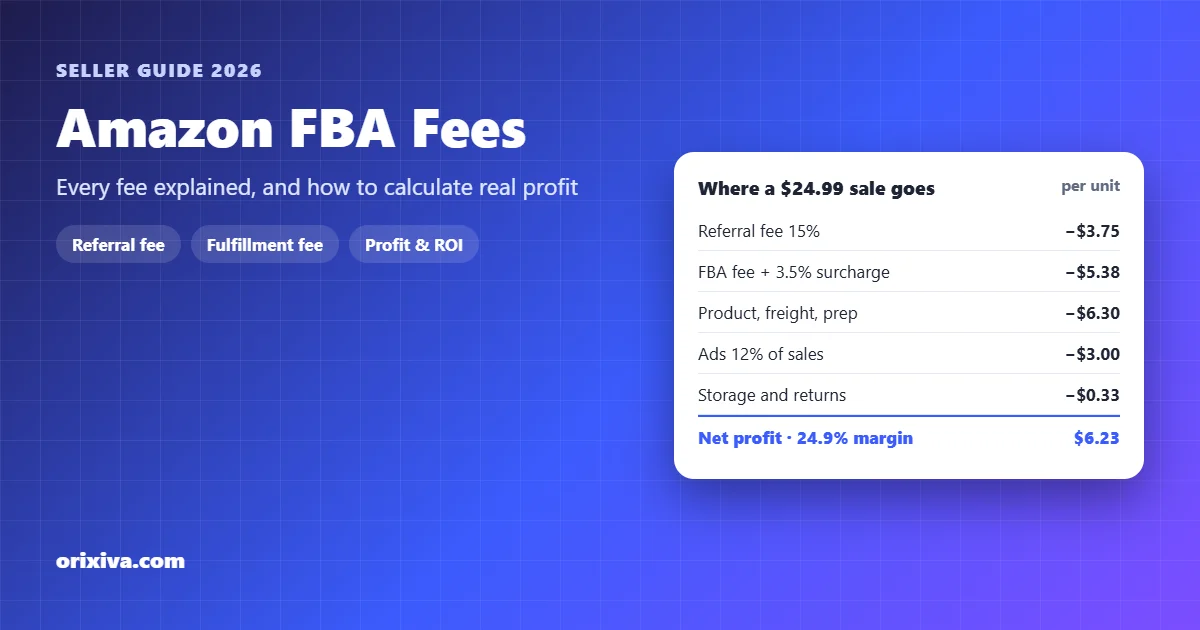
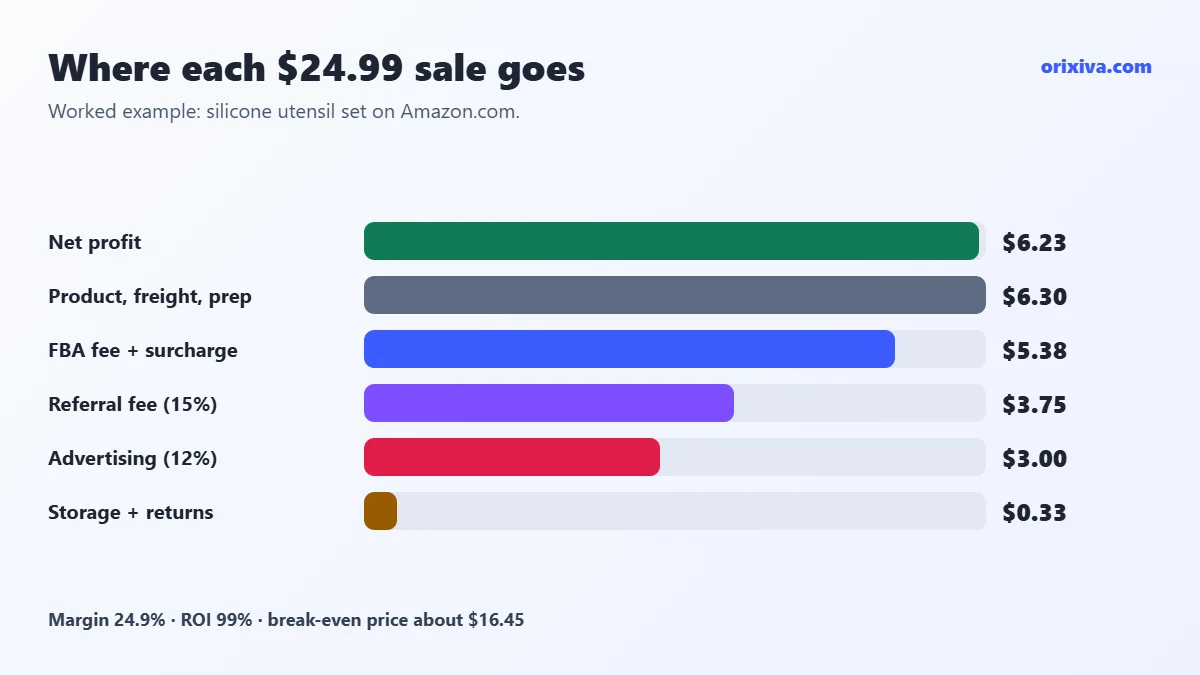
Here is a full calculation. To keep it simple, assume Seller Central shows an FBA fulfillment fee of $5.20 for this product.
Silicone utensil set · Amazon.com
Price $24.99 · 300 units/month
USD per unitPrice $24.99 · 300 units/month
| Line | How it is worked out | Amount |
|---|---|---|
| Selling price | $24.99 | |
| Referral fee | 15% × $24.99 | −$3.75 |
| FBA fulfillment fee | $5.20 + 3.5% surcharge | −$5.38 |
| Storage | 0.12 cu ft × $0.78, about one month | −$0.09 |
| Product cost | From supplier | −$5.00 |
| Freight to Amazon | Sea freight per unit | −$1.00 |
| Prep and packaging | Bag, label | −$0.30 |
| Advertising | 12% of sales | −$3.00 |
| Returns | 3% returned × $8 loss | −$0.24 |
| Net profit per unit | $6.23 | |
Margin 24.9% · ROI 99% on the $6.30 spent per unit on stock · about $1,869 a month before income tax and the $39.99 plan.
Notice where the money goes: Amazon FBA fees and ads take $12.22 of every $24.99 sale, more than twice the product cost. That is normal, which is why you must calculate before you order stock.
Break-even price, ad limit and target price
Three more numbers protect you from bad decisions. Using the example above (fixed costs of about $12.01 per unit plus a 15% referral fee and 12% ads):
- Break-even price: about $16.45. Below this, every sale loses money. Useful before a price war.
- Break-even ad spend: profit before ads is $9.23, so ads can reach about 37% of sales before the product stops making money. Useful for a launch.
- Price for a 30% margin: about $27.93, as long as the product stays in the same price band.
The calculator also has a goal planner: type the monthly profit you want and it shows the units you need to sell, the price you need at your current sales, and the cash you need for stock. For many products at once, paste or upload a CSV of up to 500 SKUs.
FBA vs FBM vs Shopify vs Etsy
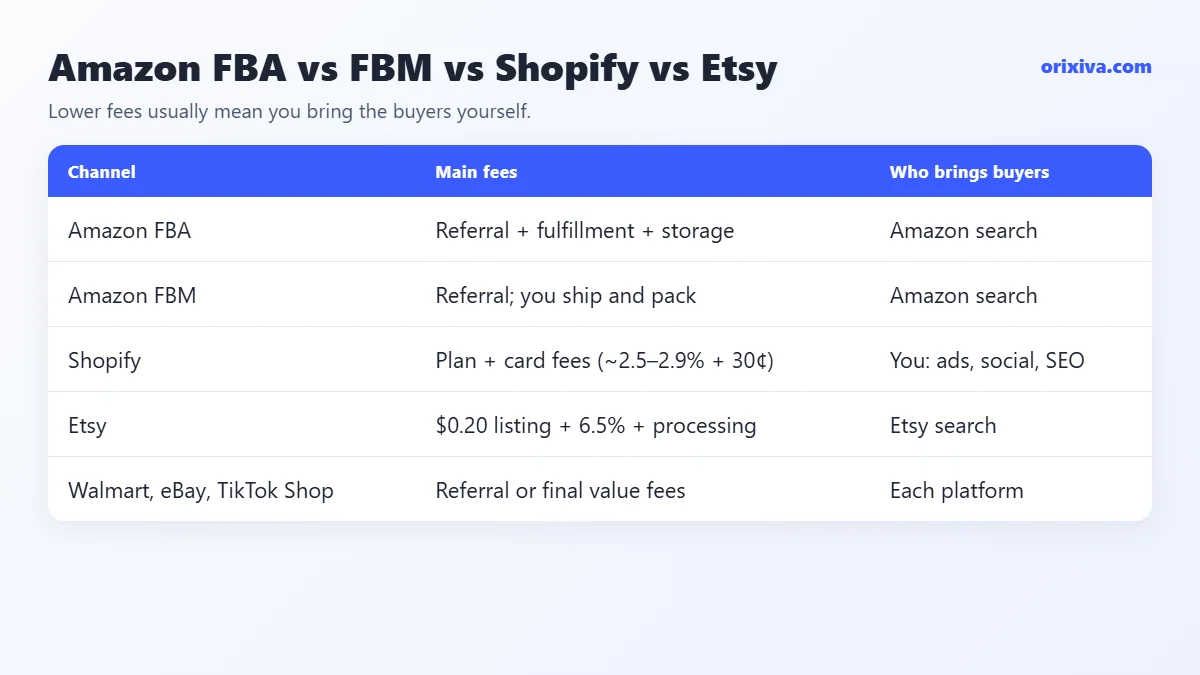
Amazon FBA fees are high, but so is Amazon’s traffic. The calculator compares the same product and price across seven channels so you can see the trade-off:
| Channel | Main fees | Who brings the buyers? |
|---|---|---|
| Amazon FBA | Referral fee + fulfillment fee + storage | Amazon search and ads |
| Amazon FBM | Referral fee; you pay shipping and do the packing | Amazon search and ads |
| Shopify | Monthly plan + card processing (about 2.5–2.9% + 30¢) | You do: ads, social, SEO |
| Etsy | $0.20 listing + 6.5% transaction + payment processing (3% + 25¢ in the US) | Etsy search, mainly handmade and vintage |
| Walmart, eBay, TikTok Shop | Referral or final value fees, plus shipping | Each platform’s own shoppers |
Shopify often shows the highest profit per unit on paper because there is no referral fee, but you pay for every visitor through ads. Raise the ad spend field to a realistic number for your own store and compare again.
Selling on Amazon outside the US
Amazon FBA fees work the same way in every marketplace (a referral fee plus fulfillment and storage), but the amounts, currency and tax rules change. In the UK and EU, prices shown to buyers include VAT, so the money you keep is the price minus VAT, then minus fees. In India, GST applies, and in the UAE, prices usually include 5% VAT.
The calculator covers Amazon.com, Amazon.co.uk, Amazon.de, Amazon.ca, Amazon.ae and Amazon.in. Choose the marketplace, enter the VAT or GST rate if you are registered, and set your exchange rate. Because local fulfillment fees differ from US rates, paste the fee shown in your Seller Central account into the override box for an exact answer.
A 7-point check before you order stock
- Is the net profit margin at least 20% after ads and returns?
- Does the product stay profitable if the price drops 10%?
- Does it still make money if ad spend doubles during launch?
- Does the packed box fit the size tier you planned, including dimensional weight?
- Can you sell the first order within about 90 days, so aging fees never apply?
- Is the ROI high enough to fund your next order without borrowing?
- Have you checked the referral category and any approval rules for it?
If the answer to any of these is no, change the price, the packaging or the order size, and run the numbers again before you pay the supplier.
8 ways to lower your Amazon FBA fees
- Shrink the box. A smaller or lighter package can drop a size tier and cut the fulfillment fee.
- Check the price band. A product at $50.49 may pay a higher fulfillment fee than one at $49.99.
- Avoid Q4 overstock. Storage is about three times more expensive from October to December.
- Sell through old stock. Run promotions before units reach 181 days and the aged surcharge starts.
- Use Amazon-optimized splits where possible to avoid inbound placement fees.
- Reduce returns. Better photos, size charts and honest listings lower return costs. A clean white background helps; try our free background remover.
- Label stock correctly. Our free barcode generator creates the labels your products need.
- Compare FBA with FBM for big, slow-selling items, where storage can eat the margin.
Your turn: Which Amazon FBA fee surprised you most when you started selling? Share your experience in the comments (no ASINs or account details needed) to help new sellers avoid the same mistake.
Calculate your real Amazon profit, free
Enter your price, product cost and box size to see every Amazon FBA fee, your profit, margin, ROI and break-even price, and compare Amazon with Shopify, Etsy and four more channels. No sign-up, nothing uploaded.
Open the Amazon FBA profit calculator → 2026 US fee rules · 6 Amazon marketplaces · Search more business tools on orixiva.comAmazon FBA fee questions
How much does Amazon take per sale with FBA?
Usually the 15% referral fee plus the FBA fulfillment fee, which starts around $3–$4 for small light items and rises with size and weight. Together they often take 30–40% of a low-priced item’s price, before storage, ads and returns.
What is a good profit margin on Amazon FBA?
Many sellers aim for at least 20–30% net margin after all fees and ads. Below about 15% there is little room for price drops, returns or fee changes.
What changed in Amazon FBA fees in 2026?
US fulfillment fees were updated on 15 January 2026, and a 3.5% fuel and logistics surcharge on fulfillment fees started on 17 April 2026. Aged inventory and low-inventory rules were also updated.
How do I find the exact FBA fee for my product?
Seller Central shows the fee for each listing, and Amazon’s Revenue Calculator estimates it for a product. Type that number into the calculator’s FBA fee override for an exact result.
Is FBA or FBM cheaper?
FBM has no fulfillment or storage fees, but you pay for shipping, packing and your time. FBA often wins for small, fast-selling items; FBM can win for large or slow-selling ones.
Do I pay Amazon FBA fees on returned items?
The referral fee is mostly refunded on returns, but some fees are not, and a returns processing fee applies above your category’s return threshold, or on every return for apparel and shoes.
Does the calculator work for Amazon UK, Germany, Canada, UAE or India?
Yes. Choose the marketplace to use its currency, VAT or GST and seller plan. Fulfillment fees are converted from US rates, so enter your Seller Central fee for an exact figure.
Is Amazon FBA still profitable in 2026?
Yes for products with healthy margins, compact packaging and steady sales. Higher fees mostly hurt low-priced, bulky or slow-selling items, so run the numbers for each product before ordering stock.
Do I need a Professional seller account for FBA?
No, FBA works with both plans. The Individual plan charges $0.99 per item sold, so once you sell more than about 40 units a month, the $39.99 Professional plan is cheaper and unlocks ads and other tools.
How do I calculate my Amazon profit margin?
Divide net profit per unit by the selling price and multiply by 100. In the worked example, $6.23 ÷ $24.99 × 100 = 24.9%. Use net profit after all Amazon FBA fees, ads and returns, not the gross margin.
What is ROI on Amazon?
ROI shows profit compared with the cash you spent on stock. A $6.23 profit on $6.30 of product, freight and prep is about 99% ROI.