Try our free AI tools – no sign-up needed!


Cups to Grams: Conversion Chart for Flour, Sugar, Butter and More (and Why Bakers Weigh)
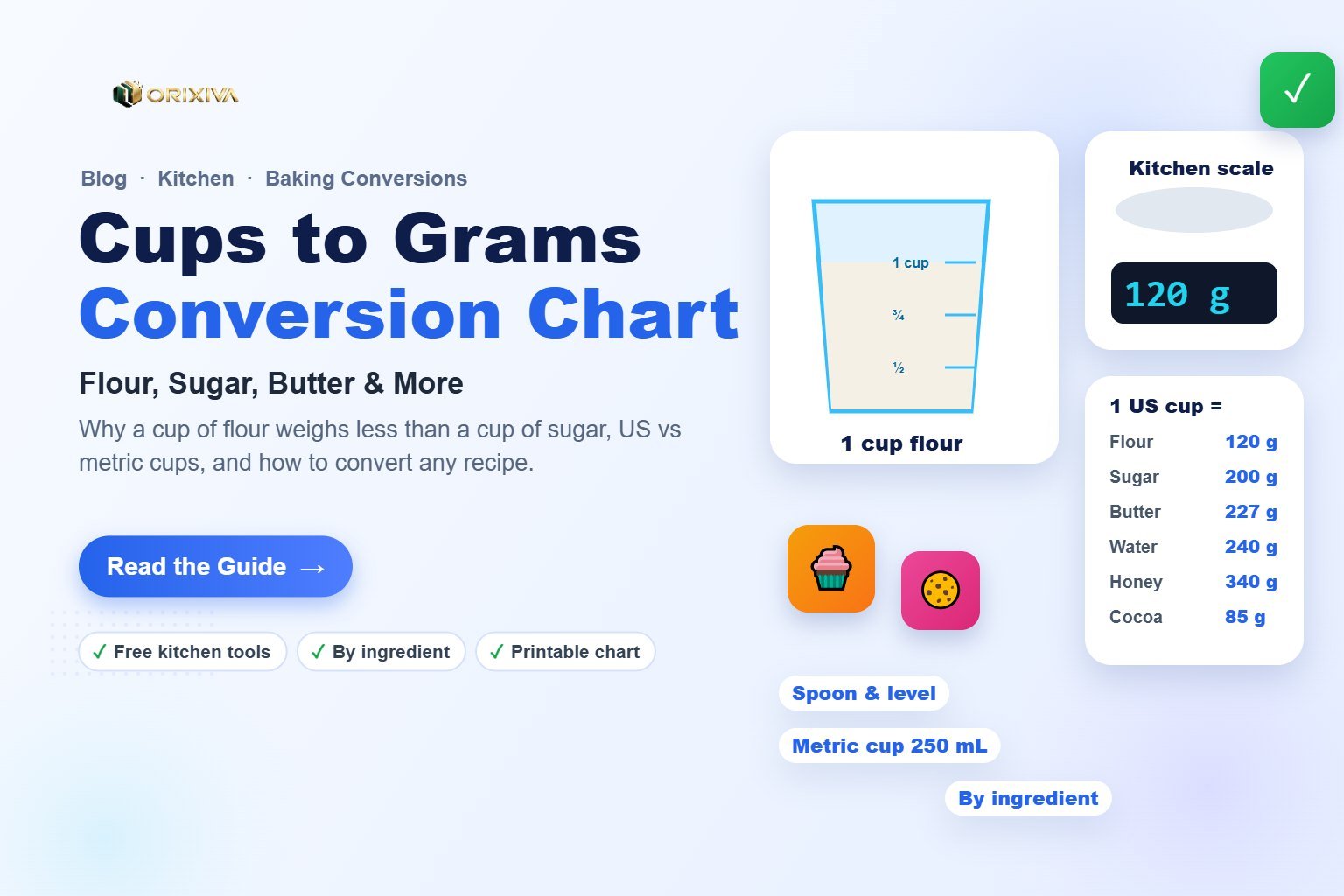
Short answer: There is no single cups-to-grams number, because a cup measures volume and grams measure weight. One US cup of all-purpose flour weighs about 120–125 g, granulated sugar about 200 g, butter 227 g and water about 240 g. For accurate baking, weigh ingredients with a kitchen scale, or use an ingredient-based converter such as the free Orixiva cooking calculator.
Key takeaways
- Different ingredients, different weights: a cup of sugar weighs much more than a cup of flour.
- How you fill the cup matters: scooped flour can weigh 20–30% more than spooned and levelled flour.
- Cups differ by country: US cup ≈ 237 mL, metric cup = 250 mL.
- Weighing is faster and cleaner once you start: one bowl, one scale, fewer dishes.
Why cups and grams don't match
A cup measures how much space an ingredient takes up. Grams measure how heavy it is. Fluffy ingredients such as flour and cocoa trap air, so a cup of them is light. Dense ingredients such as sugar, honey and butter pack tightly, so a cup of them is heavy.
That is why converting with a single number (for example "1 cup = 240 g") gives good results for water or milk but ruins cakes and bread when used for flour.
Cups to grams conversion chart
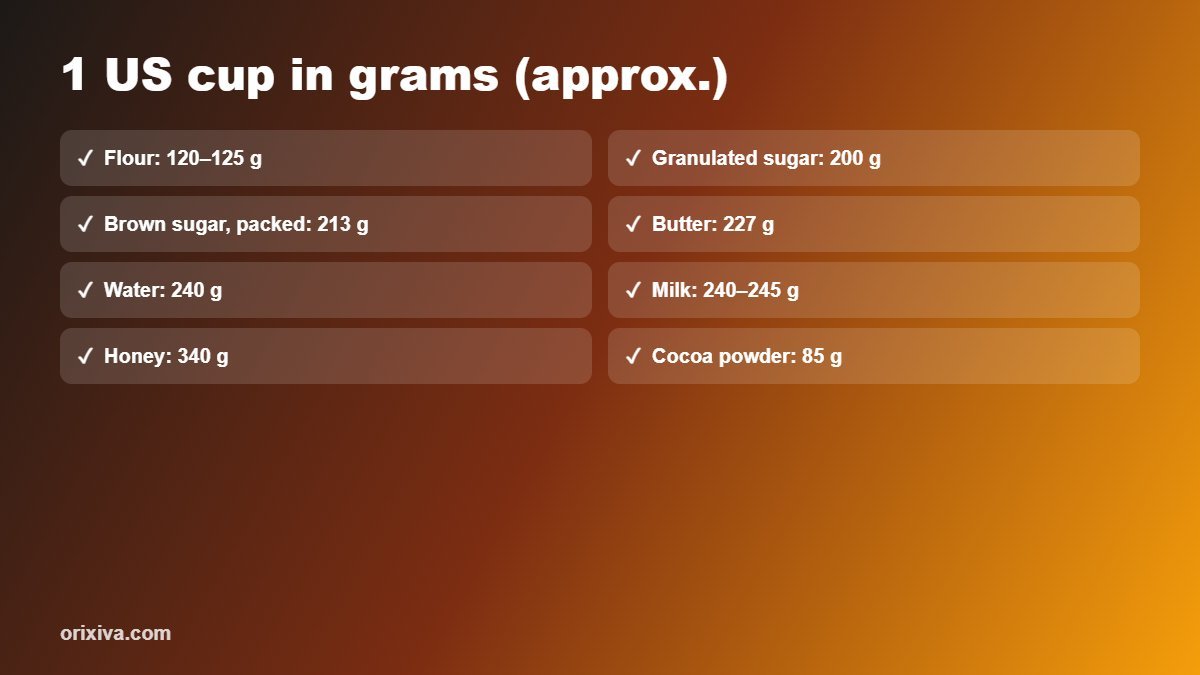
| Ingredient (1 US cup) | Approx. grams | ½ cup | ¼ cup |
|---|---|---|---|
| All-purpose (plain) flour, spooned and levelled | 120–125 g | 60 g | 30 g |
| Bread flour | about 127 g | 64 g | 32 g |
| Whole-wheat flour | about 120 g | 60 g | 30 g |
| Granulated (white) sugar | about 200 g | 100 g | 50 g |
| Brown sugar, packed | about 213 g | 107 g | 53 g |
| Powdered (icing) sugar | about 120 g | 60 g | 30 g |
| Butter | 227 g (2 US sticks) | 113 g | 57 g |
| Water | about 237–240 g | 120 g | 60 g |
| Milk | about 240–245 g | 122 g | 61 g |
| Vegetable oil | about 218 g | 109 g | 55 g |
| Honey | about 340 g | 170 g | 85 g |
| Cocoa powder | about 85 g | 43 g | 21 g |
| Rolled oats | about 90 g | 45 g | 23 g |
| Uncooked white rice | about 185–200 g | 93–100 g | 46–50 g |
These are typical values; brands and how firmly you fill the cup cause small differences. The Cups ↔ Grams tool uses ingredient densities so you can convert any amount, including tablespoons and teaspoons.
US, metric and UK cups are not the same
| Measure | Volume | Where you see it |
|---|---|---|
| US customary cup | about 236.6 mL | Most American recipes |
| US legal cup | 240 mL | US nutrition labels |
| Metric cup | 250 mL | Australia, New Zealand, Canada, many other countries |
| Tablespoon | about 15 mL (20 mL in Australia) | Everywhere, with local differences |
| Teaspoon | about 5 mL | Everywhere |
A metric cup holds about 5–6% more than a US cup. For most cooking this barely matters, but in a delicate cake recipe it can change the texture.
How to measure flour by cup (if you have no scale)
- Fluff the flour in the bag or jar with a spoon to loosen it.
- Spoon it into the cup without shaking or pressing.
- Level the top with the flat back of a knife.
- Do not scoop the cup straight into the bag; that packs extra flour in and can add 20–30% more.
Common problem: dry, crumbly cookies or dense cakes are often caused by scooped flour. Weighing fixes this instantly.
How to convert a whole recipe from cups to grams
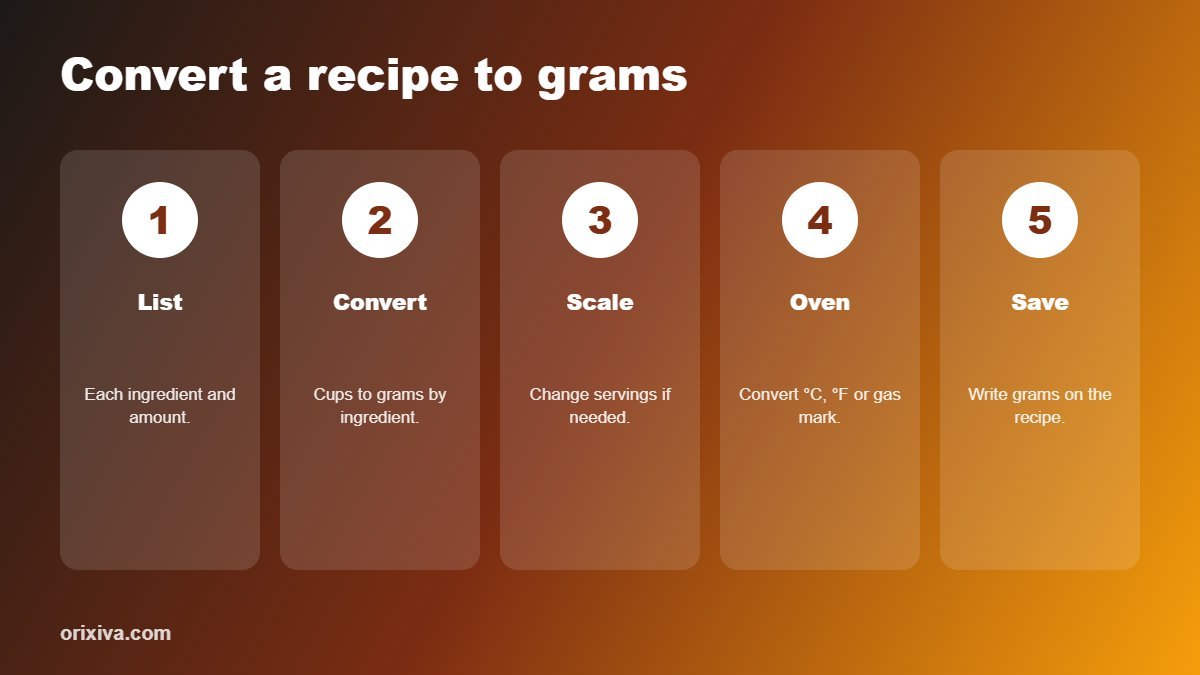
- List each ingredient with its cup or spoon amount.
- Convert by ingredient in the Cups ↔ Grams tool, choosing flour, sugar, butter and so on.
- Scale if needed with the Recipe Scaler for more or fewer servings.
- Check the oven temperature with the Oven Temperature & Gas Mark converter, reducing by about 20 °C for fan ovens.
- Write the grams on your recipe card so next time you simply weigh and bake.
Tips from bakers who weigh
- Use the tare button to zero the scale after each ingredient and weigh everything in one bowl.
- Weigh liquids too: 1 mL of water weighs 1 g, so it is quick and accurate.
- Use baker's percentages for bread: every ingredient as a percentage of flour weight. The Baker's Percentage tool turns them into grams.
- Keep small amounts in spoons: salt, yeast and baking powder are easier to measure in teaspoons unless your scale reads 0.1 g.
Convert cups to grams for any ingredient
Cups ↔ grams by ingredient, recipe scaler, oven temperatures, baker's percentage, yeast swaps and more: 14 free kitchen tools.
Open the free cooking calculator →Frequently asked questions
How many grams is 1 cup of flour?
About 120–125 g for all-purpose flour that is spooned into the cup and levelled. Scooped flour can weigh 140 g or more.
How many grams is 1 cup of sugar?
About 200 g for granulated white sugar, about 213 g for packed brown sugar and about 120 g for powdered sugar.
How many grams of butter is 1 cup?
One US cup of butter is 227 g, which is two US sticks of 113 g each.
Is 1 cup always 240 ml?
No. A US customary cup is about 237 mL, the US legal cup used on nutrition labels is 240 mL, and a metric cup is 250 mL.
Why do baking recipes use grams?
Weight is more accurate and consistent than volume, especially for flour, so results are the same every time.
How do I measure flour without a scale?
Fluff the flour, spoon it into the cup without pressing, then level the top with a knife. Do not scoop directly from the bag.
How many grams is a tablespoon?
It depends on the ingredient: about 8 g of flour, 12–13 g of sugar, 14 g of butter or 21 g of honey per US tablespoon.
Can I convert a whole recipe at once?
Yes. Convert each ingredient by type with a cups-to-grams converter, then use a recipe scaler to change the number of servings.
Over to you
Which ingredient always gives you trouble when converting? Tell us in the comments, along with your favourite recipe in grams. We will add common requests to the chart.
Related guides and tools
- Free cooking calculator: cups to grams, recipe scaler and more
- Unit converter for volume and weight
- Unit converter guide: 14 conversion tools
- BMI vs body fat vs TDEE
Sources: NIST: Approximate conversions from US customary measures to metric · King Arthur Baking: Ingredient weight chart. Weights are approximate and vary by brand and measuring method.