Try our free AI tools – no sign-up needed!


How to Calculate Percentage, Tips and Age: 10 Easy Everyday Methods
In a hurry? The free everyday calculator does percentages, tips, bill splits, discounts, tax and more in one place. No sign-up.
Jump to the free tool ↓Percentages are everywhere: a 30% sale, a 15% tip, a 5% pay rise, a 20% VAT bill. Most of us were taught how to calculate percentage at school and then forgot the details. This guide brings it back in plain English, with formulas, mental shortcuts and real examples for shopping, eating out, work and family life.
Every method can be checked with the free Orixiva everyday calculator, a set of 16 tools that work in your browser on any phone or computer.
Key takeaways
- Percent means “per hundred”: 15% = 15 ÷ 100 = 0.15.
- Most percentage questions are one of six types. Knowing which one you have is half the answer.
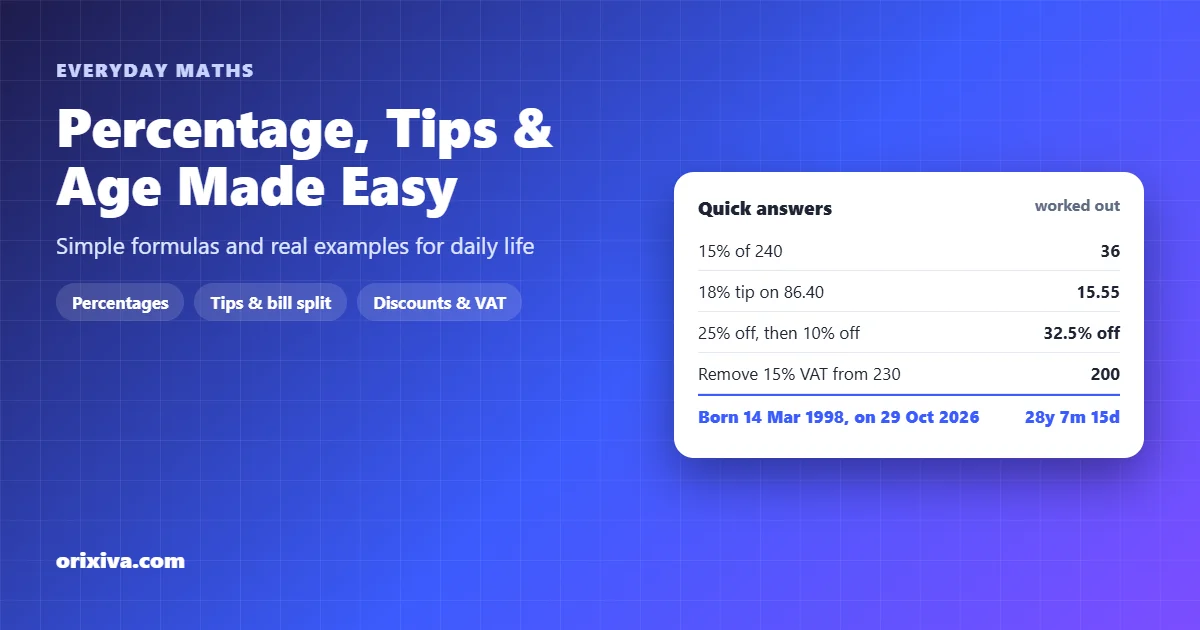
- Discounts multiply, they do not add: 25% off and then 10% off is 32.5% off, not 35%.
- To remove tax from a price that already includes it, divide; do not subtract the percentage.
- Tipping customs differ widely by country; check before you travel.
How to calculate percentage: the basics
A percentage is a fraction of 100. To use one in a calculation, turn it into a decimal by dividing by 100: 7% becomes 0.07, 120% becomes 1.2. From there, almost every question uses one of two moves:
Part = whole × percentage ÷ 100 | Percentage = part ÷ whole × 100
The percentage calculator inside the everyday calculator has six modes, one for each type of question below, and shows the formula it used so you can check the answer.
The 6 percentage questions (with examples)
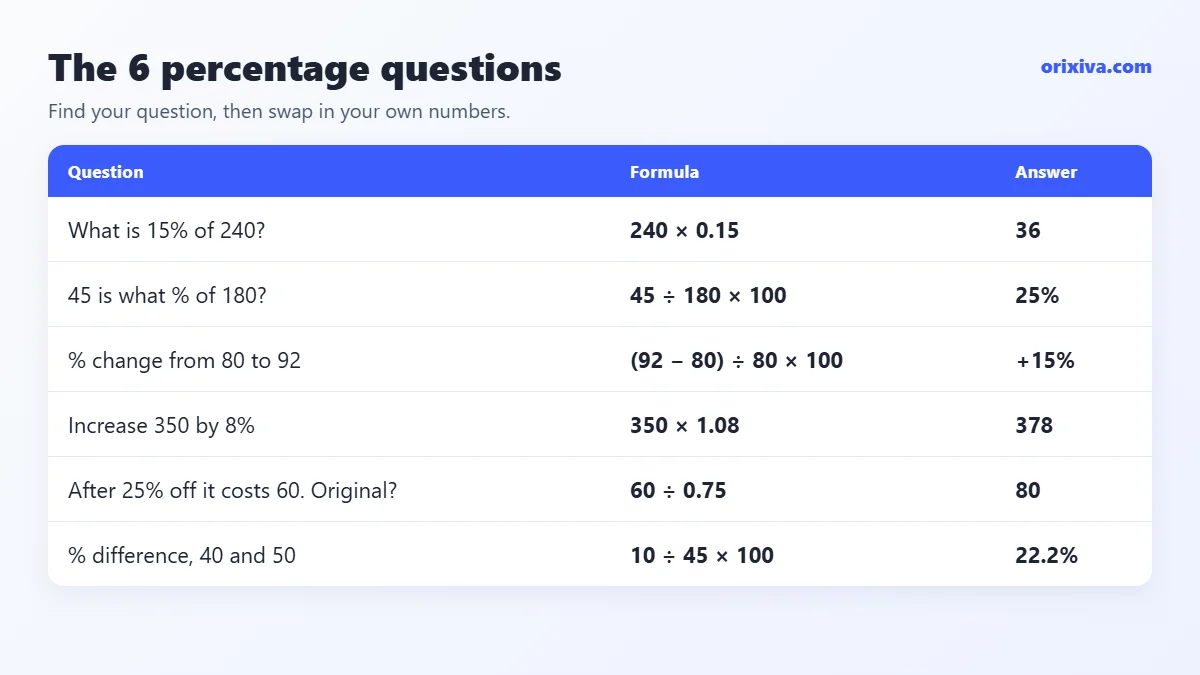
Here is how to calculate percentage answers for each type of question. Find the row that matches yours and swap in your own numbers.
| Question | Formula | Example |
|---|---|---|
| What is 15% of 240? | 240 × 0.15 | 36 |
| 45 is what % of 180? | 45 ÷ 180 × 100 | 25% |
| % change from 80 to 92 | (92 − 80) ÷ 80 × 100 | +15% |
| Increase 350 by 8% | 350 × 1.08 | 378 |
| Price after 25% off is 60. Original? | 60 ÷ 0.75 | 80 |
| % difference between 40 and 50 | 10 ÷ 45 × 100 | 22.2% |
Percentage change: up and down are not equal
To find a percentage change, always divide by the starting value. If a price falls 50% from 100 to 50, it must rise 100% to get back to 100. The second percentage is taken from a smaller starting number. The same trap appears with salaries, investments and exam scores, so always ask “percent of what?”
Percentage change in real life
- Prices: a loaf of bread goes from 2.40 to 2.70. The percentage change is 0.30 ÷ 2.40 = +12.5%.
- Exam scores: from 56% to 70% is a rise of 14 percentage points, but a 25% improvement (14 ÷ 56).
- Fitness: from 82 kg to 77.9 kg is a change of −5%.
- Business: sales from 18,000 to 21,600 in a month is +20%.
The percentage calculator’s change mode gives the result with a plus or minus sign, so you can see straight away whether something went up or down.
Percent vs percentage points
If an interest rate rises from 4% to 5%, it has gone up by 1 percentage point, but by 25 percent (1 ÷ 4). News reports often mix these up. Use points when comparing two percentages directly.
Mental maths: how to calculate percentage without a calculator
No phone handy? These shortcuts get you close enough for shopping and tips, and you can check the exact answer with the percentage calculator later.
- 10%: move the decimal point one place left. 10% of 64 is 6.4.
- 5%: half of 10%. 5% of 64 is 3.2.
- 1%: move the decimal two places. 1% of 64 is 0.64.
- Build the rest: 15% = 10% + 5% (9.6); 18% = 20% − 2%; 25% = a quarter.
- Swap the numbers: x% of y equals y% of x. 8% of 25 is the same as 25% of 8, which is 2.
- Marks to %: 68 out of 80 is 68 ÷ 80 = 0.85 = 85%.
How to calculate a tip
A tip is a percentage of the bill, so it uses the first formula: bill × tip rate. The only real question is whether to tip on the amount before or after tax. Many people in the US tip on the pre-tax amount; tipping on the total is more generous.
Dinner for three
18% tip on the pre-tax amount
Any currency18% tip on the pre-tax amount
| Food and drinks | 86.40 |
| Sales tax 8% | 6.91 |
| Tip 18% of 86.40 | 15.55 |
| Total | 108.86 |
| Each of 3 people (rounded up) | 36.29 |
Quick check in your head: 20% of 86.40 is 17.28; take away 2% (1.73) to get 15.55.
The tip calculator lets you choose tip on the pre-tax or post-tax amount, split between any number of people, and round each share up so nobody pays a few cents short.
How much to tip around the world
Customs vary, so treat this as a starting point and check locally. Consumer group Which? keeps a helpful guide to tipping abroad.
| Country or region | Typical restaurant tip |
|---|---|
| United States, Canada | About 15–20% at sit-down restaurants |
| United Kingdom | About 10–12.5%, often already added as a service charge |
| Much of Europe | Round up or leave about 5–10%; service is often included |
| UAE, Saudi Arabia | About 10–15% if no service charge is on the bill |
| Pakistan, India | About 5–10% at restaurants if no service charge is added |
| Japan, South Korea | Generally not expected |
Check the bill firstIf a “service charge” is already printed on the bill, you usually do not need to add a full tip on top.
How to split a bill fairly when people order different amounts
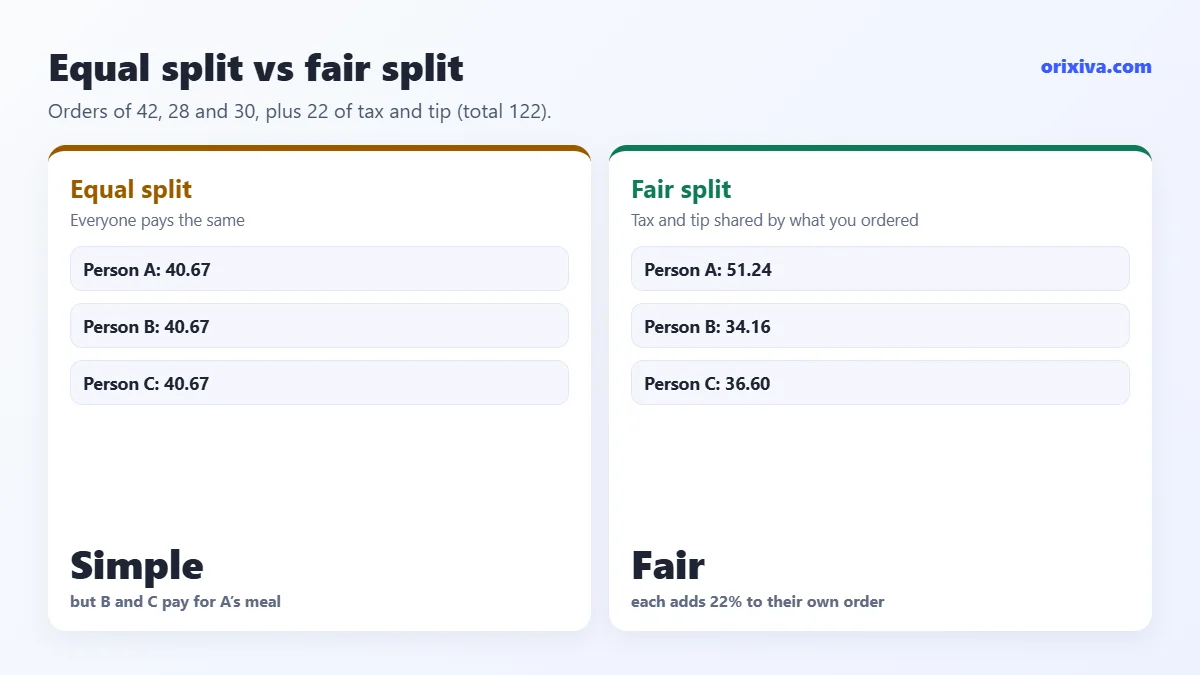
Splitting equally is simple, but unfair when one person had a steak and another had soup. The fair method shares the tax and tip in proportion to what each person ordered.
ExampleThree friends order 42, 28 and 30 (total 100). Tax and tip come to 22, which is 22% of the food. So each person adds 22% to their own order: 51.24, 34.16 and 36.60, which adds up to 122.
The uneven bill split tool, next to the tip calculator, does this automatically, and lets you share a fixed delivery fee equally instead, which is fairer for a flat charge.
Discount calculator basics: deals and the real best value
Shops are good at making deals look bigger than they are. A discount calculator, or the simple rules below, shows what you really save.
Stacked discounts multiply
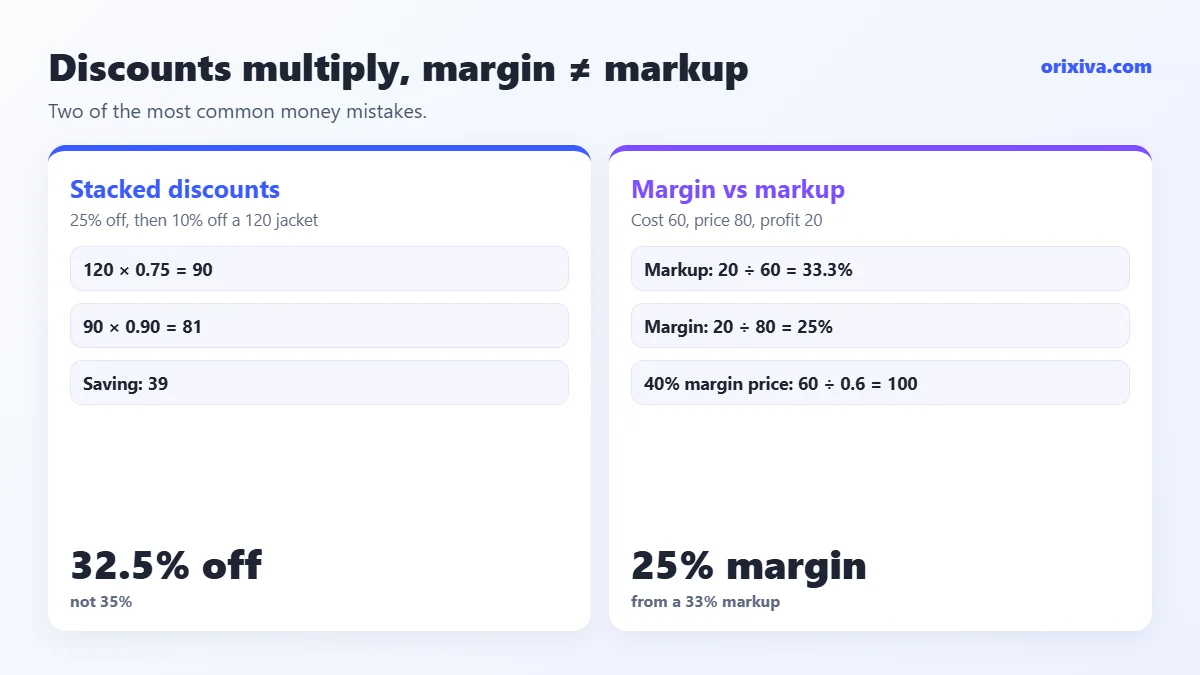
A jacket costs 120. It is 25% off, and there is an extra 10% off at checkout. The second discount applies to the reduced price: 120 × 0.75 × 0.90 = 81. You save 39, which is 32.5%, not 35%.
“Buy one, get one half price”
Two items at 40 each cost 40 + 20 = 60 instead of 80, a 25% saving on the pair. Only a good deal if you wanted two.
Unit price: is the big pack cheaper?
A 750 ml bottle for 4.50 costs 6.00 per litre. A 2-litre bottle for 10.80 costs 5.40 per litre, so the big bottle is 10% cheaper per litre. The unit price tool compares up to six pack sizes and highlights the best value.
Shopping in a different unit? Our unit converter turns ounces into grams and pints into litres first.
How to add or remove sales tax, VAT and GST
Adding tax is easy; removing it is where people go wrong.
- Add 15% VAT to 200: 200 × 1.15 = 230.
- Remove 15% VAT from 230: 230 ÷ 1.15 = 200, so the VAT inside is 30.
- The common mistake: taking 15% off 230 gives 195.50, which is wrong by 4.50.
The sales tax tool adds tax to a price or extracts it from a tax-inclusive price, for several items at once. If you invoice clients, the free invoice generator handles tax-inclusive and tax-exclusive prices for you.
Pay rises, salary and the 50/30/20 budget
Hourly pay to yearly salary
18 an hour × 40 hours × 52 weeks = 37,440 a year, or 3,120 a month. A 5% raise adds 0.90 an hour, or 1,872 a year. The salary converter switches between hourly, daily, weekly, monthly and yearly pay, including overtime, and the timesheet tool totals your weekly hours from start and end times.
The 50/30/20 budget
Split take-home pay into 50% needs, 30% wants and 20% savings or debt repayment. On 2,400 a month that is 1,200 for needs, 720 for wants and 480 for savings. The budget planner compares your real spending with these targets. For loans, savings and interest, use the financial calculators, and for monthly sign-ups the subscription cost calculator.
The everyday calculator also includes a GPA and final-grade tool, a BMI and daily calorie calculator, a fuel cost calculator, a speed, distance and time solver, and a currency converter that uses the exchange rate you enter.
Percentages at work: margin, markup and commission
These three get mixed up all the time, and the mistake costs real money.
| Term | Formula | Example (cost 60, price 80) |
|---|---|---|
| Markup | Profit ÷ cost × 100 | 20 ÷ 60 = 33.3% |
| Margin | Profit ÷ price × 100 | 20 ÷ 80 = 25% |
| Commission at 5% | Sale × 0.05 | 80 × 0.05 = 4 |
A 33% markup is only a 25% margin. If you want a 40% margin on a product that costs 60, the price is 60 ÷ (1 − 0.40) = 100, not 84. Selling online? The Amazon FBA profit calculator shows margin after every platform fee.
Splitting fuel costs on a trip
Fuel cost = distance ÷ fuel economy × fuel price. A 480 km return trip in a car using 7 litres per 100 km needs 33.6 litres; at 1.60 a litre that is 53.76, or 13.44 each for four people. The fuel cost tool works in litres or gallons, one way or return.
Growth over time: the rule of 72
Percentages that repeat every year compound, which means each year’s growth is taken from a bigger number. A quick way to see the effect is the rule of 72: divide 72 by the yearly percentage to estimate how many years it takes to double. Savings growing at 6% a year double in about 72 ÷ 6 = 12 years. Prices rising 3% a year double in about 24 years. It is an estimate, but close enough for planning.
How to use the percentage calculator
- Open the everyday calculator and choose Percentage Calculator from the menu.
- Pick the mode that matches your question: % of, is what %, change, increase or decrease, reverse %, or % difference.
- Enter your two numbers and press Calculate. The answer appears with the formula and steps.
- Copy or print the result, or change one number to compare scenarios.
The tip calculator, discount calculator and sales tax tools work the same way, so once you have used one, the others take seconds.
5 percentage mistakes to avoid
- Adding discounts together instead of multiplying them.
- Subtracting VAT as a percentage instead of dividing by (1 + rate).
- Mixing up percent and percentage points.
- Forgetting which number is the starting value in a percentage change.
- Confusing margin and markup when setting prices.
How to calculate age in years, months and days
Age is a date calculation rather than a percentage, but people need it constantly, for forms, visas, school entry and milestones. The method:
- Subtract the birth year from the current year. Someone born on 14 March 1998 is 2026 − 1998 = 28 in 2026.
- Check whether the birthday has passed. If not, subtract one year. On 29 October 2026 the birthday has passed, so the age is 28.
- Count the extra months and days. From 14 March to 14 October is 7 months, then 15 more days to 29 October: 28 years, 7 months, 15 days.
Leap years and month lengths make this easy to get wrong by hand. The age calculator gives exact age on any date, total days and your next birthday, and our guide on how to calculate dates covers date differences and working days in detail.
Your turn: What is your favourite mental maths shortcut, or how do people tip where you live? Share it in the comments to help readers in other countries.
Do the maths in seconds, free
Now you know how to calculate percentage, tips, discounts and tax by hand. Use the free everyday calculator to check your answers: 16 tools, clear formulas, nothing to install and nothing uploaded.
Open the everyday calculator → Percentages, tips, discounts, VAT, salary and more · Search all calculators on orixiva.comPercentage, tip and age questions
How do I calculate a percentage of a number?
Multiply the number by the percentage and divide by 100. For example, 12% of 350 is 350 × 12 ÷ 100 = 42.
How do I work out what percentage one number is of another?
Divide the part by the whole and multiply by 100. 27 out of 90 is 27 ÷ 90 × 100 = 30%.
How do I calculate percentage increase?
Subtract the old value from the new value, divide by the old value and multiply by 100. From 250 to 300 is 50 ÷ 250 × 100 = 20%.
How do I find the original price before a discount?
Divide the sale price by (1 − discount). A price of 63 after 30% off was 63 ÷ 0.70 = 90.
Should I tip on the total before or after tax?
Both are common. Tipping on the pre-tax amount is standard in many places; tipping on the total is a little more generous. The tip calculator lets you choose.
What is a quick way to work out a 20% tip?
Find 10% by moving the decimal point one place left, then double it. On a bill of 47, 10% is 4.70 and 20% is 9.40.
Why is 25% off then 10% off not 35% off?
The second discount is taken from the already reduced price, so the total saving is 1 − (0.75 × 0.90) = 32.5%.
How do I calculate my exact age?
Subtract your birth date from today’s date in years, then months, then days, reducing the year by one if your birthday has not happened yet this year. An age calculator handles leap years for you.
How do I calculate a percentage on a phone calculator?
For 15% of 240, type 240 × 15 ÷ 100 = 36. Some phone calculators also have a % key, but they handle it differently, so the long way is the safest.
What is the rule of 72?
Divide 72 by a yearly growth rate to estimate how many years it takes to double. At 8% a year, money doubles in about 9 years.
Do these calculators work offline and on my phone?
They run in your browser on any phone or computer. Once the page has loaded, the calculations happen on your device and nothing you type is uploaded.