Try our free AI tools – no sign-up needed!


CM to Inches, Feet to Meters and More: The Easy Length Conversion Guide
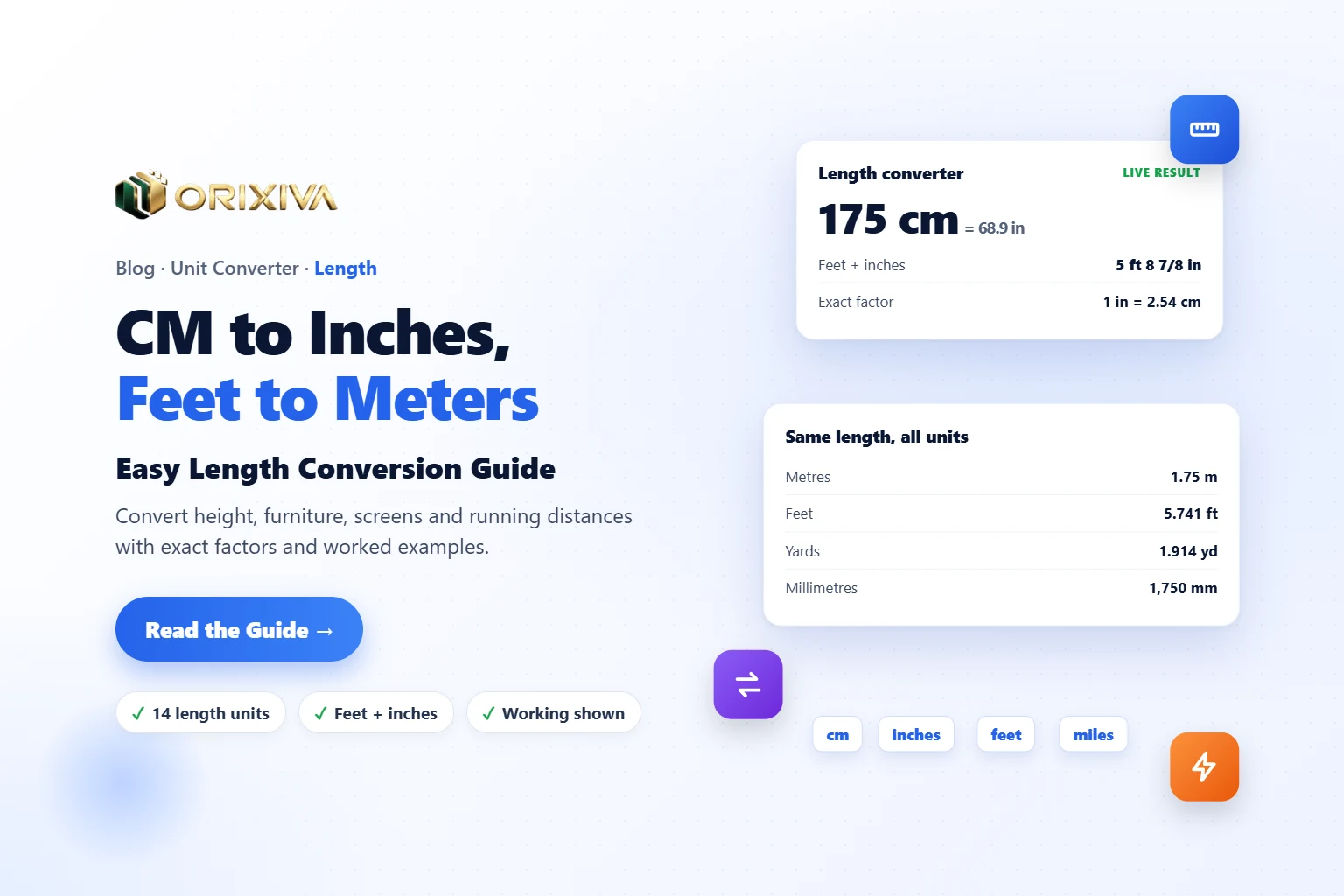
Need an answer now? The free length converter changes cm to inches, feet to meters, km to miles and 11 more units, with the working shown.
Jump to the free tool ↓A sofa listed at 220 cm, a height form that asks for feet and inches, a running app that shows miles when you think in kilometres: length conversions turn up every day. The good news is that you only need a handful of exact numbers to convert cm to inches, feet to meters and almost anything else, and none of them are guesses.
This guide explains each conversion in plain English, with worked examples for height, furniture, screens, running and science. You can check every answer with the free Orixiva length converter, which shows the formula, a table of all 14 length units and a feet-and-inches result, right in your browser.
Key takeaways
- 1 inch = 2.54 cm exactly, so cm to inches means dividing by 2.54.
- 1 foot = 0.3048 m exactly, so feet to meters means multiplying by 0.3048.
- 1 mile = 1.609344 km; 1 km is about 0.621 miles.
- For height, convert to total inches first, then split into feet (12 inches each) and inches.
- The Orixiva length converter covers 14 units, from nanometres to light-years, and shows how each answer was calculated.
The exact numbers behind every length conversion
Since 1959, the inch, foot, yard and mile have been defined in metric terms. The US National Institute of Standards and Technology (NIST) explains that the inch is exactly 25.4 mm. Because these values are exact definitions, a good length converter gives the same answer every time, with no rounding until the end.
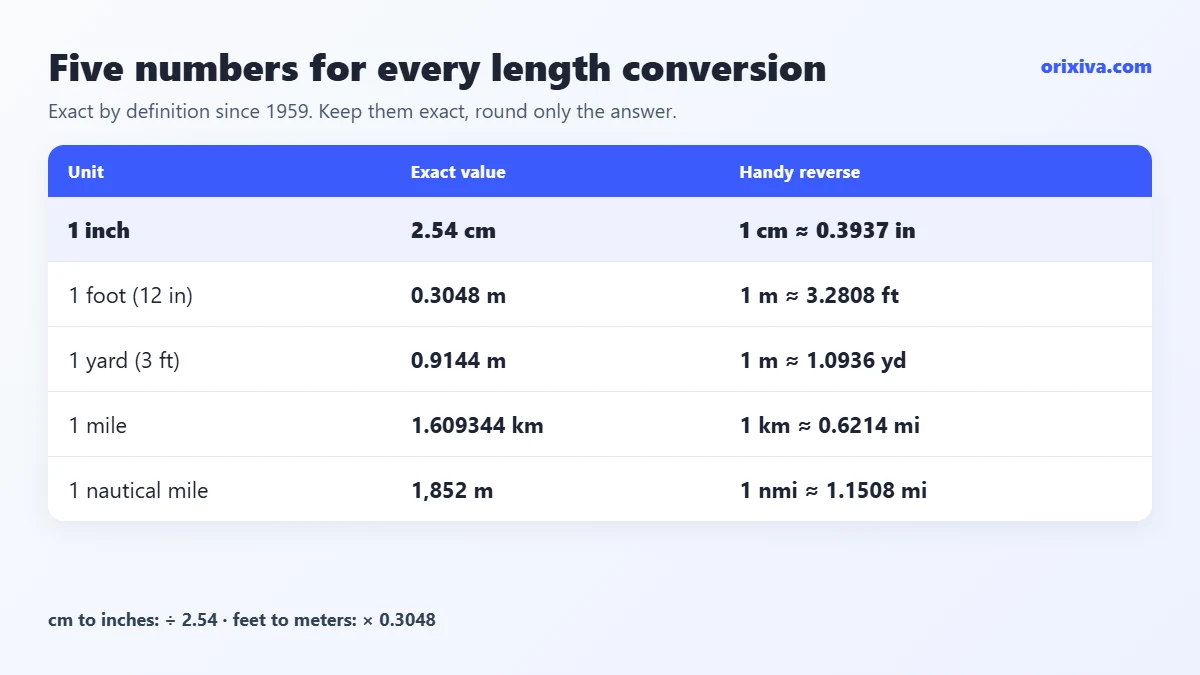
| Unit | Exact value | Handy reverse |
|---|---|---|
| 1 inch (in) | 2.54 cm = 25.4 mm | 1 cm ≈ 0.3937 in |
| 1 foot (ft) = 12 in | 30.48 cm = 0.3048 m | 1 m ≈ 3.2808 ft |
| 1 yard (yd) = 3 ft | 0.9144 m | 1 m ≈ 1.0936 yd |
| 1 mile (mi) = 5,280 ft | 1.609344 km | 1 km ≈ 0.6214 mi |
| 1 nautical mile (nmi) | 1,852 m | 1 nmi ≈ 1.1508 mi |
Metric units are simpler still: each step is a power of 10. 10 mm = 1 cm, 100 cm = 1 m and 1,000 m = 1 km.
How to convert cm to inches
inches = centimetres ÷ 2.54
To convert cm to inches, divide by 2.54. If you prefer multiplying, use 0.3937 (that is 1 ÷ 2.54, rounded).
- Write down the length in centimetres, for example 220 cm.
- Divide by 2.54: 220 ÷ 2.54 = 86.61.
- Round to what you need: about 86.6 inches, or 7 ft 2.6 in.
Example: will the sofa fit?A sofa is 220 cm wide and your wall space is 7 feet (84 inches). 220 cm is 86.6 inches, so it is about 2.6 inches too wide. Converting before you order saves a return.
Quick cm to inches examples
- A4 paper: 21 × 29.7 cm = 8.27 × 11.69 inches.
- Waist 80 cm: 80 ÷ 2.54 = 31.5 inches.
- Cabin bag 55 cm: 55 ÷ 2.54 = 21.65 inches.
How to convert inches to cm
centimetres = inches × 2.54
Going the other way, multiply by 2.54. Screens are the classic example: a TV or laptop size is the diagonal in inches.
- 55-inch TV: 55 × 2.54 = 139.7 cm diagonal.
- 15.6-inch laptop: 15.6 × 2.54 = 39.62 cm diagonal.
- 12-inch ruler: 12 × 2.54 = 30.48 cm, which is exactly one foot.
For fractions of an inch, convert the fraction first: 3/8 in = 0.375 in = 0.9525 cm. The Orixiva converter accepts fractions directly, so you can type 3/8 or even 5+3/8 in the value box.
How to convert height: feet and inches to cm (and back)
Height is the conversion people search for most, because it mixes two units. The trick is to work in total inches.
Feet and inches to cm
- Multiply the feet by 12 and add the inches. 5 ft 9 in = 5 × 12 + 9 = 69 inches.
- Multiply by 2.54. 69 × 2.54 = 175.26 cm.
CM to feet and inches
- Divide by 2.54 to get total inches. 170 cm ÷ 2.54 = 66.93 inches.
- Divide by 12 for whole feet. 66.93 ÷ 12 = 5 feet, with 6.93 inches left over.
- Result: 5 ft 6.9 in, or 5 ft 6 15/16 in to the nearest 1/16 inch.
The length converter does steps 2 and 3 for you. Every result in metres, centimetres or any other unit also shows a Feet + inches line, rounded to the nearest 1/16 inch, which is how tape measures are marked.
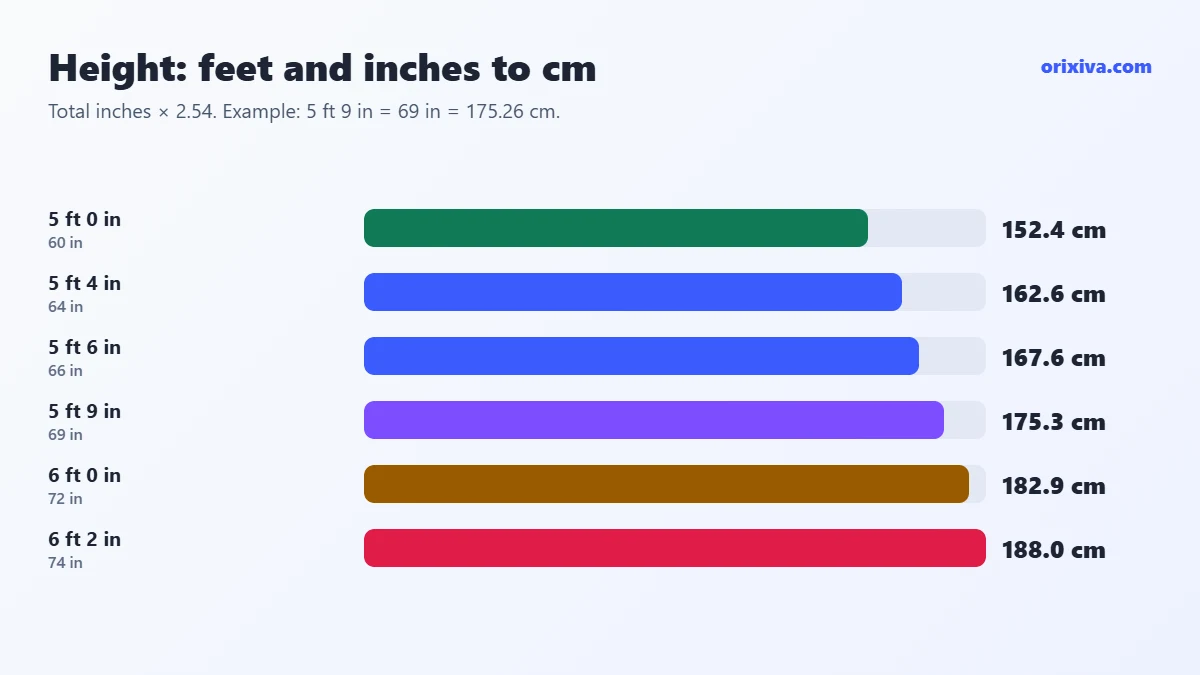
| Feet and inches | Total inches | Centimetres |
|---|---|---|
| 5 ft 0 in | 60 | 152.40 cm |
| 5 ft 4 in | 64 | 162.56 cm |
| 5 ft 6 in | 66 | 167.64 cm |
| 5 ft 9 in | 69 | 175.26 cm |
| 5 ft 11 in | 71 | 180.34 cm |
| 6 ft 0 in | 72 | 182.88 cm |
| 6 ft 2 in | 74 | 187.96 cm |
Height often feeds into health numbers. If you are working out BMI, our guide to BMI, body fat and TDEE explains which number matters for your goal.
How to convert feet to meters (and meters to feet)
meters = feet × 0.3048 · feet = meters ÷ 0.3048
To convert feet to meters, multiply by 0.3048. To convert meters to feet, divide by 0.3048, or multiply by about 3.2808.
- 6 ft door height: 6 × 0.3048 = 1.83 m.
- 100 ft: 100 × 0.3048 = 30.48 m.
- 2 m: 2 ÷ 0.3048 = 6.56 ft, or 6 ft 6.7 in.
- Mount Everest, 8,848.86 m: 8,848.86 ÷ 0.3048 = about 29,032 ft.
Quick mental checkA metre is a little over 3 feet (about 3 ft 3 in). If your answer in feet is not roughly three times the metres, something went wrong.
Yards
Yards are still used for fabric, sports fields and some land plots. 1 yd = 3 ft = 0.9144 m, so 10 yards of fabric is 9.14 m. A 100-yard field is 91.44 m long.
Kilometres to miles: running, driving and travel
miles = kilometres ÷ 1.609344 · kilometres = miles × 1.609344
Most of the world uses kilometres; the US and UK use miles on road signs. Race distances are the best-known examples:
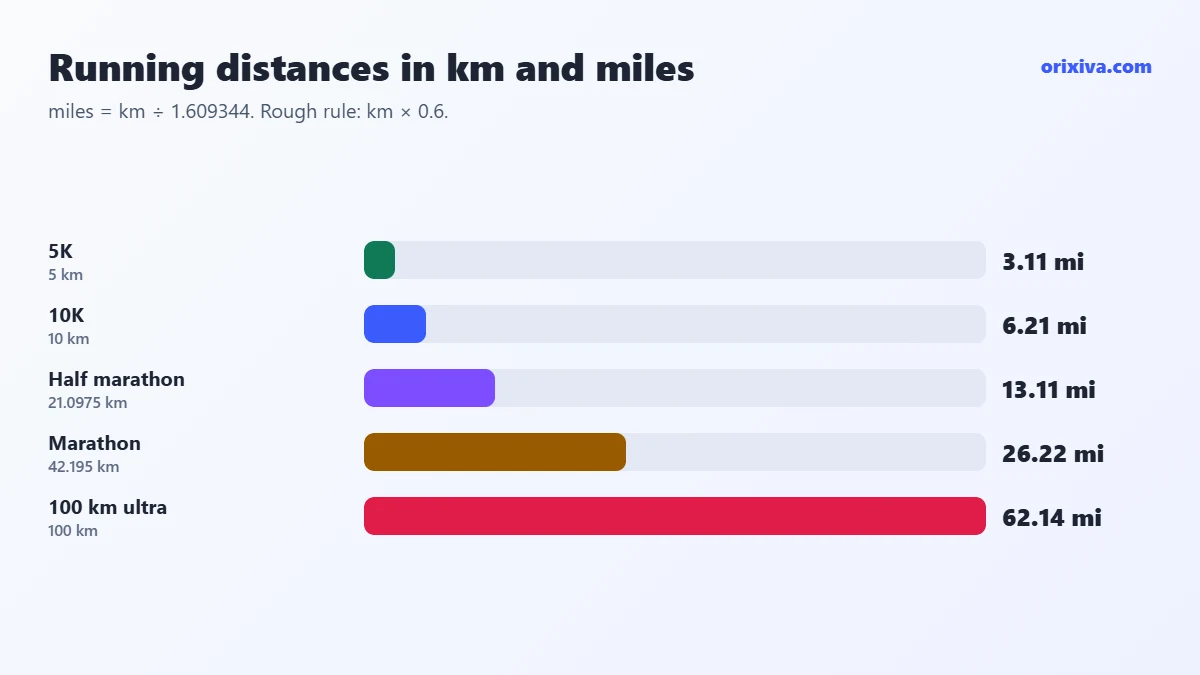
| Distance | Kilometres | Miles |
|---|---|---|
| 5K | 5 | 3.11 |
| 10K | 10 | 6.21 |
| Half marathon | 21.0975 | 13.11 |
| Marathon | 42.195 | 26.22 |
| 100 km ultra | 100 | 62.14 |
A rough rule: miles ≈ km × 0.6, and km ≈ miles × 1.6. For pace and race time, the guide to dates, work hours and running pace shows the next step.
Tiny lengths: millimetres, micrometres, nanometres and mils
The length converter goes far below a centimetre, which helps in engineering, 3D printing and science:
Millimetre (mm)
1/1,000 of a metre. Used in drawings and hardware. A standard 3D printer nozzle is 0.4 mm, which is 0.0157 in.
Micrometre (µm)
1/1,000 of a millimetre. Paint coatings, filter ratings and human hair (very roughly 50–100 µm) are measured in µm.
Nanometre (nm)
One billionth of a metre. Light wavelengths and chip manufacturing use nm.
Thou / mil
1/1,000 of an inch, or 25.4 µm. Used for plastic film thickness and machining tolerances.
If you price 3D prints, filament diameter (1.75 mm, about 0.069 in) and layer height are exactly the kind of values you will convert. See how to price 3D prints for the cost side.
Huge lengths: nautical miles, astronomical units and light-years
- Nautical mile (nmi): exactly 1,852 m. Ships and aircraft use it with knots (nautical miles per hour).
- Astronomical unit (au): 149,597,870,700 m, about the average distance from Earth to the Sun.
- Light-year (ly): the distance light travels in a year, about 9.46 trillion km, or roughly 63,241 au.
Numbers this large are easier to read in scientific notation. The converter switches to it automatically for very big or very small results (for example 9.461 × 10¹² km), and you can force standard decimals if you prefer.
CM to inches conversion chart
| Centimetres | Inches | Feet and inches |
|---|---|---|
| 1 cm | 0.39 in | – |
| 10 cm | 3.94 in | – |
| 30 cm | 11.81 in | 0 ft 11.8 in |
| 50 cm | 19.69 in | 1 ft 7.7 in |
| 100 cm | 39.37 in | 3 ft 3.4 in |
| 150 cm | 59.06 in | 4 ft 11.1 in |
| 160 cm | 62.99 in | 5 ft 3.0 in |
| 175 cm | 68.90 in | 5 ft 8.9 in |
| 180 cm | 70.87 in | 5 ft 10.9 in |
| 190 cm | 74.80 in | 6 ft 2.8 in |
Rounded to two decimal places. The converter gives up to 15 significant figures.
How to use the free length converter (step by step)
- Open the length converter. Go to the Orixiva length converter. It is the first of 14 converters in the unit converter; the menu and search box switch between them.
- Type your value. Whole numbers, decimals, fractions (5/8), scientific notation (1.2e3) and simple sums (5+3/8) all work. Commas and spaces are ignored.
- Choose From and To units. Pick from nanometre, micrometre, millimetre, centimetre, metre, kilometre, thou, inch, foot, yard, mile, nautical mile, astronomical unit and light-year.
- Read the result. It updates as you type. You also see both rates (for example 1 cm = 0.3937 in and 1 in = 2.54 cm), a feet-and-inches line, the scientific form and the full-precision value.
- Check the working. “How it was calculated” shows the two steps: your value to metres, then metres to the target unit.
- Compare all units at once. A table lists your length in all 14 units, with your From and To units highlighted.
- Save or share. Use Swap to reverse the direction, Copy result, Download TXT or Print. Press Convert to add the result to Recent conversions, which you can export as a CSV file.
Everything runs in your browser. Nothing is uploaded, there is no sign-up, and the page keeps working offline once loaded.
Precision and display options explained
Open Display options under the form to control how numbers look:
- Significant figures (1–15) or decimal places (0–12). Use 3–4 significant figures for everyday answers and more for engineering work. The default is 10 significant figures.
- Notation. Automatic, standard decimal, scientific (9.46 × 10¹⁵) or engineering (exponents in multiples of three, which match prefixes such as kilo and mega).
- Thousands separator. Show 29,031.69 or 29031.69, depending on where you will paste the number.
International foot vs US survey foot
There used to be two kinds of foot in the United States. The international foot is exactly 0.3048 m. The older US survey foot was 1200/3937 m, about 2 parts per million longer. According to NIST, the survey foot became obsolete on 1 January 2023, so new work uses the international foot. The difference only matters over very long distances, such as state-wide land surveys: about 2 mm per kilometre. The Orixiva converter uses the international foot.
Who uses which length units?
Knowing where a number comes from tells you which conversion you need:
- Most of the world uses millimetres, centimetres, metres and kilometres for everything, from road signs to clothing.
- The United States uses inches, feet, yards and miles in daily life, while science, medicine and much of industry work in metric.
- The United Kingdom mixes both: miles on road signs, feet and inches for height, and metric for most products and building work.
- Aviation and shipping use nautical miles for distance and, in aviation, feet for altitude almost everywhere.
- Screens, tyres and pipes are often sized in inches even in metric countries, so a “6.7-inch phone” is common everywhere.
Shoe and clothing sizes are a separate system in each region, so convert the body measurement (foot length or chest in cm or inches), not the size label, and then check the brand’s own size chart.
When you share a measurement with someone abroad, giving both values, such as “2 m (6 ft 7 in)”, avoids confusion.
How to convert length in Excel or Google Sheets
If you have a whole column to convert, a spreadsheet formula saves time. Both Excel and Google Sheets have a CONVERT function. According to Microsoft’s CONVERT reference, metric prefixes such as “c” and “k” can be added to “m”, so “cm” and “km” work. Google Sheets accepts most of the same unit codes.
| Conversion | Formula |
|---|---|
| CM to inches | =CONVERT(A2,"cm","in") |
| Inches to cm | =CONVERT(A2,"in","cm") |
| Feet to meters | =CONVERT(A2,"ft","m") |
| Kilometres to miles | =CONVERT(A2,"km","mi") |
| Nautical miles to km | =CONVERT(A2,"Nmi","km") |
Unit codes are case-sensitive. Without CONVERT, use the factors directly: =A2/2.54 for cm to inches or =A2*0.3048 for feet to meters. Use the length converter to spot-check a few rows before you trust the whole column.
Mistakes to avoid when converting length
Treating 5.9 feet as 5 ft 9 in
5.9 ft is 5 ft 10.8 in, not 5 ft 9 in. Decimal feet and feet-and-inches are different notations. Convert the decimal part by multiplying by 12.
Rounding too early
Using 2.5 instead of 2.54 seems harmless, but on 200 inches it gives 500 cm instead of 508 cm. Keep the exact factor until the final step.
Mixing nautical and land miles
A nautical mile is about 15% longer than a land mile. Check which one a chart, flight plan or boat spec uses.
Converting area with a length factor
1 m = 3.28 ft, but 1 m² = 10.76 ft², because both sides are converted. For floors and land, use the area converter; our guide to square feet to square meters explains why.
Your turn: Which length conversion do you need most often: height, furniture, screens or running? Tell us in the comments, along with the trick you use to remember it.
Convert cm to inches and feet to meters now, free
Change any length between 14 units, see feet and inches to the nearest 1/16 inch, and copy the working. No sign-up, and nothing leaves your browser.
Open the free length converter → Looking for another converter or calculator? Search on orixiva.comRelated guides: how to convert units (all 14 converters), kg to lbs and weight conversion, Celsius to Fahrenheit and the angle converter guide.
Length conversion questions people often ask
How do I convert cm to inches?
Divide the centimetres by 2.54. For example, 30 cm ÷ 2.54 = 11.81 inches. Multiplying by 0.3937 gives almost the same result.
How many cm are in an inch?
Exactly 2.54 cm, or 25.4 mm. This value has been fixed by international agreement since 1959.
How do I convert feet to meters?
Multiply the feet by 0.3048. For example, 10 ft × 0.3048 = 3.048 m.
What is 170 cm in feet and inches?
170 cm is 66.93 inches, which is 5 feet 6.9 inches (5 ft 6 15/16 in to the nearest sixteenth).
How many feet are in a meter?
About 3.2808 feet, or 3 feet 3.37 inches.
Is a mile longer than a kilometre?
Yes. One mile is 1.609344 km, so a 10 km run is about 6.21 miles.
How many inches are in a foot, and feet in a mile?
There are 12 inches in a foot, 3 feet in a yard and 5,280 feet (1,760 yards) in a mile.
How do I convert mm to inches?
Divide the millimetres by 25.4. For example, 100 mm ÷ 25.4 = 3.94 inches, and 6 mm is about 0.236 in, a little under 1/4 inch.
Can I type fractions like 5 3/8 inches?
Yes. Type 5+3/8 in the value box and the converter calculates 5.375 inches before converting.