Try our free AI tools – no sign-up needed!


Celsius to Fahrenheit (and Back): Easy Formulas, Charts and Examples
Need the answer now? The free temperature converter changes Celsius to Fahrenheit, Kelvin, Rankine and Réaumur, and even converts temperature changes correctly.
Jump to the free tool ↓A weather app says 30 degrees, a US recipe says bake at 350, a thermometer reads 100.4 and a science worksheet asks for kelvin. Temperature is the one conversion where a simple multiplier does not work, because the scales start at different points. That is why people search for Celsius to Fahrenheit so often, and why quick guesses go wrong.
This guide gives you both formulas, a shortcut you can do in your head, reference charts for weather, body temperature and ovens, and a clear explanation of kelvin. You can check every result in the free Orixiva temperature converter, which shows the formula it used for each step.
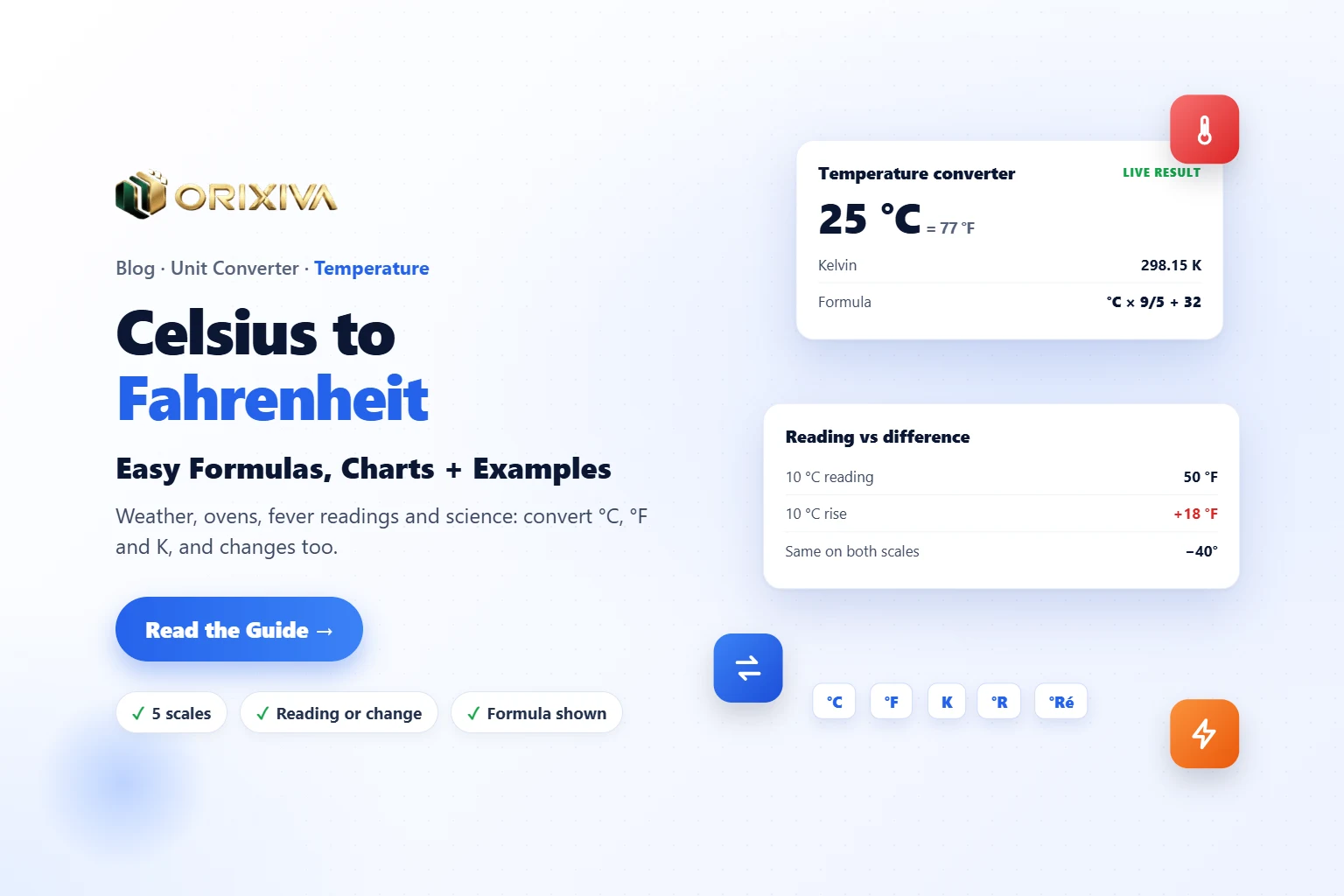
Key takeaways
- Celsius to Fahrenheit: °F = °C × 9/5 + 32 (or × 1.8 + 32).
- Fahrenheit to Celsius: °C = (°F − 32) × 5/9 (or ÷ 1.8).
- Kelvin = °C + 273.15. 0 K is absolute zero, the lowest possible temperature.
- A temperature change converts differently: a rise of 10 °C is a rise of 18 °F, not 50 °F.
- The Orixiva temperature converter handles five scales and has a separate mode for temperature differences.
Why temperature needs a formula, not just a multiplier
For length or weight, zero means zero on every scale: 0 cm is 0 inches. Temperature is different. Water freezes at 0 °C but at 32 °F, so the Fahrenheit scale is shifted by 32. The degrees are also different sizes: 100 Celsius degrees span the same range (freezing to boiling water) as 180 Fahrenheit degrees. One Celsius degree is therefore 1.8 Fahrenheit degrees.
So every Celsius to Fahrenheit conversion needs two steps: scale the size of the degree, then shift by 32. NIST’s guide to SI temperature units gives the same exact formulas used below.
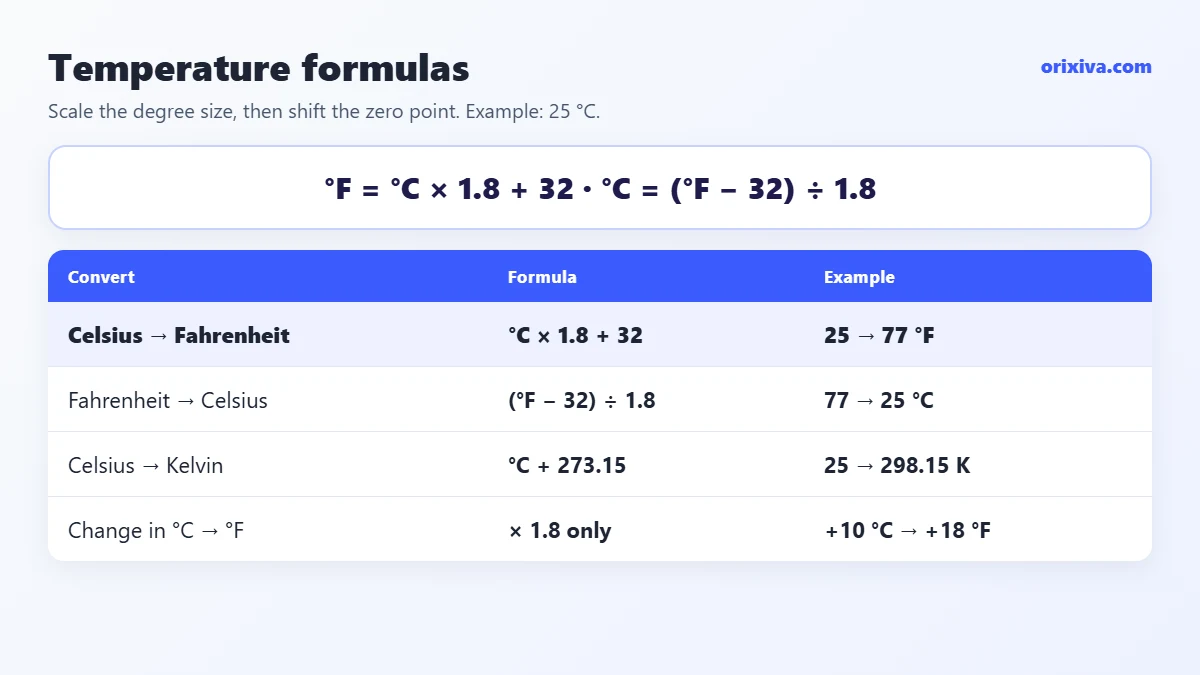
How to convert Celsius to Fahrenheit
°F = °C × 9/5 + 32 (9/5 = 1.8)
- Multiply the Celsius value by 1.8. For 25 °C: 25 × 1.8 = 45.
- Add 32: 45 + 32 = 77 °F.
More Celsius to Fahrenheit examples
- 30 °C (hot day): 30 × 1.8 + 32 = 86 °F.
- 20 °C (room temperature): 20 × 1.8 + 32 = 68 °F.
- 4 °C (fridge): 4 × 1.8 + 32 = 39.2 °F.
- −18 °C (freezer): −18 × 1.8 + 32 = −0.4 °F, about 0 °F.
- 100 °C (boiling water at sea level): 100 × 1.8 + 32 = 212 °F.
How to convert Fahrenheit to Celsius
°C = (°F − 32) × 5/9 (or ÷ 1.8)
- Subtract 32 first. For 72 °F: 72 − 32 = 40.
- Divide by 1.8 (or multiply by 5/9): 40 ÷ 1.8 = 22.2 °C.
The order matters. Subtract 32 before dividing; doing it the other way round gives a wrong answer.
- 50 °F: (50 − 32) ÷ 1.8 = 10 °C.
- 68 °F: (68 − 32) ÷ 1.8 = 20 °C.
- 100 °F: (100 − 32) ÷ 1.8 = 37.8 °C.
- 0 °F: (0 − 32) ÷ 1.8 = −17.8 °C.
A mental shortcut for weather: double and add 30
For a quick sense of the weather, double the Celsius and add 30. It is close for everyday air temperatures and drifts further away at the extremes:
| Celsius | Shortcut (×2 + 30) | Exact | Off by |
|---|---|---|---|
| 0 °C | 30 °F | 32 °F | 2 °F |
| 10 °C | 50 °F | 50 °F | 0 °F |
| 20 °C | 70 °F | 68 °F | 2 °F |
| 30 °C | 90 °F | 86 °F | 4 °F |
| 37 °C | 104 °F | 98.6 °F | 5.4 °F |
| 180 °C | 390 °F | 356 °F | 34 °F |
Good for “do I need a jacket?”. Not good enough for fever checks, cooking or science.
The reverse shortcut is “subtract 30 and halve”: 80 °F → 50 → 25 °C (exact: 26.7 °C).
Celsius to Fahrenheit chart
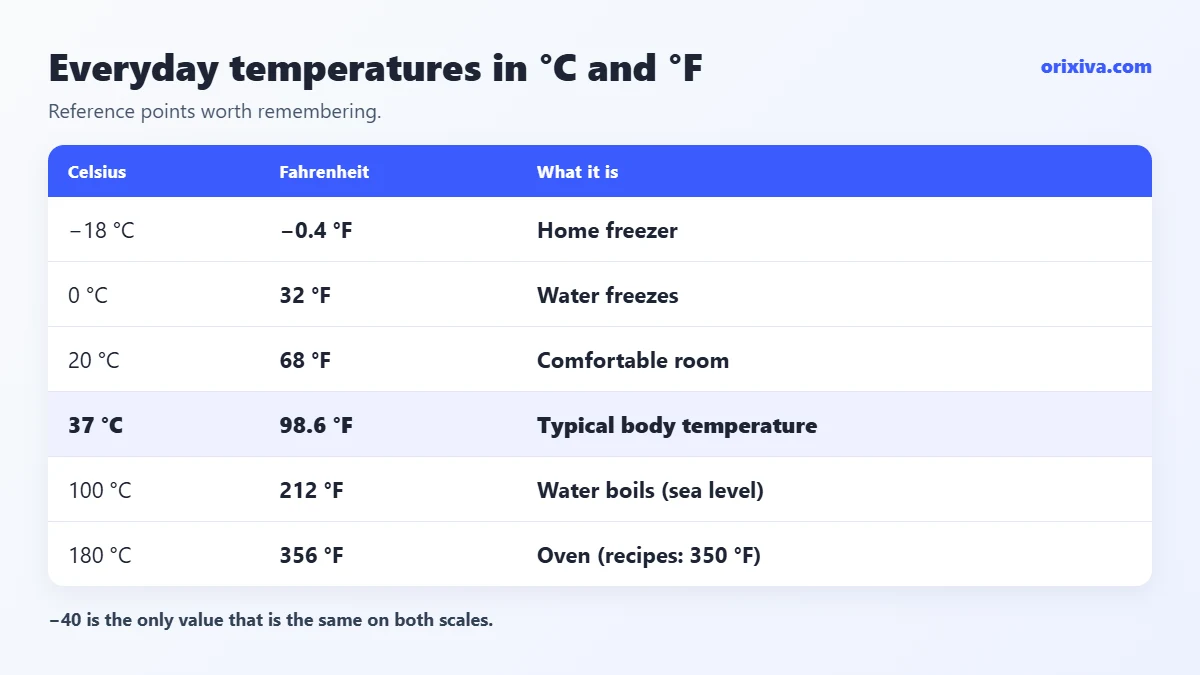
| Celsius | Fahrenheit | What it feels like |
|---|---|---|
| −40 °C | −40 °F | The one point where both scales match |
| −18 °C | −0.4 °F | Home freezer |
| 0 °C | 32 °F | Water freezes |
| 10 °C | 50 °F | Cool spring day |
| 20 °C | 68 °F | Comfortable room |
| 25 °C | 77 °F | Warm day |
| 30 °C | 86 °F | Hot day |
| 37 °C | 98.6 °F | Typical body temperature |
| 40 °C | 104 °F | Heatwave |
| 100 °C | 212 °F | Water boils at sea level |
Body temperature in Celsius and Fahrenheit
Thermometers in some countries show °C and in others °F, which causes worry when a reading looks unfamiliar.
- 37 °C = 98.6 °F, the traditional “normal” value. Normal body temperature varies from person to person and through the day.
- 38 °C = 100.4 °F, a value many health services use as a fever threshold.
- 39 °C = 102.2 °F.
Not medical adviceUse the converter to read a thermometer, not to decide on treatment. If you are worried about a fever, especially in a baby, an older person or someone with other symptoms, contact a doctor or your local health service.
Oven temperatures: Celsius to Fahrenheit for cooking
Recipes from the US use Fahrenheit; most others use Celsius. Many recipes round the result to the nearest 25 °F, which is why 180 °C is usually written as 350 °F instead of the exact 356 °F.
| Celsius | Exact Fahrenheit | Common recipe value |
|---|---|---|
| 150 °C | 302 °F | 300 °F |
| 160 °C | 320 °F | 325 °F |
| 175 °C | 347 °F | 350 °F |
| 180 °C | 356 °F | 350 °F |
| 190 °C | 374 °F | 375 °F |
| 200 °C | 392 °F | 400 °F |
| 220 °C | 428 °F | 425 °F |
| 230 °C | 446 °F | 450 °F |
UK gas marks
Older British recipes give oven heat as a gas mark. The usual equivalents are gas mark 1 = 140 °C (275 °F), 2 = 150 °C (300 °F), 3 = 170 °C (325 °F), 4 = 180 °C (350 °F), 5 = 190 °C (375 °F), 6 = 200 °C (400 °F), 7 = 220 °C (425 °F), 8 = 230 °C (450 °F) and 9 = 240 °C (475 °F). Like most recipe charts, these are rounded, not exact conversions.
Fan (convection) ovens usually need about 20 °C lower than conventional ovens; check your oven’s manual. For converting ingredients as well, use the cooking calculator and our cups to grams chart.
Food safety and storage temperatures in °C and °F
Food thermometers and US guides use Fahrenheit, while many other countries use Celsius. These are the safe minimum internal temperatures from the US government’s FoodSafety.gov chart, converted with the formula:
| Food | Fahrenheit | Celsius |
|---|---|---|
| Poultry (whole or ground) | 165 °F | 73.9 °C (about 74 °C) |
| Ground beef | 160 °F | 71.1 °C (about 71 °C) |
| Beef or pork steaks and roasts, then rest 3 minutes | 145 °F | 62.8 °C (about 63 °C) |
| Fish | 145 °F | 62.8 °C (about 63 °C) |
For storage, a fridge is usually kept at 4 °C (39.2 °F) or below and a freezer at −18 °C (−0.4 °F, close to 0 °F). Follow your local food-safety authority, as advice can differ by country.
How to convert a temperature range or tolerance
Product labels and settings often give a range. Convert each end of the range as a reading, but convert a tolerance (±) as a difference:
- Room range 18–24 °C: 64.4–75.2 °F (each end uses × 1.8 + 32).
- Storage “2–8 °C” (common for medicines and vaccines): 35.6–46.4 °F.
- Sensor accuracy “±0.5 °C”: ±0.9 °F, because ±0.5 is a difference, not a reading.
- A 20 °C to 25 °C swing is a 5 °C change, which is a 9 °F change (68 °F to 77 °F).
Kelvin, Rankine and Réaumur explained
The temperature converter supports five scales. Here is what the other three are for:
Kelvin (K)
The SI unit used in science. It starts at absolute zero, and one kelvin is the same size as one Celsius degree. K = °C + 273.15, so 25 °C = 298.15 K. Write “K”, not “°K”.
Rankine (°R)
An absolute scale with Fahrenheit-sized degrees, used in some US engineering. °R = °F + 459.67, so 25 °C = 536.67 °R.
Réaumur (°Ré)
A historical scale with water freezing at 0 and boiling at 80. °Ré = °C × 0.8, so 25 °C = 20 °Ré. You may meet it in old European recipes and texts.
Why science uses kelvin
Many physics and chemistry formulas, such as the gas law PV = nRT, only work with an absolute scale. Doubling a gas’s kelvin temperature doubles its pressure at fixed volume; doubling its Celsius value does not. That is why lab work and engineering calculations convert to kelvin first. Our molarity, dilution and pH guide shows more lab calculations.
Absolute zero
Absolute zero is 0 K, which equals −273.15 °C or −459.67 °F. Nothing can be colder. If you enter a value below it, such as −300 °C, the converter shows an error instead of a meaningless number.
How to convert a temperature change (not a reading)
This is the part that is easiest to get wrong. A temperature reading (it is 10 °C outside) and a temperature change (it got 10 °C warmer) convert differently.
- A reading of 10 °C is 50 °F, because you add 32.
- A rise of 10 °C is a rise of 18 °F, because a change only scales by 1.8. The 32 offset cancels out.
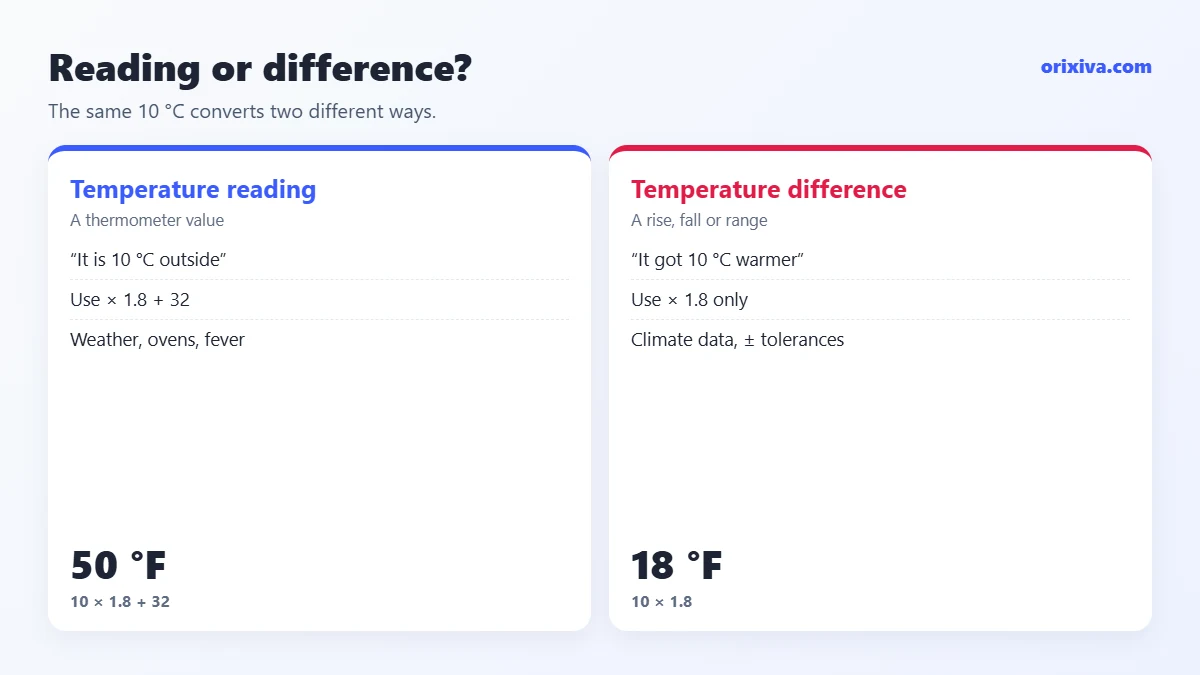
Example: a climate reportA report says average temperatures rose by 1.5 °C. In Fahrenheit that is a rise of 1.5 × 1.8 = 2.7 °F. Using the reading formula would give 34.7 °F, which is clearly wrong.
In the Orixiva converter, set Convert a to Temperature difference. The result and the working then use only the degree size: 1 °C = 1 K = 1.8 °F = 1.8 °R = 0.8 °Ré.
Who uses Celsius and who uses Fahrenheit?
Almost every country uses Celsius for weather, cooking and medicine. The United States is the main exception and uses Fahrenheit in daily life, as do a few smaller countries and territories. Science everywhere uses Celsius and kelvin. The United Kingdom uses Celsius officially, though you may still hear Fahrenheit for summer heat.
The two scales have different origins. Daniel Gabriel Fahrenheit proposed his scale in the 1720s, and Anders Celsius proposed a 100-step scale in 1742. Today both are defined from the kelvin, so the conversion between them is exact.
How to convert temperature in Excel or Google Sheets
Excel and Google Sheets both have a CONVERT function that handles temperature, including the 32-degree offset. The unit codes listed in Microsoft’s CONVERT reference are “C”, “F”, “K”, “Rank” and “Reau”. Google Sheets accepts most of the same unit codes.
| Conversion | Formula |
|---|---|
| Celsius to Fahrenheit | =CONVERT(A2,"C","F") |
| Fahrenheit to Celsius | =CONVERT(A2,"F","C") |
| Celsius to Kelvin | =CONVERT(A2,"C","K") |
| Without CONVERT | =A2*9/5+32 or =(A2-32)*5/9 |
CONVERT treats every value as a reading. To convert a temperature change, multiply or divide by 1.8 yourself, or use the difference mode in the converter.
How to use the free temperature converter (step by step)
- Open the temperature converter. Go to the Orixiva temperature converter. It opens on 25 °C to °F as an example.
- Type your value. Negative numbers, decimals and fractions all work, for example −18, 98.6 or 1/2.
- Choose From and To scales. Celsius, Fahrenheit, Kelvin, Rankine or Réaumur.
- Pick reading or difference. Leave Temperature reading for a thermometer value. Choose Temperature difference for a rise, fall or range.
- Read the result and the working. The answer updates as you type. “How it was calculated” shows the formula for each step, for example °C = (°F − 32) × 5/9, then °F = °C × 9/5 + 32.
- See all five scales. A table shows your temperature in every scale at once.
- Adjust and share. Set decimal places or significant figures under Display options, swap the scales, copy the result, download it as TXT, print it, or export Recent conversions as CSV.
Everything runs in your browser, with no sign-up and nothing uploaded.
Mistakes to avoid when converting temperature
Forgetting the 32
Multiplying 25 °C by 1.8 gives 45, not 77 °F. The shift of 32 is what makes Fahrenheit readings look so much higher.
Subtracting 32 at the wrong time
For Fahrenheit to Celsius, subtract 32 first, then divide. 100 ÷ 1.8 − 32 gives 23.6, but the correct answer is 37.8 °C.
Converting a change like a reading
Spec sheets, climate data and lab notes often give differences (“±2 °C”, “a 5 °C rise”). Use the difference mode, or just multiply by 1.8.
Trusting rounded recipe values for precise cooking
For cakes, rounding 180 °C to 350 °F works fine. For sugar work, chocolate tempering or sous vide, a few degrees matter, so convert exactly (for example 118 °C is 244.4 °F, not 245) and use a good thermometer.
Changing a thermostat in the wrong scale
Many thermostats and air conditioners can display either scale. If a setting of 22 suddenly reads 72, the unit has switched to Fahrenheit, not heated up. Check the display unit before changing anything.
Writing °K
Kelvin is written as K without a degree sign. 300 K, not 300 °K.
Your turn: Which temperature trips you up most, weather, ovens or fever readings? Share your favourite memory trick in the comments to help readers in other countries.
Convert Celsius to Fahrenheit now, free
Convert between Celsius, Fahrenheit, Kelvin, Rankine and Réaumur, handle temperature changes correctly, and see every formula used. No sign-up, and nothing leaves your browser.
Open the free temperature converter → Looking for another converter or calculator? Search on orixiva.comRelated guides: how to convert units (all 14 converters), cm to inches and feet to meters, kg to lbs and electricity cost explained.
Temperature conversion questions people often ask
What is the formula for Celsius to Fahrenheit?
°F = °C × 9/5 + 32. Multiply by 1.8, then add 32. For example, 30 °C × 1.8 + 32 = 86 °F.
How do I convert Fahrenheit to Celsius?
Subtract 32, then multiply by 5/9 (or divide by 1.8). For example, (77 − 32) ÷ 1.8 = 25 °C.
At what temperature are Celsius and Fahrenheit the same?
At −40. −40 °C is exactly −40 °F.
What is 37 °C in Fahrenheit?
98.6 °F, the traditional value for normal body temperature.
What is 180 °C in Fahrenheit for an oven?
Exactly 356 °F. Recipes usually round it to 350 °F.
How do I convert Celsius to Kelvin?
Add 273.15. For example, 20 °C + 273.15 = 293.15 K.
What is 350 °F in Celsius?
(350 − 32) ÷ 1.8 = 176.7 °C. Recipes usually round it to 180 °C, or 160 °C for a fan oven.
What is absolute zero in Fahrenheit?
−459.67 °F, which is 0 K or −273.15 °C.
Is 0 °F the same as 0 °C?
No. 0 °F is about −17.8 °C, much colder than 0 °C, which is the freezing point of water (32 °F).
What is room temperature in Fahrenheit?
Room temperature is usually taken as about 20–22 °C, which is 68–71.6 °F.
Why is a 10 °C rise not 50 °F?
Because a change only scales by 1.8; the +32 offset applies to readings, not differences. A 10 °C rise is an 18 °F rise.