Try our free AI tools – no sign-up needed!



ORIXIVA · PERSONAL FINANCE & BUSINESS PLANNING
Financial Calculators Online: A Practical Guide to 11 Money Tools
Use online financial calculators to estimate compound interest, simple interest, loan and EMI payments, investment returns, profit margin, discounts, savings goals, break-even sales, inflation and GST. This guide explains what each calculator does, which inputs matter, how to read the results and how to compare scenarios responsibly.
What Can You Do With Financial Calculators Online?
An online financial calculator helps you apply a formula to figures such as money, interest rates, prices, costs and time periods. Orixiva’s financial calculator suite contains 11 calculators for personal financial planning, investment comparisons, shopping discounts and small-business decisions. Select a calculator, enter the required values and review the result together with the working, tables or charts shown for that calculation.
For personal money planning
Estimate interest growth, loan payments, a savings target, future costs after inflation and the purchasing power of money over time.
For investments
Compare return on investment (ROI), compound annual growth rate (CAGR), net present value (NPV), internal rate of return (IRR) and cash-flow scenarios.
For business owners
Estimate a product’s selling price, profit margin, markup, break-even units, target-profit volume and potential net profit after entered costs and tax.
For everyday pricing
Work out sale prices, stacked discounts, coupon effects and tax-inclusive totals. The currency selector changes the displayed symbol; it does not fetch exchange rates or convert currencies.
Important: These calculators are planning aids. Their outputs depend on the values, rates, timing and assumptions you enter. They do not guarantee investment returns, quote official loan terms or determine which tax rule applies to your transaction.
How to Use an Online Financial Calculator
For a more useful estimate, prepare your figures before calculating. Check whether an amount means a total or a per-period payment, whether an interest rate is annual or periodic, and whether the calculator asks for a percentage or a money amount.
Choose the question you need to answer
For example, use Compound Interest for future value, Loan / EMI for payment estimates, Profit Margin & Markup for pricing, or Break-Even Units to estimate the sales volume needed to cover costs.
Enter complete and consistent inputs
Use the correct currency, rate, time period, compounding frequency, payment frequency, sales volume, costs or tax rate. Do not mix a monthly rate with a yearly period.
Calculate and inspect the working
Review the main result first. Then read the explanation, formula steps, schedule, table or chart when available. A headline number without its assumptions can be misleading.
Compare scenarios one change at a time
Adjust one input—such as rate, term, monthly deposit, selling price or fixed cost—and calculate again. This makes it easier to see which assumption is driving the result.
1. Choose your goal
2. Enter the figures
3. Calculate
4. Review the result
5. Compare or verify
If the result looks unexpected, revisit the input fields, timing assumptions and selected calculation mode before relying on the estimate.
Which Financial Calculator Should You Choose?
| Calculator | Main purpose | Extra features |
|---|---|---|
| Compound Interest | Estimate a future balance from an initial amount and regular deposits. | Contribution step-ups, inflation adjustment, effective annual rate, yearly table and chart. |
| Simple Interest | Solve for interest, principal, rate or time. | Months or days, 360- or 365-day basis, comparison with compound interest. |
| Loan / EMI | Estimate periodic payment or the loan principal supported by a payment budget. | Flat or reducing balance, fees, extra payments, estimated APR and amortization. |
| Profit Margin & Markup | Measure profitability or find a price for a target margin or markup. | Unit volume, expenses, tax estimate and margin conversion table. |
| Return on Investment (ROI) | Estimate gain or loss relative to an investment. | Annualized return, after-tax scenario, target exit value, IRR and NPV. |
| CAGR | Calculate an equivalent annual growth rate between values. | Future/end value, starting value, years needed, dates and yearly-return comparison. |
| Discount | Estimate a sale price or work backward to a discount or original price. | Stacked discounts, fixed coupon, tax, quantity and buy-X-get-Y offers. |
| Savings Goal | Estimate monthly saving needed or time required to reach a target. | Current savings, estimated returns, inflation adjustment and deposit timing. |
| Break-Even Units | Estimate the unit volume or sales value at which modelled revenue covers costs. | Target profit, margin of safety, operating leverage and chart. |
| Inflation & Real Value | Estimate future cost or the current purchasing-power value of future money. | Average annual inflation calculated from two prices. |
| Sales Tax / GST | Add tax, remove tax from a total or infer a percentage rate. | Tax amount and pre-tax/tax-inclusive comparisons. |
1. Compound Interest and Simple Interest Calculators
Compound Interest Calculator
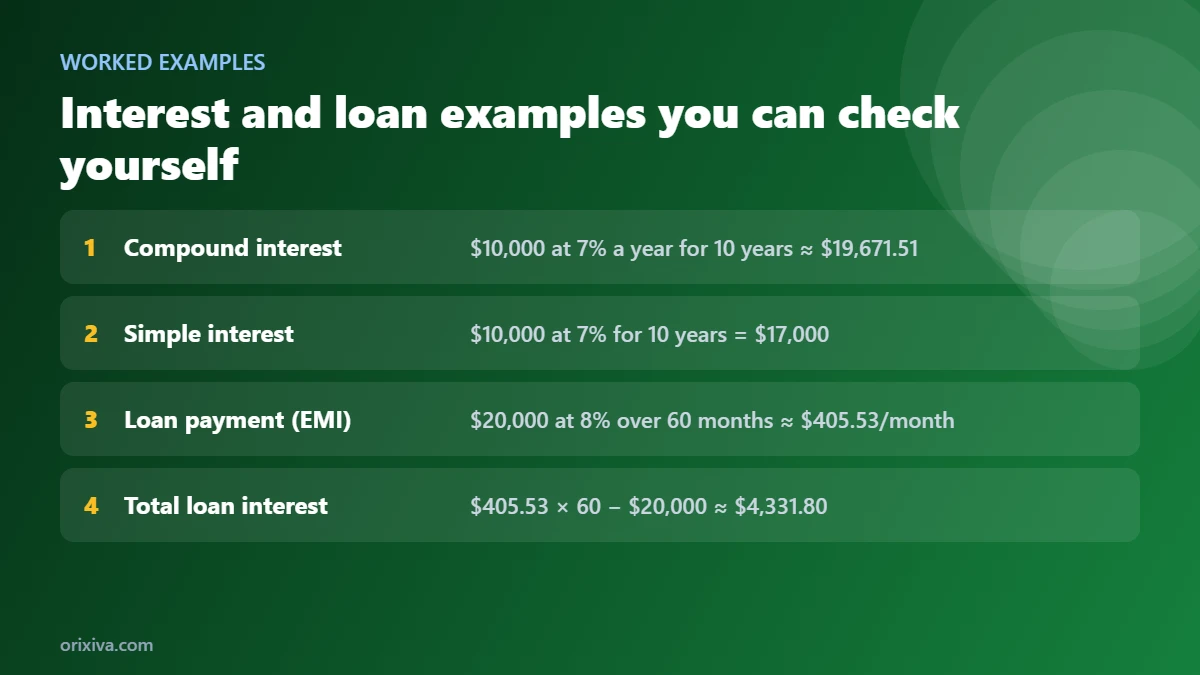
Compound interest means that earned interest becomes part of the balance used for later interest calculations. Over time, that can create a different growth path from simple interest. Orixiva’s compound interest calculator estimates future value from an initial amount, annual rate and investment period, with options for regular contributions and contribution increases.
The tool supports annual, semi-annual, quarterly, monthly, weekly, daily and continuous compounding. Contributions can be set to weekly, monthly, quarterly, semi-annual or annual frequency, and can be made at the beginning or end of a period. A yearly contribution step-up lets you explore a plan where deposits rise over time.
How to use the compound interest calculator
- Enter the initial amount, annual interest rate and number of years.
- Choose how frequently interest compounds.
- Enter a regular contribution and its frequency, or enter zero if there are no contributions.
- Choose beginning-of-period or end-of-period contributions and enter any planned annual contribution increase.
- Optionally enter an expected inflation rate to view a future value adjusted to today’s purchasing power.
- Review the final balance, estimated contributions, interest earned, effective annual rate, doubling-time estimate and yearly growth table or chart where shown.
Example: $10,000 compounded monthly at an assumed nominal annual rate of 6% for 10 years, with no further deposits or withdrawals, grows to approximately $18,194 before taxes, fees and inflation. This is a mathematical illustration, not a forecast of what an investment will earn.
The basic formula is only the starting point. A calculation with recurring contributions, step-ups, continuous compounding or inflation adjustment uses additional assumptions. The doubling-time output is an estimate based on the selected growth rate.
Simple Interest Calculator
Simple interest is calculated on the original principal, rather than adding each period’s interest to the principal for future calculations. The calculator can solve for the interest amount, principal, annual rate or time. It also provides a comparison with yearly and monthly compounding at the same entered rate and time.
How to use the simple interest calculator
- Select the unknown value: interest, principal, rate or time.
- Fill in the remaining fields requested for that mode.
- Select whether the time is measured in years, months or days.
- For a day-based calculation, choose the 365-day or 360-day convention appropriate to your example or agreement.
- Compare the simple-interest total with the compounding comparison displayed in the result.
Example: A principal of $5,000 at 7% simple interest for three years earns $1,050 in interest. The total before any fees or taxes is $6,050.
Financial products can use contractual day-count rules and payment conditions. Check the agreement if you need an exact amount for a real account or loan.
2. Loan and EMI Calculator
The Loan / EMI Calculator estimates a periodic repayment for a stated loan or works backward from a periodic payment budget to estimate the loan amount that may fit it. You can set the loan term in years or months, select monthly, every-two-weeks or weekly payments, and compare flat-rate and reducing-balance methods.
It also supports an upfront fee percentage and an extra periodic payment for reducing-balance scenarios. The result includes total interest, total paid, borrowing cost including the entered fee, a payment schedule and a balance/interest chart. An APR-style figure is estimated from the inputs and cash flows; it is not a lender’s official quote.
How to use the loan or EMI calculator
- Choose whether you want a payment estimate for a known loan amount or a maximum-loan estimate for a payment budget.
- Enter the loan amount or payment budget, annual interest rate and term.
- Choose the payment frequency and the flat-rate or reducing-balance method that matches your comparison.
- Enter an upfront fee percentage if it applies. For a reducing-balance scenario, enter any extra amount you expect to pay each period.
- Review the payment, total interest, fees, total repayment and amortization schedule. Compare the assumptions against the lender’s disclosure.
In this formula, P is the loan principal, i is the interest rate per payment period and n is the total number of payments. A flat-rate loan uses a different interest method and can have a much higher effective borrowing cost than the headline flat rate suggests.
Official loan offers may include fees, rounding, dates or early-repayment rules that are not represented by the calculator inputs.
Loan comparison tip: Do not compare offers using the stated interest rate alone. Compare the payment frequency, total amount repaid, fees, repayment conditions and official APR disclosure where applicable.
3. Return on Investment (ROI) and CAGR Calculators
Return on Investment (ROI) Calculator
Return on investment compares a gain or loss with the cost of an investment. Orixiva’s ROI calculator estimates ROI from an initial amount, final value, interim income, fees and an entered tax assumption. It can also calculate a target final value for a desired ROI and analyse a series of cash flows using IRR and NPV.
How to use the ROI calculator
- Choose ROI, target final value or IRR / NPV cash-flow analysis.
- For a basic ROI calculation, enter the initial investment, final value, interim income, fees and holding period where applicable.
- Use the tax input only as a scenario assumption; do not treat it as a tax assessment.
- For cash-flow analysis, enter a sequence containing both money outflows and inflows, choose periods per year and enter a discount rate for NPV.
- Review ROI, annualized return, multiple of money, break-even value, IRR or NPV and any warnings about multiple possible IRRs.
Example: If an investment costs $1,000 and the final value is $1,350, with no fees or interim income, the basic gain is $350 and ROI is 35%. If the holding period is two years, the equivalent annualized growth rate is lower than 35% per year because the return is spread across two years.
Basic ROI does not account for when cash flows occur. IRR and NPV can incorporate timing in different ways, but they depend on the accuracy of the cash-flow schedule and discount-rate assumptions.
Compound Annual Growth Rate (CAGR) Calculator
CAGR is the constant annual growth rate that would connect a starting value and an ending value over a specified period. It is useful for summarising growth, but it does not show the ups and downs along the way. The calculator can solve for CAGR, end value, years needed or starting value. It can also use start and end dates, or calculate a geometric CAGR from a list of yearly returns.
How to use the CAGR calculator
- Choose the value you want to calculate: CAGR, ending value, years needed, starting value or CAGR from yearly returns.
- Enter the known values and the number of years or dates requested by that mode.
- For a yearly-return comparison, enter the returns as percentages separated by commas or new lines.
- Review the growth rate, total growth, simple average comparison and chart or year-by-year values where provided.
Example: Growth from $1,000 to $1,800 over five years corresponds to a CAGR of approximately 12.47% a year. That does not mean the value actually increased by 12.47% in every single year.
4. Profit Margin, Markup and Break-Even Calculators
Profit Margin & Markup Calculator
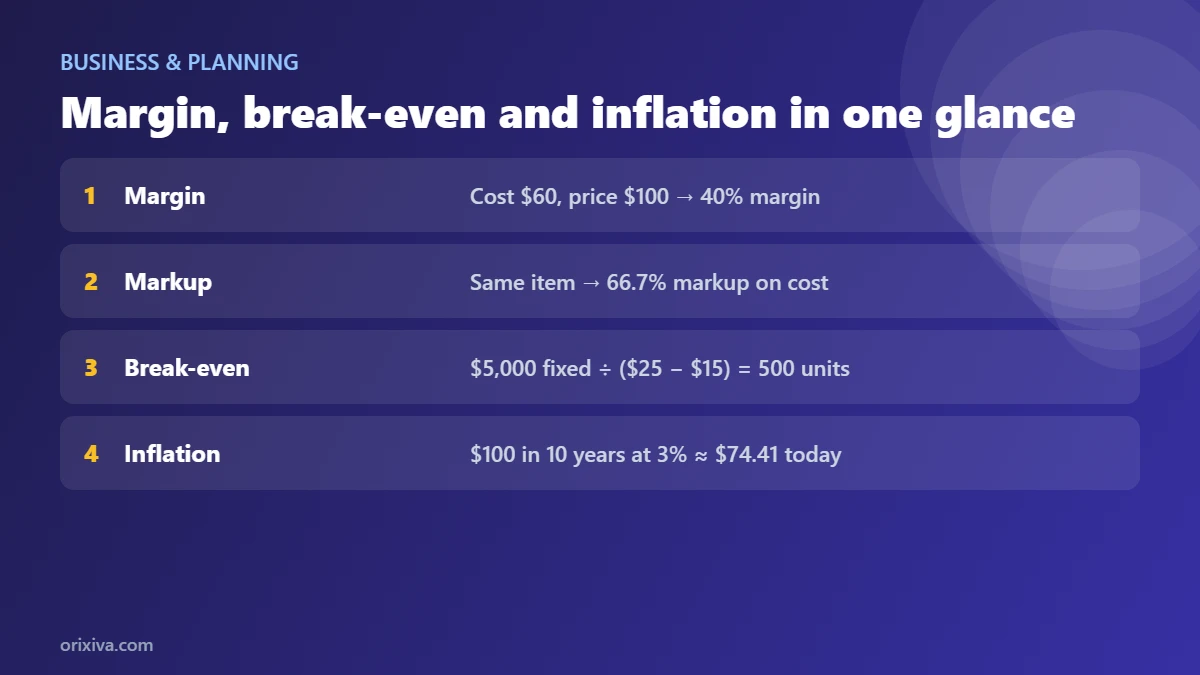
Margin and markup both compare profit with another amount, but their denominators are different. Gross profit margin compares profit with the selling price; markup compares profit with the cost. Confusing them can lead to prices that are lower or higher than intended.
The calculator can find margin and markup from a cost and selling price, calculate a selling price for a target margin or markup, or calculate the maximum cost for a target margin. It also estimates revenue, gross profit, expenses, profit before tax, an entered tax estimate and net profit based on the number of units entered. A conversion table helps compare common target margins and the markup needed to achieve each one.
How to use the margin and markup calculator
- Choose whether to calculate current margin and markup, price for a target margin, price for a target markup or maximum cost.
- Enter the cost, selling price or target percentage requested by the selected mode.
- Enter units sold, operating expenses and a tax assumption to explore total profit.
- Review the per-unit result separately from total revenue and net profit.
Markup = (Selling price − cost) ÷ cost × 100%
Example: A product costs $60 and sells for $100. Gross profit is $40, gross margin is 40%, and markup is approximately 66.67%. The two percentages differ because they use different bases.
Break-Even Units Calculator
Break-even is the point at which the revenue in a model covers its fixed and variable costs, leaving no operating profit or loss. This calculator estimates break-even units and sales, the units needed to achieve a target profit, margin of safety, operating leverage and a chart. It can also work out a break-even selling price or a maximum variable cost for an expected unit volume.
How to use the break-even calculator
- Choose break-even units, required selling price or maximum variable cost.
- Enter fixed costs and the selling price and variable cost relevant to your mode.
- For target profit, enter the additional profit goal. For price or cost modes, enter expected unit sales.
- Review contribution per unit, required sales, target-profit units and margin of safety where shown.
- Test different costs or selling prices to understand how the break-even level changes.
Break-even units = Fixed costs ÷ contribution per unit
Example: If fixed costs are $10,000, the selling price is $50 and variable cost is $30 per unit, the contribution is $20 per unit. The business model breaks even at 500 units, or $25,000 in sales, under those assumptions.
The unit break-even output is rounded up to a whole unit. The model assumes the entered price and unit costs remain applicable over the sales range being considered.
5. Discount Calculator for Sale Prices and Offers
The Discount Calculator estimates the final cost after a single discount, successive discounts, a fixed-value coupon and tax in the supported mode. It can work backward from an original and sale price to find the discount percentage, recover an original price from a discounted price, and calculate the effective discount in a buy-X-get-Y-free offer.
How to use the discount calculator
- Choose the task: final price, stacked discounts, discount percentage, original price or buy-X-get-Y-free.
- Enter the original price and quantity, or the sale price and discount information required by your selected mode.
- For stacked discounts, enter each percentage separated by commas, spaces or semicolons.
- Enter a fixed coupon and tax rate when the chosen mode supports them.
- Review the final total, amount saved, effective combined discount and price per item.
Example: A 20% discount followed by a 10% discount gives an effective reduction of 28%, not 30%. The second discount is applied to the price remaining after the first discount.
Offer tip: Retail offers may have minimum-spend conditions, excluded products or special tax treatment. Check the seller’s terms to verify the order in which discounts, coupons and tax apply.
6. Savings Goal Calculator
A savings goal calculator helps answer two common questions: how much should you save each month to reach a target by a chosen date, or how long might it take to reach a target with a given monthly deposit? Orixiva’s tool considers current savings, an assumed annual return, inflation-adjusted goals and whether deposits occur at the start or end of each month.
How to use the savings goal calculator
- Choose “Monthly saving needed” or “Time to reach the goal.”
- Enter the savings target and current savings.
- For a monthly-deposit estimate, enter the available years. For a time estimate, enter the planned monthly deposit.
- Set an assumed return and inflation rate if you want those factors included. Choose whether the goal is expressed in future money or adjusted for inflation.
- Select whether deposits occur at the beginning or end of each month, then review the estimated balance, timeline and sensitivity table or chart where available.
When a return assumption is included, the result depends on the compounding model and deposit timing. A higher assumed return can reduce the amount that appears necessary to save, but actual returns may be lower than expected or negative. For inflation-adjusted targets, the future target is increased using the entered inflation assumption.
7. Inflation and Real Value Calculator
Inflation changes the amount of goods and services that a given sum of money can buy. This calculator estimates the future cost of an amount at an assumed annual inflation rate, converts a future amount into an estimated value in today’s money, or calculates average annual inflation from two prices and a time period.
How to use the inflation calculator
- Choose future cost, today’s value or average inflation rate.
- For future cost or real value, enter the amount, annual inflation assumption and years.
- To calculate average inflation, enter the earlier price, later price and the number of years between them.
- Review the resulting amount, estimated change in purchasing power and chart or value table where shown.
- Try more than one rate to compare possible scenarios rather than treating one rate as a forecast.
Today’s value = Future amount ÷ (1 + annual inflation rate)years
Example: If an item costs 100,000 today and prices rise by an assumed 7% annually for 10 years, the equivalent future cost is about 196,715. Actual price changes can differ by location and product category.
8. Sales Tax and GST Calculator
The Sales Tax / GST Calculator can add a tax rate to a pre-tax price, remove tax from a tax-inclusive total, or infer the percentage rate from a pre-tax amount and total. It helps with estimates and arithmetic checks, but it does not look up legal tax rates, exemptions or filing rules.
How to use the sales tax or GST calculator
- Select “Add tax,” “Remove tax” or “Find the tax rate.”
- Enter the pre-tax price and tax percentage, or the tax-inclusive total, as required by that mode.
- Review the estimated tax amount and the total or pre-tax value.
- Verify the correct rate and any exemptions, rounding requirements or special rules for the product, service and jurisdiction.
Example: A pre-tax price of 10,000 with an illustrative 18% tax gives a total of 11,800. The 18% is an example only; use the rate that actually applies to the transaction.
Tax reminder: GST, VAT and sales-tax rules vary by jurisdiction and can change. Confirm the applicable rate and treatment with an official tax source or qualified professional before invoicing or filing.
Other Features in the Orixiva Financial Calculator Suite
Alongside the financial formulas, the suite includes practical controls intended to make results easier to inspect, compare and keep for reference.
Search and calculator navigation
Use the calculator search field or select a calculator from the visible list. Quick-access chips provide another way to move between calculators.
Currency display options
Choose PKR (Rs), USD ($), GBP (£), EUR (€), AED, SAR or no currency symbol. This changes how money is displayed; it does not convert between currencies or use a live foreign-exchange feed.
International or South Asian number format
Switch between a format such as 1,234,567 and the South Asian grouping style 12,34,567 for easier reading.
Formula steps, tables and charts
Depending on the calculator, results include working, schedules, year-by-year tables, comparison tables or charts to help explain the estimate.
Copy, download and print
Copy the current result, download a TXT summary or print the result for reference. Browser permissions may affect clipboard access.
Recent calculations and CSV export
The page keeps up to 30 recent results in its current in-page session. You can clear the list or export it as a CSV file. The history is not a permanent account-based record and may reset when the page reloads.
Does the financial calculator need an API?
The supplied calculator code performs its arithmetic in the browser and does not call an external calculation API. This helps the tool work without an external finance API connection. However, the results still depend on browser functionality and accurate inputs, and the tool does not supply live bank rates, stock prices, tax rates or currency exchange rates.
Define the question
Calculate an estimate
Compare scenarios
Verify rates and terms
Decide with context
How to Get More Reliable Results
- Use realistic inputs. A small error in rate, term, payment frequency or unit cost can change the output meaningfully.
- Match the model to the real situation. Select the correct compounding method, loan method, time unit, contribution timing and cost structure.
- Compare complete costs. For loans, include known fees and confirm the official repayment schedule. For products, include the costs and taxes relevant to your business.
- Treat future rates as assumptions. Investment returns and inflation rates are uncertain. Compare several scenarios instead of relying on one projection.
- Check local rules. Tax, GST, VAT, lender disclosures and investment taxation can depend on where and how a transaction takes place.
- Keep records of key assumptions. Use the copy, TXT, print or CSV options when you need to compare calculations later.
The most useful result is not always the largest number or the lowest payment. It is the result that matches the question you are asking, uses credible assumptions and is understood in its real-world context.
For independent checks, the U.S. SEC's Investor.gov offers a compound interest calculator, and the Consumer Financial Protection Bureau explains mortgage costs in its home buying guide. Comparing two sources is a simple habit that makes financial calculators online even more useful.
Conclusion: Use Financial Calculators to Compare Scenarios
Financial calculations become easier to understand when the inputs, formula and assumptions are visible. Orixiva’s 11-calculator suite covers common questions about interest, loan repayments, investment growth, business pricing, savings goals, discounts, inflation and sales tax. Begin with the calculator that fits your task, review the supporting details and adjust one assumption at a time to understand how the estimate changes.
For decisions involving a real loan, tax obligation, business commitment or investment, compare the calculator’s estimate with official figures and qualified advice. The tool is designed to help you explore the maths—not to replace your own judgement or professional guidance.
Ready to Run Your Own Financial Calculations?
Open the free financial calculators page to try every tool in this guide, from the loan calculator to the savings calculator.
Explore Orixiva’s calculator directory to find practical tools for money planning, business calculations and everyday tasks. Choose a calculator, enter your figures and compare the result against your own assumptions.
Explore Free Calculator ToolsFrequently Asked Questions About Financial Calculators
These answers explain common uses and limitations of online financial calculators. Your final result still depends on the chosen mode, values entered and assumptions used.
1. What can I calculate with Orixiva’s financial calculators?
You can estimate compound and simple interest, loan or EMI payments, profit margin and markup, ROI, CAGR, discounted prices, savings goals, break-even units, inflation-adjusted values and sales tax or GST. Each calculator is designed for a different type of question.
2. Are these financial calculators free to use?
The calculator interface is presented as an online tool suite. Check the live Orixiva page for current access terms, because the page content by itself cannot guarantee that a website’s access policy will never change.
3. Do I need to install an application?
No separate desktop application is needed for the supplied browser-based interface. Open the tool in a supported web browser with JavaScript enabled.
4. Do the calculations use an external API?
The supplied code performs its calculations in the browser and does not call an external calculation API. It also does not retrieve live market prices, bank rates, tax rates or foreign-exchange rates.
5. Does selecting USD, GBP, EUR, AED or SAR convert currencies?
No. The currency selector changes the symbol or label used to display a value. It does not exchange one currency for another. Use a reliable current exchange rate separately when a currency conversion is required.
6. Why might my result differ from a bank or accountant?
A lender or professional may use different fees, rounding, payment dates, compounding rules, tax treatment or contractual assumptions. Compare the inputs and method, then use official terms or advice for a binding decision.
7. What is the difference between simple and compound interest?
Simple interest is calculated on the original principal. Compound interest adds earned interest to the balance used for later interest calculations, so its growth path can differ over time.
8. Why does compounding frequency affect the result?
Compounding frequency controls how often accrued interest is added to the balance. With the same nominal annual rate, the final amount may differ when interest is compounded annually, monthly, daily or continuously.
9. Can the compound interest calculator include regular deposits?
Yes. It includes a regular contribution, contribution frequency, beginning- or end-of-period timing and a yearly contribution increase. It can also account for an entered inflation assumption in its displayed estimate.
10. What is the difference between a flat-rate and reducing-balance loan?
A flat-rate method calculates interest on the original loan amount for the defined term. A reducing-balance method calculates interest on the remaining balance, which generally falls as principal is repaid. Compare total cost and official APR disclosures, not just the stated rate.
11. Does the EMI calculator include fees and extra payments?
It has an upfront fee percentage field and an extra-payment field for reducing-balance calculations. A real lender can have additional charges, payment-date rules or early-repayment restrictions that are not represented by those inputs.
12. Is the loan calculator’s APR an official quote?
No. It is an estimate based on the cash flows and fees entered. Official APR definitions and disclosures may follow local legal requirements, so use the lender’s formal disclosure when comparing offers.
13. What is ROI?
Return on investment compares a gain or loss with the cost of an investment. Basic ROI is useful for a high-level comparison but does not by itself show the timing of cash flows or the risk taken.
14. What is the difference between ROI and CAGR?
ROI compares total gain or loss with the investment cost. CAGR expresses the equivalent constant annual growth rate linking a starting value and an ending value over a period. CAGR smooths the path and does not show actual year-to-year fluctuations.
15. When should I use IRR or NPV?
IRR and NPV can help assess a series of cash flows that occur at different times. They require a properly ordered cash-flow list and sensible assumptions about periods and discount rate. Unusual cash-flow patterns can produce multiple IRRs or make the result harder to interpret.
16. Why are margin and markup percentages different?
Margin divides profit by selling price, while markup divides profit by cost. Because the denominator differs, the same cost and selling price can produce two different percentages.
17. Does a higher markup always mean a higher net profit?
No. Net profit also depends on unit volume, costs, discounts, operating expenses and tax. Use margin or markup alongside a realistic view of sales and total expenses.
18. How do stacked discounts work?
Each discount is applied to the remaining price after the previous discount. For example, 20% off followed by 10% off produces a 28% effective discount, not 30%.
19. Can the discount calculator handle coupons and tax?
It includes a fixed-value coupon and tax input in the applicable final-price mode, plus separate modes for stacked discounts and reverse calculations. Always check the seller’s rules for which order discounts, coupons and taxes are applied.
20. What does break-even mean?
Break-even is the sales level where the revenue in the model covers the included fixed and variable costs. Above that point, additional sales can contribute to profit if prices and unit costs stay consistent with the assumptions.
21. Why does the break-even calculator round units up?
A business typically cannot sell a fraction of a complete unit in many situations. Rounding up shows the next whole-unit quantity at which the model covers fixed costs.
22. Can the savings goal calculator account for inflation?
Yes. You can choose an inflation-adjusted target so the goal reflects an assumed rise in prices. The outcome remains a scenario estimate because actual inflation and investment returns can differ from the entered rates.
23. Does deposit timing affect a savings projection?
Yes. A deposit made at the beginning of a month has more time to earn the assumed return than a deposit made at the end. Select the timing that best matches your intended saving pattern.
24. Can the inflation calculator predict future inflation?
No. It calculates a result using the rate you enter. It does not forecast future inflation or know how prices for a particular product or service will change.
25. What does “real value” mean?
Real value expresses a money amount in purchasing-power terms after accounting for an assumed change in prices. It can help compare amounts across time, but it does not capture every household’s specific spending pattern.
26. Can I use the GST calculator for any country?
You can enter a percentage to estimate tax arithmetic, but the tool does not select the legally correct rate for your country or transaction. Verify local GST, VAT or sales-tax rules, exemptions and rounding requirements before invoicing or filing.
27. Does changing the number format change the calculation?
The number-format selector controls how large numbers are grouped for display—for example, international grouping or South Asian lakh-style grouping. It is a presentation preference, not a currency conversion or a change in the underlying financial assumptions.
28. Can I save or export my calculations?
You can copy the current result, download a TXT summary, print it, clear the in-page recent-calculations list or export that list as CSV. The supplied code keeps recent results in page memory, so do not treat the list as permanent storage.
29. Are the results suitable for tax, legal or investment advice?
No. The calculators are planning aids and do not replace a qualified financial, tax or legal professional. Confirm important decisions with the relevant authority, lender or adviser.
30. What should I do if a calculator shows an error?
Read the on-screen message, check required fields, confirm that percentages and time units are entered in the expected format, and make sure values are within the allowed range. Then correct the input and calculate again.


[…] Financial calculators guide: loans, interest and ROI […]
[…] A practical guide to 11 money tools […]