Try our free AI tools – no sign-up needed!


How to Calculate Fuel for a Flight or Boat Trip: Burn Rate, Reserves and Range (With Examples)
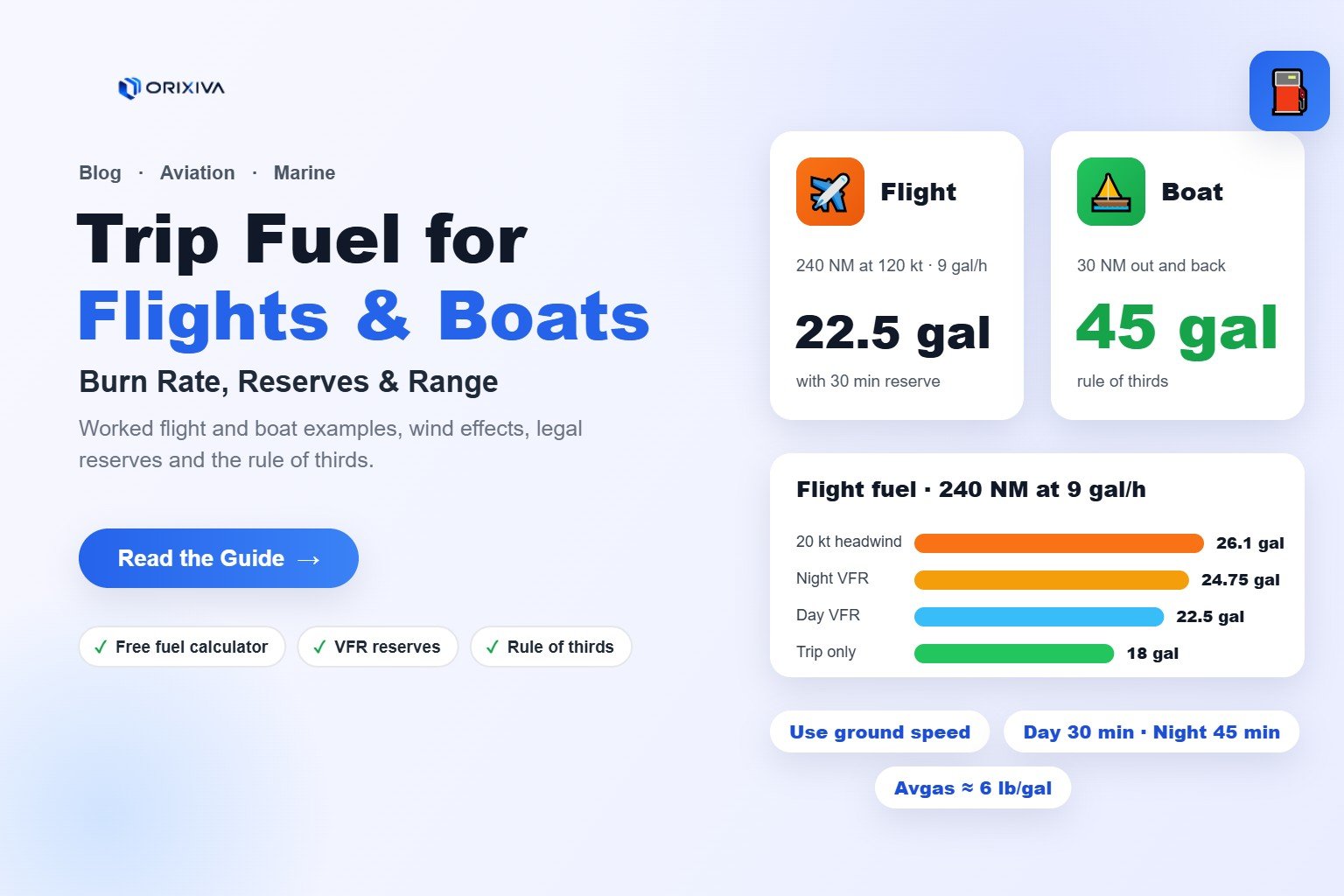
Short answer: Fuel needed = trip time × fuel burn per hour, plus a reserve. Trip time = distance ÷ ground speed. A 240 nautical mile flight at 120 knots takes 2 hours; at 9 US gallons per hour that is 18 gallons, plus a 30-minute day VFR reserve of 4.5 gallons, so you need at least 22.5 gallons before taxi and climb. For boats, a common rule is to plan one third of fuel out, one third back and keep one third in reserve. The free Orixiva aviation and marine fuel calculator does all of this in one page.
Key takeaways
- Use ground speed, not airspeed or boat speed through the water, to work out trip time.
- Headwinds and currents add time, and every extra minute burns fuel.
- US VFR rules require at least 30 minutes of reserve by day and 45 minutes at night for airplanes.
- Boats burn far more fuel above hull speed, so a small slowdown can extend range a lot.
- Fuel is planned by volume but limited by weight: avgas weighs about 6 lb per US gallon.
The trip fuel formula
- Trip time: distance ÷ ground speed. 240 NM ÷ 120 kt = 2.0 hours.
- Trip fuel: time × burn rate. 2.0 h × 9 gal/h = 18 gallons.
- Reserve: reserve time × burn rate. 30 min × 9 gal/h = 4.5 gallons.
- Extras: add fuel for start, taxi, climb and any planned holding or diversion.
- Total: trip + reserve + extras, then check it against tank capacity and weight.
Shortcut: the Fuel Consumption and Fuel Reserve tools in the aviation fuel calculator work out trip fuel, endurance, reserve and cost from your own burn rate.
Flight example with legal reserves
A light aircraft burning 9 US gallons per hour flies 240 nautical miles at a ground speed of 120 knots.
| Item | Day VFR | Night VFR |
|---|---|---|
| Trip time | 2 h 00 min | 2 h 00 min |
| Trip fuel at 9 gal/h | 18.0 gal | 18.0 gal |
| Minimum reserve | 30 min = 4.5 gal | 45 min = 6.75 gal |
| Minimum fuel before taxi and climb | 22.5 gal | 24.75 gal |
| Weight of avgas (about 6 lb/gal) | about 135 lb | about 149 lb |
Under US rule 14 CFR 91.151, airplanes flying VFR must be able to reach the first intended landing point plus 30 minutes at normal cruise by day, or 45 minutes at night; helicopters need 20 minutes. IFR flights need enough to reach the destination and alternate plus 45 minutes. These are legal minimums, and many pilots plan to land with an hour of fuel.
How wind changes your fuel
Fuel burn per hour stays about the same, but a headwind slows you over the ground, so the trip takes longer. With a true airspeed of 120 knots and a 20-knot headwind, ground speed drops to 100 knots:
- Trip time: 240 ÷ 100 = 2.4 hours instead of 2.0.
- Trip fuel: 2.4 × 9 = 21.6 gallons instead of 18.
- With the 30-minute reserve: 26.1 gallons, 3.6 more than in still air.
The Flight Time tool includes a wind component so you can see this before you go. Currents do the same for boats: a 2-knot current against you at 10 knots means 8 knots over the ground and 25% more time.
Boat fuel and the rule of thirds
The best figure is your own measured burn rate at cruise. If you do not have one, a rough rule of thumb at wide-open throttle is horsepower ÷ 10 = gallons per hour for gasoline engines and about horsepower × 0.06 for diesels. A 150 hp gasoline outboard can use around 15 gallons an hour flat out, and much less at a moderate cruise.
Example: a 30 nautical mile run at 20 knots takes 1.5 hours. At a cruise burn of 10 gallons per hour that is 15 gallons each way. Using the common rule of thirds (one third out, one third back, one third reserve), the 30 gallons you expect to use for the round trip should be no more than two thirds of what you carry, so plan for 45 gallons on board.
Above hull speed, fuel burn climbs fast. A displacement boat pushed past its hull speed can burn far more fuel for very little extra speed. Slowing down a few knots is often the easiest way to add range.
Units and conversions
| From | To | Multiply by |
|---|---|---|
| Nautical miles | Kilometres | 1.852 |
| Nautical miles | Statute miles | 1.1508 |
| Knots | km/h | 1.852 |
| US gallons | Litres | 3.785 |
| Imperial gallons | Litres | 4.546 |
| Avgas, US gallons | Pounds | about 6.0 |
| Jet A, US gallons | Pounds | about 6.7 |
Fuel density changes with temperature, so heavy aircraft plan by weight. The Nautical Converter in the calculator handles distance and speed units, and the Fuel Consumption tool accepts litres, US and imperial gallons, kilograms and pounds.
Fuel planning mistakes to avoid
- Using airspeed instead of ground speed for trip time.
- Forgetting start, taxi and climb fuel, which can be a gallon or more in a light aircraft.
- Mixing US and imperial gallons or litres and gallons in the same plan.
- Trusting the gauge alone. Check tanks visually and keep a fuel log.
- Planning to land with only the legal minimum when weather or traffic could hold you up.
Plan your next trip in one minute
Fuel consumption, flight time with wind, boat speed, ETA, fuel reserve and nautical conversions. Free, private and no sign-up.
Open the aviation and marine fuel calculator →Planning aid only. Always follow your aircraft flight manual or vessel documentation, official charts, weather briefings and the rules that apply where you operate.
Frequently asked questions
How do I calculate fuel for a flight?
Divide distance by ground speed to get flight time, multiply by your fuel burn per hour for trip fuel, then add the required reserve and fuel for start, taxi and climb. 240 NM at 120 knots and 9 gal/h needs 18 gallons plus a 4.5-gallon day VFR reserve.
What fuel reserve is required for VFR flight?
In the US, 14 CFR 91.151 requires airplanes to carry enough fuel to reach the first intended landing point plus 30 minutes at normal cruise by day and 45 minutes at night. Helicopters need 20 minutes. Other countries have similar rules.
How does wind affect fuel burn?
Fuel burn per hour stays about the same, but a headwind lowers ground speed so the trip takes longer and uses more fuel. A 20-knot headwind on a 120-knot aircraft adds 24 minutes and 3.6 gallons to a 240 NM trip at 9 gal/h.
How much fuel does a boat use per hour?
Measure your own rate at cruise if you can. As a rough rule at full throttle, gasoline engines use about horsepower divided by 10 in US gallons per hour and diesels about horsepower x 0.06, so a 150 hp gasoline outboard uses around 15 gallons an hour flat out.
What is the rule of thirds for boat fuel?
Plan to use one third of your fuel going out, one third coming back and keep one third in reserve. If a round trip will use 30 gallons, carry at least 45.
How much does a gallon of avgas weigh?
About 6 pounds per US gallon, and Jet A about 6.7 pounds. Density changes with temperature, so check your aircraft documents for weight and balance.
Can I use this calculator for official flight planning?
No. It is a planning aid for estimates and training. Always follow your aircraft flight manual or vessel documentation, official weather and charts and the regulations that apply to you.
Over to you
What burn rate do you plan with for your aircraft or boat, and how much reserve do you like to land with? Share it in the comments to help other pilots and boaters. Comments are reviewed before they appear.
Related guides and tools
- Aviation and marine fuel calculator: 7 tools in one page
- Unit converter for distance, volume and weight
- EV vs petrol: real running cost per kilometre
- Car calculator: fuel economy and trip cost
- Date and time calculator for arrival times
Sources: eCFR: 14 CFR 91.151 fuel requirements for flight in VFR conditions · Boating Magazine: calculating boat fuel consumption.