Try our free AI tools – no sign-up needed!


Fuel Calculator Free Online: MPG to L/100km, US vs UK MPG and Trip Fuel Cost
Need the number now? The free fuel economy converter changes MPG to L/100km, km/L, US MPG and UK MPG instantly, with no signup or login and the formula shown.
Jump to the free tool ↓An American review says 35 MPG, a British one says 42 MPG, a European brochure says 6.7 L/100km and a dealer in Asia says 15 km/L. They might all describe the same car. If you have searched for how to use a fuel calculator free online without login, the challenge is not the arithmetic: it is knowing that fuel economy units work in opposite directions and that a US gallon is smaller than a UK gallon.
This guide explains each fuel economy unit, shows how to convert MPG to L/100km by hand, and works through trip cost and comparison examples. You can check every answer with the free Orixiva fuel economy converter, which runs in your browser without signup, sign-in or login and shows the formula for each step.
Key takeaways
- MPG and km/L measure distance per fuel (higher is better); L/100km measures fuel per distance (lower is better).
- L/100km = 235.215 ÷ US MPG, or 282.481 ÷ UK MPG.
- A UK (imperial) gallon is about 20% bigger, so UK MPG is about 20% higher than US MPG for the same car.
- L/100km = 100 ÷ km/L. 15 km/L is 6.67 L/100km.
- The Orixiva fuel economy converter handles all four units and shows the two-step formula it used.
The four fuel economy units
L/100km
Litres of fuel used per 100 km. Europe, Australia, Canada and many other countries. Lower is better.
km/L
Kilometres per litre. Common in India, Japan, Pakistan and parts of Latin America. Higher is better.
US MPG
Miles per US gallon (3.785 L). Used in the United States. Higher is better.
UK MPG
Miles per imperial gallon (4.546 L). Used in the UK, even though fuel is sold in litres there. Higher is better.
Why fuel economy is not a simple multiplier
Length or weight conversions multiply by a fixed factor. Fuel economy does not, because L/100km is fuel per distance while MPG and km/L are distance per fuel. One is the inverse of the other, so the conversion divides:
L/100km = 100 ÷ km/L · km/L = 100 ÷ L/100km
In practice this means you should never look for a single “multiply by” factor between MPG and L/100km. The constants 235.215 and 282.481 are divided by the figure you have, and the same constant works in both directions.
That is why doubling MPG does not halve the number in the same way you might expect, and why the Orixiva converter shows its working in two steps: first to km/L, then to the target unit.
How to convert MPG to L/100km
L/100km = 235.215 ÷ US MPG · L/100km = 282.481 ÷ UK MPG
- Check whether the MPG figure is US or UK.
- Divide 235.215 (US) or 282.481 (UK) by the MPG.
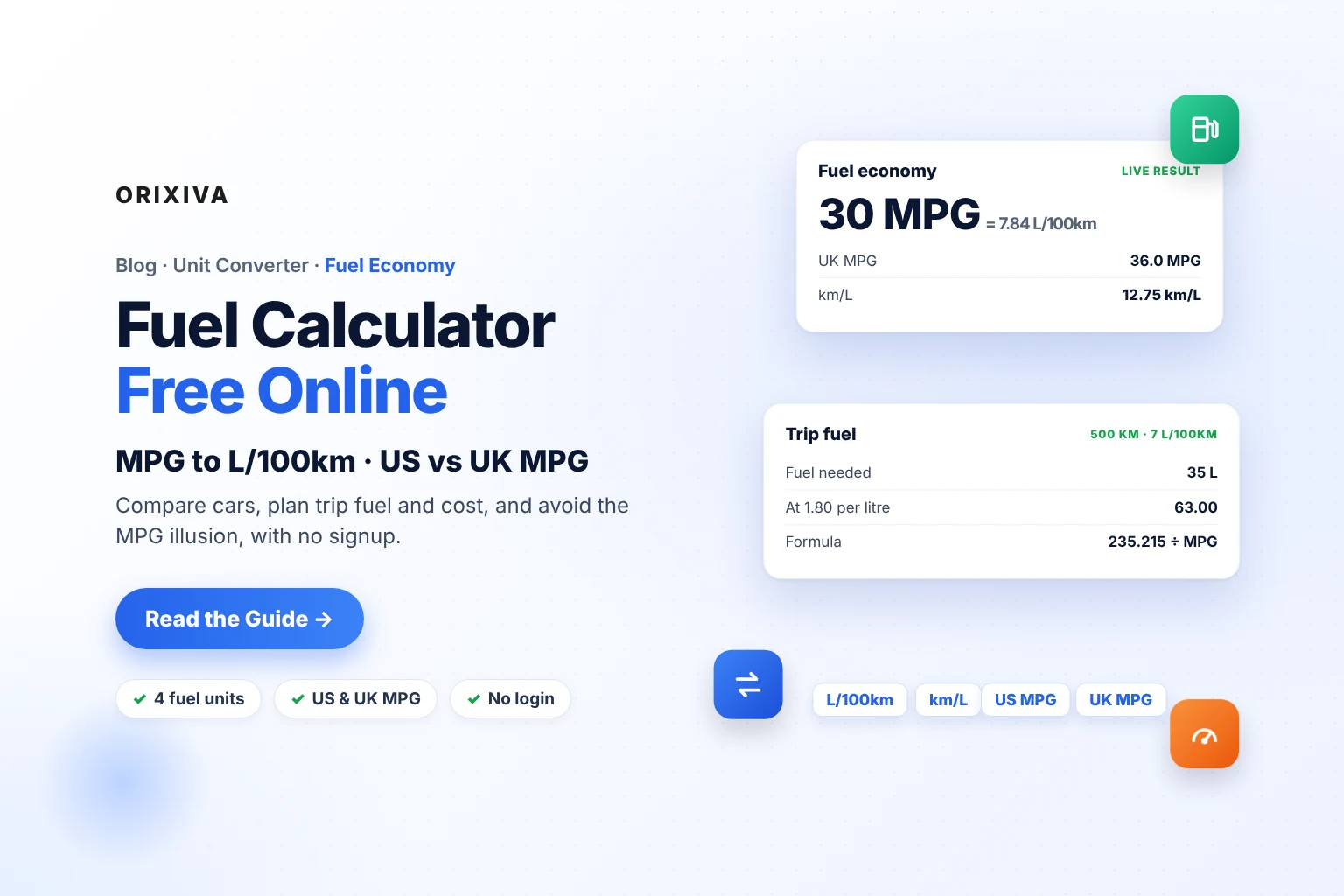
- Round to one or two decimals. 30 US MPG = 235.215 ÷ 30 = 7.84 L/100km.
- 25 US MPG = 9.41 L/100km.
- 40 US MPG = 5.88 L/100km.
- 40 UK MPG = 7.06 L/100km.
- 50 UK MPG = 5.65 L/100km.

How to convert L/100km to MPG
US MPG = 235.215 ÷ L/100km · UK MPG = 282.481 ÷ L/100km
- 5 L/100km = 47.0 US MPG = 56.5 UK MPG.
- 7 L/100km = 33.6 US MPG = 40.4 UK MPG.
- 10 L/100km = 23.5 US MPG = 28.2 UK MPG.
km/L to L/100km
Divide 100 by km/L. A car rated 15 km/L uses 100 ÷ 15 = 6.67 L/100km, which is 35.3 US MPG.
US MPG vs UK MPG
A UK gallon is 4.546 litres and a US gallon is 3.785 litres, so the same car travels further on a UK gallon. UK MPG is about 1.2 times US MPG:
Same car, two MPG figures
A car using 7 L/100km, shown in each unit.
US MPG3.785 L gallon
33.6 MPG
UK MPG4.546 L gallon
40.4 MPG
km/Lmetric
14.3 km/L
UK MPG = US MPG × 1.201. Always check which gallon a review uses.
Comparing reviews from different countriesA British review quoting 50 MPG and an American one quoting 42 MPG may describe almost the same efficiency. Convert both to L/100km before deciding.
Flowchart: which unit is my fuel figure in?
- Read the fuel economy figureBrochure, review, dashboard or trip computer
- Is it “per 100 km”?YesL/100km: lower is betterNoDistance per fuel: higher is better
- Is it miles per gallon?From the USUS MPG (3.785 L)From the UKUK MPG (4.546 L)
- Is it km per litre?L/100km = 100 ÷ km/L
- Convert all cars to one unitL/100km makes fuel use and cost easy to compare
The MPG illusion: why L/100km is easier to compare
Because MPG is distance per fuel, equal MPG gains do not save equal fuel. The US government’s fueleconomy.gov label guide gives the example: over 1,000 miles, going from 10 to 15 MPG saves about 33 gallons, but going from 30 to 35 MPG saves only about 5.
Fuel used over 1,000 miles
In US gallons. Gallons = 1,000 ÷ MPG.
10 MPG
100.0 gal
15 MPG
66.7 gal
30 MPG
33.3 gal
35 MPG
28.6 gal
Upgrading the 10 MPG vehicle saves far more fuel than upgrading the 30 MPG one.
L/100km avoids this trap: it grows in a straight line with fuel used, so a car at 6 L/100km really uses half the fuel of one at 12 L/100km over the same distance.
How to calculate trip fuel and cost
fuel (L) = distance (km) × L/100km ÷ 100 · cost = fuel × price per litre
Example: a 500 km road tripYour car uses 7 L/100km. Fuel = 500 × 7 ÷ 100 = 35 litres. At 1.80 per litre, the trip costs 63.00 in fuel. In the US: 300 miles at 30 MPG uses 10 gallons; at $3.50 per gallon that is $35.
- Convert your car’s figure to L/100km (or MPG if you work in miles and gallons).
- Multiply by the trip distance in the matching unit.
- Multiply by the fuel price per litre or gallon.
- Add 10–15% for traffic, air conditioning and hills.
Comparing petrol with electric running costs? See EV vs petrol running cost per kilometre. For flights and boats, the trip fuel guide uses burn rates instead of MPG, and the volume calculator guide converts litres and gallons.
What changes your real fuel use
Official figures come from standard tests. On the road, these make the biggest difference:
- Speed: air resistance rises steeply with speed, so motorway driving at high speed uses noticeably more fuel.
- Driving style: hard acceleration and braking waste fuel; smooth driving saves it.
- Tyre pressure: under-inflated tyres increase rolling resistance. Our pressure calculator guide converts psi, bar and kPa.
- Load and roof racks: extra weight and drag add consumption.
- Air conditioning and short trips: cold engines and A/C both raise fuel use.
Measure your own figure with the fill-up method
- Fill the tank completely and reset the trip meter.
- Drive normally until the tank is at least half empty.
- Fill up again and note the litres added and the distance driven.
- L/100km = litres ÷ km × 100. For example, 42 L over 600 km = 7.0 L/100km.
How far can you go on a full tank?
range (km) = tank size (L) ÷ L/100km × 100
| 40 L tank at | Range |
|---|---|
| 5 L/100km | 800 km |
| 7 L/100km | 571 km |
| 10 L/100km | 400 km |
Plan to refuel well before the tank is empty; the last part of a tank is a safety reserve, not usable range. Many cars also let you switch the trip computer between L/100km, km/L and MPG in the settings menu, which is quicker than converting by hand while driving.
Converting fuel prices between litres and gallons
To compare prices across countries, convert the price, not only the economy. $3.50 per US gallon is $3.50 ÷ 3.785 = $0.92 per litre. A UK price of £1.45 per litre is £1.45 × 4.546 = £6.59 per imperial gallon. The volume calculator guide explains the gallon sizes.
Example: yearly fuel cost of two cars
Converting both cars to L/100km makes the comparison simple:
| Car A | Car B | |
|---|---|---|
| Fuel economy | 7.0 L/100km (33.6 US MPG) | 5.5 L/100km (42.8 US MPG) |
| Distance per year | 15,000 km | 15,000 km |
| Fuel per year | 1,050 L | 825 L |
| Cost at 1.80 per litre | 1,890 | 1,485 |
Car B saves 225 litres, or 405 a year at that price. Over five years, that is 2,025 before any change in fuel prices.
Hybrids, EVs and MPGe
Electric cars do not burn fuel, so their efficiency is shown differently: kWh per 100 km (or per 100 miles) in most countries, and MPGe (miles per gallon equivalent) on US labels. MPGe treats 33.7 kWh of electricity as equal to the energy in one US gallon of gasoline. The fuel economy converter handles liquid-fuel units; for kWh, use the energy converter, and for running cost per kilometre see EV vs petrol.
Fuel economy conversion chart
| L/100km | km/L | US MPG | UK MPG |
|---|---|---|---|
| 4 | 25.0 | 58.8 | 70.6 |
| 5 | 20.0 | 47.0 | 56.5 |
| 6 | 16.7 | 39.2 | 47.1 |
| 7 | 14.3 | 33.6 | 40.4 |
| 8 | 12.5 | 29.4 | 35.3 |
| 10 | 10.0 | 23.5 | 28.2 |
| 12 | 8.3 | 19.6 | 23.5 |
| 15 | 6.7 | 15.7 | 18.8 |

How to use the free fuel economy converter (step by step)
- Open the fuel converter. Go to the Orixiva fuel economy converter. It opens on 8 L/100km to US MPG. No signup or login is needed.
- Type your figure. Enter a value such as 35 or 6.7. Values must be greater than zero; the converter shows a clear message otherwise.
- Choose From and To units. Litres per 100 km, kilometres per litre, miles per US gallon or miles per imperial gallon.
- Read the result. It updates as you type and shows your figure in all four units in the table.
- Check the formula. “How it was calculated” shows both steps, for example km/L = US mpg × 0.425144, then L/100 km = 100 ÷ (km/L).
- Save or share. Swap units, copy the result, download TXT or print. Press Convert to keep it in Recent conversions and export the list as CSV.
So, how to use a fuel calculator free online without signup or login? Open the converter on any PC or phone browser and type: there is no account, nothing to install, and nothing is uploaded.
How to convert fuel economy in Excel or Google Sheets
Spreadsheet unit functions do not include fuel economy, so use the formulas directly. They work in any spreadsheet:
| Conversion | Formula |
|---|---|
| US MPG to L/100km | =235.215/A2 |
| UK MPG to L/100km | =282.481/A2 |
| L/100km to US MPG | =235.215/A2 |
| km/L to L/100km | =100/A2 |
| US MPG to UK MPG | =A2*1.20095 |
| Trip litres (km in B2, L/100km in C2) | =B2*C2/100 |
The same constant converts both ways because the relationship is an inverse: if 235.215 ÷ 30 = 7.84, then 235.215 ÷ 7.84 = 30.
Mistakes to avoid with fuel economy
Multiplying instead of dividing
L/100km and MPG are inverses. Multiplying 30 MPG by any factor cannot give the right L/100km.
Mixing US and UK MPG
The 20% gap can make a car look much better or worse than it is.
Comparing official figures with real driving
Lab test cycles differ between regions, and real-world use is often higher. Compare cars using figures from the same test standard.
Averaging MPG across trips
For an overall figure, divide total distance by total fuel. Averaging the MPG of each trip gives the wrong answer.
Forgetting tank size
Range = tank litres ÷ L/100km × 100. A 50 L tank at 7 L/100km gives about 714 km; keep a reserve.
Your turn: What does your car really use: L/100km, km/L or MPG? Share your car and figure in the comments to help other readers compare.
Use the free fuel calculator online now
Convert MPG to L/100km, km/L, US and UK MPG, see the two-step formula and copy the working. Free, without signup or login, and nothing leaves your browser.
Open the free fuel economy converter → Looking for another converter or calculator? Search on orixiva.comRelated guides: speed calculator online, power calculator free online, km to miles and length conversion and the automotive and transport calculators.
Fuel calculator questions people often ask
How do I use a fuel calculator free online without login?
Open the Orixiva fuel economy converter, type your figure and pick the units. It is free and needs no signup, sign-in or login.
How do I convert MPG to L/100km?
Divide 235.215 by US MPG, or 282.481 by UK MPG. 30 US MPG = 7.84 L/100km.
Is UK MPG different from US MPG?
Yes. A UK gallon is about 20% larger, so UK MPG is about 1.2 times US MPG for the same car.
Is a lower L/100km better?
Yes. L/100km is fuel used per distance, so lower means less fuel. For MPG and km/L, higher is better.
What is 6 L/100km in MPG?
39.2 US MPG or 47.1 UK MPG.
How do I convert km/L to L/100km?
Divide 100 by km/L. 20 km/L is 5 L/100km.
How much fuel will my trip use?
Multiply distance in km by L/100km and divide by 100. 400 km at 6 L/100km uses 24 litres.
How do I calculate my car’s real fuel economy?
Fill the tank, drive, refill, then divide the litres added by the km driven and multiply by 100 to get L/100km.
Does the converter work for motorbikes and trucks?
Yes. The units are the same for any vehicle that burns liquid fuel, from scooters to lorries. Just make sure the figure you enter uses the same gallon or litre basis as the source.
What is 30 MPG in km/L?
30 US MPG × 0.425 = 12.75 km/L. For 30 UK MPG it is 10.6 km/L.
Do diesel and petrol cars use the same units?
Yes. Both are measured in L/100km, km/L or MPG. Diesel holds more energy per litre, so diesel cars often show lower L/100km figures.
Can I convert km/L to UK MPG?
Yes. Divide km/L by 0.354. For example, 15 km/L is about 42.4 UK MPG.
What is 50 UK MPG in L/100km?
282.481 ÷ 50 = 5.65 L/100km, which is about 41.6 US MPG.
Why does the UK use MPG when fuel is sold in litres?
Mostly tradition: road distances are in miles and many drivers still think in miles per gallon, so UK MPG remains common in reviews and adverts.
How far can I drive on a full tank?
Divide the tank size in litres by your L/100km and multiply by 100. A 50 L tank at 6 L/100km gives about 833 km, but keep a reserve.
What is MPGe?
Miles per gallon equivalent, used for electric cars in the US. It counts 33.7 kWh of electricity as one gallon of gasoline.
Why does the converter show an error for zero?
Fuel economy must be greater than zero; a car cannot travel any distance on zero fuel, and the inverse formula would divide by zero.