Try our free AI tools – no sign-up needed!


Pressure Calculator Online Free: PSI to Bar, kPa, Tyre Pressure and P = F ÷ A
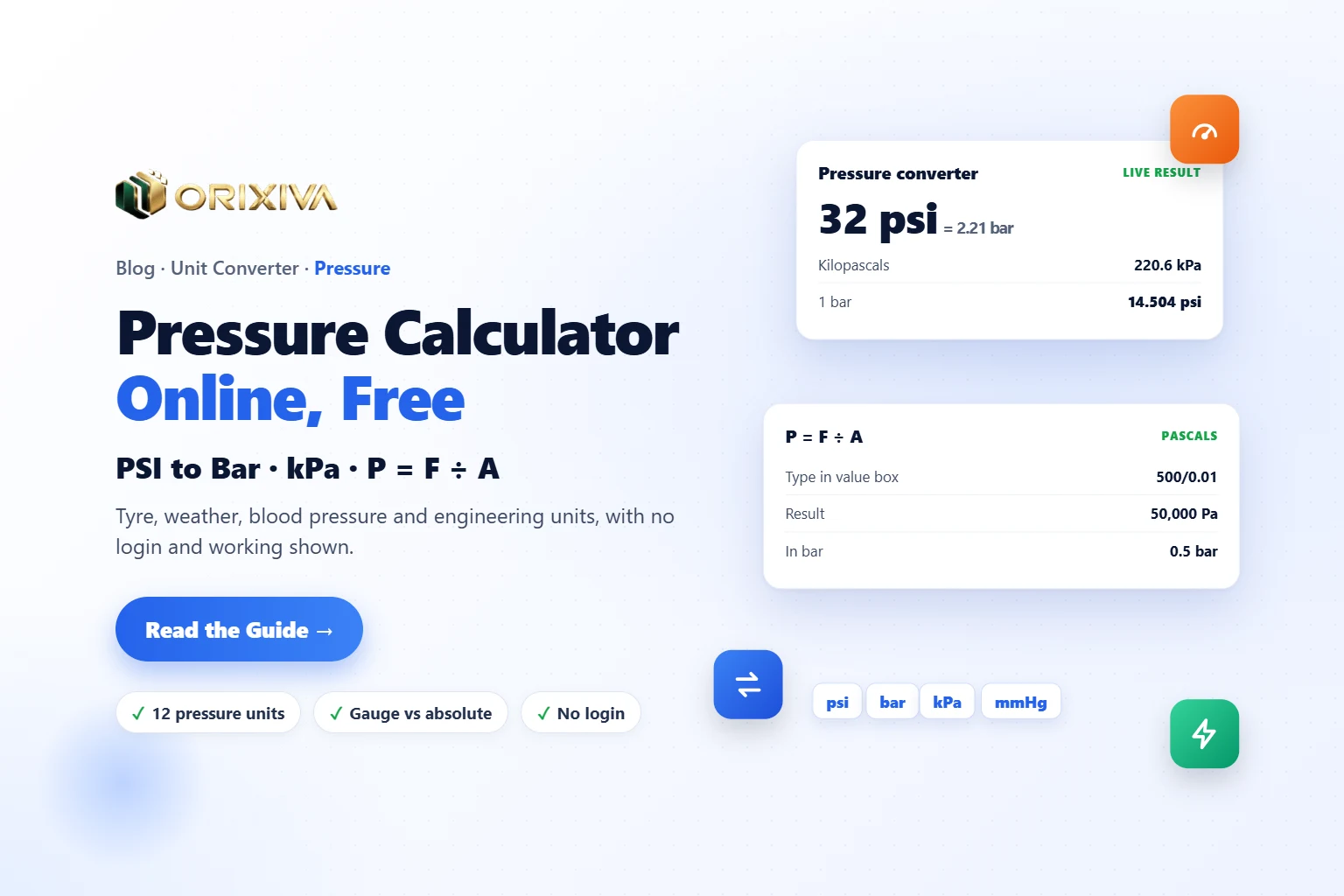
Need the number now? The free pressure converter changes psi to bar, kPa, atm, mmHg and 7 more units instantly, with no login and the working shown.
Jump to the free tool ↓Your car manual says 2.3 bar but the air pump at the petrol station shows psi. A weather app gives hPa, a blood-pressure monitor reads mmHg and a pressure washer is rated in psi. A free pressure calculator online turns any of these into the unit you need, and the formula P = F ÷ A tells you where pressure comes from in the first place.
This guide covers both: how to calculate pressure from force and area, and how to convert between psi, bar, kPa, atm and the other common units, with tyre, weather, health and engineering examples. Check every answer in the free Orixiva pressure converter, which works free and without login, and shows all 12 pressure units at once.
Key takeaways
- Pressure = force ÷ area (P = F ÷ A). 1 pascal (Pa) = 1 newton per square metre.
- 1 bar = 100 kPa = 14.504 psi. 1 psi = 6.895 kPa.
- 1 standard atmosphere = 101.325 kPa = 1.01325 bar = 14.696 psi = 760 mmHg.
- Tyre pressures are gauge pressures: 32 psi = 2.21 bar = 221 kPa above the surrounding air.
- The Orixiva pressure converter covers Pa, hPa, kPa, MPa, bar, mbar, atm, psi, mmHg, inHg, Torr and kgf/cm².
How to calculate pressure: P = F ÷ A
pressure (Pa) = force (N) ÷ area (m²) · F = P × A · A = F ÷ P
Pressure is force spread over an area. The same force on a smaller area gives a higher pressure, which is why a knife cuts and snowshoes don’t sink.
- Find the force in newtons. A mass in kg pushes down with about mass × 9.81 N. A 61 kg person weighs about 600 N.
- Find the area in square metres. 1 cm² = 0.0001 m².
- Divide. The answer is in pascals. Convert to kPa, bar or psi as needed.
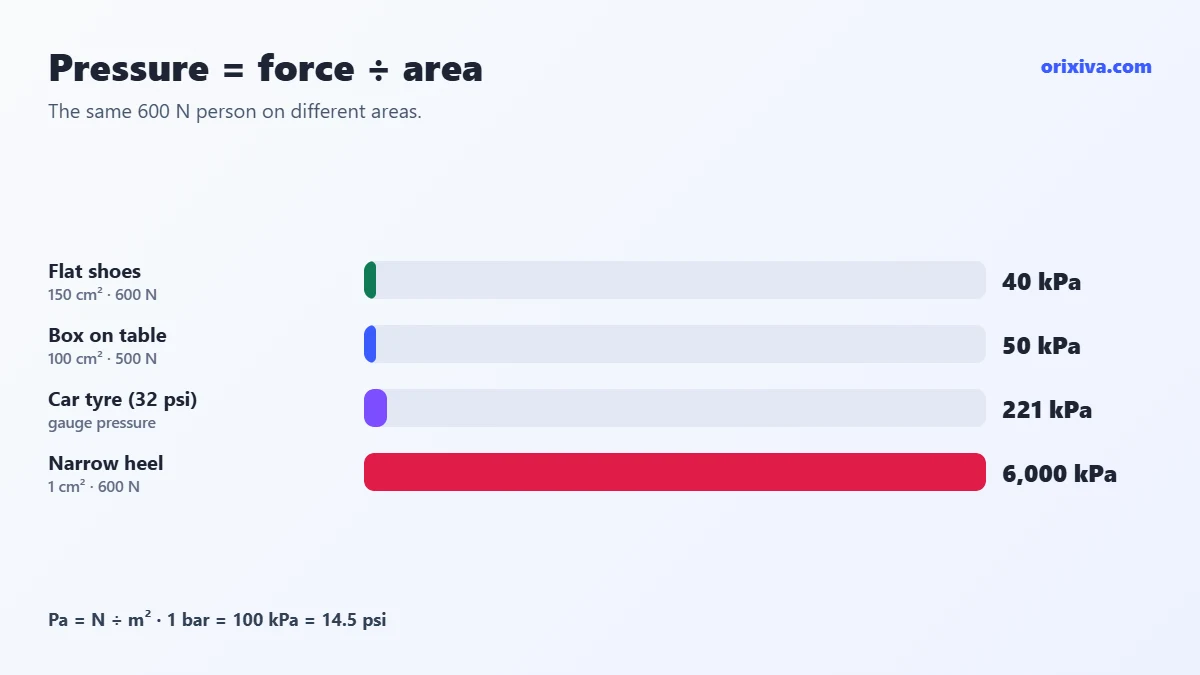
| Example | Force | Area | Pressure |
|---|---|---|---|
| Box on a table | 500 N | 0.01 m² (10 × 10 cm) | 50,000 Pa = 50 kPa |
| Person on flat shoes | 600 N | 0.015 m² (150 cm²) | 40 kPa = 5.8 psi |
| Person on one narrow heel | 600 N | 0.0001 m² (1 cm²) | 6 MPa = 870 psi |
Use the converter as a pressure calculatorChoose pascal as the From unit and type the division directly, for example
600/0.0001. Set To as psi or bar to see 870.2 psi or 60 bar. For more physics, the electrical and physics calculator includes a Pressure & Hydrostatics tool.Pressure units explained
Pascal family
Pa, hPa, kPa, MPa. SI units. Weather uses hPa; tyres and engineering often use kPa or MPa.
Bar and mbar
1 bar = 100,000 Pa, close to air pressure at sea level. Tyres in Europe and Asia; 1 mbar = 1 hPa.
PSI
Pounds per square inch. Tyres, compressors and pressure washers in the US and UK.
mmHg, inHg, Torr
Based on a mercury column. Blood pressure (mmHg), US weather (inHg) and vacuum work (Torr).
Atmosphere (atm)
Standard sea-level air pressure: 101,325 Pa. Used in chemistry and diving.
kgf/cm²
Kilogram-force per square centimetre (about 0.98 bar). Seen on older gauges and some equipment in Asia.
Which units do different fields use?
- Cars and bikes: psi in the US and UK, bar in much of Europe and Asia, kPa in Canada and Australia.
- Weather and aviation: hPa (mbar) in most countries; inHg on US altimeters and forecasts.
- Medicine: mmHg for blood pressure; kPa in some lung and blood-gas tests.
- Hydraulics and industry: bar, MPa and psi; kgf/cm² on older equipment.
- Science: pascals and atmospheres.
Reading a gauge with two scales
Many tyre and compressor gauges show psi on the outer ring and bar or kPa on the inner ring. Read the scale that matches your manual, or read one scale and convert it. If the two scales on a cheap gauge disagree with the converter, trust the converter and consider a better gauge.
How to convert psi to bar (and bar to psi)
bar = psi ÷ 14.504 · psi = bar × 14.504 · kPa = psi × 6.895
- 32 psi = 2.21 bar = 220.6 kPa.
- 2.5 bar = 36.3 psi = 250 kPa.
- 100 psi (air compressor) = 6.89 bar.
- 3,000 psi (scuba tank) = 206.8 bar.
Quick estimate: psi ÷ 14.5 = bar, and bar × 14.5 = psi. For kPa, bar × 100 is exact.
Tyre pressure examples: psi, bar and kPa
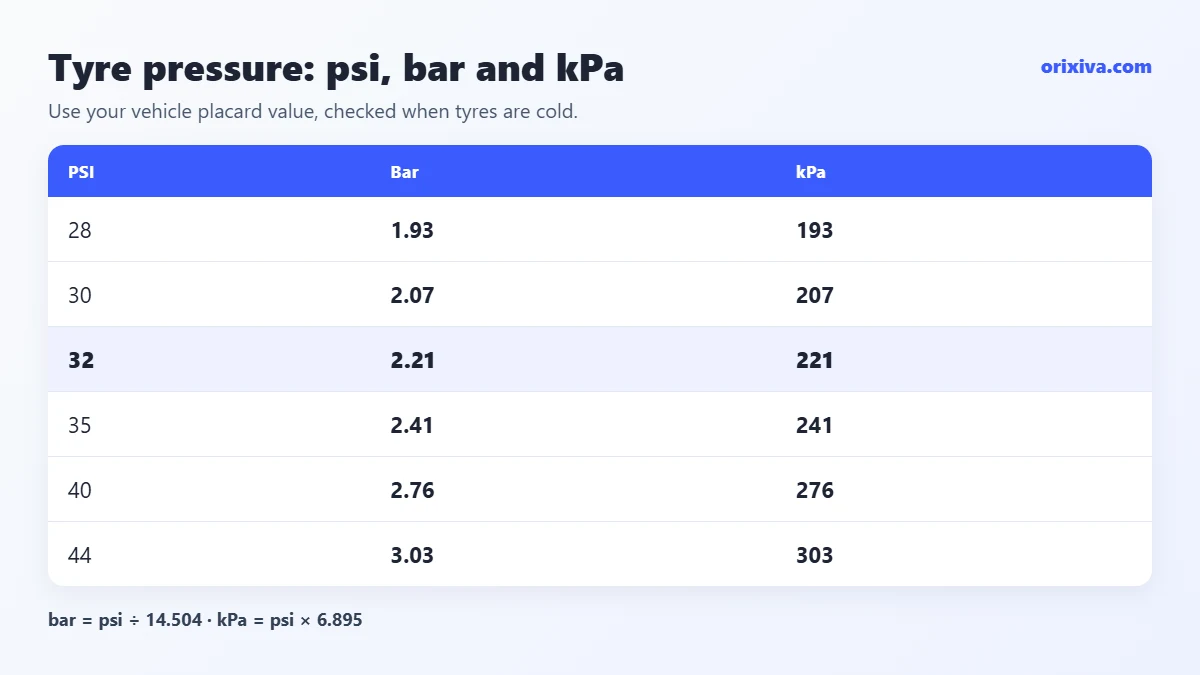
Car tyres in the US are usually labelled in psi, in Europe in bar and in Canada and Australia often in kPa. Use the recommended pressure from your vehicle’s placard (often on the driver’s door frame) or owner’s manual, not the maximum printed on the tyre sidewall.
| PSI | Bar | kPa | Typical use |
|---|---|---|---|
| 28 | 1.93 | 193 | Some small cars |
| 30 | 2.07 | 207 | Small and mid-size cars |
| 32 | 2.21 | 221 | Common car setting |
| 35 | 2.41 | 241 | Many sedans and SUVs |
| 40 | 2.76 | 276 | Loaded vehicles, some SUVs |
| 44 | 3.03 | 303 | Light trucks, vans |
Typical ranges only. Your vehicle’s placard is the right value.
Example: a European manual in a US stationThe manual says 2.3 bar front. 2.3 × 14.504 = 33.4 psi, so set the pump to 33 psi. The US NHTSA advises checking pressure at least once a month when the tyres are cold.
Why tyre pressure changes with temperature
Air pressure in a closed tyre rises and falls with temperature. As a rough guide, a tyre loses about 1 psi (about 0.07 bar) for every 10 °F (about 5.6 °C) drop in air temperature. A tyre set to 35 psi on a warm afternoon can read close to 32 psi on a cold morning, so check and adjust when the seasons change.
Flowchart: gauge or absolute pressure?
- You have a pressure readingTyre, tank, boiler, weather or lab
- Does the gauge read 0 when open to the air?YesGauge pressure (psig, barg)NoAbsolute pressure (psia, bara)
- Is it for a gas-law or chemistry formula?YesUse absolute: gauge + about 101.3 kPaNoKeep it as written
- Convert the unitsThe converter converts as written; it does not add air pressure
- Label the answer clearlyFor example “2.2 bar (gauge)”
Engineers often add a letter to make this clear: psig or barg for gauge pressure and psia or bara for absolute pressure. If a specification does not say which, ask before you convert or compare.
Tyre, compressor and boiler gauges show gauge pressure: how much the pressure is above the surrounding air. Weather and lab readings are usually absolute.
Weather, altitude and diving
Air pressure in weather reports
Standard sea-level pressure is 1013.25 hPa, which is 29.92 inHg or 760 mmHg. Forecasts in most countries use hPa (the same as mbar); US forecasts often use inHg. A reading of 990 hPa usually means low pressure and unsettled weather; 1030 hPa usually means high pressure and calmer weather.
Altitude
Air pressure falls as you go up. At around 5,500 m it is roughly half of sea-level pressure, which is why climbers and pilots need extra oxygen at high altitude.
Diving
Water is heavy. Every 10 m of seawater adds roughly 1 bar. In fresh water, 10 m adds 98.1 kPa (0.98 bar), close to one extra atmosphere. A diver at 10 m feels about 2 bar absolute: 1 bar of air plus about 1 bar of water.
Blood pressure in mmHg and kPa
Blood pressure is written as two numbers in millimetres of mercury, for example 120/80 mmHg. Some countries and medical papers use kPa:
- 120 mmHg = 16.0 kPa
- 80 mmHg = 10.7 kPa
Not medical adviceThe converter helps you read a number in another unit. Ask a doctor or nurse what your readings mean for you.
Water, cooking and hydrostatic pressure
Hydrostatic pressure: P = ρ × g × h
The pressure at the bottom of a liquid depends on its density (ρ), gravity (g = 9.81 m/s²) and depth (h), not on the shape of the container.
pressure (Pa) = density (kg/m³) × 9.81 × depth (m)
- A 2 m deep water tank: 1,000 × 9.81 × 2 = 19,613 Pa = 19.6 kPa = 2.84 psi at the bottom.
- A water tower 30 m above a tap gives about 294 kPa, or 2.9 bar, which is why towers are built tall.
Home water pressure
Mains water pressure is often quoted in psi in the US and in bar elsewhere. A reading of 40–60 psi is 2.8–4.1 bar. Fittings, pumps and filters list a maximum working pressure, so convert before buying.
Pressure cookers
Many stovetop pressure cookers work at around 15 psi above atmospheric pressure, which is about 1.03 bar or 103 kPa (gauge). The higher pressure raises the boiling point of water, so food cooks faster.
Vacuum
Below atmospheric pressure, units such as mbar, Torr and Pa are common. 1 Torr is almost exactly 1 mmHg (133.3 Pa), and 1 mbar is 100 Pa.
Pressure comparison chart
Everyday pressures compared
In bar, shown on a log-style scale so small values stay visible.
Blood pressure (120 mmHg)
0.16 bar
Sea-level air
1.01 bar
Car tyre (32 psi)
2.21 bar
Road bike tyre (100 psi)
6.9 bar
Pressure washer (1,900 psi)
131 bar
Scuba tank (3,000 psi)
207 bar
Log-style scale: each step to the right is a multiple, not an equal amount. Typical values only.
Every pressure unit in pascals
The converter works by turning your value into pascals, then into the target unit. You can do the same by hand with this table: multiply by the first unit’s value, then divide by the second.
| Unit | Pascals |
|---|---|
| 1 hPa = 1 mbar | 100 |
| 1 Torr | 133.322 |
| 1 mmHg | 133.322 |
| 1 kPa | 1,000 |
| 1 inHg | 3,386.39 |
| 1 psi | 6,894.76 |
| 1 kgf/cm² | 98,066.5 |
| 1 bar | 100,000 |
| 1 atm | 101,325 |
| 1 MPa | 1,000,000 |
Example: 32 psi × 6,894.76 = 220,632 Pa; ÷ 100,000 = 2.21 bar.
PSI to bar conversion chart
| PSI | Bar | kPa | atm |
|---|---|---|---|
| 1 | 0.069 | 6.89 | 0.068 |
| 10 | 0.689 | 68.95 | 0.680 |
| 14.7 | 1.014 | 101.35 | 1.000 |
| 30 | 2.068 | 206.84 | 2.041 |
| 50 | 3.447 | 344.74 | 3.402 |
| 100 | 6.895 | 689.48 | 6.805 |
| 150 | 10.342 | 1,034.21 | 10.207 |
How to convert pressure in Excel or Google Sheets
For a column of readings, use simple factors. They work in every spreadsheet:
| Conversion | Formula |
|---|---|
| psi to bar | =A2*0.0689476 |
| bar to psi | =A2*14.5038 |
| psi to kPa | =A2*6.894757 |
| kPa to bar | =A2/100 |
| Pressure from force (B2, N) and area (C2, m²) | =B2/C2 (pascals) |
How to use the free pressure converter (step by step)
- Open the pressure converter. Go to the Orixiva pressure converter. It opens on 1 bar to psi.
- Type a value or P = F ÷ A. Enter a reading such as 32, or a force-over-area sum in pascals such as
500/0.01. - Choose From and To units. Pascal, hectopascal, kilopascal, megapascal, bar, millibar, standard atmosphere, psi, mmHg, inHg, Torr or kgf/cm².
- Read the result. It updates live, with both rates (1 bar = 14.5038 psi and 1 psi = 0.0689 bar), the scientific form and full precision.
- Check the working. “How it was calculated” shows your value in pascals, then in the target unit.
- Compare all 12 units. One entry shows psi, bar, kPa, atm, mmHg and the rest together.
- Save or share. Swap, copy, download TXT or print. Press Convert to add it to Recent conversions and export as CSV.
The pressure calculator is free online without login. It runs in your browser on PC or phone, and nothing is uploaded.
Mistakes to avoid when converting pressure
Mixing gauge and absolute pressure
A tyre at 2.2 bar gauge is about 3.2 bar absolute. Gas-law and chemistry formulas need absolute pressure.
Using the sidewall maximum
The number on the tyre sidewall is a maximum, not the recommended setting. Use the vehicle placard.
Checking tyres when hot
Driving warms the air inside and raises the reading. Check when the tyres are cold.
Forgetting to use square metres
Force in newtons over area in cm² does not give pascals. Convert cm² to m² (divide by 10,000) first.
Rounding the factor too early
Using 14 instead of 14.504 to turn bar into psi makes a 3 bar reading 42 psi instead of 43.5 psi. For tyres a small difference matters little, but for hydraulic or gas systems keep the full factor and round only the final answer.
Confusing kgf/cm² with bar
They are close but not equal: 1 kgf/cm² = 0.981 bar = 14.22 psi.
Your turn: What pressure unit does your car, bike or gauge use? Share the reading and your country in the comments to help other drivers.
Use the free pressure calculator online now
Convert psi to bar, kPa, atm, mmHg and more, calculate P = F ÷ A in the value box, and copy the working. Free, without login, and nothing leaves your browser.
Open the free pressure converter → Looking for another converter or calculator? Search on orixiva.comRelated guides: Ohm’s law and electricity cost, energy calculator online, Celsius to Fahrenheit and the automotive calculators.
Pressure calculator questions people often ask
Is there a pressure calculator online free without login?
Yes. The Orixiva pressure converter is free, needs no login and works in any browser on PC or phone.
How do I calculate pressure?
Divide force by area: P = F ÷ A. A force of 500 N on 0.01 m² gives 50,000 Pa, which is 50 kPa or 0.5 bar.
How do I convert psi to bar?
Divide psi by 14.504. For example, 35 psi ÷ 14.504 = 2.41 bar.
How many psi is 1 bar?
1 bar is 14.504 psi and exactly 100 kPa.
What is 2.2 bar in psi?
2.2 × 14.504 = 31.9 psi, about 32 psi.
How many kPa is 1 psi?
1 psi is 6.895 kPa.
What is 30 psi in bar?
30 psi ÷ 14.504 = 2.07 bar, or 206.8 kPa.
Why does tyre pressure change in cold weather?
Air contracts as it cools, so the pressure drops. Recheck tyres when the season changes, with the tyres cold.
How many bar is 1 MPa?
1 MPa = 10 bar = 145 psi. Hydraulic systems are often rated in MPa or bar.
How do I convert mmHg to kPa?
Multiply mmHg by 0.1333. For example, 140 mmHg × 0.1333 = 18.7 kPa.
How do I convert kPa to psi?
Multiply kPa by 0.145. For example, 220 kPa × 0.145 = 31.9 psi.
What pressure should my tyres be?
Use the value on your vehicle’s placard or in the owner’s manual, not the maximum on the tyre sidewall, and check when the tyres are cold.
Is a bar the same as an atmosphere?
Almost. 1 atm = 1.01325 bar, so they differ by about 1.3%.
How many hPa are in 1 inHg?
1 inHg = 33.86 hPa, so 30.00 inHg is about 1,016 hPa.
What is standard atmospheric pressure?
101.325 kPa, which equals 1013.25 hPa, 1.01325 bar, 14.696 psi, 29.92 inHg or 760 mmHg.