Try our free AI tools – no sign-up needed!


Speed Calculator Online: How to Calculate Speed and Convert km/h, mph, Knots and Mach
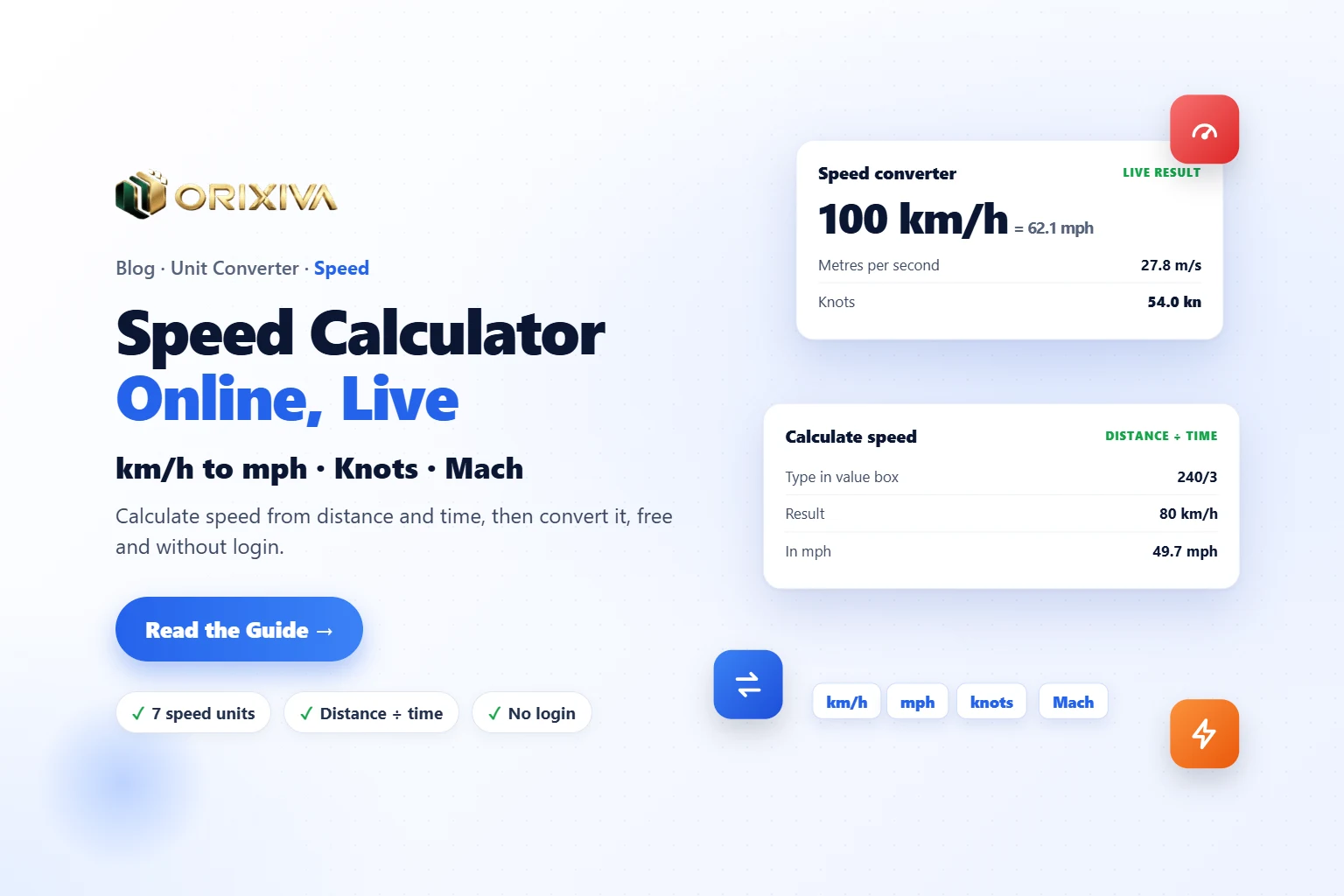
Need the number now? The free speed converter turns km/h into mph, knots, m/s, ft/s and Mach instantly, with no login and the working shown.
Jump to the free tool ↓How fast was that drive? Is 100 km/h legal on a road signed in miles? What does a 25-knot wind feel like? A good speed calculator online answers two kinds of questions: how to calculate speed from distance and time, and how to convert one speed unit into another. This guide covers both, step by step, with real examples for driving, running, sailing, flying and physics homework.
You can check every answer in the free Orixiva speed converter. It works live as you type, free and without login or sign-up, and shows your speed in all seven units at once.
Key takeaways
- Speed = distance ÷ time. 240 km in 3 hours is 80 km/h.
- mph = km/h ÷ 1.609344, and km/h = mph × 1.609344.
- m/s = km/h ÷ 3.6. 1 knot = 1 nautical mile per hour = 1.852 km/h.
- Mach 1 is the speed of sound, which changes with air temperature. The converter uses 340.294 m/s (sea level, 15 °C).
- The Orixiva speed converter covers m/s, km/h, mph, knots, ft/s, Mach and the speed of light, and accepts calculations like 240/3.
How to calculate speed (the basic formula)
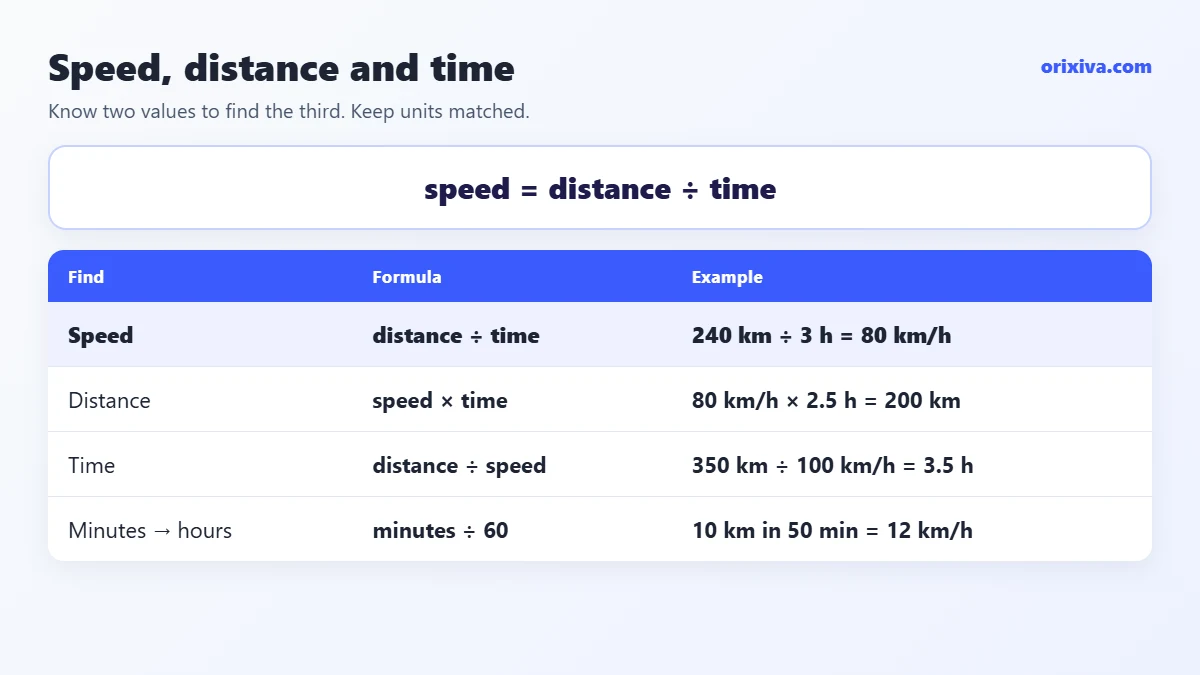
speed = distance ÷ time · distance = speed × time · time = distance ÷ speed
Speed tells you how much distance is covered in a unit of time. To calculate speed online or on paper:
- Write down the distance in one unit, for example 240 km.
- Write down the time in hours (for km/h or mph) or seconds (for m/s). 3 hours.
- Divide distance by time. 240 ÷ 3 = 80 km/h.
- Convert if needed. 80 km/h is 49.7 mph.
Times in minutes
Convert minutes to hours by dividing by 60. A 10 km run in 50 minutes is 10 ÷ (50 ÷ 60) = 10 ÷ 0.833 = 12 km/h. In the converter you can type 10/(50/60) directly with km/h selected, so it works as a speed calculator too.
Example: average speed on a road tripYou drive 150 miles in 2 hours 30 minutes. 150 ÷ 2.5 = 60 mph average. In km/h that is 60 × 1.609 = 96.6 km/h. Stops count: average speed is total distance ÷ total time, including breaks.
Flowchart: speed, distance or time?
- What do you need to find?Speed, distance or time
- Do you know distance and time?YesSpeed = distance ÷ timeNoGo to the next question
- Do you know speed and time?YesDistance = speed × timeNo, speed and distanceTime = distance ÷ speed
- Make the units matchkm with hours for km/h, metres with seconds for m/s
- Convert the result to the unit you needkm/h, mph, knots, m/s or Mach
Average speed vs instantaneous speed
The formula above gives average speed over a whole trip. Your speedometer shows instantaneous speed, the speed at one moment. A car that averages 60 km/h on a city trip may reach 80 km/h on some streets and stop completely at lights.
Speed vs velocity
In physics, speed is how fast something moves; velocity is speed with a direction, such as 20 m/s north. A car driving round a roundabout at a steady 30 km/h has a constant speed but a changing velocity. For everyday conversions, the units are the same.
How to convert km/h to mph (and mph to km/h)
mph = km/h ÷ 1.609344 · km/h = mph × 1.609344
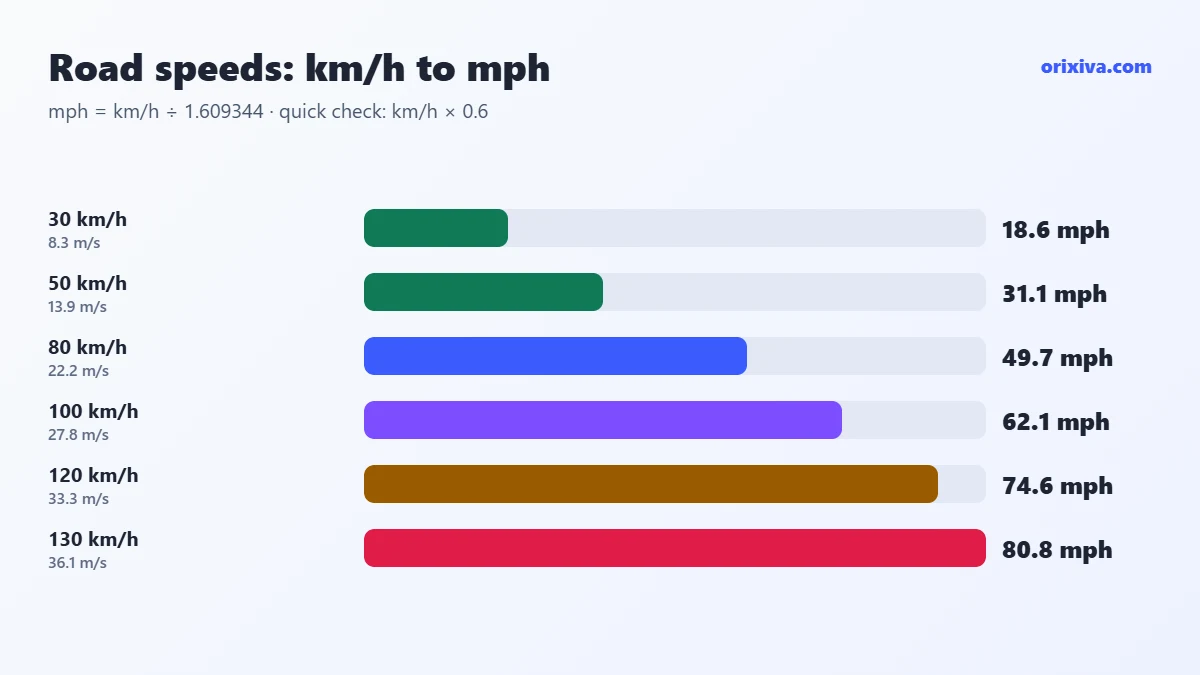
A mile is exactly 1.609344 km, so the same factor converts speed. For a quick estimate, multiply km/h by 0.6 to get mph, or multiply mph by 1.6 to get km/h.
- 50 km/h (common city limit) = 31.1 mph.
- 100 km/h = 62.1 mph.
- 120 km/h (common motorway limit) = 74.6 mph.
- 30 mph = 48.3 km/h.
- 70 mph (UK motorway limit) = 112.7 km/h.
Road signsAlways follow the units on local signs and your speedometer. The UK and US sign in mph; most other countries sign in km/h. Many car speedometers show both scales.
Metres per second and feet per second
m/s = km/h ÷ 3.6 · km/h = m/s × 3.6
Science and engineering use metres per second because it fits SI units. There are 1,000 m in a km and 3,600 s in an hour, and 1,000 ÷ 3,600 = 1 ÷ 3.6.
- A brisk walk of 5 km/h is 1.39 m/s.
- A car at 100 km/h covers 27.8 m every second, which is why following distance matters.
- 1 m/s = 2.24 mph = 3.28 ft/s.
Example: a world-record sprintUsain Bolt ran 100 m in 9.58 s in 2009. Average speed = 100 ÷ 9.58 = 10.44 m/s = 37.6 km/h = 23.4 mph. His top speed during the race was higher than this average.
Knots: speed for boats, wind and aircraft
A knot is one nautical mile per hour. A nautical mile is exactly 1,852 m, so:
1 knot = 1.852 km/h = 1.151 mph = 0.514 m/s
- A 25-knot wind is 46.3 km/h (12.9 m/s), a strong breeze for sailors.
- A ship cruising at 20 knots does 37 km/h.
- Aircraft airspeeds and weather reports use knots in most countries.
Planning a flight or a boat trip? The trip fuel guide shows how speed in knots feeds into fuel and range.
Mach number and the speed of light
Mach is the ratio of a speed to the speed of sound. As NASA explains, the speed of sound depends on the temperature of the air, so it changes with altitude. The Orixiva converter uses the sea-level value at 15 °C: 340.294 m/s, which is about 1,225 km/h or 761 mph.
High-altitude MachAt cruising altitude the air is much colder, so Mach 1 is slower there than at sea level. Treat Mach conversions for aircraft at altitude as estimates.
The converter also includes the speed of light, c = 299,792,458 m/s (about 1.08 billion km/h), which is useful for physics problems and for showing how small everyday speeds are by comparison.
Who uses which speed units?
- Roads: km/h in most countries; mph in the United States and the United Kingdom.
- Sea and air: knots almost everywhere, because nautical miles match latitude on charts.
- Weather: wind may be given in km/h, mph, m/s or knots, depending on the country and the forecast service.
- Science and engineering: m/s, the SI unit.
- Aerospace: Mach numbers for high speeds, together with knots for airspeed.
Very high speeds
The International Space Station orbits at about 7.66 km/s, roughly 27,600 km/h. A point on the equator moves at about 1,670 km/h as the Earth rotates. Numbers this large are easier to read in scientific notation, which the converter can show for you.
Speed comparison chart
Everyday speeds compared
In km/h, with mph. Typical values, not records.
Walking
5 km/h · 3 mph
Cycling
20 km/h · 12 mph
City driving
50 km/h · 31 mph
Motorway
120 km/h · 75 mph
High-speed train
300 km/h · 186 mph
Airliner cruise
≈900 km/h · 560 mph
Mach 1 (sea level)
1,225 km/h · 761 mph
Bars to scale. Airliner speed is approximate and varies by aircraft and wind.
Running pace vs speed
Runners often use pace (minutes per km or per mile) instead of speed. Pace is the inverse of speed:
pace (min/km) = 60 ÷ speed (km/h) · speed (km/h) = 60 ÷ pace (min/km)
- 12 km/h = 5:00 min/km = 7.46 mph.
- 10 km/h = 6:00 min/km.
- A 5:00 min/km pace finishes a 10K in 50 minutes.
The speed converter handles the speed side; for pace, finish times and splits, use the dates, hours and running pace guide.
How long will a trip take?
time = distance ÷ speed
Rearranging the speed formula gives the travel time. The answer comes out in hours as a decimal, so convert the decimal part to minutes by multiplying by 60:
- 350 km at 100 km/h: 350 ÷ 100 = 3.5 h = 3 hours 30 minutes.
- 400 miles at 65 mph: 400 ÷ 65 = 6.15 h = about 6 hours 9 minutes.
- 21.1 km at 10 km/h: 2.11 h = about 2 hours 7 minutes.
The time converter in the same tool turns decimal hours into a days-hours-minutes-seconds breakdown, so 6.15 hours becomes 6 h 9 min automatically. Add time for breaks, traffic and fuel stops on long drives.
Speed in real life: braking, lightning and sport
Distance covered while you react
Speed in m/s shows how far a car travels before the driver even touches the brake. Assuming a 1.5-second reaction time:
Distance travelled during a 1.5 s reaction
Before braking starts. Braking distance comes on top.
50 km/h13.9 m/s
20.8 m
80 km/h22.2 m/s
33.3 m
100 km/h27.8 m/s
41.7 m
120 km/h33.3 m/s
50.0 m
Distance = speed in m/s × 1.5 s. Real reaction times vary from person to person.
How far away is the lightning?
Sound travels at about 343 m/s in air at 20 °C. Count the seconds between the flash and the thunder: every 3 seconds is about 1 km (3 × 343 = 1,029 m), and every 5 seconds is about 1 mile.
Wind speed in four units
Forecasts in different countries use different units for the same wind. A 10 m/s wind is 36 km/h, 22.4 mph or 19.4 knots. Sailors and pilots usually think in knots, cyclists in km/h or mph, and engineers in m/s, so one entry in the converter answers all of them.
Ball speeds in sport
Cricket and tennis speeds are shown in km/h in most countries and in mph in the US. A 150 km/h fast bowler delivers at 93.2 mph; a 200 km/h tennis serve is 124.3 mph.
The seven speed units in the converter
| Unit | Exact value | Where it is used |
|---|---|---|
| Metre per second (m/s) | SI base | Science, engineering, sport science |
| Kilometre per hour (km/h) | 1/3.6 m/s | Roads in most countries, weather |
| Mile per hour (mph) | 0.44704 m/s | Roads in the US and UK |
| Knot (kn) | 1,852/3,600 m/s | Ships, aircraft, wind |
| Foot per second (ft/s) | 0.3048 m/s | US engineering, ballistics |
| Mach (sea level) | 340.294 m/s | Aerospace |
| Speed of light (c) | 299,792,458 m/s | Physics, astronomy |
km/h to mph conversion chart
| km/h | mph | m/s | knots |
|---|---|---|---|
| 30 | 18.64 | 8.33 | 16.20 |
| 50 | 31.07 | 13.89 | 27.00 |
| 60 | 37.28 | 16.67 | 32.40 |
| 80 | 49.71 | 22.22 | 43.20 |
| 100 | 62.14 | 27.78 | 54.00 |
| 110 | 68.35 | 30.56 | 59.40 |
| 120 | 74.56 | 33.33 | 64.79 |
| 130 | 80.78 | 36.11 | 70.19 |
How to convert speed in Excel or Google Sheets
For a list of speeds, simple formulas are the most reliable choice in any spreadsheet:
| Conversion | Formula |
|---|---|
| km/h to mph | =A2/1.609344 |
| mph to km/h | =A2*1.609344 |
| km/h to m/s | =A2/3.6 |
| knots to km/h | =A2*1.852 |
| Speed from distance (B2) and minutes (C2) | =B2/(C2/60) |
Spot-check a few rows with the speed converter before relying on the whole column.
How to use the free speed converter (step by step)
- Open the speed converter. Go to the Orixiva speed converter. It opens on 100 km/h to mph.
- Type a speed or a calculation. Enter a value such as 120, or a distance-over-time sum such as
240/3or10/(50/60)to calculate speed online in one step. - Choose From and To units. Metres per second, kilometres per hour, miles per hour, knots, feet per second, Mach (sea level) or the speed of light.
- Read the live result. It updates as you type, with both rates (1 km/h = 0.6214 mph and 1 mph = 1.609 km/h), the scientific form and full precision.
- Check the working. “How it was calculated” shows your speed in m/s first, then in the target unit.
- See all seven units. The results table lists your speed in every unit, highlighted for the pair you chose.
- Save or share. Swap, copy, download as TXT or print. Press Convert to keep the result in Recent conversions and export it as CSV.
No login, no sign-in or sign-up, and nothing is uploaded. The tool works on PC, Mac and mobile browsers.
Mistakes to avoid when calculating speed
Using minutes as hours
30 km in 20 minutes is not 1.5 km/h. Convert 20 minutes to 0.333 hours first: 30 ÷ 0.333 = 90 km/h.
Averaging speeds directly
Driving 60 km at 60 km/h and 60 km at 120 km/h does not average 90 km/h. Total distance 120 km ÷ total time 1.5 h = 80 km/h.
Confusing knots with mph
A knot is 15% faster than 1 mph. A 30-knot boat is doing 34.5 mph, not 30.
Using sea-level Mach at altitude
Mach depends on air temperature. Use the converter’s Mach value for sea-level comparisons only.
Your turn: Which speed unit do you use most: km/h, mph or knots? Share an example from your country or hobby in the comments.
Use the free speed calculator online now
Calculate speed from distance and time, then convert between km/h, mph, knots, m/s, ft/s and Mach with the working shown. Free, live, and without login.
Open the free speed converter → Looking for another converter or calculator? Search on orixiva.comRelated guides: cm to inches and km to miles, volume calculator online, energy calculator online and the automotive and transport calculators.
Speed calculator questions people often ask
How do I calculate speed online for free without login?
Open the Orixiva speed converter, choose km/h (or another unit), and type distance ÷ time, for example 240/3. The answer, 80 km/h, appears instantly with no login.
What is the formula for speed?
Speed = distance ÷ time. Distance = speed × time, and time = distance ÷ speed.
How do I convert km/h to mph?
Divide km/h by 1.609344. For example, 100 km/h ÷ 1.609 = 62.1 mph.
How do I convert km/h to m/s?
Divide by 3.6. For example, 72 km/h ÷ 3.6 = 20 m/s.
How fast is one knot?
1 knot is 1.852 km/h, 1.151 mph or 0.514 m/s.
How fast is Mach 1?
About 1,225 km/h (761 mph) at sea level and 15 °C. It is slower in colder air at high altitude.
Can I calculate speed from minutes and seconds?
Yes. Convert the time to seconds first. 400 m in 1 minute 20 seconds is 400 ÷ 80 = 5 m/s, which is 18 km/h. In the converter, choose m/s and type 400/80.
How do I convert m/s to km/h?
Multiply by 3.6. For example, 15 m/s × 3.6 = 54 km/h.
How do I convert mph to knots?
Divide mph by 1.1508. For example, 46 mph is about 40 knots.
Is km/h the same as kph?
Yes. km/h, kph and kmph all mean kilometres per hour; km/h is the standard symbol.
How do I calculate average speed?
Divide total distance by total time, including stops. Do not average the speeds of each part of the trip.
What is 100 mph in km/h?
100 mph × 1.609344 = 160.9 km/h.
Does the speed calculator update live?
Yes. Results change as you type, and pressing Convert saves the result to your recent conversions.