Try our free AI tools – no sign-up needed!


How Much Does It Cost to Run an AI Chatbot? Token Math, Real Examples and 7 Ways to Save (2026)
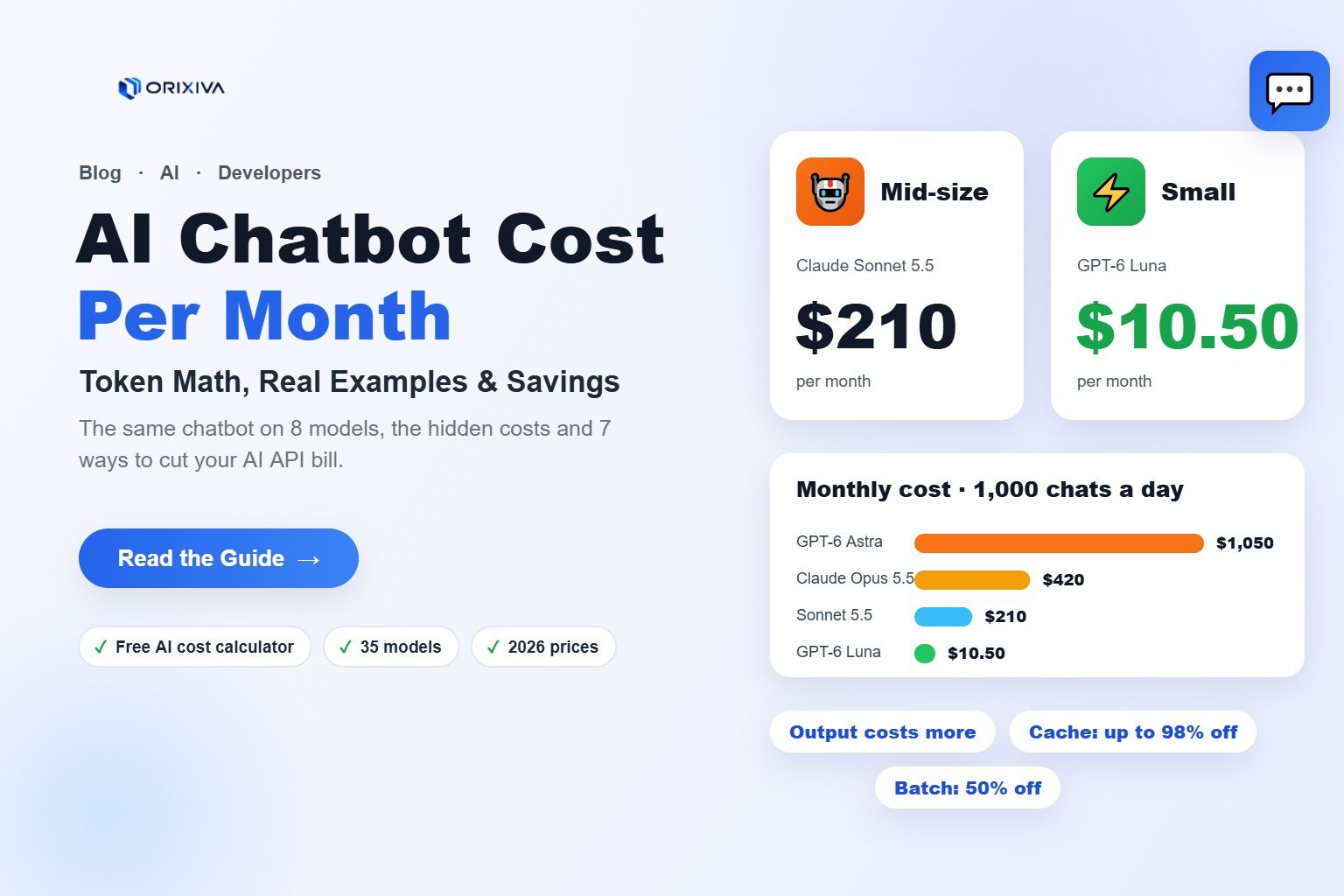
Short answer: An AI chatbot that sends 1,500 input tokens and gets 400 output tokens back, 1,000 times a day, costs about $10 a month on a small model such as GPT-6 Luna or Claude Haiku 5.5, about $210 a month on a mid-size model such as Claude Sonnet 5.5, and over $1,000 a month on a top model such as GPT-6 Astra. Prompt caching and the Batch API can cut that by a further 12 to 50%. The free Orixiva AI API cost calculator works this out for 35 models at once.
Key takeaways
- You pay per token, separately for input (what you send) and output (what the model writes).
- Output costs 3 to 8 times more than input, so long answers drive most bills.
- Chat history is sent again on every turn, so long conversations grow input cost fast.
- Reasoning tokens are billed as output, even though users never see them.
- Model choice matters most: test the cheapest model that does the job before you scale.
How AI API pricing works
AI providers charge per token, a small piece of text. In English one token is roughly four characters, or about three quarters of a word, so 1,000 tokens is around 750 words. Prices are quoted in US dollars per 1 million tokens.
Every request has two parts with different prices:
- Input tokens: the system prompt, the user's message, earlier messages in the chat and any documents you attach.
- Output tokens: the answer the model writes, plus any hidden reasoning tokens on reasoning models.
The AI chatbot cost formula
cost per request = (input tokens × input price + output tokens × output price) ÷ 1,000,000
Then multiply by requests per day and days per month. If part of your input is served from the provider's prompt cache, that part is charged at the much lower cached price instead.
Shortcut: the Token counter tab in the AI API cost calculator estimates tokens from pasted text, so you do not have to count them by hand.
Real example: a support chatbot on different models
Workload: 1,500 input tokens and 400 output tokens per message, 1,000 messages a day, 30 days. List prices per 1 million tokens, checked on 22 October 2026.
| Model | Input / output price | Per message | Per month | With 30% cached input |
|---|---|---|---|---|
| GPT-6 Luna | $0.10 / $0.50 | $0.00035 | $10.50 | $9.29 |
| Claude Haiku 5.5 | $0.10 / $0.50 | $0.00035 | $10.50 | $9.29 |
| Gemini 3.8 Flash | $0.75 / $3.75 | $0.0026 | $78.75 | $69.64 |
| DeepSeek V4 Pro (peak) | $1.32 / $3.96 | $0.0036 | $106.92 | $89.69 |
| Grok 4.6 | $2.00 / $6.00 | $0.0054 | $162.00 | $141.75 |
| Claude Sonnet 5.5 | $2.00 / $10.00 | $0.0070 | $210.00 | $184.35 |
| Claude Opus 5.5 | $4.00 / $20.00 | $0.0140 | $420.00 | $368.70 |
| GPT-6 Astra | $10.00 / $50.00 | $0.0350 | $1,050.00 | $928.50 |
The cheapest and most expensive options differ by 100 times for the same traffic. On Claude Sonnet 5.5, the 400 output tokens cost more than the 1,500 input tokens: $0.004 against $0.003 per message.
Hidden costs most people miss
Chat history grows every turn
The API has no memory, so your app resends the conversation each time. If every turn adds 300 tokens, the tenth message in a chat sends about 3,000 extra input tokens. Summarise or trim old turns to keep input small.
Reasoning tokens
Reasoning models think before they answer and bill that thinking as output. Just 1,000 reasoning tokens per message on Claude Sonnet 5.5 adds $300 a month to the example above.
Long prompts cost more per token
Some providers raise the price above a prompt size, for example about 272,000 tokens on OpenAI models and 200,000 on some Gemini and xAI models. Very long documents can push you into the higher tier.
Retries, tests and price changes
Failed calls, retries and development testing all cost money. Some prices are also scheduled to change: Google has announced that Gemini 4 Argon doubles in price from 1 December 2026.
7 ways to cut your AI chatbot bill
- Pick the smallest model that is good enough. Test classification, FAQ answers and short replies on Luna, Haiku or Flash models first.
- Use prompt caching. Put the fixed system prompt and documents at the start so they can be cached at 75 to 98% off.
- Limit output length. Set a maximum output tokens value and ask for short, direct answers.
- Trim chat history. Keep the last few turns and a short summary instead of the whole conversation.
- Batch work that can wait. OpenAI, Anthropic and Google give 50% off through their Batch APIs for jobs finished within 24 hours.
- Control reasoning effort. Use low effort, or a non-reasoning model, for simple questions.
- Route by difficulty. Send easy questions to a small model and only hard ones to a large model.
How to estimate your cost before you build
- Write a realistic prompt with your real system prompt and a typical user question.
- Count the tokens for input and a typical answer.
- Estimate volume: users × messages per user per day.
- Compare models for the same workload and note the monthly cost of each.
- Run 50 to 100 real test calls and use the usage numbers the API returns to correct your estimate.
The AI API cost calculator does steps 2 to 4 in one place, with presets for chatbots, document Q&A and coding agents, a budget planner and 20 currencies.
Prices change often: the figures above are list prices checked on 22 October 2026. Always confirm on the provider's pricing page before you commit a budget.
Estimate your AI bill in one minute
Cost per request, per month and per year for 35 models, with caching, batch discounts and a budget planner. Free, private and no sign-up.
Open the AI API cost calculator →Frequently asked questions
How much does it cost to run an AI chatbot?
It depends on the model and traffic. A chatbot with 1,500 input and 400 output tokens per message and 1,000 messages a day costs about $10 a month on GPT-6 Luna or Claude Haiku 5.5, about $210 on Claude Sonnet 5.5 and about $1,050 on GPT-6 Astra at October 2026 list prices.
How are AI API costs calculated?
Cost per request = (input tokens x input price + output tokens x output price) / 1,000,000, with prices quoted per 1 million tokens. Multiply by requests per day and days per month for the monthly bill.
Why is output more expensive than input?
Generating text takes more computing work than reading it, so providers charge 3 to 8 times more per output token. Long answers and reasoning tokens therefore drive most of the bill.
How many tokens is 1,000 words?
In English, about 1,300 tokens, because one token is roughly three quarters of a word or four characters. Code and non-Latin scripts usually use more tokens per word.
How can I reduce my AI API costs?
Use the smallest model that is good enough, turn on prompt caching, limit output length, trim chat history, use the Batch API for work that can wait and lower reasoning effort for simple tasks.
What is prompt caching?
Providers can store the start of a prompt that you send repeatedly, such as a long system prompt, and charge 75 to 98% less for those cached input tokens on later requests.
Do reasoning tokens cost money?
Yes. Reasoning or thinking tokens are billed at the output price even though they are not shown to the user. 1,000 extra reasoning tokens per message adds $300 a month at 1,000 messages a day on Claude Sonnet 5.5.
Over to you
Which model are you using for your chatbot, and what does it cost you per month? Share your numbers in the comments so other builders can compare. Comments are reviewed before they appear.
Related guides and tools
- AI API cost calculator: compare 35 LLM models
- Free developer tools: JSON, API and code utilities
- How to fix invalid JSON
- Subscription cost calculator for your SaaS spending
- Business calculator: margin and break-even
Sources: Anthropic pricing · Gemini API pricing · OpenAI API pricing. Prices checked 22 October 2026.